On this page
These seven N1 records describe an institutional transfer cycle: an organisation accepts people or proposals, a donor presents property, an authority grants something, a committee allocates resources, members divide the result, and the holder may later return it. The difficult choices are 寄贈 versus 寄付, 配分 versus 分配, and formal 返還 versus more ordinary ways to say “return.”
The curriculum title says “helping, exchanging and sharing,” but none of the assigned headwords simply means “to help” or “to exchange.” This lesson instead follows acceptance, transfer, sharing and restoration through universities, museums, foundations and public bodies.
Seven records form one institutional cycle
| Headword | Reading | Grammar | Core role | Anchor phrase |
|---|---|---|---|---|
| 受け入れる | うけいれる | Transitive ichidan verb | accept; receive into a group, system or view | 留学生を受け入れる |
| 寄贈 | きぞう | Noun / する | donate or present an object to an institution; usual current reading | 資料を博物館に寄贈する |
| 寄贈 | きそう | Noun / する | same word; attested uncommon reading | 図書の寄贈 |
| 授ける | さずける | Transitive ichidan verb | formally grant, award or impart | 学位を授ける |
| 配分 | はいぶん | Noun / する | allocate shares among uses or destinations | 予算を各部門に配分する |
| 分配 | ぶんぱい | Noun / する | divide and distribute a whole among recipients | 利益を会員に分配する |
| 返還 | へんかん | Noun / する | restore or return to an original owner or status | 所有者に返還する |
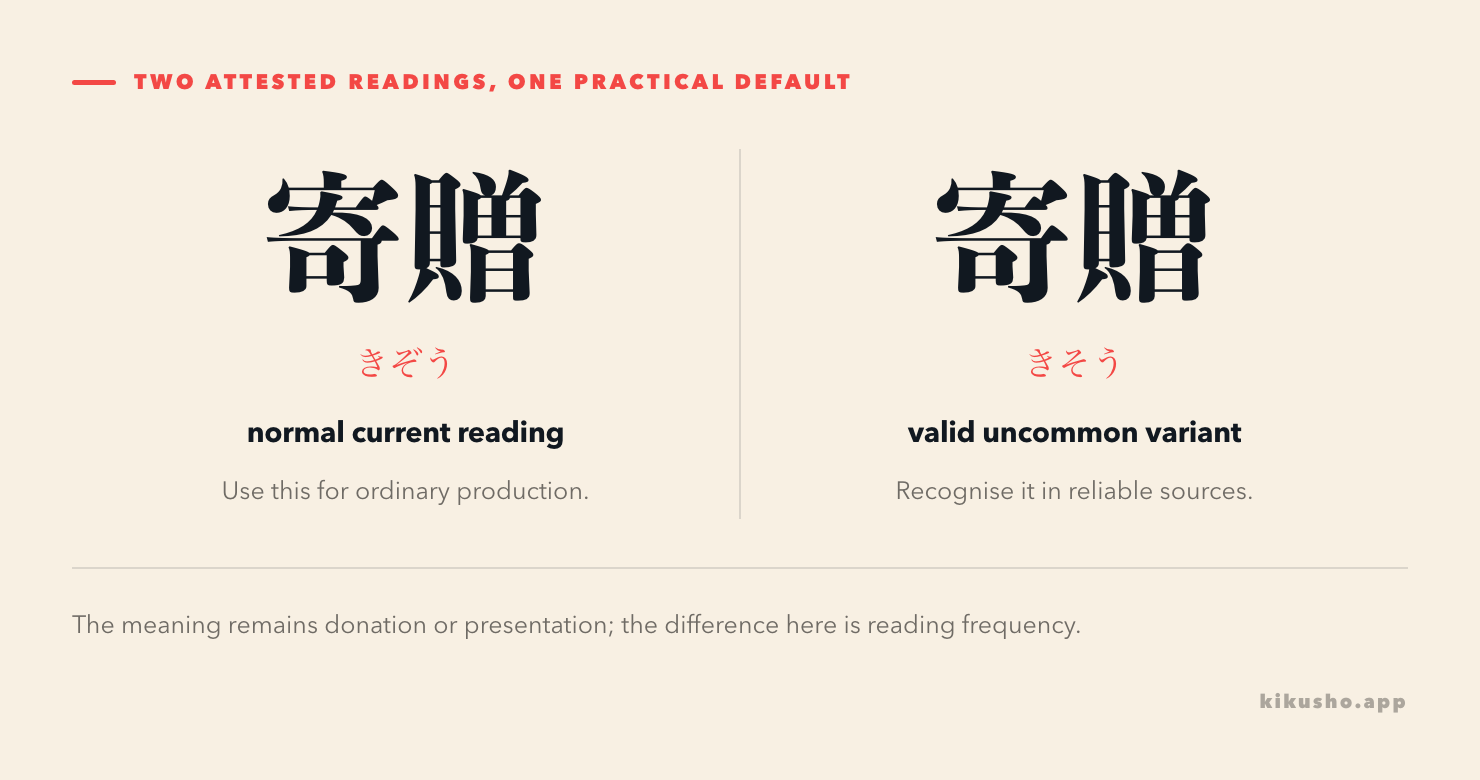
The two 寄贈 rows are not two meanings to memorise. They preserve two readings found in the source inventory. In present-day production, きぞう is the safe default.
受け入れる brings something inside a system
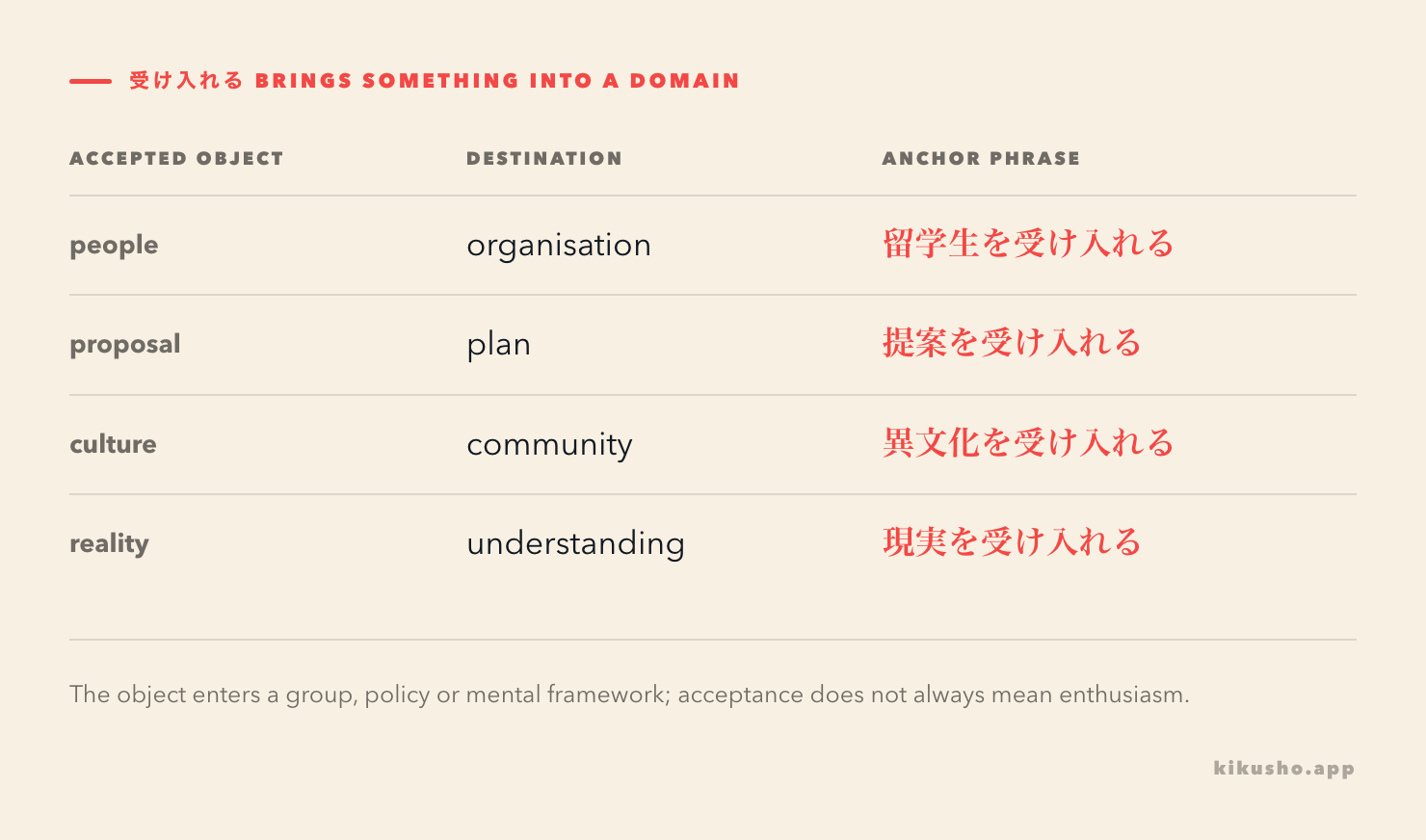
受け入れる(うけいれる) is more than physically receiving an object. It presents a person, proposal, culture, situation or system as entering a group, policy or mental framework. The accepted item takes を.
大学は来年度、海外から二十人の研究者を受け入れる。
だいがくは らいねんど、かいがいから にじゅうにんの けんきゅうしゃを うけいれる。
Next academic year, the university will accept twenty researchers from overseas.
委員会は住民の提案を一部受け入れ、計画を修正した。
いいんかいは じゅうみんの ていあんを いちぶ うけいれ、けいかくを しゅうせいした。
The committee accepted part of the residents’ proposal and revised the plan.
Shogakukan records both welcoming people or outside culture and accepting a claim or request. 承諾する focuses on consenting to a request or condition, and 同意する on sharing or formally expressing agreement. 受け入れる has the wider image of allowing something into an existing domain—even when the subject does not enthusiastically agree with every aspect.
寄贈 usually reads きぞう; きそう is an attested variant
寄贈 means presenting an object or collection as a donation, especially to a school, library, museum, municipality or other institution. Common objects include 本, books; 資料, archival material; 作品, works of art; and 設備, equipment.
写真家の遺族は、未公開の作品を市立美術館に寄贈した。
しゃしんかの いぞくは、みこうかいの さくひんを しりつ びじゅつかんに きぞうした。
The photographer’s family donated the unpublished works to the municipal art museum.
Modern references and usage overwhelmingly favour きぞう. Japanese Wiktionary records both きぞう and きそう, while current learner examples on Bunpro use きぞう. The less common きそう should therefore be recognised as a legitimate variant, not promoted as an equally usual production choice.
寄贈 and 寄付 overlap but frame the contribution differently
寄贈 tends to foreground a presented object and its institutional recipient: a private archive goes to a library, or equipment goes to a university. 寄付(きふ) is broader: money, goods or property are contributed voluntarily to an organisation or cause. A museum may announce 絵画の寄贈, the donation of a painting, while a relief group asks for 寄付, contributions.
This is a usage tendency rather than an absolute boundary. Books can be 寄付する, and money can appear in formal 寄贈 contexts. Choose from the scene and the organisation’s established wording. The N3 social-issues lesson introduces 寄付 beside 援助; the present lesson adds the more institution-centred 寄贈.
授ける moves authority, honour or knowledge downward
授ける(さずける) is a formal transitive verb. A person or institution in a position to authorise, recognise or teach gives something special to a recipient: 学位を授ける, confer a degree; 勲章を授ける, award a decoration; 称号を授ける, bestow a title; 秘伝を授ける, impart a secret teaching.
学長は長年研究に貢献した教授に名誉学位を授けた。
がくちょうは ながねん けんきゅうに こうけんした きょうじゅに めいよ がくいを さずけた。
The university president conferred an honorary degree on the professor who had contributed to research for many years.
The typical frame is giver は recipient に content を 授ける. Shogakukan covers both granting a special status or honour and teaching knowledge or a technique. Neutral 与える can give a role, chance or effect; 贈る presents a socially meaningful gift. The N3 transfer lesson develops those broader verbs. 授ける specifically adds authority, rank or a teacher-to-learner direction.
配分 plans the shares; 分配 divides the result
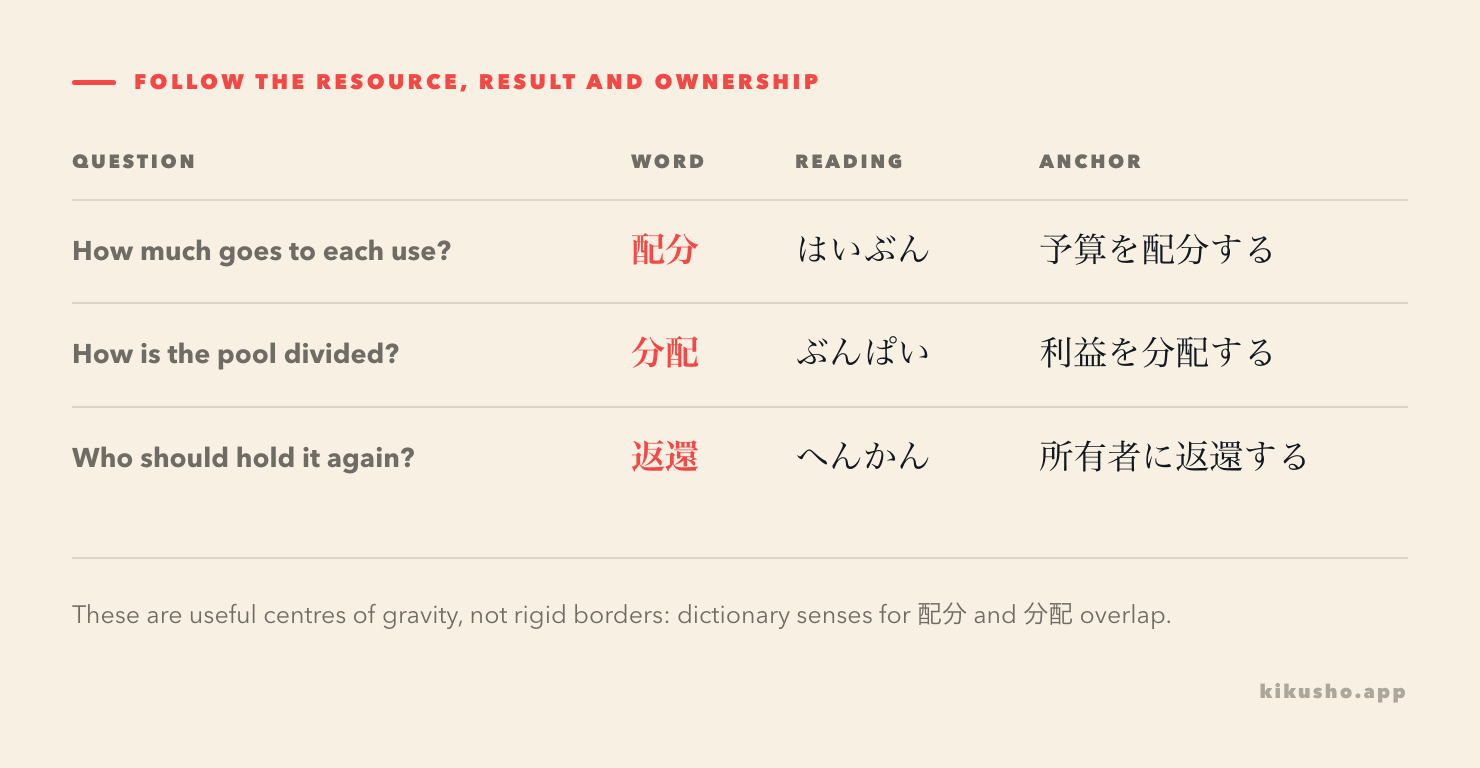
配分(はいぶん) often starts with a limited resource and an allocator’s plan. The resource takes を, and destinations can take に: 予算を研究と教育に配分する, allocate a budget to research and education; 時間を各作業に配分する, divide time among tasks. 比例配分, proportional allocation, makes the calculated-share perspective explicit.
分配(ぶんぱい) often starts with one whole, pool, proceeds or result and divides it among recipients: 利益を出資者に分配する, distribute profits to investors; 遺産を相続人に分配する, divide an estate among heirs. In economics, 所得分配 names the distribution of income.
委員会は修復費を三つの事業に配分し、展示会の利益は協力団体に分配した。
いいんかいは しゅうふくひを みっつの じぎょうに はいぶんし、てんじかいの りえきは きょうりょく だんたいに ぶんぱいした。
The committee allocated restoration funds among three projects and distributed the exhibition proceeds to partner organisations.
The dictionary definitions overlap: 配分 can include distributing, and 分配 includes division and distribution. Use the contrast as a decision aid, not a rule that invalidates every overlap:
- Choose 配分 when the central question is how much of a resource each purpose or destination should receive.
- Choose 分配 when the central question is how a whole or resulting pool is divided among recipients.
- Preserve common combinations: 資源配分, resource allocation; 利益分配, profit distribution.
返還 restores something to its prior holder or status
返還(へんかん) is a formal noun and する verb for returning something to its original place, owner or legal holder. It commonly appears with 領土, territory; 所有権, ownership; 保証金, a deposit; 優勝旗, a championship flag; and cultural property.
調査が終わり次第、借り受けた資料を所有者に返還する。
ちょうさが おわりしだい、かりうけた しりょうを しょゆうしゃに へんかんする。
As soon as the investigation is complete, the borrowed materials will be returned to their owner.
Shogakukan centres on restoring something to its original place or owner. 返す is the broad everyday verb. 返却 is common for handing back a borrowed object such as a book or key. 返済 repays borrowed money or a debt. 返還 sounds natural when ownership, custody, territory, rights or official procedure matters.
One archive project uses every record
大学は、ある研究者の遺族から資料の寄贈を受け入れた。寄贈は通常きぞうと読むが、古い資料にはきそうという読みも記録されていた。学長は整理に貢献した職員に賞を授けた。委員会は保存予算を写真、手紙、録音資料に配分し、展示会の利益を共同研究機関に分配した。ただし、所有権が移っていない借用資料は、調査後に遺族へ返還した。
The university 受け入れる the proposed donation. The archive is a 寄贈, normally read きぞう, while the project records the variant きそう. The president 授ける an award. The committee uses 配分 to assign funds among preservation targets and 分配 to divide proceeds among partner institutions. Materials that were only on loan undergo 返還, because custody returns to the original holders.
In Kikusho, a learner can capture an unfamiliar term from a museum notice, keep the source sentence in an editable card and test a new example against these participant roles. For this set, record the object, the recipient and whether ownership, authority or merely custody changes.
N1 is the inventory placement, not an official guarantee
Kikusho’s September 2026 inventory places all seven spelling-and-reading records in this N1 lesson. Its two baseline files share Waller/Tanos ancestry, so matching labels inside them are one source family rather than independent exam evidence. A separate JapaneseTest4You index also lists 分配 at N1, but its underlying provenance is not established.
Current Bunpro material instead places 受け入れる at N2 while placing 寄贈 at N1. That disagreement is useful: 受け入れる may appear before an N1 course even though its institutional uses remain valuable here. The official JLPT FAQ confirms that the current exam publishes no exhaustive vocabulary list. Treat N1 as this curriculum’s study placement and practise the contrasts in context.
Practice: follow the transfer
Answer every question before opening the explanation panel.
1 · Current reading. Which reading is the safest default for 寄贈 in present-day production?
- A. きそう
- B. きぞう
- C. きしょう
- D. よそう
2 · Variant recognition. What should a learner conclude after encountering 寄贈(きそう) in a reliable older source?
- A. It is an attested uncommon reading of 寄贈.
- B. It must be a typographical error for 寄付.
- C. It is the only accepted modern reading.
- D. It means restoration rather than donation.
3 · Acceptance into a system. Choose the natural completion: 大学は海外から研究者を__。
- A. 分配する
- B. 授ける
- C. 受け入れる
- D. 返還する
4 · Institutional donation. A family presents a painter’s archive to a municipal museum. Which phrase best foregrounds that act?
- A. 美術館に資料を寄贈する
- B. 美術館に学位を授ける
- C. 美術館を予算に配分する
- D. 美術館から資料を返済する
5 · Formal authority. Complete: 大学は卒業生に学位を__。
- A. 受け入れる
- B. 分配する
- C. 返還する
- D. 授ける
6 · Resource planning. A committee decides how much of its budget goes to preservation, digitisation and public access. Which word best fits the planning focus?
- A. 返還
- B. 配分
- C. 寄贈
- D. 分配
7 · Dividing proceeds. An exhibition’s net proceeds are divided among three partner organisations. Which phrase best fits?
- A. 利益を三団体に分配する
- B. 利益を三団体に授ける
- C. 利益を三団体から受け入れる
- D. 利益を三団体へ返還する
8 · Return category. Which pairing is the most natural?
- A. 借金を返還する / 領土を返済する
- B. 本を授ける / 学位を返却する
- C. 借金を返済する / 領土を返還する
- D. 予算を寄贈する / 所有権を配分する
9 · Connected archive. Which summary matches the archive project?
- A. The university rejected the archive and repaid an academic degree.
- B. The family allocated researchers, while the university donated its budget back.
- C. Every donated and borrowed object became university property permanently.
- D. The university accepted a donation, allocated preservation funds, distributed proceeds and returned loaned material.
Answers and explanations
B, きぞう. Both readings are attested, but きぞう is overwhelmingly the normal current choice.
A. きそう is a valid but uncommon variant. Recognition is useful; ordinary production should default to きぞう.
C, 受け入れる. Researchers enter the university’s programme or community. The other verbs describe distribution, granting or formal return.
A. 寄贈 naturally frames an archive or collection presented to an institution.
D, 授ける. A university has the authority to confer a degree upon a graduate.
B, 配分. The central decision is how a limited resource is allocated among uses. 分配 would more readily foreground dividing a resulting pool among recipients.
A, 利益を三団体に分配する. The proceeds form a whole that is divided among recipient organisations.
C. 返済 repays debt; 返還 formally restores territory, rights or property to a prior holder.
D. The sequence preserves every participant relation: acceptance of the gift, allocation of resources, distribution of proceeds and restoration of borrowed material.
Common questions
Is 寄贈 read きぞう or きそう?
Both readings are attested. きぞう is overwhelmingly the normal current reading, while きそう survives as a valid but uncommon variant. Kikusho keeps both spelling-and-reading records visible instead of silently replacing one with the other.
What is the difference between 寄贈 and 寄付?
寄贈 commonly presents an object, collection or equipment to an institution and often foregrounds the donor and recipient. 寄付 is the broader voluntary contribution of money, goods or property to an organisation or cause. Their uses overlap, so the object and institutional context matter.
What is the difference between 配分 and 分配?
配分 often views an allocator assigning limited resources among uses or destinations according to a plan. 分配 often views a whole, proceeds or results being divided among recipients. Dictionaries allow overlap, so learn established combinations such as 資源配分 and 利益分配.
How is 返還 different from 返却 and 返済?
返還 is a formal restoration to the original owner, holder or status and is common with territory, rights, deposits and trophies. 返却 commonly returns a borrowed object, while 返済 repays money or a debt.