On this page
These nine N3 words show how something moves between people: one person entrusts an item, another keeps it, someone offers help, and possessions, gifts or portions pass to a new recipient. The central contrasts are 預ける/預かる, 助ける/助かる, and 与える/贈る/譲る.
The curriculum title says “exchanging,” but 交換(こうかん) is not an assigned headword. This set teaches one-way custody, transfer and division, plus the coordination that makes sharing possible.
Nine words track responsibility, help and transfer
| Headword | Reading | Grammar | Core meaning | Anchor phrase |
|---|---|---|---|---|
| 預かる | あずかる | Transitive godan verb | receive and keep in one's care | 荷物を預かる |
| 預ける | あずける | Transitive ichidan verb | entrust or deposit with someone | 荷物を受付に預ける |
| 与える | あたえる | Transitive ichidan verb | give; assign; cause an effect | 影響を与える |
| 贈る | おくる | Transitive godan verb | present as a gift or award | 花を贈る |
| 協調 | きょうちょう | Noun / する | coordination; harmony | 周囲と協調する |
| 助かる | たすかる | Intransitive godan verb | be saved; be spared a burden | 命が助かる |
| 助ける | たすける | Transitive ichidan verb | help, save or support | 人を助ける |
| 譲る | ゆずる | Transitive godan verb | transfer; yield; give up to another | 席を譲る |
| 分ける | わける | Transitive ichidan verb | divide, classify or distribute | 三つに分ける |
Do not decide from an English gloss alone. “Give” may create an effect, mark a gift, transfer ownership or distribute one whole. “Help” may name the helper's action or the resulting relief.
預ける hands over; 預かる takes charge
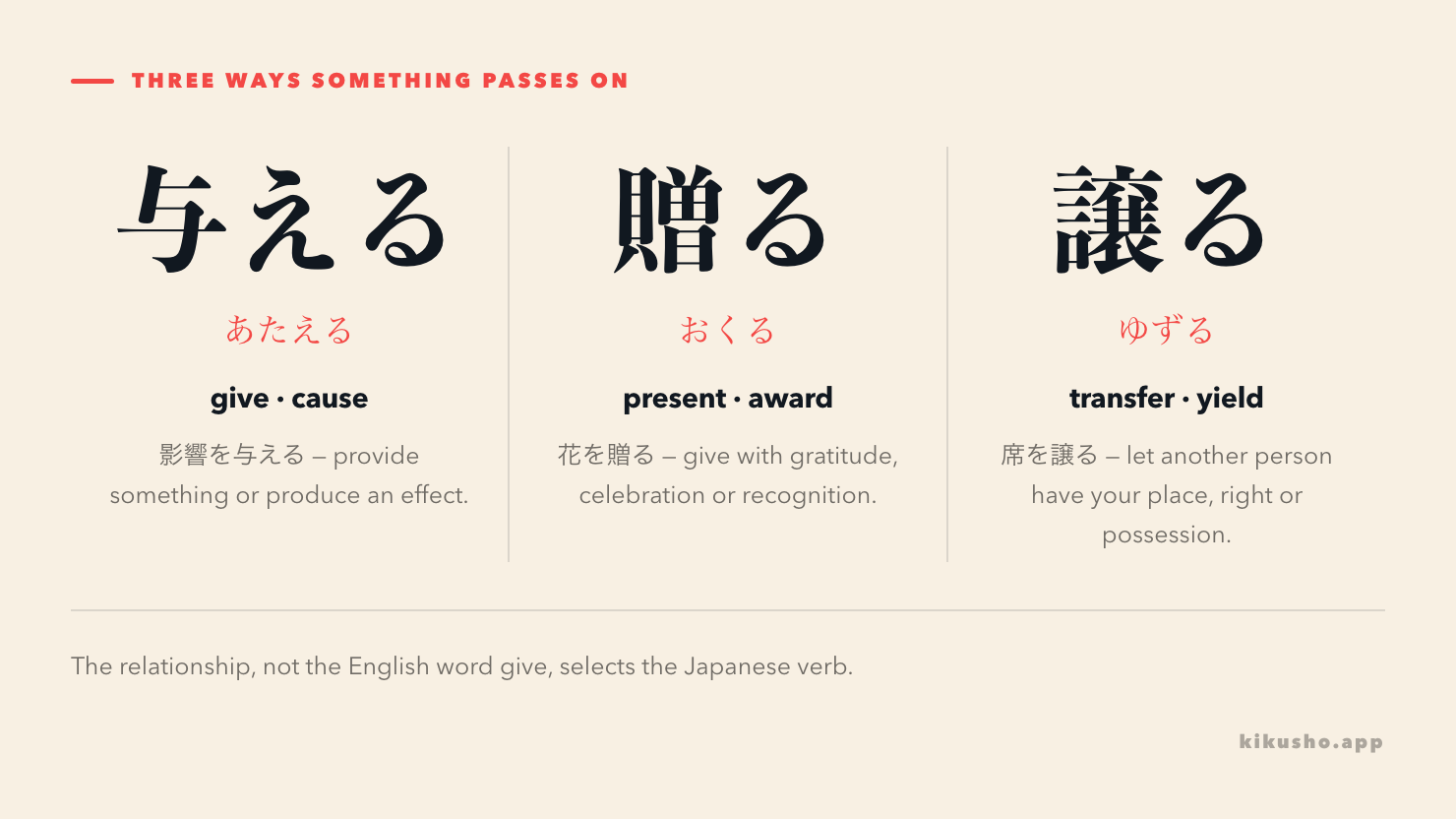
預ける(あずける) follows the person who places an object, person or responsibility in someone else's care. The entrusted item takes を, and the custodian often takes に.
出発前に、大きな荷物をホテルのフロントに預けた。
しゅっぱつまえに、おおきな にもつを ホテルの フロントに あずけた。
Before leaving, I entrusted my large bag to the hotel desk.
預かる(あずかる) views the same relationship from the receiving side. The custodian accepts the item with を and becomes responsible for keeping, managing or looking after it.
フロントでは、宿泊客の荷物を夕方まで預かっている。
フロントでは、しゅくはくきゃくの にもつを ゆうがたまで あずかっている。
The front desk keeps guests' luggage until the evening.
Both are transitive. The difference is not を versus が; it is the participant selected as subject. Compare 私は鍵を友達に預けた, I left the key with my friend, and 友達は私の鍵を預かった, my friend took charge of my key.
Shogakukan also records wider uses of 預かる: managing an area of work, taking charge of a dispute, or withholding an announcement. Its 預ける entry extends entrusting from belongings to a shop, a decision or one's weight.
与える, 贈る and 譲る transfer different things
与える gives or causes an effect
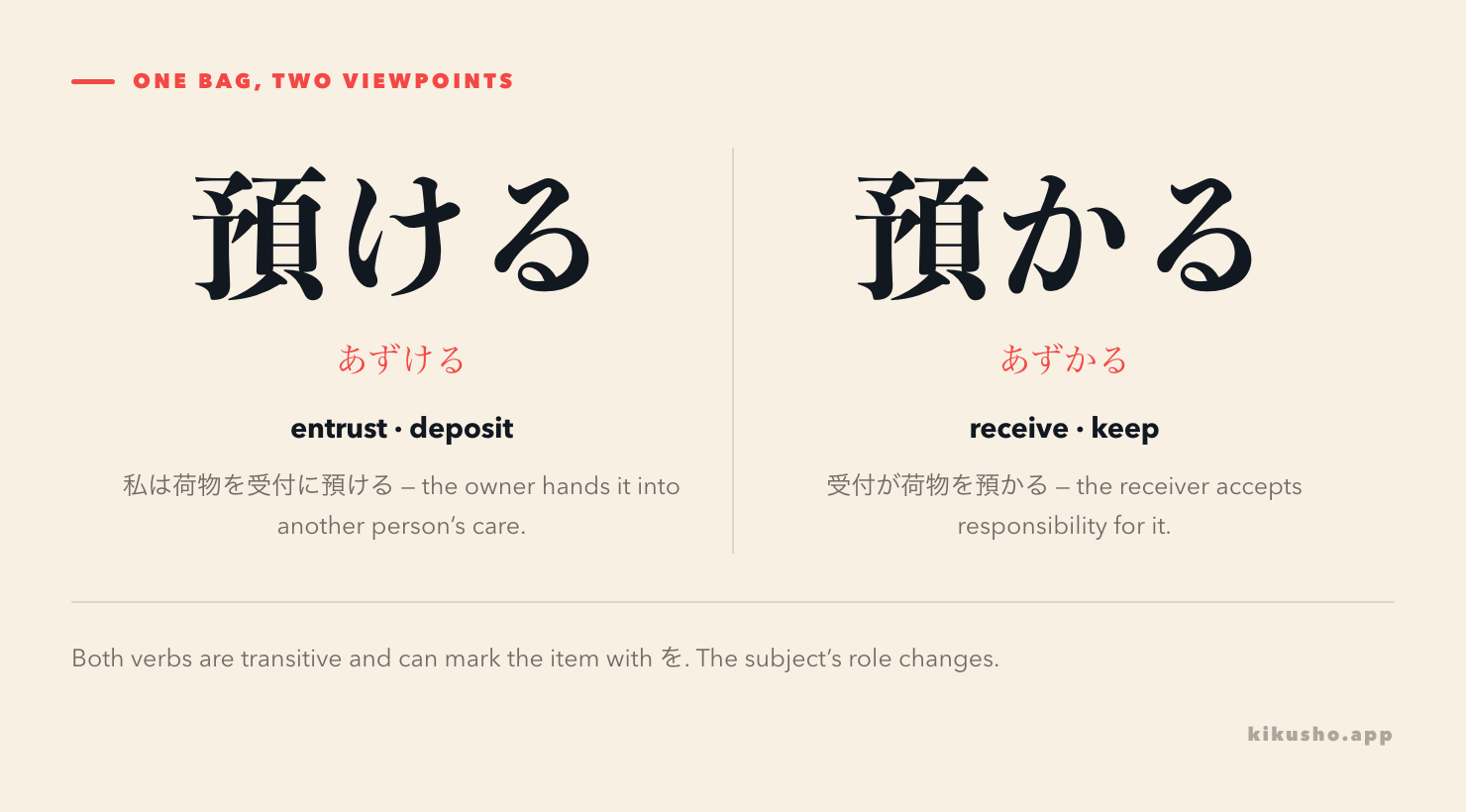
与える(あたえる) is broader and more formal than everyday あげる. It can give an object, role, opportunity or permission, and it commonly causes an abstract effect: 影響を与える, have an influence; 印象を与える, create an impression; 課題を与える, assign a task.
新しい制度は、地域の店に大きな影響を与えた。
あたらしい せいどは、ちいきの みせに おおきな えいきょうを あたえた。
The new system had a major impact on local shops.
Shogakukan records both making something another person's possession and bringing an effect upon them. Because the word can sound one-directional or institutional, it is not a universal replacement for あげる in friendly conversation.
贈る presents with feeling or ceremony
贈る(おくる) gives a present, words, title or award with gratitude, affection, celebration or recognition. The recipient takes に and the gift takes を.
卒業する先輩に、感謝の言葉と花束を贈った。
そつぎょうする せんぱいに、かんしゃの ことばと はなたばを おくった。
We presented words of thanks and a bouquet to the graduating senior.
Write 贈る for a gift or award; write the homophone 送る when the point is dispatching an object, message or person. Shogakukan gives 記念品を贈る and はなむけの言葉を贈る as representative frames.
譲る gives up possession, priority or a position
譲る(ゆずる) starts from something the subject possesses, occupies or claims and lets another person have it. It covers 席を譲る, give up a seat; 順番を譲る, let someone go first; 店を息子に譲る, transfer a shop; and 意見を譲らない, refuse to concede an opinion.
電車の中で、お年寄りに席を譲った。
でんしゃの なかで、おとしよりに せきを ゆずった。
I gave up my seat to an older passenger on the train.
The transfer may be free or for a price: the dictionary includes selling something to a person who wants it. The stable idea is relinquishing one's claim, place or control.
分ける divides a whole and can share the portions
分ける(わける) first makes boundaries inside something. It can divide one whole, classify items or distribute portions:
- ケーキを六つに分ける: divide a cake into six pieces
- ごみを種類別に分ける: sort rubbish by type
- 利益を三人で分ける: divide the profit among three people
- お菓子を弟に分ける: share some sweets with a younger brother
集まった食料を家族の人数に応じて分けた。
あつまった しょくりょうを かぞくの にんずうに おうじて わけた。
We divided the collected food according to family size.
Shogakukan lists division, classification and distribution as central senses. Sharing is therefore not a separate unexplained meaning: a portion becomes available because the whole is divided.
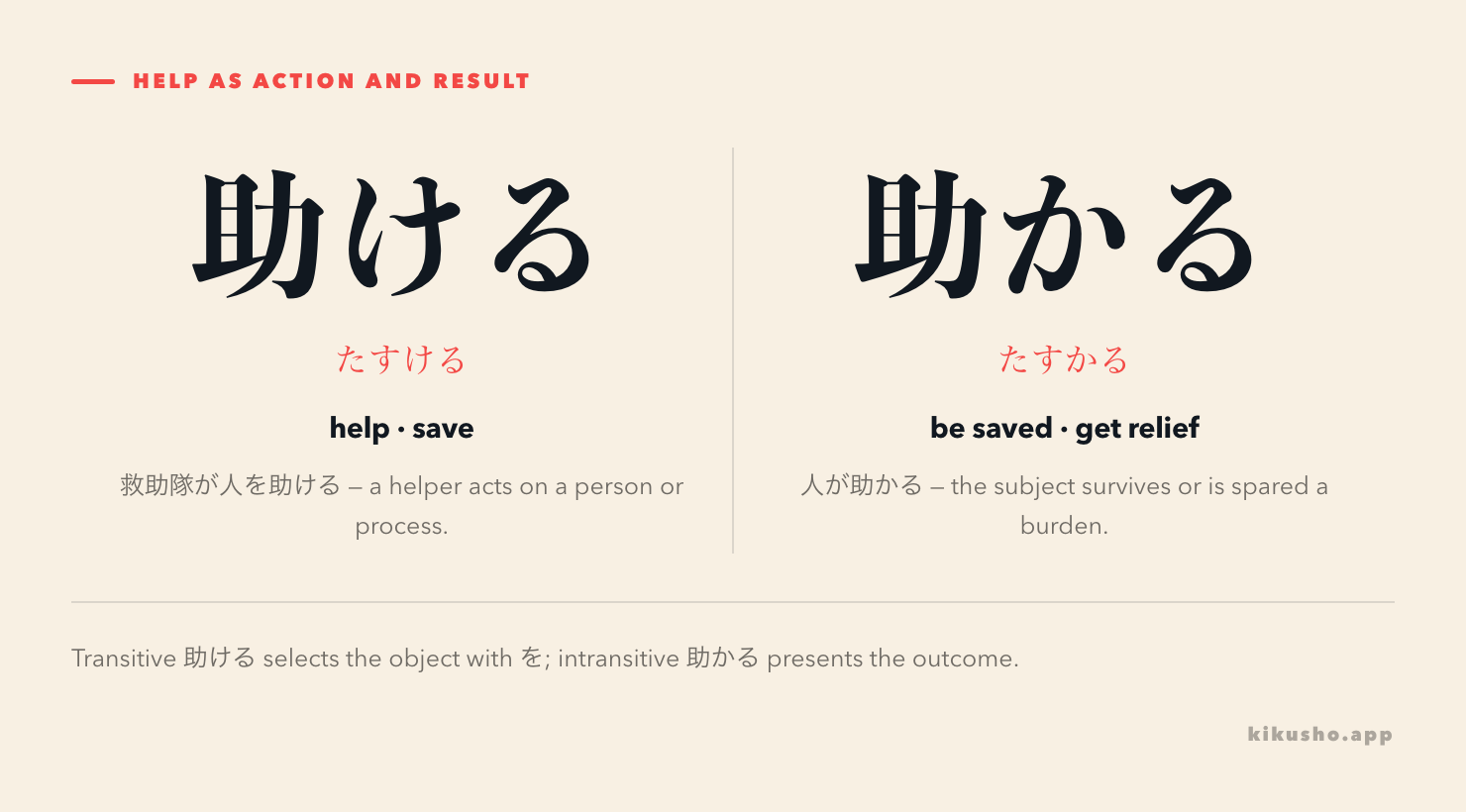
助ける names the action; 助かる names the result
助ける(たすける) is transitive. A helper saves 人を, supports 仕事を, or helps a process such as 消化を助ける.
近くにいた人が、転んだ子供を助けた。
ちかくに いた ひとが、ころんだ こどもを たすけた。
A nearby person helped the child who had fallen.
助かる(たすかる) is intransitive. A person survives or escapes harm—命が助かる—or a cost, task or kindness reduces someone's burden.
資料を今日中に送ってくれると助かります。
しりょうを きょうじゅうに おくってくれると たすかります。
It would be a great help if you could send the materials today.
The second sentence is a restrained request because the speaker describes the helpful result instead of directly commanding the listener. Shogakukan's entries for 助ける and 助かる show the transitive action and intransitive outcome clearly.
協調 keeps different people or parts in harmony
協調(きょうちょう)する means to act in harmony or coordinate with others. Common forms are 周囲と協調する, coordinate with those around you; 協調して行動する, act in concert; and 協調性がある/ない, be cooperative or uncooperative as a personal quality.
意見が違っても、チーム全体と協調して行動する必要がある。
いけんが ちがっても、チーム ぜんたいと きょうちょうして こうどうする ひつようが ある。
Even when opinions differ, it is necessary to act in coordination with the whole team.
協力 foregrounds combining effort toward a task; 協調 foregrounds alignment and harmony among participants, policies or actions. The N3 project vocabulary lesson already teaches 協力 and 共同. This lesson adds the coordination needed when people begin from different roles or views.
One community event uses all nine words
地域の交流会で、受付は参加者の荷物を預かった。参加者は貴重品だけをロッカーに預けた。主催者は仕事を六つの係に分け、全員に役割を与えた。各係は互いに協調して準備を進めた。重い箱を運べない人がいたので、別の参加者が助けた。人手が増えて担当者も助かった。最後に、子供たちには記念品を贈り、余った本は希望する人に譲った。
The reception desk 預かる items that participants 預ける. The organizer 分ける work and 与える roles. Teams act in 協調. One person 助ける another, producing the relieved result 助かる. A ceremonial item is 贈る, while surplus books are 譲る to new owners.
N3 is a practical placement with disagreements
The retained baseline rows place all nine words in this N3 lesson, but three have conflicting observations inside that source family: 預かる also appears at N2, 協調 at N1, and 助かる at N2. Current independent Bunpro pages place 預かる, 贈る and 協調 at N3, while they place 助ける and 助かる at N4.
The JLPT FAQ confirms that the current test has no exhaustive published vocabulary list. These labels guide study order; the N3 task is to follow viewpoint, transitivity and social purpose in context.
Practice: nine movements between people
Answer every question before opening the explanation panel.
1 · Reception-side reading. Select the kana for 預かる in 受付が荷物を預かる.
- A. あずける
- B. あずかる
- C. あつまる
- D. あたえる
2 · Custody viewpoint. Choose the pair.
客は荷物を受付に( 前 )。受付はその荷物を三時まで( 後 )。
- A. 前 預かった / 後 預けた
- B. 前 分けた / 後 譲った
- C. 前 預けた / 後 預かった
- D. 前 与えた / 後 贈った
3 · Cause an effect. Which collocation means “have a strong impact on society”?
- A. 社会に強い影響を与える
- B. 社会に強い影響を贈る
- C. 社会を強い影響に預ける
- D. 社会から強い影響を分ける
4 · Gift or dispatch? Choose the spelling for presenting flowers with gratitude: 先生に花を__。
- A. 送る
- B. 贈る
- C. 預かる
- D. 助かる
5 · Yield priority. What does お年寄りに席を譲る mean?
- A. Divide a seat into portions.
- B. Ask an older person to keep a seat.
- C. Give up one's seat to an older person.
- D. Award an older person a seat as a prize.
6 · Divide and distribute. Complete: ケーキを八つ__分けて、子供たち__分けた。
- A. を / が
- B. に / に
- C. が / を
- D. と / で
7 · Action or result? Choose the pair.
救助隊が登山者を( 前 )。登山者は無事に( 後 )。
- A. 前 助かった / 後 助けた
- B. 前 協調した / 後 与えた
- C. 前 助けた / 後 助かった
- D. 前 預けた / 後 分けた
8 · Polite relief. What is the practical force of 明日までに返事をいただけると助かります?
- A. It reports that the reply has already saved someone's life.
- B. It indirectly asks for a reply by tomorrow and says that would help.
- C. It offers to keep the reply until tomorrow.
- D. It refuses to coordinate about the reply.
9 · Coordinated event. Which summary matches the community event?
- A. The desk entrusted its own bags to guests, and the organizer refused to divide the work.
- B. Participants kept the desk, and every surplus book was presented as an award.
- C. The desk kept bags, teams coordinated, one participant helped another, and surplus books went to people who wanted them.
- D. Nobody received responsibility, help or a share of anything.
Answers and explanations
The reception-side verb is B: あずかる. 預ける is read あずける and follows the person who entrusts the item.
C: 前 預けた / 後 預かった. The guest hands the bag into the desk's care; the desk accepts responsibility for it. Both verbs take 荷物を in their own clause.
A. 影響を与える is the standard abstract-effect frame. 贈る marks a gift or award, and the other choices assign unnatural roles and particles.
B, 贈る. Gratitude makes the flowers a gift. 送る would foreground sending or dispatching them to a destination.
C. 譲る lets another person take something the subject occupied or claimed. Here the subject gives up priority to the older passenger.
B: 八つに / 子供たちに. The result of division takes に, and the people receiving portions also take に. Context distinguishes the two roles.
C: 前 助けた / 後 助かった. The rescue team performs the transitive action on 登山者を. The climber is the subject of the intransitive saved result.
B. Vていただけると助かります presents the requested action as a condition that would reduce the speaker's burden. It is indirect, but the desired action is clear.
C. The account preserves every direction: the desk 預かる, teams act in 協調, a participant 助ける another, and the books are 譲る to new owners.
Common questions
What is the difference between 預ける and 預かる?
Both verbs can take the entrusted item with を. 預ける follows the person who hands it into someone else's care, while 預かる follows the person who receives it and takes responsibility for it.
What is the difference between 助ける and 助かる?
助ける is transitive: someone helps or saves a person or process. 助かる is intransitive: the person is saved, or a burden becomes lighter. The common pattern Vてくれると助かる means that someone's action would be helpful.
How do 与える, 贈る and 譲る differ?
与える gives something or causes an effect; 贈る presents something with a feeling such as gratitude or celebration; 譲る transfers one's possession, right, place or turn to another person.
Does 分ける mean both divide and share?
Yes. 分ける can divide one whole into parts, classify items into groups or distribute portions to people. The particle and destination show which sense is active.