On this page
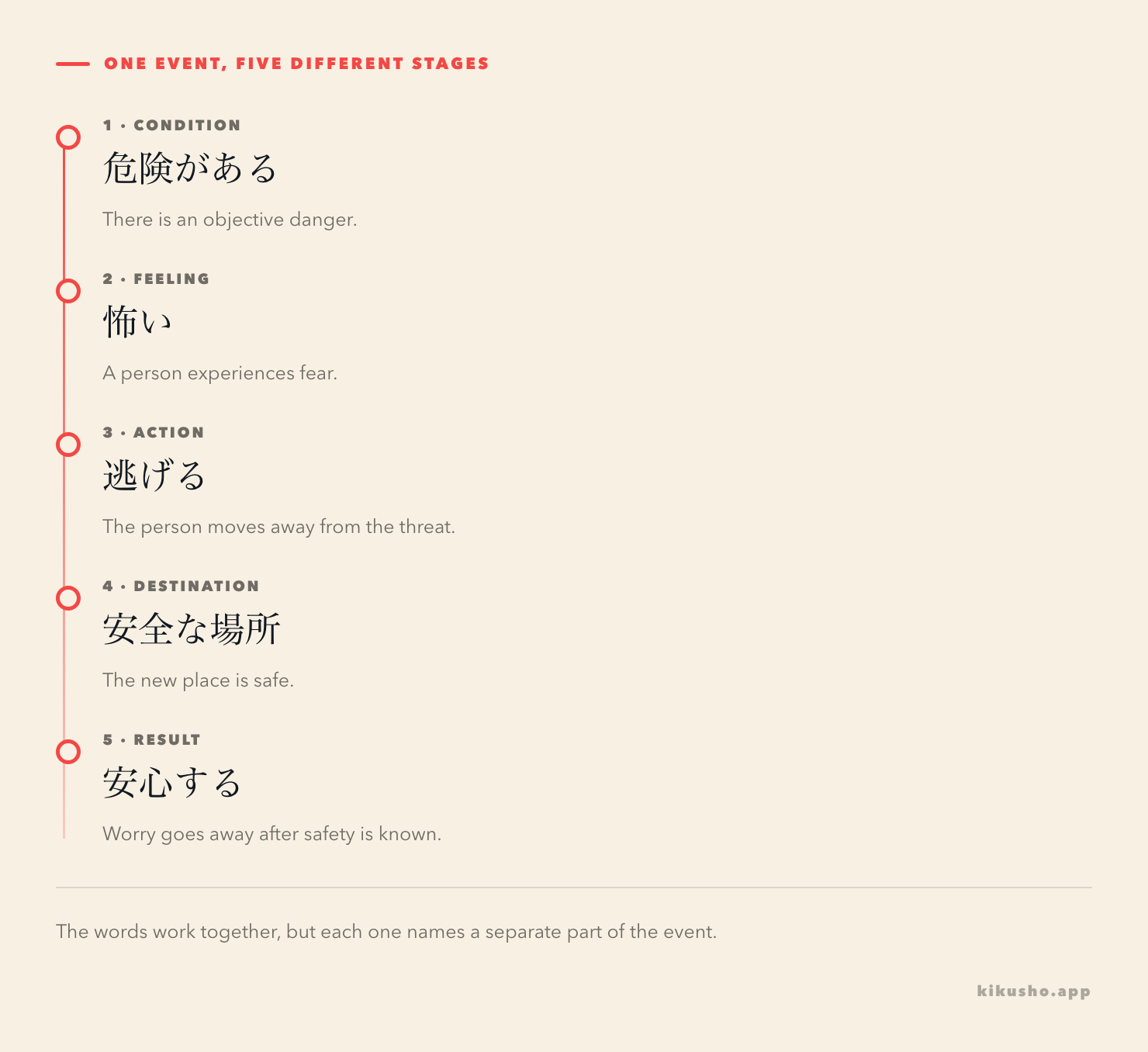
These six N4 words describe a complete safety situation: 危険 is present, something feels 怖い, people 逃げる, they reach a place that is 安全, and then they can 安心する. 戦争 names the largest conflict in the set, but the same vocabulary also belongs to fires, storms, traffic and ordinary warnings.
Six words form one practical sequence
| Headword | Reading | Word class and core meaning | Useful pattern |
|---|---|---|---|
| 安心 | あんしん, anshin | noun; na-adjective; suru verb; relief or peace of mind | 安心する |
| 安全 | あんぜん, anzen | noun; na-adjective; safety or freedom from danger | 安全な場所 |
| 危険 | きけん, kiken | noun; na-adjective; danger, risk or hazard | 危険がある |
| 怖い | こわい, kowai | i-adjective; scary, frightening or personally feared | 地震が怖い |
| 戦争 | せんそう, sensō | noun; suru verb; war or armed conflict | 戦争が終わる |
| 逃げる | にげる, nigeru | intransitive ichidan verb; escape, flee or run away | 外へ逃げる |
Kikusho's September 2026 inventory assigns all six spelling-and-reading records to N4, with no internal disagreement. The two baseline files share the Waller lineage, while Japanesetest4you supplies a separately published comparison list. Current broad lists from Nihongo Circle and Nihon Torii also place several or all of these words at N4. The JLPT organisers do not publish an exhaustive official vocabulary list, so N4 is a study placement rather than a promise about a specific test paper.
安全 describes the situation; 安心 describes the mind
Both words begin with 安, but they answer different questions.
安全(あんぜん) answers “Is there danger?” It describes a place, route, method or condition in which harm is unlikely.
- 安全な場所: a safe place
- 安全な道: a safe route
- 安全に使う: use safely
- 安全を確認する: check safety
この道は明るくて、人も多いので安全です。
この みちは あかるくて、ひとも おおいので あんぜんです。
This road is well lit and busy, so it is safe.
安心(あんしん) answers “How does the person feel?” Use 安心する when worry goes away, 安心できる when something allows you to feel at ease and 安心して before an action done without worry.
- 無事だと聞いて安心する: feel relieved after hearing someone is safe
- 安心できる店: a shop one can trust or feel comfortable with
- 安心して眠る: sleep without worry
家族から「みんな無事だ」と聞いて、安心しました。
かぞくから「みんな ぶじだ」と きいて、あんしんしました。
I felt relieved when my family told me that everyone was safe.
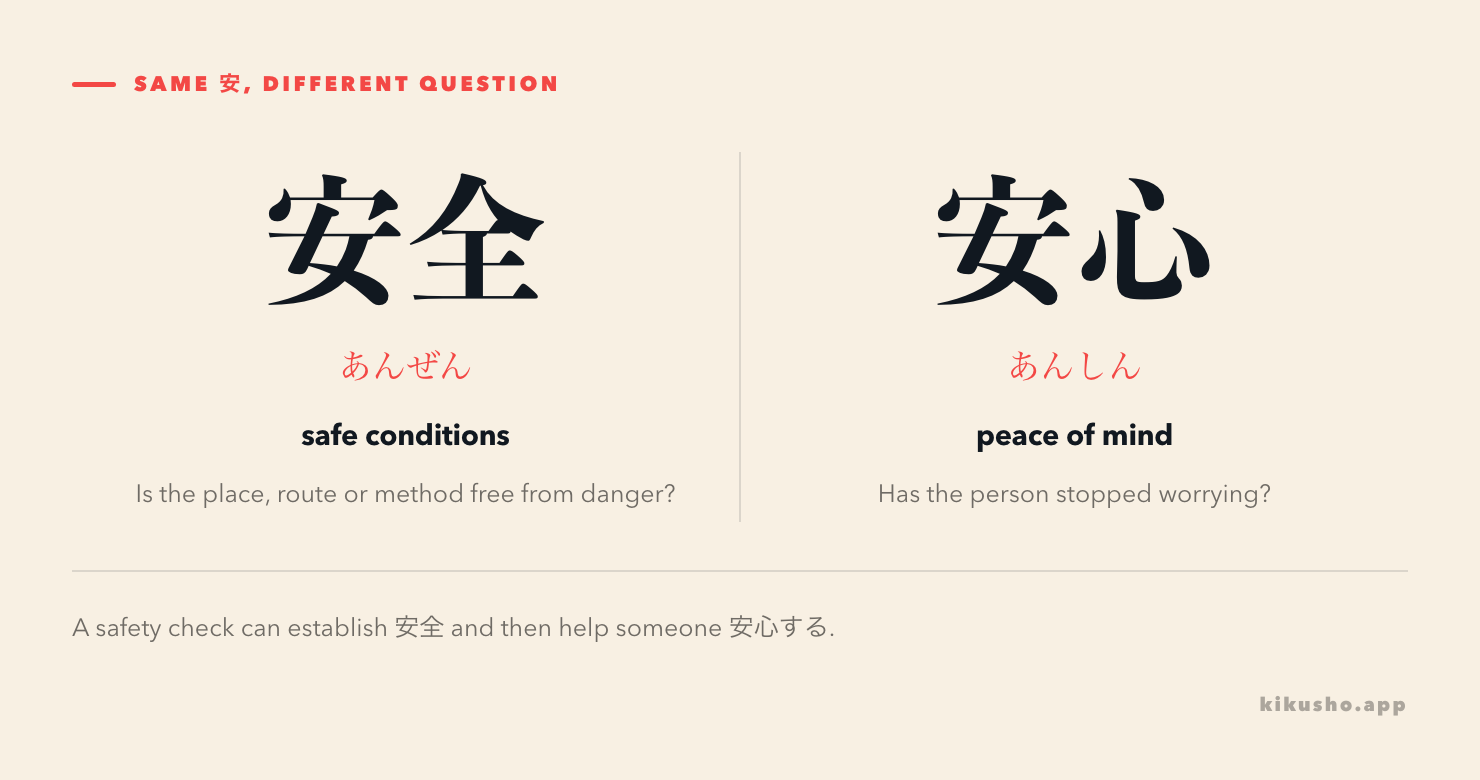
A place can be 安全 while a visitor still does not 安心. The opposite can also happen: someone may feel reassured without having checked the real danger. The dictionary entries define 安全 around freedom from danger and 安心 around a settled, unworried mind.
駅員が安全を確認したので、乗客は安心して電車に乗りました。
えきいんが あんぜんを かくにんしたので、じょうきゃくは あんしんして でんしゃに のりました。
The station staff checked that it was safe, so the passengers boarded the train without worry.
This sentence keeps the order clear: an external check establishes 安全, and that knowledge creates 安心.
危険 is a condition; 怖い is an experience
危険(きけん) is the direct opposite of 安全 in this lesson. It identifies a situation where an accident, injury or other bad result may occur. It works as a noun and a na-adjective.
- 危険がある: there is danger
- 危険を感じる: sense danger
- 危険な場所: a dangerous place
- 危険なので入らないでください: it is dangerous, so please do not enter
雨の後は川の水が増えるので、近づくと危険です。
あめの あとは かわの みずが ふえるので、ちかづくと きけんです。
After rain, the river rises, so approaching it is dangerous.
怖い(こわい) is an i-adjective. It presents something as frightening or expresses fear from the speaker's point of view.
- 怖い話: a scary story
- 大きな犬が怖い: be afraid of big dogs
- 一人で帰るのが怖い: be scared to go home alone
- 怖くない: not scary; not afraid
弟は雷の音が怖くて、窓から離れました。
おとうとは かみなりの おとが こわくて、まどから はなれました。
My younger brother was afraid of the thunder, so he moved away from the window.
The 危険 dictionary entry centres on the possibility of harm or a bad result. 怖い describes the wish to avoid something because it may cause harm or another bad outcome. This produces a useful contrast:
この橋は古くて危険ですが、私は高い所が怖くありません。
この はしは ふるくて きけんですが、わたしは たかい ところが こわく ありません。
This bridge is old and dangerous, but I am not afraid of high places.
The bridge can be objectively 危険 even when the speaker does not feel 怖い. Personal courage does not remove a hazard.
逃げる needs a source and often a destination
逃げる(にげる) is an intransitive ichidan verb: 逃げます, 逃げました, 逃げない, 逃げて. The person or animal moves away by itself, so the subject takes は or が.
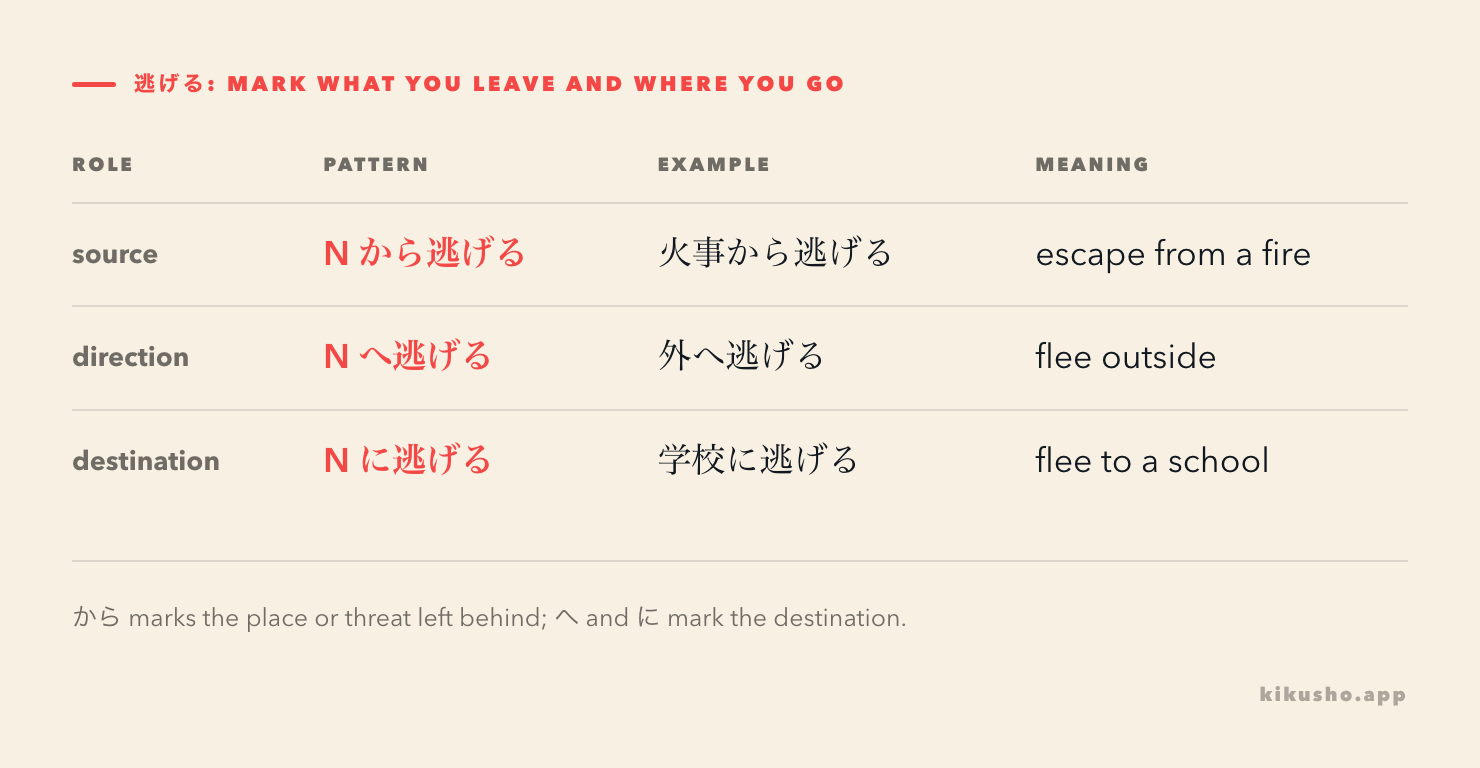
Use から for the place, danger or problem left behind:
- 火事から逃げる: escape from a fire
- 危険から逃げる: escape from danger
- 家から逃げる: run away from home
- 責任から逃げる: avoid responsibility
Use へ or に for the destination:
- 外へ逃げる: flee outside
- 安全な場所に逃げる: escape to a safe place
- 二階へ逃げる: flee to the second floor
煙が見えたら、すぐに建物から外へ逃げてください。
けむりが みえたら、すぐに たてものから そとへ にげて ください。
If you see smoke, please leave the building and escape outside immediately.
Do not use を for the danger in this beginner pattern. The dictionary notes that 逃げる is intransitive and distinguishes it from 逃れる(のがれる), which can take を in patterns such as 責任を逃れる, escape responsibility. At N4, 危険から逃げる is the reliable model.
The N4 natural hazards lesson supplies weather and disaster words that can create the reason to move. The N4 city and public facilities lesson gives places such as the police station that may appear in a safety plan.
戦争 names war and also appears in strong compounds
戦争(せんそう) means war: sustained armed conflict, especially between states or organised groups. Common event patterns use が:
- 戦争が始まる / 起こる: a war begins / breaks out
- 戦争が続く: a war continues
- 戦争が終わる: a war ends
- 戦争を止める: stop a war
- 戦争に反対する: oppose war
祖父は、戦争が終わって家に帰った日のことを話しました。
そふは、せんそうが おわって いえに かえった ひの ことを はなしました。
My grandfather spoke about the day the war ended and he returned home.
The word can also intensify a nonmilitary competition in compounds such as 受験戦争, fierce competition over entrance examinations, or 価格戦争, a price war. Those are figurative. Without such a compound, 戦争 normally refers to actual armed conflict. The dictionary definition records both the military meaning and the figurative extension to intense competition.
One school report uses all six words
学校で戦争について勉強していた時、近くの大きな工場で火事がありました。外は危険だったので、生徒は体育館へ逃げました。子どもたちは煙を怖がっていましたが、体育館は安全でした。火が消えたと聞いて、みんな安心しました。
While the students were learning about war at school, there was a fire at a large factory nearby. Because it was dangerous outside, they fled to the gym. The children were frightened by the smoke, but the gym was safe. Everyone felt relieved when they heard that the fire was out.
The report uses 危険 for the external condition and 安全 for the destination. 怖がっていました shows the children's visible fear; Japanese often uses 怖がる rather than directly stating another person's inner feeling with 怖い. Finally, 安心しました marks the change after reassuring news. 戦争 remains the lesson topic at school, separate from the ordinary accident that causes the evacuation.
The N3 emergencies lesson continues the topic with vocabulary for professional response and medical care.
For police response and crime reporting, the N3 law, crime and public-order lesson adds 事件, 捜査, 逮捕, 犯人 and 被害.
Practice
1 · Safety or relief. The building inspection is complete and no danger was found. Which word describes the building's condition?
- A. 安心
- B. 安全
- C. 怖い
- D. 戦争
2 · A change of feeling. Complete the sentence: 家族が無事だと聞いて、___しました。
- A. 安心
- B. 安全
- C. 危険
- D. 戦争
3 · Objective danger. Which sentence is natural?
- A. この道は夜、危険です。
- B. この道は夜、危険いです。
- C. この道は夜、危険します。
- D. この道は夜、危険を怖いです。
4 · Personal fear. How do you say “I am afraid of big dogs”?
- A. 大きな犬は安心です。
- B. 大きな犬が怖いです。
- C. 大きな犬を危険です。
- D. 大きな犬へ逃げます。
5 · Reading. Choose the reading of 戦争.
- A. せんぞう
- B. せんしょう
- C. せんそう
- D. せいそう
6 · Escape route. Choose the particles: 火事___建物の外___逃げました。
- A. に / から
- B. を / が
- C. から / へ
- D. で / を
7 · Event sequence. Which order tells a logical safety story?
- A. 安心する → 危険がある → 逃げる → 安全な場所
- B. 危険がある → 怖い → 逃げる → 安全な場所 → 安心する
- C. 戦争する → 安全が怖い → 危険へ逃げる
- D. 怖い → 安心から逃げる → 危険になる
8 · Connected meaning. 安全な場所へ逃げたので、もう安心です。 What does this mean?
- A. The safe place became dangerous, so I am frightened.
- B. I escaped from peace of mind because a war began.
- C. I fled to a safe place, so I feel relieved now.
- D. I checked the war and returned to the dangerous place.
Show all 8 answers after completing the set
- B. 安全 describes the checked condition of the building.
- A. 安心する means to feel relieved when worry goes away.
- A. 危険 is a na-adjective, so 危険です and 危険な道 are correct.
- B. The feared object commonly takes が with 怖い.
- C. 戦争 is read せんそう.
- C. から marks the fire escaped from; へ marks the destination.
- B. The sequence moves from danger and fear through escape to safety and relief.
- C. 安全な場所 is the safe destination, and 安心 is the resulting feeling.
Common questions
What is the difference between 安全 and 安心?
安全 describes a situation with little or no danger: a safe place, route or method. 安心 describes the person's peaceful or relieved state of mind. Something may be objectively safe before a worried person feels reassured.
What is the difference between 危険 and 怖い?
危険 is a noun and na-adjective for objective danger or the possibility of harm. 怖い is an i-adjective for the fear a person feels or for something experienced as frightening.
Which particles are used with 逃げる?
Use から for the place, threat or problem escaped from, and へ or に for the destination: 火事から外へ逃げる. The verb is intransitive, so the person who escapes is normally marked by が or は, not を.
How do you say that a war starts or ends in Japanese?
Common patterns are 戦争が始まる or 戦争が起こる for a war starting, 戦争が続く for it continuing and 戦争が終わる for it ending.