On this page
These eleven N3 words let you follow a basic Japanese crime report from an incident and its damage to an investigation, arrest and court judgment. The words do not form an automatic legal sequence: 事件 is not always a crime, 逮捕 is not a conviction, and 犯人 should not be used as though suspicion alone proved guilt.
Eleven records for incidents and investigations
| Headword | Reading | Core meaning | Useful pattern |
|---|---|---|---|
| 違反 | いはん, ihan | violation; breach | 規則に違反する |
| 監督 | かんとく, kantoku | supervision; supervisor, director or coach | 工事を監督する |
| 刑事 | けいじ, keiji | police detective; criminal matter | 刑事事件 |
| 強盗 | ごうとう, gōtō | robbery using force or threat; robber | 強盗に入る |
| 裁く | さばく, sabaku | judge; try in court | 罪を裁く |
| 事件 | じけん, jiken | incident; affair; legal case | 事件が起きる |
| 捜査 | そうさ, sōsa | criminal investigation | 事件を捜査する |
| 逮捕 | たいほ, taiho | arrest; apprehension | 容疑者を逮捕する |
| 犯罪 | はんざい, hanzai | crime; criminal act | 犯罪を防ぐ |
| 犯人 | はんにん, hannin | culprit; perpetrator | 犯人を捜す |
| 被害 | ひがい, higai | harm; damage suffered | 被害に遭う |
Kikusho's September 2026 inventory places all eleven spelling-and-reading records in this N3 lesson. Nine have no internal level disagreement. 裁く and 捜査 each have an N3 record and an N1 observation in the imported lists. Those baselines largely share the same Waller/Tanos ancestry, while the separately published comparison list has uncertain provenance. A current N3 vocabulary list independently includes words such as 刑事, 犯罪 and 被害. The JLPT organisers issue no fixed vocabulary specification for the current test, so the level remains a source-backed study placement.
違反 breaks a rule; 犯罪 breaks criminal law
違反(いはん) is a breach or violation of a rule, agreement, law or duty. The thing violated normally takes に:
- 交通規則に違反する: violate traffic rules
- 契約に違反する: breach a contract
- 校則違反: violation of school rules
- スピード違反: speeding violation
The 違反 reference covers laws, agreements and promises. That breadth means not every 違反 is a 犯罪(はんざい), a crime punishable under criminal law. Breaking a private promise can be a violation without being a crime. Conversely, a report about 犯罪を防ぐ, preventing crime, or 犯罪が増える, crime increasing, is explicitly about criminal acts. The 犯罪 entry separates crime in the general sense from the stricter legal sense.
会社の規則に違反しただけでは、必ずしも犯罪になるわけではありません。
かいしゃの きそくに いはんしただけでは、かならずしも はんざいに なるわけでは ありません。
Violating a company rule does not necessarily make the act a crime.
事件, 捜査, 逮捕 and 裁く name different stages
事件(じけん) is a noteworthy incident, matter or legal case. Use 事件が起きる, an incident occurs; 事件を解決する, solve a case; and 事件現場, scene of the incident. The 事件 dictionary entry includes both a newsworthy event and a matter handled under legal procedure. The noun does not itself say who caused it or whether a crime has been proved.
捜査(そうさ) is a criminal investigation. Police and prosecutors 事件を捜査する, investigate a case, by collecting evidence and trying to identify what happened. The 捜査 definition specifically centres on finding or securing an offender and collecting and preserving evidence. It is narrower than general 調査, research or inquiry.
逮捕(たいほ) is arrest or apprehension: restraining a suspected person's movement under legal procedure. Natural patterns are 容疑者を逮捕する, arrest a suspect; 逮捕される, be arrested; and 逮捕状, arrest warrant. The 逮捕 reference defines it as physical restraint of a suspected person. It does not mean that a court has found the person guilty.
裁く(さばく) means to judge right and wrong or try a person or case in court: 罪を裁く, judge an offence; 法廷で裁かれる, be tried in court. The spelling matters because さばく can also be written 捌く for handling, sorting or preparing things. The 裁く entry gives the judicial sense first and records the wider handling senses.
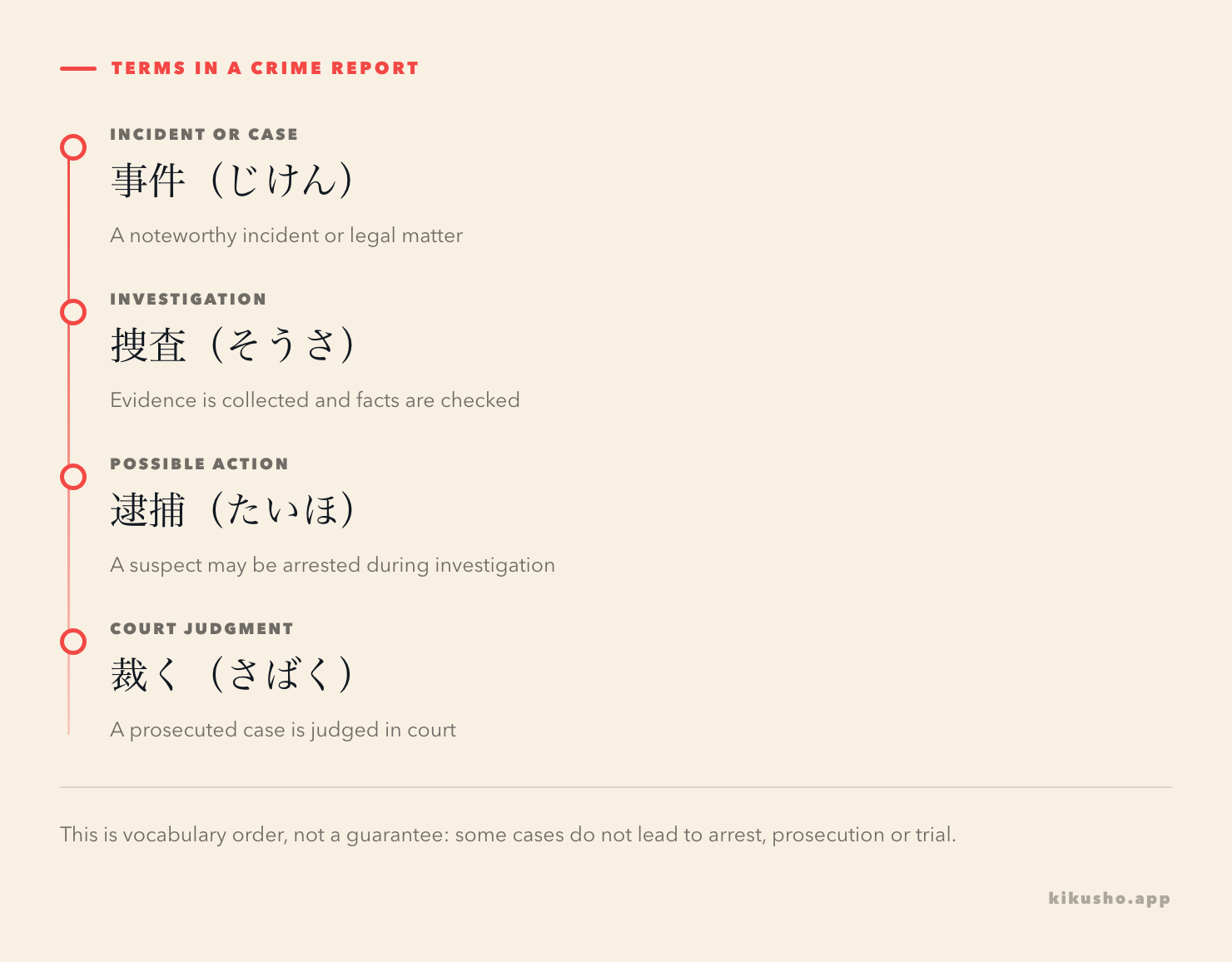
Japan's Ministry of Justice shows 捜査 → 起訴 or 不起訴 → 公判 → 判決 in its criminal-procedure flow. Arrest may occur during investigation, but prosecution and judgment are separate decisions. For reading practice, keep this modest contrast:
警察は事件を捜査し、容疑者を逮捕しました。しかし、その人が犯人かどうかは裁判で判断されます。
けいさつは じけんを そうさし、ようぎしゃを たいほしました。しかし、そのひとが はんにんか どうかは さいばんで はんだんされます。
Police investigated the incident and arrested a suspect. Whether that person is the perpetrator will be decided in court.
刑事 investigates; 犯人 committed the act
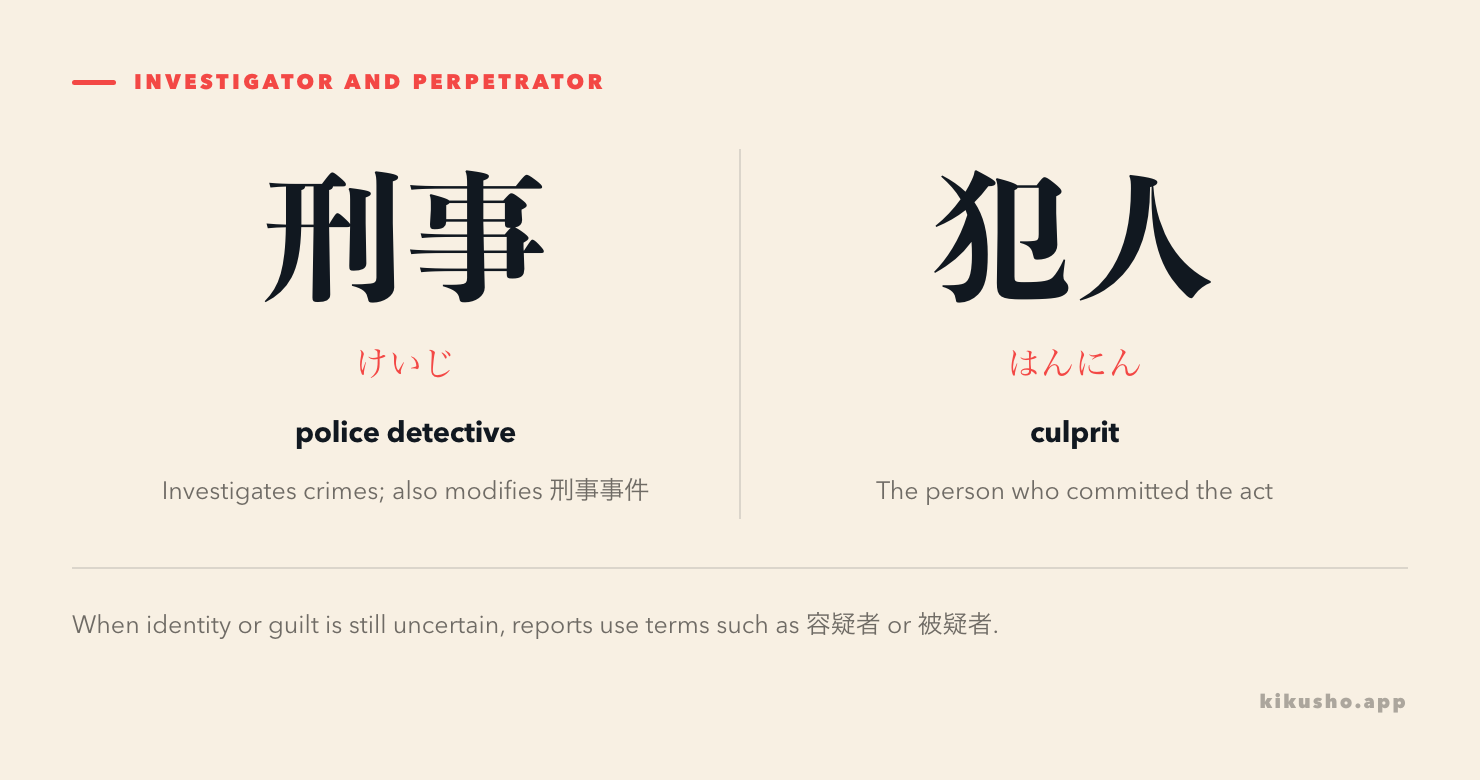
刑事(けいじ) has two connected uses. As a person, it is the common term for a police detective whose main work is criminal investigation: 刑事が聞き込みをする, a detective interviews people. As a modifier, it means criminal rather than civil: 刑事事件, criminal case; 刑事責任, criminal responsibility; 刑事裁判, criminal trial. The 刑事 reference records both uses and notes that 刑事 is a common role label, not a police rank.
犯人(はんにん) is the person who actually committed an offence, the culprit or perpetrator. The dictionary definition is direct: a person who committed a crime. Before that fact is established, reports often use 容疑者, suspect, 被疑者, a formal investigative term, or 男・女・人物, man, woman or person, according to what is known.
刑事は防犯カメラの映像を調べ、犯人が逃げた方向を確認しました。
けいじは ぼうはんカメラの えいぞうを しらべ、はんにんが にげた ほうこうを かくにんしました。
The detective examined the security-camera footage and confirmed the direction in which the perpetrator had fled.
The sentence treats 犯人 as the person who committed the recorded act. If the identity were uncertain, 犯人と思われる人物, the person believed to be the culprit, would keep that uncertainty visible.
強盗 requires force or threat
強盗(ごうとう) means robbery committed through violence or threat, and it can also name the robber. The 強盗 definition makes that force element explicit. This corrects an overly broad imported gloss that also offered “burglary.” Entering a building to steal is not automatically 強盗; if nobody is threatened or attacked, another theft term may be needed.
Common phrases are:
- 銀行強盗: bank robbery; bank robber
- 強盗事件: robbery case
- 店に強盗に入る: enter a shop to commit robbery
- 強盗に金を奪われる: have money taken by a robber
強盗は店員を脅して現金を奪い、車で逃げました。
ごうとうは てんいんを おどして げんきんを うばい、くるまで にげました。
The robber threatened the clerk, took the cash and escaped by car.
被害 is the harm suffered
被害(ひがい) is harm or damage suffered. It belongs to crime reports, but also to accidents and disasters:
- 被害に遭う: suffer harm; fall victim
- 被害を受ける: sustain damage
- 被害が出る: damage or casualties occur
- 被害を防ぐ: prevent harm
- 被害者: victim; person harmed
The 被害 entry defines both suffering harm and the harm itself. It contrasts with 加害, causing harm. A storm can therefore cause 被害 even though no crime or 犯人 exists.
台風では多くの家が被害を受けましたが、これは犯罪事件ではありません。
たいふうでは おおくの いえが ひがいを うけましたが、これは はんざい じけんでは ありません。
Many homes were damaged by the typhoon, but this was not a criminal incident.
監督 changes with the field
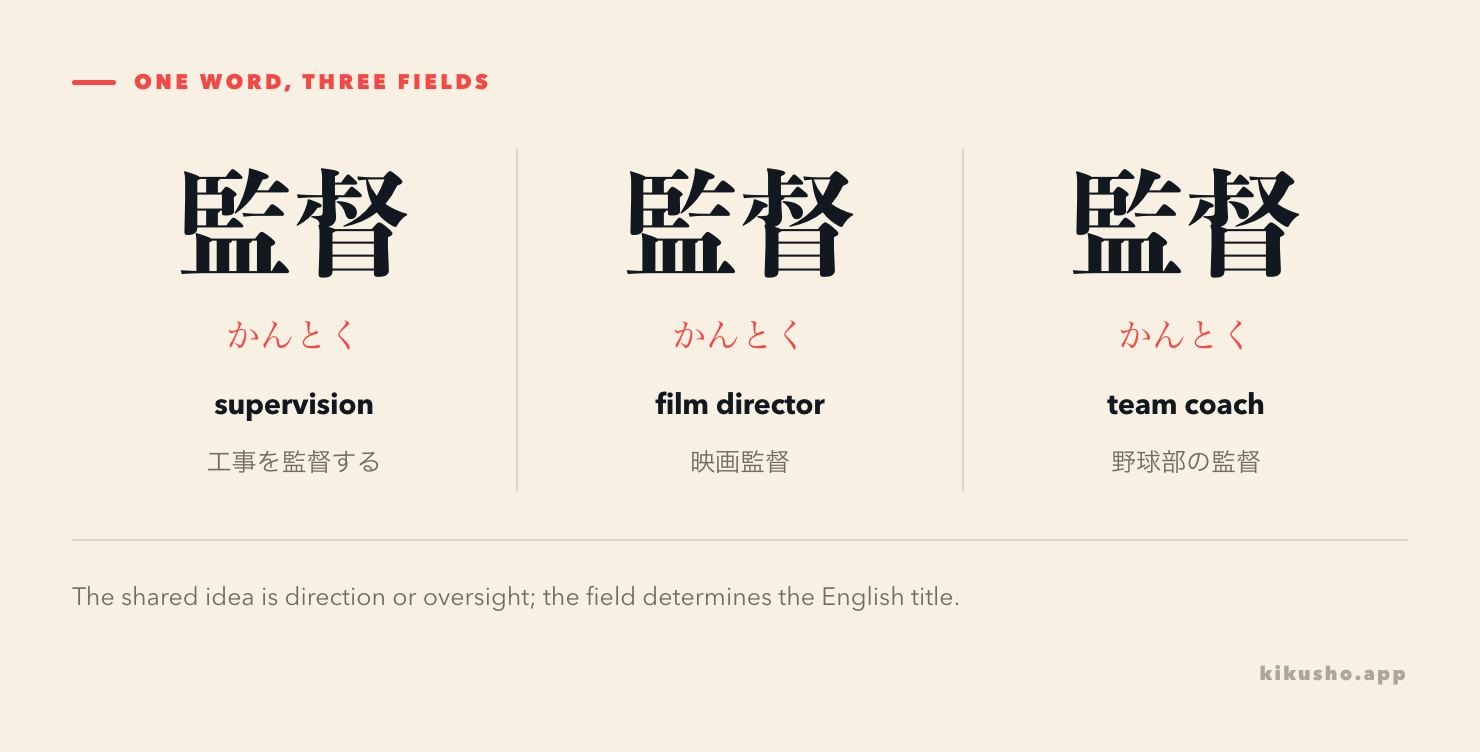
監督(かんとく) starts from supervision, direction or oversight. As a suru verb, 工事を監督する means supervise construction and 職員を監督する means oversee staff. As a person, it becomes a director or coach: 映画監督, film director; 野球部の監督, baseball-team manager or coach. 試験監督 is an exam proctor.
The 監督 dictionary entry joins these senses through the idea of directing and ensuring that work or conduct follows its requirements. It does not mean “police detective,” even when supervision concerns compliance.
現場監督は作業員が安全規則に違反していないか確認しました。
げんば かんとくは さぎょういんが あんぜん きそくに いはんしていないか かくにんしました。
The site supervisor checked whether the workers were violating the safety rules.
One fictional report uses all eleven records
昨夜、駅前の店で強盗事件が起き、店員一人が被害を受けました。犯人は現金を奪って逃げました。刑事が捜査を始め、防犯カメラを管理する会社の監督者から話を聞きました。警察は映像を調べ、交通規則に違反して逃げた車を特定し、運転していた容疑者を逮捕しました。強盗が犯罪に当たることは明らかですが、その人が犯人かどうかを判断するには、証拠を法廷で確かめる必要があります。
Last night, a robbery occurred at a shop near the station, and one clerk was harmed. The perpetrator took cash and fled. A detective began investigating and spoke with the supervisor from the company managing the security cameras. Police examined the footage, identified a car that broke traffic rules as it fled and arrested the suspect driving it. Robbery is clearly a crime, but the evidence must be examined in court to decide whether that person was the perpetrator.
The report uses 犯人 for the unknown person shown committing the robbery and 容疑者 for the person arrested on suspicion of being that offender. 捜査, 逮捕 and 裁く remain separate actions. The N1 law, crime and public-order lesson continues with prosecutors, defense, evidence, surveillance, enforcement and punishment. The N1 legal and administrative lesson continues with litigation, judgments, bills and formal provisions. The N4 danger and security lesson supplies the earlier words 危険, 安全 and 逃げる.
Check the report vocabulary
1 · Police investigation. Which kana give the reading of 捜査?
- A. そうさ
- B. そうざ
- C. しょうさ
- D. そうさつ
2 · Harm and damage. Which kana give the reading of 被害?
- A. ひかい
- B. ひがい
- C. ひけい
- D. ひがえ
3 · Rule or crime. Which statement is accurate?
- A. Every 違反 is automatically a 犯罪.
- B. 犯罪 only means breaking a school rule.
- C. 違反 can concern many kinds of rules; 犯罪 specifically names crime.
- D. 違反 and 被害 both mean arrest.
4 · Investigator or culprit. Complete the sentence: ___が事件を捜査し、逃げた___を捜している。
- A. 犯人 / 刑事
- B. 刑事 / 犯人
- C. 被害 / 監督
- D. 強盗 / 犯罪
5 · Arrest. 警察が容疑者を逮捕した tells us that:
- A. the court has already convicted the person
- B. the case was definitely dismissed
- C. police arrested a suspect, but guilt is a separate question
- D. the suspect supervised the police
6 · Robbery. Which detail makes 強盗 the best word?
- A. Someone returned a lost wallet.
- B. Someone threatened a clerk and took cash.
- C. A storm damaged a shop roof.
- D. A customer broke a store rule.
7 · Investigation. Which sentence is natural?
- A. 刑事が事件を捜査している。
- B. 事件が刑事を捜査される。
- C. 犯罪を捜査に違反した。
- D. 被害が刑事を逮捕している。
8 · Damage beyond crime. Which sentence shows 被害 without a crime?
- A. 映画監督が作品を完成させた。
- B. 裁判官が事件を裁いた。
- C. 台風で農家が大きな被害を受けた。
- D. 刑事が犯人を捜した。
9 · Multiple senses. Which three people can all be called 監督?
- A. a film director, a team coach and a site supervisor
- B. a judge, a victim and a robber
- C. a detective, a suspect and a witness
- D. a legislator, an ambassador and a voter
10 · Connected meaning. 事件の捜査中に容疑者が逮捕されたが、裁判はまだ始まっていない。 What is the safest conclusion?
- A. The perpetrator has already been convicted.
- B. A suspect was arrested during the investigation; no trial has begun.
- C. The incident caused no damage.
- D. A film director broke a sports rule.
Reveal the law, crime and public-order answer key
- A. 捜査 is read そうさ.
- B. 被害 is read ひがい.
- C. 違反 covers breaches of rules, agreements or laws, while 犯罪 specifically names crime.
- B. A 刑事 investigates; the 犯人 is the person who committed the act.
- C. 逮捕 is an arrest during criminal procedure, not a conviction.
- B. Violence or threat used to take property is the defining clue for 強盗.
- A. 事件を捜査する is the standard object-and-verb pattern.
- C. 被害 also covers harm from accidents and natural disasters.
- A. 監督 connects supervision with directing a film or coaching a team.
- B. The sentence reports investigation and arrest while explicitly saying the trial has not begun.
Common questions
What is the difference between 犯罪 and 事件?
犯罪 is a crime or criminal act. 事件 is a notable incident, matter or legal case. A crime can become an事件 under investigation, but 事件 does not by itself prove that a crime occurred.
Does 逮捕 mean that someone has been found guilty?
No. 逮捕 means arrest or apprehension. It restrains a suspected person's movement during the investigative stage; a court judgment comes later, if the case is prosecuted. An arrest is not itself a conviction.
What is the difference between 刑事 and 犯人?
As a person, 刑事 is a police detective who investigates crimes. 犯人 is the person who committed an offence, the culprit or perpetrator. 刑事 also modifies legal terms such as 刑事事件, a criminal case.
Does 強盗 mean any kind of theft?
No. 強盗 specifically involves taking property through violence or threat, and it can also name the robber. Simple theft, shoplifting and burglary without that force distinction need other words.