On this page
固い, 堅い and 硬い are all read かたい, but their usual written contexts differ. Add ガラス, 滑る and 柔らかい, and you can describe what an object is made of, how it feels, and why a surface may be unsafe.
Six entries connect material, condition and movement
| Word | Reading | Word type and core sense | Anchor phrase |
|---|---|---|---|
| 固い | かたい, katai | i-adjective; firm, fixed, tight or resistant to change | 固い約束: a firm promise |
| 堅い | かたい, katai | i-adjective; solid, reliable, secure or difficult to break | 口が堅い: good at keeping secrets |
| 硬い | かたい, katai | i-adjective; physically hard or stiff | 硬いパン: hard bread |
| ガラス | がらす, garasu | noun; glass as a material or pane | ガラスの窓: a glass window |
| 滑る | すべる, suberu | godan verb; to slide, slip or lose one's footing | 雨で道が滑る: the road is slippery from rain |
| 柔らかい | やわらかい, yawarakai | i-adjective; soft, tender, supple or gentle | 柔らかい布: soft cloth |
The three かたい entries share a pronunciation and a broad core idea. Their kanji help the reader anticipate a common setting, but the borders are conventions rather than a mechanical rule. The Kanjipedia comparison groups all three while giving each a characteristic set of examples.
Kikusho's reference inventory places all six records at N4. Current lists disagree on the two less basic spellings: the source comparison also records 堅い and 硬い at N3, while Japanesetest4you groups 硬い, 堅い and 固い in an N4 lesson. The JLPT organisers publish no exhaustive official word list, so the level is a study estimate rather than an exam guarantee.
The N4 material-source lesson answers the next grammar question: whether to say a product is made から a transformed source or で a visible material. Here the task is earlier and more concrete: choose the noun or adjective that describes the object in front of you.
固い, 堅い and 硬い are one sound with three spelling cues
Start with the noun beside かたい. If the sentence is about a material resisting pressure, 硬い is often the clearest choice. If it is about a bond, fixed state or resistance to change, 固い is common. If the emphasis is trust, security or dependable strength, 堅い often appears.
| Spelling | Useful cue | Typical pair | Meaning in that pair |
|---|---|---|---|
| 固い | fixed, tight, joined, unchanging | 固い約束 | firm promise |
| 堅い | reliable, secure, difficult to break | 口が堅い | able to keep a secret |
| 硬い | physical hardness or stiffness | 硬い石 | hard stone |
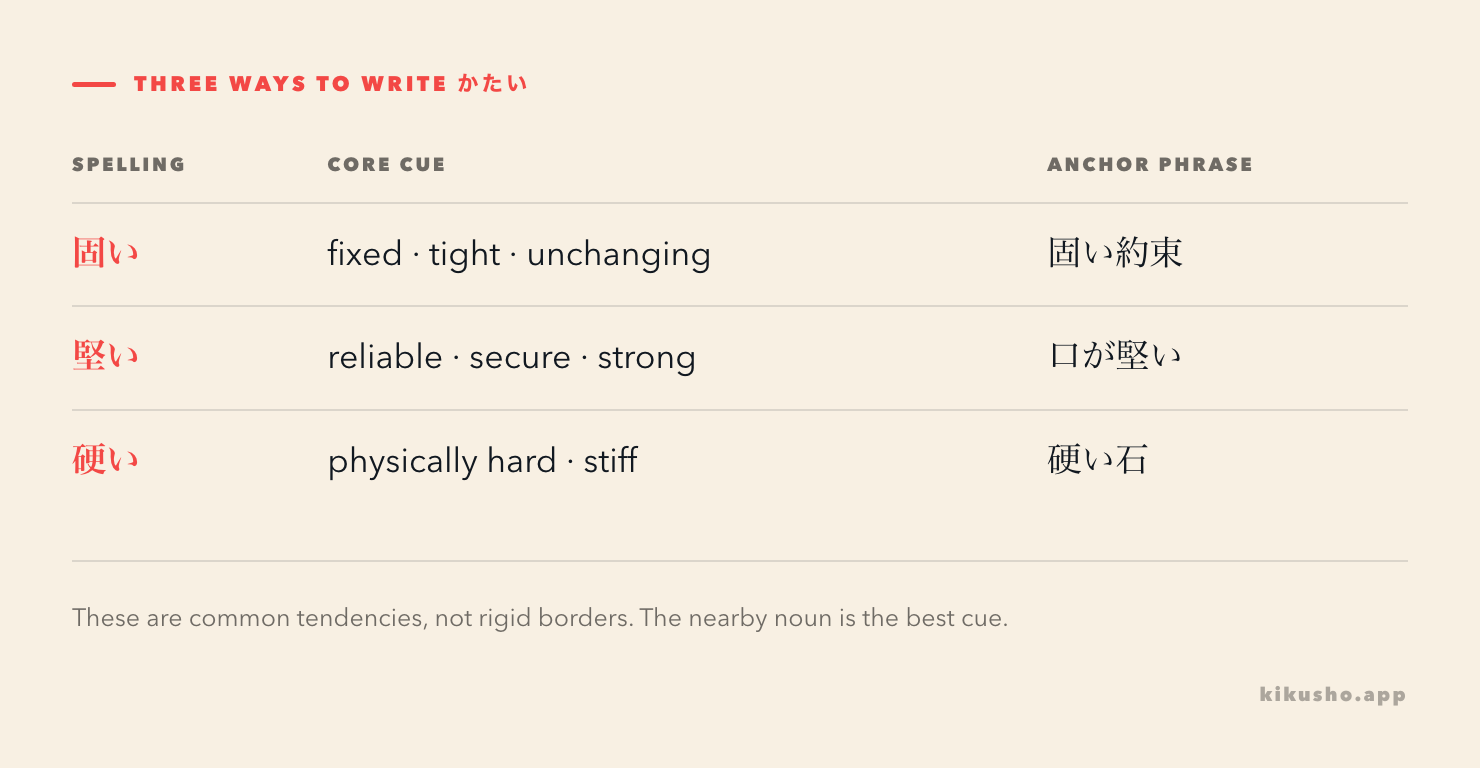
These examples make the tendencies visible:
このふたは固くて、開きません。
This lid is tight and will not open.
田中さんは口が堅いので、秘密を話しても大丈夫です。
Tanaka is good at keeping secrets, so it is safe to tell them the secret.
このパンは硬くて、食べにくいです。
This bread is hard and difficult to eat.
The first sentence treats the lid as tightly fixed. The second evaluates a person's reliability. The third describes texture. This is a better memory system than assigning the English word “hard” to three isolated cards.
The rule still has overlap. Dictionaries often place the three spellings under the same headword, and 固い is used broadly. When you are writing and no standard pair comes to mind, hiragana かたい avoids a false distinction. When you are reading, use the nearby noun to infer why the writer chose that kanji.
硬い and 柔らかい form the clearest physical contrast
For touch and texture, 硬い and 柔らかい make a useful pair.
- 硬い石: a hard stone
- 硬いパン: hard bread
- 柔らかい布: soft cloth
- 柔らかいパン: soft bread
The dictionary entry for 柔らかい gives both a physical sense, such as soft fabric or bread, and a gentler extended sense, such as a soft expression or tone. Its forms follow the ordinary i-adjective pattern:
| Function | 硬い | 柔らかい |
|---|---|---|
| before a noun | 硬い椅子 | 柔らかい椅子 |
| adverb form | 硬くなる | 柔らかくなる |
| past | 硬かった | 柔らかかった |
| negative | 硬くない | 柔らかくない |
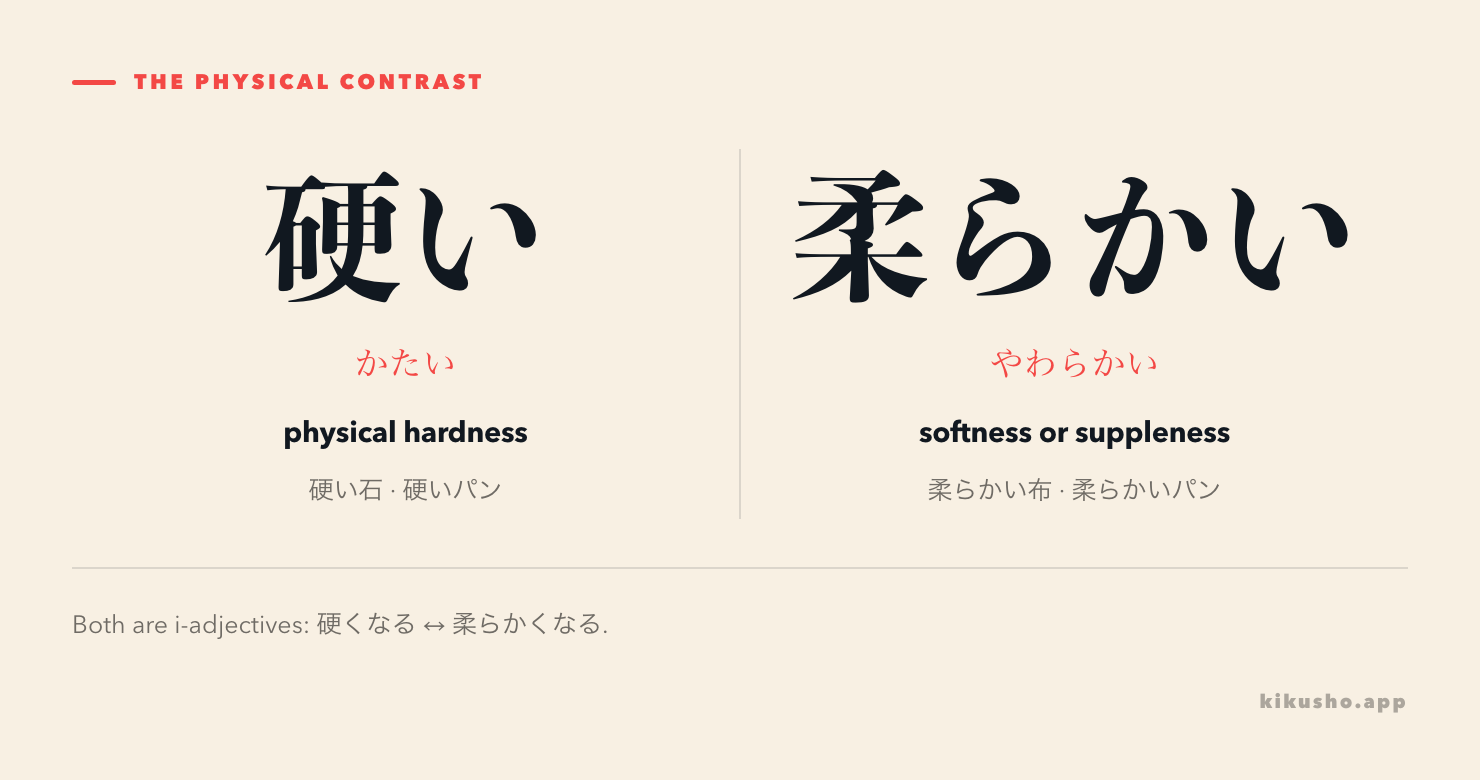
このタオルは洗ったら柔らかくなりました。
This towel became soft after it was washed.
先生は柔らかい声で説明しました。
The teacher explained it in a gentle voice.
The second example extends a physical impression to manner. English does the same with “soft voice,” so the move is easy to recognise. At this level, keep the concrete sense as your anchor and learn the extensions as phrases.
The N5 lesson on opposite adjective pairs gives the wider pattern. This N4 set adds a spelling problem: the opposite of 柔らかい is normally written 硬い when physical texture is in focus.
ガラス names the material; グラス usually names the vessel
ガラス is the material glass and, by extension, a sheet or pane of it. The Kanjipedia definition describes a transparent, hard but brittle material used in buildings, crafts and containers. That matters because “hard” does not mean “unbreakable.”
窓のガラスが割れています。
The window glass is broken.
このテーブルはガラスでできています。
This table is made of glass.
割れたガラスに触らないでください。
Please do not touch the broken glass.
The original inventory gloss “a glass pane” is useful but too narrow. ガラス can name the substance in a window, table or container. A pane is one common object made from it.
Keep ガラス apart from グラス. In everyday use, グラス commonly means a Western-style drinking glass, while ガラス identifies the material:
- ガラスのコップ: a cup made of glass
- ワイングラス: a wine glass
- ガラスのドア: a glass door
The room vocabulary lesson already teaches the objects around this material, including walls, mirrors and household equipment. Use ガラスの before one of those nouns when the material is visible in the finished object.
滑る describes motion or a loss of grip
滑る(すべる) can mean moving smoothly across a surface or slipping because grip is lost. Kanjipedia lists both 氷の上を滑る, moving over ice, and 雨の日に滑って転ぶ, slipping and falling on a rainy day. It can also describe an object slipping from your hand.
The verb ends in る, but it is a godan verb:
| Form | Japanese | Example |
|---|---|---|
| dictionary | 滑る | 氷の上を滑る |
| polite | 滑ります | よく滑ります |
| て-form | 滑って | 滑って転びました |
| past | 滑った | 足が滑った |
| negative | 滑らない | この靴は滑らない |
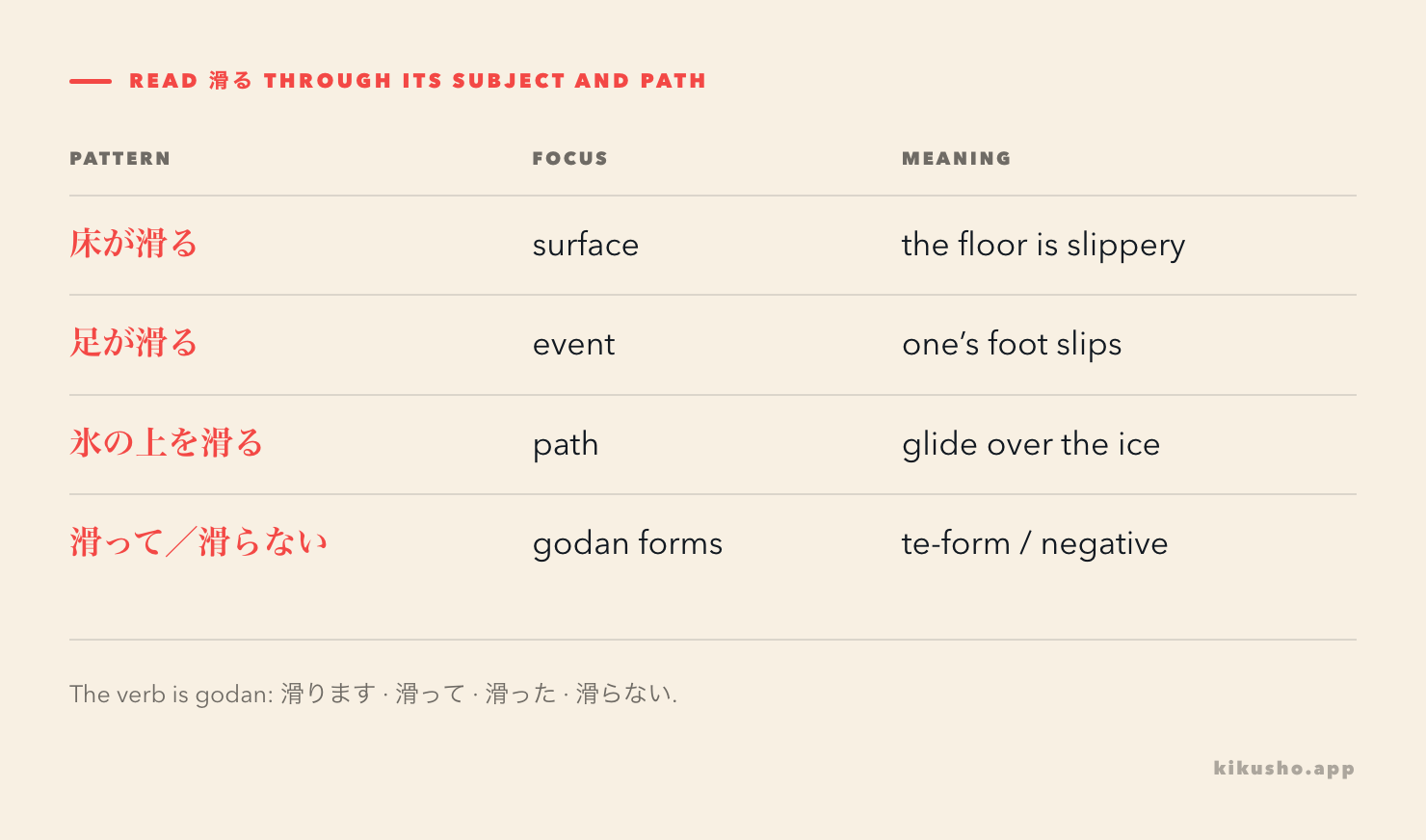
Three sentence frames cover most N4 situations:
- 床が滑る: the floor is slippery
- 足が滑る: one's foot slips
- 氷の上を滑る: glide or skate over the ice
雨で入口の床が滑りやすくなっています。
The entrance floor has become slippery because of the rain.
滑りやすい combines the verb stem 滑り with やすい, “easy to do.” On a warning sign, it means “prone to slipping” or simply “slippery.” The subject tells you whether Japanese is describing the surface or the person who loses balance.
The verb also has figurative meanings, including failing an examination, but the physical meanings are the right N4 anchor. Learn the image of contact failing first; later senses grow from that image.
A room description makes all six choices concrete
Read this short moving-day note:
新しい部屋には、大きいガラスのテーブルがあります。ガラスは硬いですが、割れやすいので、柔らかい布で包みます。テーブルの脚のねじを固く締めます。雨の日は入口の床が滑るので、運ぶ人に注意してもらいます。手伝ってくれる友達は口が堅く、引っ越しのことをまだ誰にも話していません。
The new room has a large glass table. Glass is hard, but because it breaks easily, we wrap it in soft cloth. We tighten the screws in the table legs firmly. On rainy days the entrance floor is slippery, so we ask the people carrying it to be careful. The friend helping us is good at keeping secrets and has not told anyone about the move yet.
Each choice answers a different question:
- What is the table made of? ガラス
- What is its physical texture? 硬い
- What protects it? 柔らかい布
- How are the screws fastened? 固く
- What does the wet floor do? 滑る
- What quality does the friend have? 口が堅い
The six entries now form one scene instead of six translations. That is enough context to choose a spelling without turning a tendency into an absolute rule.
Practice
1 · Reading. How is 堅い read?
- A. こたい
- B. かたい
- C. けたい
- D. かだい
2 · Orthography. Which spelling best fits physical texture in このパンは___ので、かみにくいです?
- A. 硬い
- B. 堅い
- C. 固い
- D. 柔らかい
3 · Collocation. Which phrase conventionally means “a firm promise”?
- A. 硬い約束
- B. 堅い約束
- C. 固い約束
- D. 滑る約束
4 · Meaning in context. What does 山田さんは口が堅い say about Yamada?
- A. Yamada speaks in a loud voice.
- B. Yamada can be trusted with a secret.
- C. Yamada has difficulty opening their mouth.
- D. Yamada only eats hard food.
5 · Context. Which word completes 赤ちゃんには___毛布を使います?
- A. 柔らかい
- B. 滑る
- C. ガラス
- D. 堅い
6 · Verb form. What is the て-form of 滑る?
- A. 滑て
- B. 滑りて
- C. 滑って
- D. 滑るて
7 · Paraphrase. Which English sentence best matches 雨で床が滑ります?
- A. The rain broke the floor.
- B. The floor is slippery because of the rain.
- C. The floor becomes soft in the rain.
- D. We skate indoors when it rains.
8 · Word choice. Which sentence clearly describes a window made of glass?
- A. ガラスの窓があります。
- B. グラスで水を飲みます。
- C. 窓が柔らかいです。
- D. 窓を滑ります。
9 · Warning sign. Which phrase means “This road is slippery”?
- A. この道は口が堅いです。
- B. この道は柔らかいです。
- C. この道は滑りやすいです。
- D. この道はガラスです。
10 · Connected text. In the moving-day note, why is the glass table wrapped in soft cloth?
- A. The table is too soft to carry.
- B. The friend must keep the table secret.
- C. Glass is hard but can still break.
- D. Soft cloth makes the floor slippery.
Check every choice, then reveal the solutions.
Answers and explanations
1 · B, かたい. 固い, 堅い and 硬い all share the reading かたい. The kanji changes the normal context, not the pronunciation.
2 · A, 硬い. 硬い is the usual choice for physical hardness or stiffness and contrasts clearly with 柔らかい. Hard bread is a texture.
3 · C, 固い約束. 固い often appears when a bond, decision or promise is firm and resistant to change.
4 · B. 口が堅い describes someone who does not reveal secrets. It is a conventional use of 堅い for dependable restraint.
5 · A, 柔らかい. A soft blanket is 柔らかい毛布. The other choices describe slipping, glass or a different kind of firmness.
6 · C, 滑って. 滑る is a godan verb. Its final る changes to って in the て-form.
7 · B. With 床 as the subject, 滑る says that the floor is slippery. 雨で gives rain as the cause.
8 · A. ガラスの窓 is a window made of glass. Choice B contains グラス, a drinking glass, and describes drinking water.
9 · C, この道は滑りやすいです. 滑りやすい means easy or likely to slip on. It is the natural warning about a slippery road.
10 · C. The note says ガラスは硬いですが、割れやすい: glass is hard, but it breaks easily. The soft cloth protects it.
Common questions
What is the difference between 固い, 堅い and 硬い?
All three are read かたい. As a practical guide, 固い often describes something fixed, tight or resistant to change; 堅い suggests reliability, security or something difficult to break; and 硬い commonly describes physical hardness or stiffness, the opposite of 柔らかい. Actual usage overlaps, so learn common noun-and-adjective pairs.
Is ガラス a glass material or a drinking glass?
ガラス normally names the material glass or a pane, as in ガラスの窓. グラス commonly names a Western-style drinking glass. A ガラスのコップ is a cup made of glass.
Is 滑る an ichidan verb?
No. 滑る(すべる) is a godan verb: 滑ります, 滑って, 滑った and 滑らない. Its て-form is 滑って, not 滑て.
Can 柔らかい describe more than touch?
Yes. 柔らかい can describe soft food or fabric, a supple body, a gentle voice or expression, and flexible thinking. This lesson begins with the physical sense and then shows the common extension.