On this page
These nine N3 Japanese medical care, emergency and welfare words describe people, systems, rescue actions and public reporting. Learn them as contrasts: 医師 is the professional, 医療 is the care, 救助 names a rescue operation, 救う is the verb “save,” and 死亡 reports a death more factually than 死.
Two words also require social context. 障害 can mean an obstacle or a disability, while 老人 remains common in established compounds but is often replaced by 高齢者 when referring neutrally to older people.
Nine N3 words connect care, rescue and public services
| Record | Reading | Word class | Meaning here | Phrase to remember |
|---|---|---|---|---|
| 医師 | いし, ishi | noun | physician; doctor | 医師の診察を受ける: be examined by a physician |
| 医療 | いりょう, iryō | noun | medical care; healthcare | 必要な医療を受ける: receive necessary medical care |
| 救助 | きゅうじょ, kyūjo | noun; suru verb | rescue; aid out of danger | 遭難者を救助する: rescue a person in distress |
| 死 | し, shi | noun | death; the state or idea of death | 生と死: life and death |
| 死亡 | しぼう, shibō | noun; suru verb | death; to die in factual reporting | 事故で死亡する: die in an accident |
| 手術 | しゅじゅつ, shujutsu | noun; suru verb | surgery; an operation | 手術を受ける: undergo surgery |
| 障害 | しょうがい, shōgai | noun | obstacle; disruption; impairment or disability | 通信障害が起きる: a communications outage occurs |
| 救う | すくう, sukuu | transitive godan verb | save; rescue from danger or distress | 命を救う: save a life |
| 老人 | ろうじん, rōjin | noun | older person; elderly person | 老人福祉: welfare for older people |
The long vowels matter in 医療(いりょう), 救助(きゅうじょ), 死亡(しぼう) and 障害(しょうがい). 手術 has a different trap: it is しゅじゅつ, with じゅ twice, not しゅじつ.
A current independent N3 list includes much of this medical group, including 医師, 医療, 手術 and 障害. The official JLPT, however, does not publish a definitive vocabulary list. N3 is therefore a useful editorial placement, not an official promise that every word appears on a particular test.
The N3 illness and recovery lesson teaches what happens around these words: 症状, 検査, 治療, 患者 and 回復. This lesson moves outward to the professional, the care system, emergency action and public-service language.
医師 is a person; 医療 is the care that surrounds the person
医師(いし) is a licensed professional who diagnoses and treats illness or injury. It is common in formal speech, notices, news and occupational descriptions. The dictionary entry for 医師 defines the role through diagnosis and treatment under the 医師法.
医師が患者に手術の方法を説明しました。
いしがかんじゃにしゅじゅつのほうほうをせつめいしました。
The physician explained the surgical procedure to the patient.
医者(いしゃ) is the everyday word learners often meet first. Both can mean “doctor,” but 医師 foregrounds the professional qualification or role. 担当医師 is a standard formal label, while ordinary conversation can use 医者に行く or お医者さんに診てもらう.
医療(いりょう) names medical care itself. Its scope can be one person's treatment or the wider system that makes care available. The 医療 definition centres on treating illness or injury through medical knowledge and medicine.
島の住民は、必要な医療を受けるために船で町へ行きます。
しまのじゅうみんは、ひつようないりょうをうけるためにふねでまちへいきます。
The island's residents travel to town by boat to receive the medical care they need.
The surrounding noun tells you how wide the meaning is:
| Phrase | What it points to |
|---|---|
| 医療を受ける | receive medical care |
| 医療機関 | a healthcare institution |
| 医療費 | medical expenses |
| 地域医療 | healthcare serving a local area |
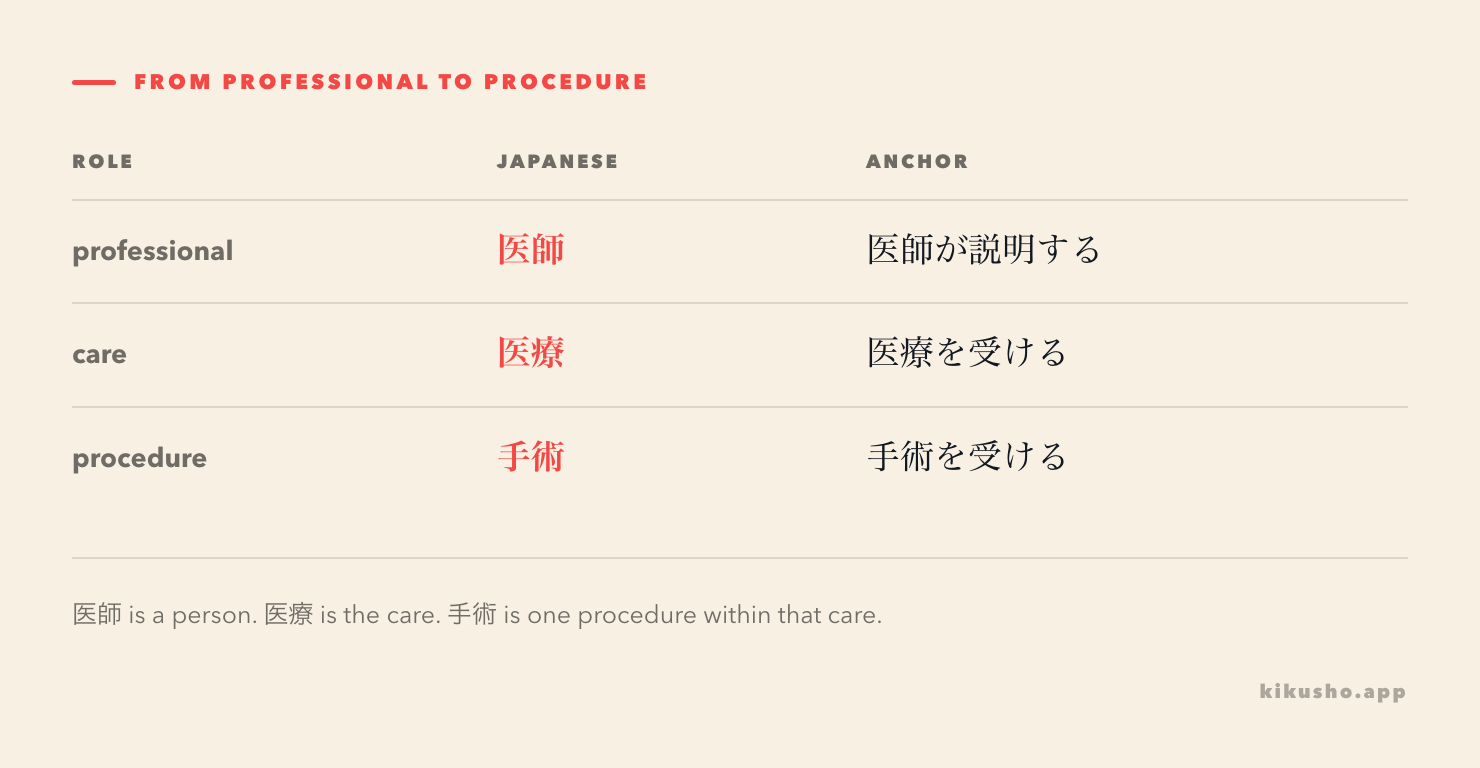
This distinction prevents an English-driven error. A person can be 医師, but a person cannot be 医療. Medical care is what someone provides, receives, finances or organises.
手術 changes its partner with the viewpoint
手術(しゅじゅつ) is an operation or surgery. The word is a noun and can combine with する, but the safest N3 patterns make the participant's role explicit.
患者は来週、手術を受けます。
かんじゃはらいしゅう、しゅじゅつをうけます。
The patient will undergo surgery next week.
| Viewpoint | Pattern | Meaning |
|---|---|---|
| patient | 手術を受ける | undergo surgery |
| clinician | 手術を行う | perform surgery |
| event | 手術が終わる | the operation ends |
| result | 手術が成功する | the operation succeeds |
The dictionary entry classifies 手術 as a noun and suru verb for a medical procedure. It also records a figurative use for radically changing an organisation or system, as in 組織に大手術を施す. The medical sense should be your default unless the object is plainly non-medical.
Do not use 手術 as a broad replacement for 治療. Every operation is a form of treatment, but many treatments involve medicine, rest, rehabilitation or another intervention rather than surgery.
救助 names the operation; 救う makes the saving action direct
救助(きゅうじょ) is a noun and suru verb for bringing a person or animal out of danger. It fits organised emergency action especially well: 救助隊, 救助活動, 人命救助. The 救助 entry gives disaster victims and people in distress as central objects.
救助隊が海で二人を救助しました。
きゅうじょたいがうみでふたりをきゅうじょしました。
The rescue team rescued two people at sea.
救う(すくう) is a transitive godan verb. It places the saved person, life or situation directly before を.
近くにいた人の行動が、子どもの命を救いました。
ちかくにいたひとのこうどうが、こどものいのちをすくいました。
The actions of someone nearby saved the child's life.
The verb reaches beyond physical rescue. Its dictionary senses also cover release from hardship, distress or a bad situation: 会社を危機から救う, save a company from crisis. The passive 救われる can even describe emotional relief: その言葉に救われました, those words gave me relief.
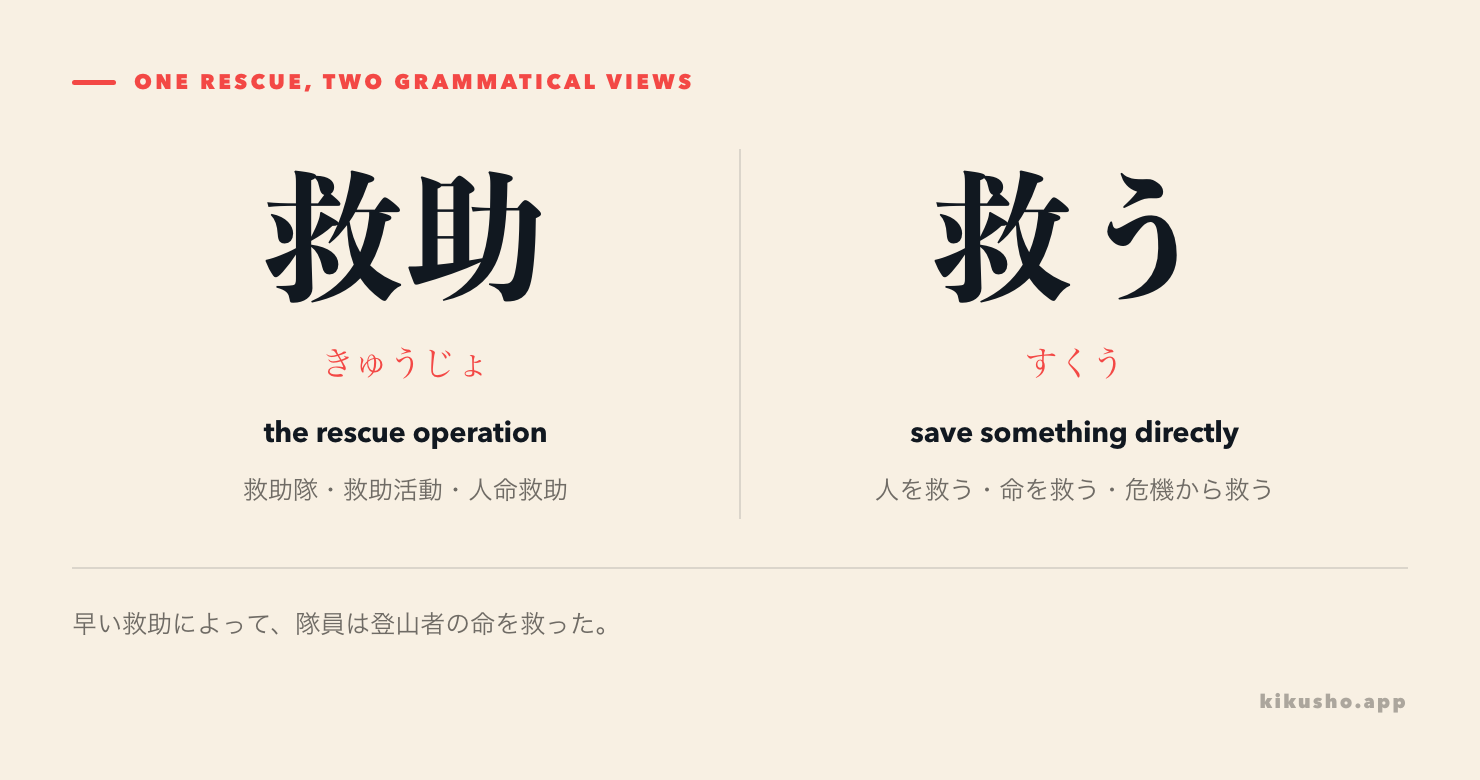
One emergency can support both words without repetition in meaning:
早い救助によって、隊員は登山者の命を救いました。
はやいきゅうじょによって、たいいんはとざんしゃのいのちをすくいました。
Through the rapid rescue, the team members saved the climber's life.
Here 救助 names the operation. 救う states its successful effect.
死 names the concept; 死亡 records that a person died
死(し) is the noun for death as a state, idea or opposite of life. It appears in reflective, literary and abstract language, as well as in compounds such as 死因 and 生死.
その小説は生と死をテーマにしています。
そのしょうせつはせいとしをテーマにしています。
The novel takes life and death as its theme.
The dictionary entry for 死 gives the loss or absence of life as its central noun sense. It can be modified and discussed: 突然の死, a sudden death; 死を恐れる, fear death; 死に至る, lead to death.
死亡(しぼう) turns the event into a factual report. It is a noun and suru verb used in news, statistics, records, notices and official explanations.
警察は、事故で二人が死亡したと発表しました。
けいさつは、じこでふたりがしぼうしたとはっぴょうしました。
The police announced that two people had died in the accident.
The 死亡 entry defines it specifically as a person's dying. That factual tone explains expressions such as 死亡者, 死亡事故, 死亡原因 and 死亡届.
死亡 can sound clinical when the relationship is personal. In conversation about one's own family, 祖父が亡くなりました is usually more natural than 祖父が死亡しました. The latter becomes appropriate when a form, report or investigation treats the death as a recorded event.
The N2 medical care, emergencies and welfare lesson continues this register path with 生存 for formally reported survival and 葬式 for the funeral ceremony that follows a death.
The inventory sources disagree about the level of standalone 死: one places it at N3 and another at N1. The kanji and core idea are basic, while the abstract and compound uses spread across levels. Treat the N3 placement here as preparation for the everyday contrasts on this page rather than a fixed official boundary.
障害 has an obstacle sense and a human-context sense
障害(しょうがい) first names something that obstructs an action or function. Weather can obstruct rescue, a system can suffer a disruption, and an old rule can stand in the way of reform.
大雪が救助活動の障害になりました。
おおゆきがきゅうじょかつどうのしょうがいになりました。
Heavy snow became an obstacle to the rescue operation.
Common non-human compounds include 通信障害, communications disruption; 電波障害, radio interference; and システム障害, system failure. In each one, something is preventing normal operation.
The same word also appears in language about bodily or mental functions and disability: 視覚障害, visual impairment; 聴覚障害, hearing impairment; 障害のある人, a person with a disability. The dictionary entry records both the obstacle sense and limits on activity connected with personal or social conditions.
市は、障害のある人が利用しやすい入口を増やしました。
しは、しょうがいのあるひとがりようしやすいいりぐちをふやしました。
The city added more entrances that are easy for people with disabilities to use.
Modern public language does not have to place the entire problem inside the individual. Japan's Disability Discrimination Act guidance defines social barriers as objects, systems, customs and ideas that obstruct daily or social life. That is why 障害を取り除く can refer to changing an environment as well as treating a bodily condition.
Use the wording chosen by the person or organisation in front of you. 障害者 is an established legal and policy term; 障害のある人 keeps 人 explicit and is common in explanatory prose. A vocabulary gloss cannot settle every identity preference.
老人 survives in compounds, while 高齢者 is often the neutral label
老人(ろうじん) literally means an older person. The word remains visible in legislation, literature and established compounds:
- 老人ホーム: residential home for older people
- 老人福祉: welfare for older people
- 老人医療: medical care for older people, especially in historical or institutional names
母は老人ホームで働いています。
はははろうじんホームではたらいています。
My mother works at a residential home for older people.
The 老人 usage note calls it normal in formal prose and compounds, while also noting the wide spread of 高齢者(こうれいしゃ). Contemporary neutral notices often choose 高齢者 because it identifies an age group without making “old person” the individual's defining label.
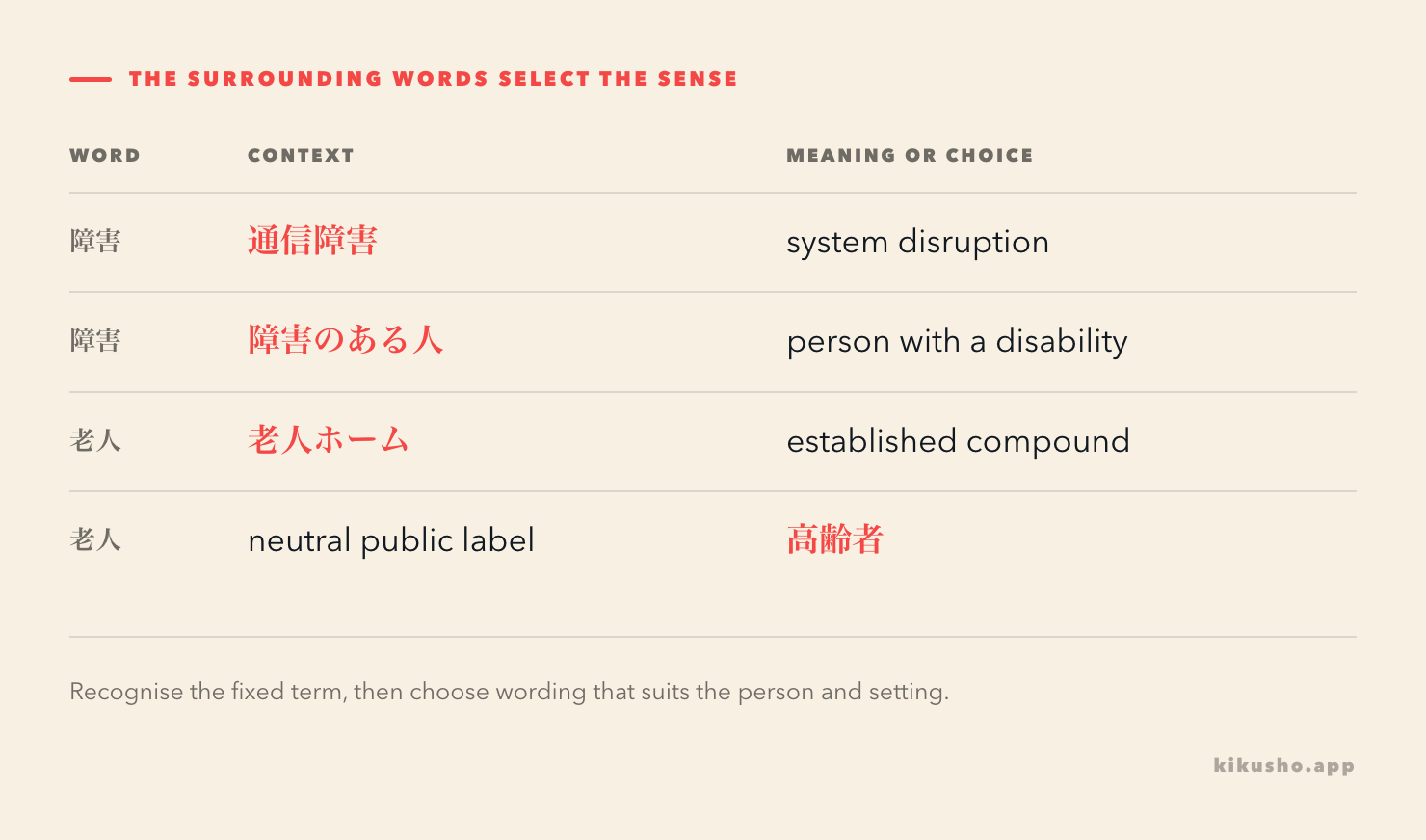
Neither 老人 nor お年寄り is automatically insulting. Tone, relationship and whether the speaker is reducing someone to age all matter. When addressing a particular person, their name or role is usually better than calling them 老人. In a public notice, 高齢者, 高齢の方 or the institution's chosen term will often sound more neutral.
One emergency report uses all nine records
台風のあと、停電による通信障害が起き、山あいの老人福祉施設と連絡が取れなくなりました。救助隊が施設へ向かい、そこにいた人たちを救助しました。けがをした一人は病院で手術を受けました。医師は「早く医療を受けられたので、命を救うことができました」と説明しました。死亡者はいませんでした。市は、人の死につながる危険を減らすには、通信と福祉の連携が必要だと報告しました。
たいふうのあと、ていでんによるつうしんしょうがいがおき、やまあいのろうじんふくししせつとれんらくがとれなくなりました。きゅうじょたいがしせつへむかい、そこにいたひとたちをきゅうじょしました。けがをしたひとりはびょういんでしゅじゅつをうけました。いしは「はやくいりょうをうけられたので、いのちをすくうことができました」とせつめいしました。しぼうしゃはいませんでした。しは、ひとのしにつながるきけんをへらすには、つうしんとふくしのれんけいがひつようだとほうこくしました。
After the typhoon, a power outage caused a communications failure, and contact was lost with a welfare facility for older people in the mountains. A rescue team went to the facility and rescued the people there. One injured person underwent surgery at a hospital. A physician explained, “Because the person was able to receive medical care quickly, we were able to save their life.” There were no deaths. The city reported that coordination between communications and welfare services was necessary to reduce risks that could lead to loss of life.
The passage changes register with purpose. 老人 appears inside the fixed institutional compound 老人福祉施設. 死亡者はいませんでした belongs to a factual report. 人の死 then treats death as the broader outcome that planning aims to prevent.
When you save these words for review, keep the partner with the headword. 手術を受ける, 命を救う and 通信障害が起きる are much easier to retrieve correctly than three English glosses floating by themselves.
Test the distinctions before opening the explanations
1 · 医療 at the clinic. Select the pronunciation of 医療 in 必要な医療を受ける.
A. いりょ B. いりょう C. いし D. いやく
2 · 手術 on a consent form. Select the standard pronunciation of 手術.
A. しゅじつ B. てじゅつ C. しゅじゅつ D. しゅうじゅつ
3 · Orthography. Which spelling represents きゅうじょ, “rescue”?
A. 救所 B. 救助 C. 急助 D. 救う
4 · Context. Complete the patient-centred sentence: 来週、ひざの__を受けます。
A. 医師 B. 死亡 C. 障害 D. 手術
5 · Usage. Which sentence correctly uses 救う as a transitive verb?
A. 救助隊が命を救いました。 B. 救助隊が命に救いました。 C. 救助隊を命が救いました。 D. 救助隊が命を救助でした。
6 · Paraphrase. In 大雪が救助活動の障害になった, what does 障害 mean?
A. a physician B. a surgical procedure C. an obstacle to the activity D. an older person
7 · Context. A news report states the factual result of an accident. Which word best completes 事故で二人が__した?
A. 死亡 B. 死 C. 医療 D. 老人
8 · Usage. Which sentence correctly separates the professional from the care?
A. 医療が患者に説明しました。 B. 患者は医師を受けました。 C. 医師が患者に説明し、患者は医療を受けました。 D. 医師は必要な医療になりました。
9 · Register. Which sentence uses 老人 in an established compound without directly labelling a particular person?
A. あの老人、こっちへ来て。 B. 母は老人ホームで働いています。 C. 田中さんは老人ですか。 D. 老人さんに電話します。
10 · Connected context. Why does the emergency report use both 死 and 死亡者?
A. 死 is the physician, while 死亡者 is medical care. B. 死 reports the number, while 死亡者 names an abstract theme. C. Both words mean surgery and can replace 手術. D. 死 names the broader outcome, while 死亡者 is the factual count category.
Answers and explanations
1 · B, いりょう. 医療 has a long final vowel: い・りょ・う. 医師 is read いし and names the professional rather than the care.
2 · C, しゅじゅつ. 手術 repeats the じゅ sound. しゅじつ and しゅうじゅつ change the mora pattern, while てじゅつ is not the standard reading.
3 · B, 救助. 救助 is read きゅうじょ and is a noun or suru verb. 救う is related in meaning but read すくう.
4 · D, 手術. A patient undergoes surgery with 手術を受ける. 医師 is a person, and neither 死亡 nor 障害 names the procedure.
5 · A. 救う directly takes the saved object with を, so 命を救う means “save a life.” The other choices assign the particles or predicate incorrectly.
6 · C. The snow is preventing the rescue activity from proceeding normally, so 障害 means an obstacle. Nothing in the sentence refers to disability.
7 · A, 死亡. 死亡する reports that a person died and fits factual news language. Standalone 死 is a noun and does not take する in this pattern.
8 · C. 医師 is the professional who explains; 医療 is the care a patient receives. The other sentences exchange a person and a service or use an impossible complement.
9 · B. 老人ホーム is an established institutional compound. The other choices label or address a particular person in ways that can sound blunt or are grammatically unnatural.
10 · D. 人の死 treats death as the wider harmful outcome. 死亡者 is the administrative category used to report that no one died.
Common questions
What is the difference between 医師 and 医療?
医師(いし) is a person: a licensed physician. 医療(いりょう) is medical care as an activity, service or system. An 医師 provides care, while a patient can 医療を受ける, receive medical care.
What is the difference between 救助 and 救う?
救助(きゅうじょ) is a noun and suru verb for a rescue operation or the act of bringing someone out of danger. 救う(すくう) is a transitive godan verb that directly takes the person, life or situation saved as its object.
How are 死 and 死亡 different?
死(し) names death as a state, idea or contrast with life. 死亡(しぼう) reports the factual occurrence of a person's death and is common in news, statistics, forms and official statements.
Is 老人 a rude word in Japanese?
老人(ろうじん) is an established word and remains normal in compounds such as 老人ホーム and 老人福祉. As a direct label for an individual it can sound distant or reductive, so neutral public language often uses 高齢者 and conversation usually follows the person's name, role or preference.