On this page
These five N2 Japanese medical care, emergency and welfare words move from caring for an ill person to public reporting about life and death. The useful distinctions are concrete: 看病 can be family care, 消毒 is not the same technical standard as 滅菌, 寿命 applies to people and objects, 生存 reports continued life, and 葬式 changes its particle with your role.
Five N2 words connect care with life events
| Word | Reading | Word class | Core meaning | Phrase to remember |
|---|---|---|---|---|
| 看病 | かんびょう, kanbyō | noun; transitive suru verb | caring for an ill person | 病気の父を看病する: care for one's ill father |
| 消毒 | しょうどく, shōdoku | noun; transitive suru verb | disinfection | 手を消毒する: disinfect one's hands |
| 寿命 | じゅみょう, jumyō | noun | lifespan; usable life | 電池の寿命が延びる: the battery life becomes longer |
| 生存 | せいぞん, seizon | noun; suru verb | survival; being alive | 生存を確認する: confirm that someone is alive |
| 葬式 | そうしき, sōshiki | noun | funeral; funeral ceremony | 葬式に参列する: attend a funeral |
Watch the long vowels in 看病(かんびょう), 消毒(しょうどく) and 葬式(そうしき). 寿命 has a different reading trap: it is じゅみょう, not じゅうめい. 生存 is normally せいぞん in modern standard usage.
Independent N2 study lists place these words at N2, including 看病 on Bunpro and 消毒 and 寿命 in the MLC vocabulary list. These are study estimates rather than an official syllabus: the JLPT organisers explain that they no longer publish an exhaustive vocabulary and grammar specification.
The N2 illness, symptoms and recovery lesson covers words such as 痛み, 重症 and 治す. This page starts where that lesson leaves off: who provides care, how hygiene is described, and how formal language records survival and death.
看病 is personal care for someone who is ill
看病(かんびょう) means looking after an ill or injured person. The person receiving care takes を, and the carer is the subject.
母が熱を出したので、週末は家で看病しました。
ははがねつをだしたので、しゅうまつはいえでかんびょうしました。
My mother developed a fever, so I cared for her at home over the weekend.
When you receive the help, 看病してもらう keeps the carer marked by に.
入院中、姉に看病してもらいました。
にゅういんちゅう、あねにかんびょうしてもらいました。
While I was in hospital, my older sister cared for me.
The 看病 dictionary entry centres on attending to a sick person. It does not by itself say that the carer holds a medical licence. 看護(かんご) has a broader nursing sense and often points to organised or professional care, especially in 看護師. 介護(かいご) focuses on support with daily life for someone who needs assistance and is not limited to illness.
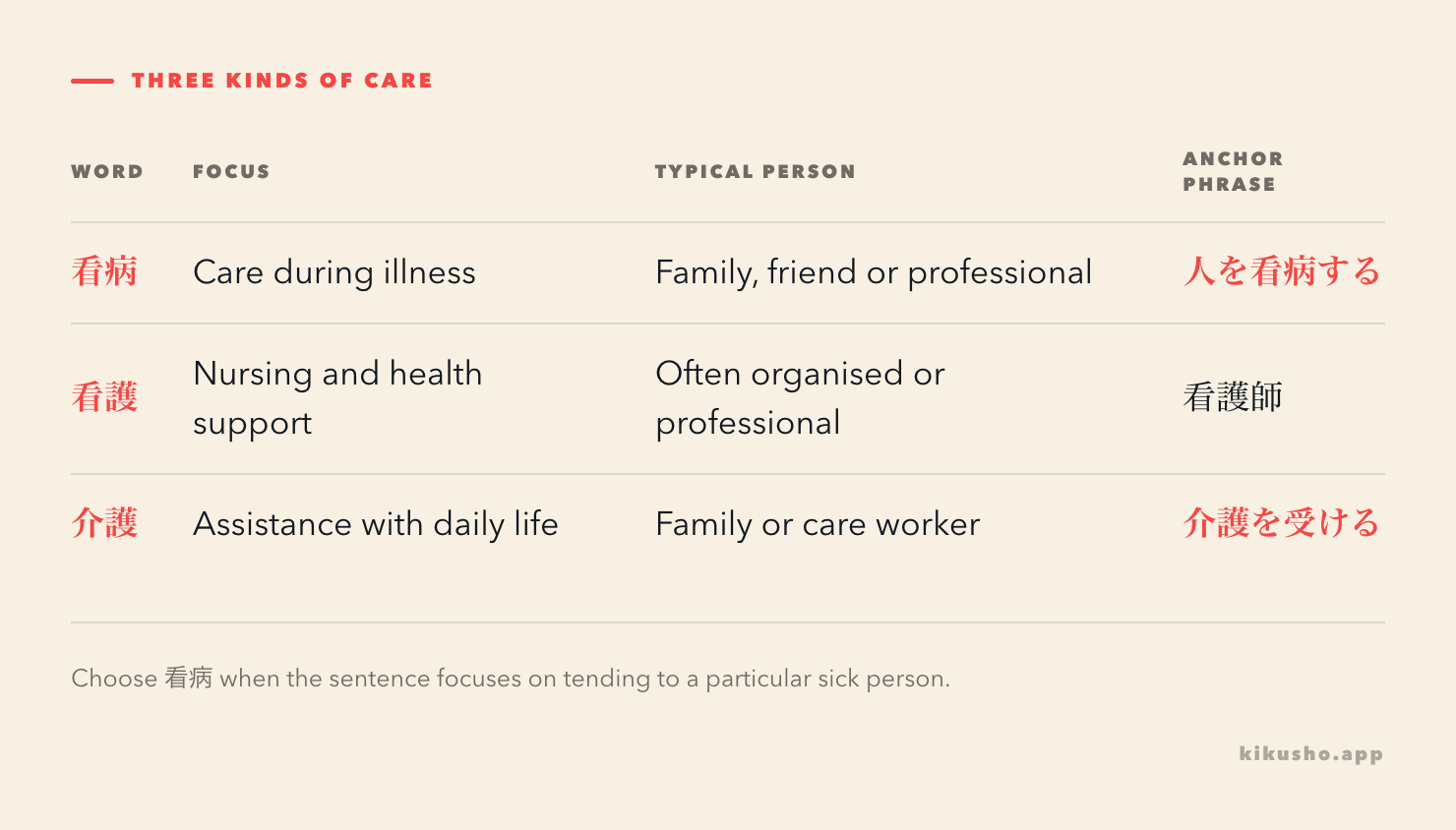
The contrast is about focus, not a wall between professions. A nurse can 看病する, and a family member can participate in 看護. The safer learning rule is to choose 看病 when the sentence highlights staying with and tending to a particular sick person.
The N1 medical care, emergencies and welfare lesson continues this comparison with 介護, 看護 and 診療, then connects care to 応急 response, 福祉 services, 保険 and 救済.
消毒 reduces infection risk; 滅菌 is the stricter technical standard
消毒(しょうどく) is disinfection. It combines naturally with body parts, wounds, tools, surfaces and liquids:
- 手を消毒する: disinfect one's hands
- 傷口を消毒する: disinfect a wound
- 器具を消毒する: disinfect equipment
- 消毒液: disinfectant solution
受付の前で手を消毒してから、診察室に入りました。
うけつけのまえでてをしょうどくしてから、しんさつしつにはいりました。
I disinfected my hands in front of reception before entering the examination room.
The Ministry of Health, Labour and Welfare's infection-control guidance distinguishes the technical terms. 消毒 removes or inactivates pathogenic microorganisms to a level at which infection should not occur; 滅菌(めっきん) means eliminating all viable microorganisms. A source gloss that gives both “disinfection” and “sterilisation” for 消毒 is therefore too broad for precise technical use.
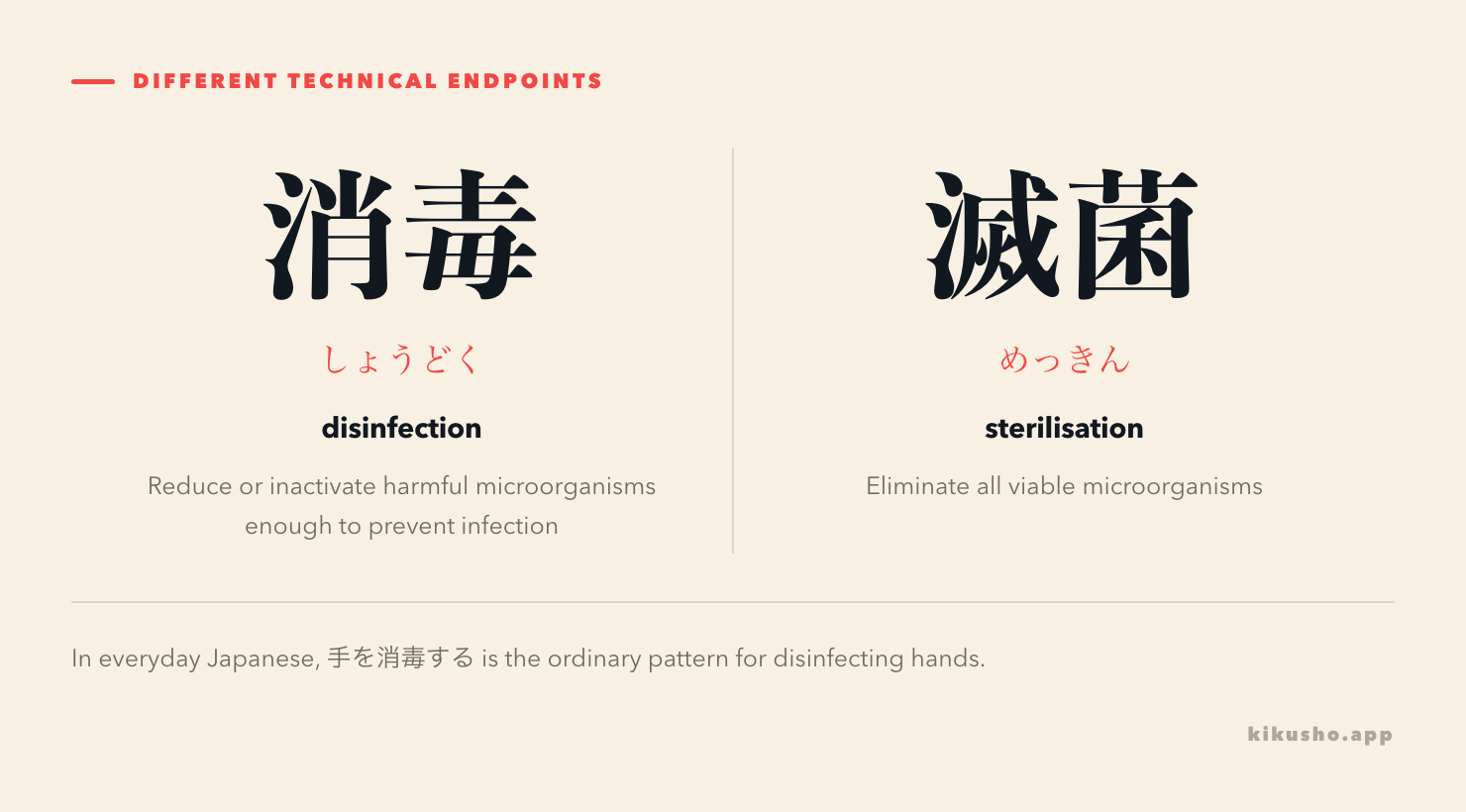
In ordinary conversation, you do not need to diagnose which procedure a facility uses. The language point is that 消毒する is the everyday verb for disinfecting, while a technical document may require 滅菌 when complete sterilisation is intended.
寿命 measures a life or an object's useful service
寿命(じゅみょう) is the length of time a living being lives. It appears with verbs of extension, limitation and completion:
| Pattern | Meaning |
|---|---|
| 寿命が延びる | lifespan becomes longer |
| 寿命を延ばす | extend a lifespan or service life |
| 寿命が尽きる | reach the end of one's life or useful life |
| 平均寿命 | average life expectancy at birth |
医療の進歩によって、平均寿命は大きく延びました。
いりょうのしんぽによって、へいきんじゅみょうはおおきくのびました。
Advances in medical care greatly increased average life expectancy.
The same noun works for things that wear out. The 寿命 dictionary entry includes both a living being's span of life and the period for which an object can fulfil its function.
画面を暗くすると、電池の寿命を延ばせます。
がめんをくらくすると、でんちのじゅみょうをのばせます。
Dimming the screen can extend the battery's life.
Do not automatically translate 平均寿命 as the average age at death in a particular year's death records. The Ministry of Health, Labour and Welfare defines it as life expectancy at age zero, calculated from a life table.
生存 reports the state of remaining alive
生存(せいぞん) is a formal noun and suru verb for being alive, continuing to exist or surviving. It is common in emergency reports, science and statistics because it treats survival as a state that can be confirmed or measured.
救助隊は、行方不明者の生存を確認しました。
きゅうじょたいは、ゆくえふめいしゃのせいぞんをかくにんしました。
The rescue team confirmed that the missing person was alive.
Useful compounds keep that reporting tone:
- 生存者: survivor; living person
- 生存確認: confirmation that someone is alive
- 生存率: survival rate
- 生存している: be alive; survive
The dictionary definition of 生存 describes continuing to possess life. 生き残る(いきのこる) is more dynamic: it foregrounds making it through an accident, disaster, competition or difficult period.
乗客全員の生存が確認されました。
じょうきゃくぜんいんのせいぞんがかくにんされました。
It was confirmed that all the passengers were alive.
彼は事故から生き残りました。
かれはじこからいきのこりました。
He survived the accident.
The first sentence records a status. The second tells a person's movement through a dangerous event.
葬式 takes に for an attendee and を for an organiser
葬式(そうしき) is a funeral or the set of funeral rites. The dictionary entry treats it as the ceremony for the deceased and notes that practices vary across time and region. Learn the participant's role through the particle:
| Role | Pattern | Meaning |
|---|---|---|
| attendee | 葬式に参列する | attend a funeral, formal |
| attendee | 葬式に出る | go to or attend a funeral, conversational |
| family or organiser | 葬式を行う | hold a funeral |
| bereaved family | 葬式を出す | arrange or hold a funeral |
明日は親戚の葬式に参列します。
あしたはしんせきのそうしきにさんれつします。
Tomorrow I will attend a relative's funeral.
葬儀(そうぎ) is a more formal word common in notices, service names and official explanations. お葬式 is common and considerate in conversation. These register choices do not define one universal ceremony: funeral customs differ by family, religion and region.
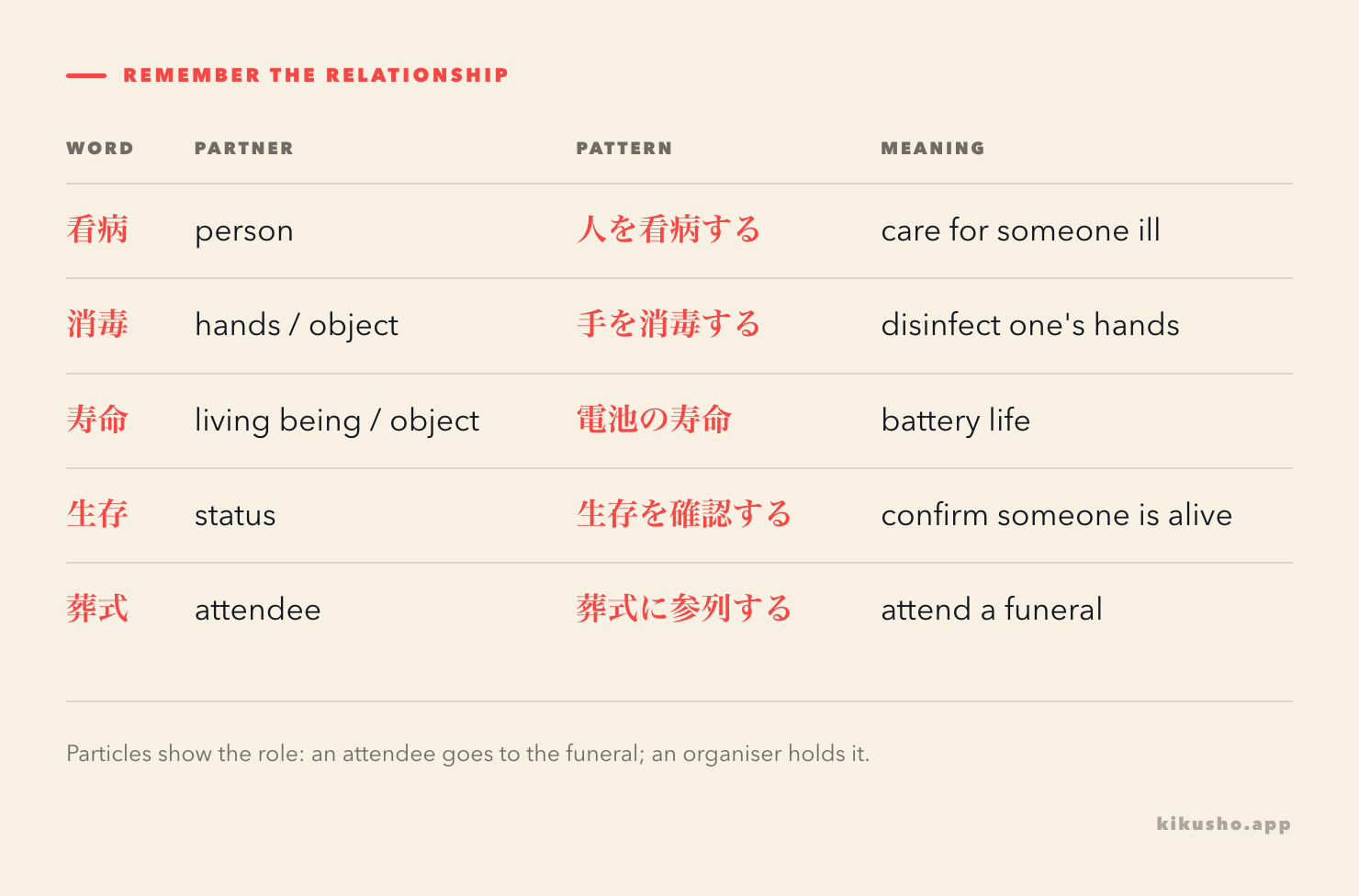
The N3 medical care and welfare lesson separates 医師 from 医療 and 死 from factual 死亡. 葬式 continues that register path: it names the ceremony after a death, while 生存 belongs to the reporting language used when a person's condition is still being established.
One family update uses all five words without forcing them together
祖父が入院したとき、父は祖父を看病するため、毎日病院へ通いました。病室に入る前には手を消毒しました。医師は治療について説明し、「高齢でも回復する力はあります」と話しました。祖父は退院後、「この時計も私も、寿命が尽きるのはまだ先だ」と笑っていました。数年後、祖父が亡くなり、家族で葬式を行いました。災害のニュースで生存者という言葉を聞くたび、父は、一人の生存が家族全体にとってどれほど大きな意味を持つかを思い出すそうです。
そふがにゅういんしたとき、ちちはそふをかんびょうするため、まいにちびょういんへかよいました。びょうしつにはいるまえにはてをしょうどくしました。いしはちりょうについてせつめいし、「こうれいでもかいふくするちからはあります」とはなしました。そふはたいいんご、「このとけいもわたしも、じゅみょうがつきるのはまださきだ」とわらっていました。すうねんご、そふがなくなり、かぞくでそうしきをおこないました。さいがいのニュースでせいぞんしゃということばをきくたび、ちちは、ひとりのせいぞんがかぞくぜんたいにとってどれほどおおきないみをもつかをおもいだすそうです。
When my grandfather was admitted to hospital, my father went there every day to care for him. He disinfected his hands before entering the room. The physician explained the treatment and said, “Even at an advanced age, he still has the strength to recover.” After leaving hospital, my grandfather laughed and said, “Neither this watch nor I am near the end of our life yet.” Several years later, he died, and the family held a funeral. My father says that whenever he hears the word survivor in disaster news, he remembers how much one person's survival means to an entire family.
The passage uses each noun with a different frame. 看病 describes sustained personal care, 消毒 a concrete hygiene action, 寿命 a bounded period for a person and a watch, 葬式 a ceremony organised by the family, and 生存 a formal status whose emotional weight comes from the surrounding context.
Save the partner with the word when you review it. 人を看病する, 手を消毒する, 電池の寿命, 生存を確認する and 葬式に参列する are more retrievable than five English glosses on their own.
Test the words before opening the explanations
1 · Kanji reading. What is the standard reading of 看病 in 母を看病する?
A. かんびょう
B. かんぴょう
C. けんびょう
D. かんびょ
2 · Orthography. Which spelling represents しょうどく, “disinfection”?
A. 消読
B. 小毒
C. 消毒
D. 消独
3 · Word formation. Which compound means “disinfectant solution”?
A. 消毒者
B. 消毒液
C. 消毒命
D. 消毒式
4 · Context. Complete the sentence: 妹がインフルエンザにかかったので、家で__しました。
A. 生存
B. 葬式
C. 看病
D. 寿命
5 · Usage. Which sentence uses 寿命 naturally for an object?
A. この電池は寿命が長いです。
B. この電池を寿命しました。
C. この電池に寿命を参列します。
D. この電池が寿命を看病します。
6 · Paraphrase. What does 全員の生存が確認された mean?
A. Everyone attended the funeral.
B. It was confirmed that everyone was alive.
C. Everyone's hands were disinfected.
D. Everyone provided nursing care.
7 · Usage. You are attending a colleague's funeral. Which sentence best states your role?
A. 同僚の葬式を生存します。
B. 同僚の葬式を看病します。
C. 同僚の葬式に参列します。
D. 同僚の葬式が消毒します。
8 · Context. A technical manual requires the elimination of all viable microorganisms. Which word is more precise than 消毒?
A. 看病
B. 滅菌
C. 寿命
D. 生存
9 · Paraphrase. Which sentence best paraphrases 姉に看病してもらった?
A. My older sister cared for me while I was ill.
B. I attended my older sister's funeral.
C. I confirmed that my older sister was alive.
D. My older sister extended the battery life.
10 · Connected context. Choose the only sequence that fits all three blanks: 救助隊は男性の__を確認した。家族は病院で男性を__し、入室前に手を__した。
A. 葬式・寿命・生存
B. 生存・看病・消毒
C. 寿命・消毒・看病
D. 看病・生存・葬式
Answers and explanations
1 · A, かんびょう. 看病 has the long final vowel びょう. かんぴょう is a different word, 干瓢, dried gourd strips.
2 · C, 消毒. 消毒 is read しょうどく. Each distractor preserves part of the sound while changing the established spelling.
3 · B, 消毒液. 液 means liquid or solution, so 消毒液 is a disinfectant solution. The other endings do not form the required compound.
4 · C, 看病. Influenza creates the context of caring for a particular sick person, so 看病する fits. The other nouns describe survival, a funeral or a lifespan.
5 · A. 寿命 can describe an object's usable life, and 寿命が長い means that life is long. 寿命 is not used as a transitive action in the other patterns.
6 · B. 生存 is the state of remaining alive, and 生存が確認された means that this state was confirmed. It says nothing by itself about care, hygiene or a funeral.
7 · C. An attendee goes to the ceremony, so 葬式に参列する states the role precisely. A family or organiser would use 葬式を行う or 葬式を出す.
8 · B, 滅菌. 消毒 controls pathogenic microorganisms enough to prevent infection. 滅菌 is the stricter technical term when the required endpoint is the elimination of all viable microorganisms.
9 · A. The てもらう pattern presents the action as help received by the speaker: the older sister provided the care. The other answers switch to unrelated target words.
10 · B, 生存・看病・消毒. A rescue team confirms survival with 生存を確認する. The family cares for the man with 男性を看病する, then disinfects its hands with 手を消毒する.
Common questions
What is the difference between 看病 and 看護?
看病(かんびょう) is caring for someone who is ill and can describe help from family or friends. 看護(かんご) has a wider nursing sense and often foregrounds organised or professional care, as in 看護師.
Does 消毒 mean sterilisation?
消毒(しょうどく) means disinfection: reducing or inactivating harmful microorganisms enough to prevent infection. 滅菌(めっきん) is the stricter technical word for eliminating all viable microorganisms.
Can 寿命 be used for machines and batteries?
Yes. 寿命(じゅみょう) can mean the lifespan of a person or animal and the usable life of an object. 電池の寿命 and 機械の寿命 are ordinary patterns.
How do you say attend a funeral in Japanese?
葬式に参列する is formal and 葬式に出る is common in conversation. The family or organiser can 葬式を行う or 葬式を出す, so the particle changes with the person's role.