On this page
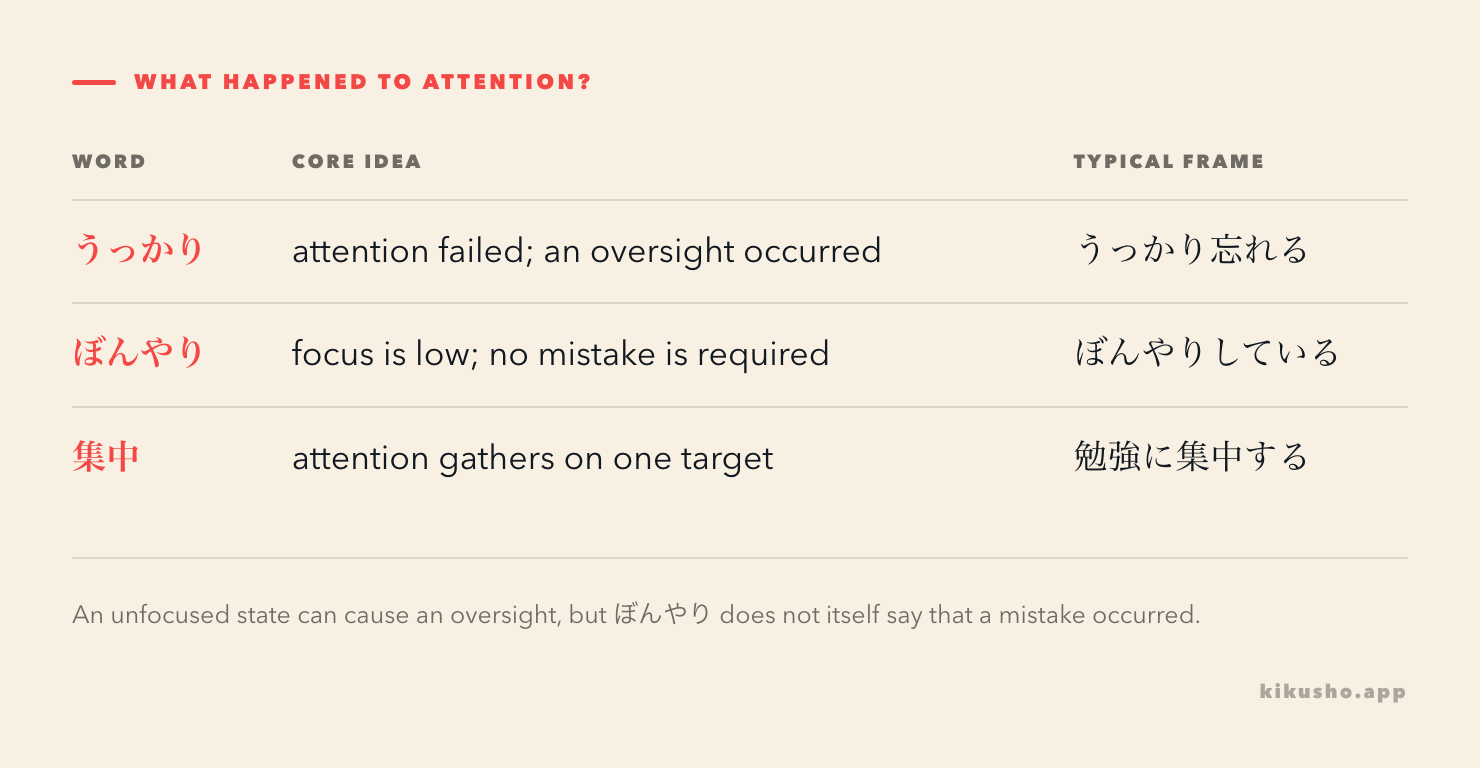
If you forget a key through inattention, you うっかり leave it behind. If your mind is unfocused, you are ぼんやりしている. The first word explains an oversight; the second describes a state.
This N3 set follows that distinction through sixteen words. It separates stored 知識 from applied 知恵, an idea that you 思い付く from a remembered 思い出, and a broad 予想 from an event you did not 予期.
Sixteen words map different mental jobs
| Word | Reading | Class | Core role | Combination to keep |
|---|---|---|---|---|
| うっかり | うっかり | adverb + する | carelessly; inadvertently | うっかり忘れる |
| 思い付く | おもいつく | godan verb | think of; hit upon | 方法を思い付く |
| 思い出 | おもいで | noun | memory; recollection | 旅の思い出 |
| 賢い | かしこい | い-adjective | smart; wise | 賢い選択 |
| 集中 | しゅうちゅう | noun + する | concentration; focus | 勉強に集中する |
| 常識 | じょうしき | noun | common knowledge and judgment | 常識で考える |
| 想像 | そうぞう | noun + する | imagine what is unseen | 生活を想像する |
| 知恵 | ちえ | noun | practical wisdom or ingenuity | 知恵を絞る |
| 知識 | ちしき | noun | acquired knowledge | 知識を身につける |
| 知能 | ちのう | noun | intellectual capacity | 高い知能 |
| ぼんやり | ぼんやり | adverb + する | unfocused; vague or dim | ぼんやりしている |
| 予期 | よき | noun + する | expect in advance | 予期せぬ出来事 |
| 予想 | よそう | noun + する | forecast or estimate | 結果を予想する |
| 利口 | りこう | noun / な-adjective | clever; well-behaved | 利口な子/お利口だ |
| 連想 | れんそう | noun + する | association of ideas | 海から夏を連想する |
| 分かれる | わかれる | ichidan verb | split, branch or divide | 意見が分かれる |
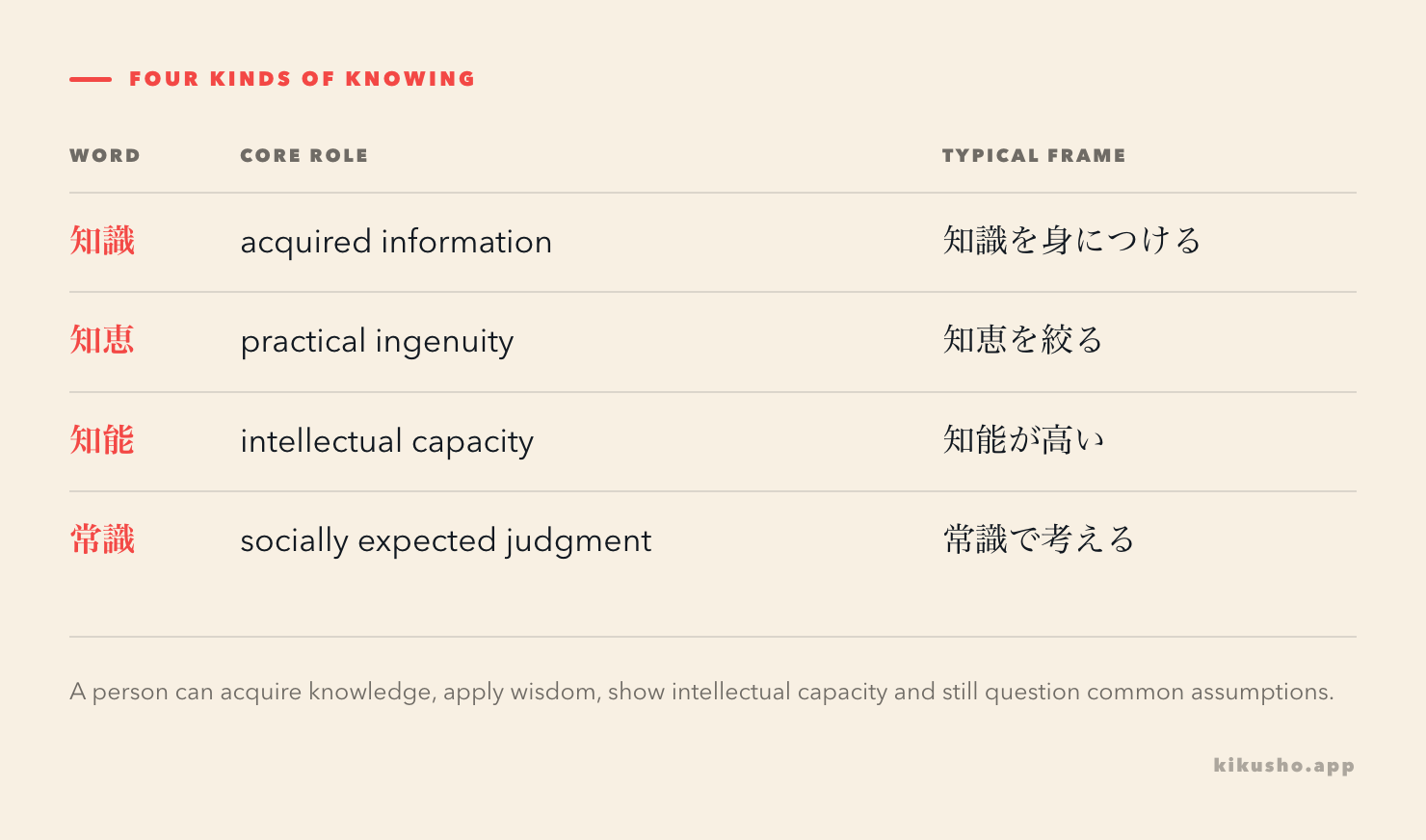
The English glosses overlap, but the combinations do not. A learner can possess 知識, use 知恵, show 知能, and still challenge what a group treats as 常識.
うっかり causes an oversight; ぼんやり is a state
うっかり presents insufficient attention as the cause of an unintended action or omission.
うっかり電車に傘を忘れてしまった。
うっかり でんしゃに かさを わすれてしまった。
I carelessly left my umbrella on the train.
Shogakukan defines the central modern use as acting without sufficient attention and gives examples with revealing a secret and forgetting to lock a door. The word often modifies the mistake directly: うっかり間違える, うっかり話す, うっかり忘れる.
The N3 comparison of ふと, つい and うっかり separates a careless oversight from a spontaneous thought and an impulse that overcomes restraint.
ぼんやり can describe an unfocused person, an unclear memory, or a dim visual outline.
寝不足で、授業中ずっとぼんやりしていた。
ねぶそくで、じゅぎょうちゅう ずっと ぼんやりしていた。
I was sleep-deprived and unfocused throughout class.
霧の向こうに建物がぼんやり見える。
きりの むこうに たてものが ぼんやり みえる。
A building is faintly visible beyond the fog.
The dictionary entry for ぼんやり records both lack of mental focus and visual or conceptual vagueness. A person can be ぼんやりしている without making a mistake. Once that state causes an oversight, うっかり can describe the resulting act.
集中(しゅうちゅう) moves in the opposite direction: attention or resources gather on one target.
音楽を止めて、レポートを書くことに集中した。
おんがくを とめて、レポートを かく ことに しゅうちゅうした。
I stopped the music and concentrated on writing the report.
The target commonly takes に. 精神を集中する and 注意を集中する treat mental energy or attention as the thing being gathered. Shogakukan also records nonmental uses such as questions gathering on one person, so 集中 does not always mean studying.
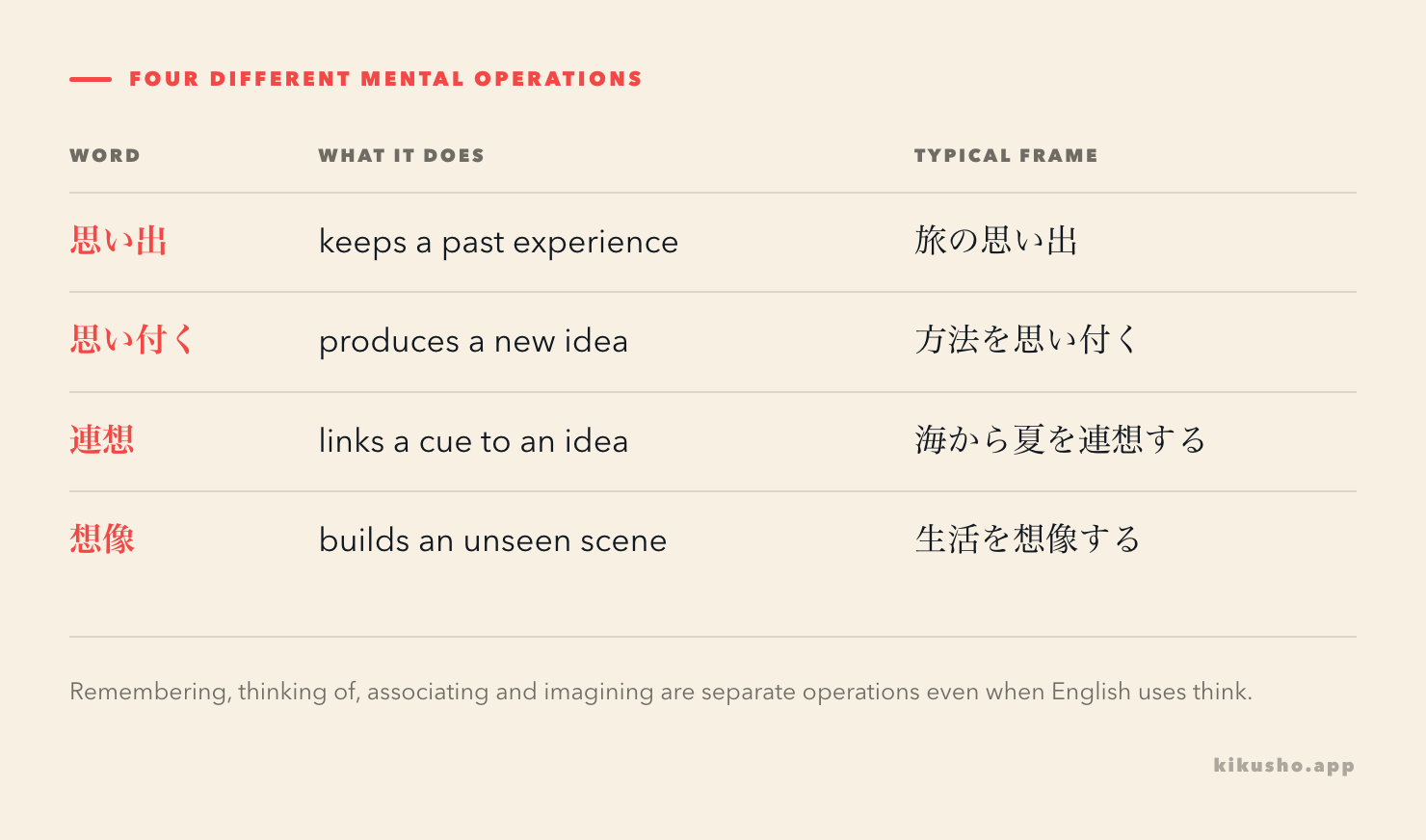
思い出 is retained; 思い付く arrives
思い出(おもいで) is a noun for a recollection or something kept as a reminder.
この写真は留学中の大切な思い出だ。
この しゃしんは りゅうがくちゅうの たいせつな おもいでだ。
This photograph is a precious memory from my time studying abroad.
Shogakukan also records 旅の思い出に写真を撮る, where an object is made as a keepsake. Do not confuse the noun with 思い出す, “recall,” or 思い付く, “think of.”
帰り道で、問題を解く新しい方法を思い付いた。
かえりみちで、もんだいを とく あたらしい ほうほうを おもいついた。
On the way home, I thought of a new way to solve the problem.
思い付く(おもいつく) often takes the idea with を: 名案を思い付く, 解決策を思い付く. It presents the idea as entering awareness, rather than returning from a past experience. Cambridge's Japanese dictionary summarizes it as 考えが浮かぶ, an idea coming to mind.
想像(そうぞう) constructs an image or supposition about something not presently experienced. 連想(れんそう) links one idea to another.
写真を見て、百年前の町の生活を想像した。
しゃしんを みて、ひゃくねんまえの まちの せいかつを そうぞうした。
Looking at the photograph, I imagined life in the town a century ago.
この香りから、祖母の台所を連想した。
この かおりから、そぼの だいどころを れんそうした。
This smell made me associate it with my grandmother's kitchen.
Shogakukan defines 想像 as mentally picturing something not directly experienced or not real. In AからBを連想する, A is the cue and B is the associated idea. 思い付く produces an idea; 想像 develops an unseen scene; 連想 connects one mental item to another.
知識, 知恵, 知能 and 常識 are not one kind of knowing
知識(ちしき) is information acquired about a subject. Learn 知識を得る, 知識を身につける and Nについての知識.
防災についての知識を身につける必要がある。
ぼうさいについての ちしきを みにつける ひつようが ある。
We need to acquire knowledge about disaster preparedness.
知恵(ちえ) is practical judgment, ingenuity or advice that makes knowledge useful.
予算が少ないので、みんなで知恵を絞った。
よさんが すくないので、みんなで ちえを しぼった。
Because the budget was small, everyone racked their brains for ideas.
知能(ちのう) names the broader capacity to understand, reason and handle problems. It appears in 知能が高い, 知能検査 and 人工知能. Kotobank's encyclopedia entry notes that the exact scholarly definition varies, but reasoning, adaptation and the use of acquired knowledge are central.
常識(じょうしき) is knowledge and judgment treated as ordinary or socially expected.
国や世代が変われば、常識も変わることがある。
くにや せだいが かわれば、じょうしきも かわる ことが ある。
Common assumptions can change when the country or generation changes.
Shogakukan defines it as ordinary knowledge, opinions and judgment generally shared or expected in society. 常識がない is therefore a criticism of social judgment, not merely a claim that someone lacks facts.
賢い(かしこい) is an い-adjective for a smart person, a wise action or an effective choice: 賢い学生, 賢い選択. 利口(りこう) is a noun and な-adjective for cleverness, but お利口 is especially common for a well-behaved child or pet.
その子は店の中でも静かで、お利口だった。
その こは みせの なかでも しずかで、おりこうだった。
The child stayed quiet even inside the shop and was very well behaved.
Shogakukan's 賢い entry includes sharp intelligence and effective conduct. Its 利口 entry includes intelligence, shrewd conduct and the お利口 use for obedient children. Calling an adult お利口 can sound patronising because it evaluates them like a child.
予想 forecasts; 予期 prepares for what may arrive
予想(よそう) is the broad word for estimating a future course or result.
試合の結果を予想したが、外れた。
しあいの けっかを よそうしたが、はずれた。
I predicted the result of the match, but I was wrong.
Useful combinations include 予想が当たる/外れる, 予想以上 and 混雑が予想される. 予期(よき) emphasizes expecting or being mentally prepared for something in advance.
予期せぬ質問をされて、すぐに答えられなかった。
よきせぬ しつもんを されて、すぐに こたえられなかった。
I was asked an unexpected question and could not answer immediately.
Shogakukan's usage comparison explains that 予想 has the wider range and can name the forecast itself, while 予期 puts weight on prior expectation or readiness. This produces the fixed-looking patterns 予期せぬ出来事 and 予期に反して.
分かれる(わかれる) describes one thing splitting into parts or paths.
この先で道が二つに分かれる。
この さきで みちが ふたつに わかれる。
The road splits in two ahead.
It also works abstractly: 意見が分かれる, opinions are divided; 三つのグループに分かれる, split into three groups. Shogakukan records physical branching, classification and differences of opinion. Use 別れる for people parting or ending a relationship.
Follow the words through one planning meeting
地域の防災計画を考える会議で、私は最初ぼんやりしていて、うっかり資料を一枚読み飛ばした。そこで議論に集中すると、昔の洪水の思い出から新しい避難方法を連想し、別の案も思い付いた。専門家の知識と住民の知恵を合わせれば、予期せぬ事態にも対応できると想像した。ただし、何を常識と考えるかで意見が分かれ、被害の予想も一致しなかった。賢い計画には知能だけでなく、地域を知ることが必要だ。子どもたちは長い会議の間もお利口に待っていた。
ちいきの ぼうさいけいかくを かんがえる かいぎで、わたしは さいしょ ぼんやりしていて、うっかり しりょうを いちまい よみとばした。そこで ぎろんに しゅうちゅうすると、むかしの こうずいの おもいでから あたらしい ひなんほうほうを れんそうし、べつの あんも おもいついた。せんもんかの ちしきと じゅうみんの ちえを あわせれば、よきせぬ じたいにも たいおうできると そうぞうした。ただし、なにを じょうしきと かんがえるかで いけんが わかれ、ひがいの よそうも いっちしなかった。かしこい けいかくには ちのうだけでなく、ちいきを しる ことが ひつようだ。こどもたちは ながい かいぎの あいだも おりこうに まっていた。
At a meeting about the area's disaster plan, I was unfocused at first and carelessly skipped one page of the materials. Once I concentrated on the discussion, memories of an earlier flood suggested a new evacuation method, and I thought of another proposal too. I imagined that combining the experts' knowledge with residents' practical wisdom would let us handle unexpected situations. However, opinions differed over what counted as common sense, and the damage forecasts did not agree. A wise plan requires knowledge of the area, not intellectual ability alone. The children waited patiently through the long meeting.
How firm is the N3 label?
Kikusho's September 2026 inventory places these sixteen spelling-and-reading records in its N3 sequence. The records for うっかり, 思い付く and 分かれる also appear at N2 in Waller-derived snapshots; 予想 appears at N1 in one snapshot. Because those snapshots share one lineage, the differences show unstable study-list boundaries rather than independent consensus.
Current independent N3 resources include many of the headwords, while dictionaries verify their readings and uses. The official JLPT FAQ says that the revised test does not publish an exhaustive vocabulary list. Treat N3 as a useful study position for this lesson, not an official word-by-word guarantee.
The N1 continuation on judgment, perception and intuition moves from these concrete operations to 愚か, 錯覚, 知性 and 予感, including the boundary between a forecast and a felt premonition.
In Kikusho, preserve the contrast inside the example. Save ぼんやりして、うっかり読み飛ばした or 知識を得て、知恵を絞る. The paired actions make the English overlap reconstructable at review time.
Practice: choose the mental operation
Answer all ten questions before opening the explanation panel.
1 · Read 知恵. Which kana form matches the bold word?
- イ. ちえ
- ロ. ちしき
- ハ. ちのう
- ニ. じょうしき
2 · Find しゅうちゅう. Which written word has this reading?
- イ. 集合
- ロ. 集中
- ハ. 集計
- ニ. 集団
3 · Oversight or state. Fill both blanks in order.
寝不足で( 前 )していたので、( 後 )違う駅で降りた。
- イ. 前:うっかり / 後:ぼんやり
- ロ. 前:集中 / 後:常識で
- ハ. 前:ぼんやり / 後:うっかり
- ニ. 前:予想 / 後:連想して
4 · Memory or idea. Which sentence says that a solution came to mind?
- イ. 解決策を思い付いた。
- ロ. 解決策は大切な思い出だ。
- ハ. 解決策にぼんやりした。
- ニ. 解決策が常識を分かれた。
5 · Knowledge in use. Which pair best completes the sentence?
本で( 前 )を得て、現場では( 後 )を絞った。
- イ. 前:知能 / 後:常識
- ロ. 前:知識 / 後:知恵
- ハ. 前:知恵 / 後:知能
- ニ. 前:常識 / 後:思い出
6 · Smart or well-behaved. A child waits quietly while adults speak. Which description most directly praises that behaviour?
- イ. お利口だ
- ロ. 予想以上だ
- ハ. 知能だ
- ニ. 賢くをする
7 · Imagine or associate. Fill both blanks in order.
香りから海を( 前 )し、海辺で暮らす自分を( 後 )した。
- イ. 前:想像 / 後:連想
- ロ. 前:連想 / 後:想像
- ハ. 前:集中 / 後:予期
- ニ. 前:分かれ / 後:思い出
8 · Prediction or expectation. Which phrase most naturally means “an unexpected event”?
- イ. 予想が当たる出来事
- ロ. 予期せぬ出来事
- ハ. 想像を分かれる出来事
- ニ. 常識に集中する出来事
9 · Branching. Which spelling and particle correctly complete the sentence?
この先で道が二つ( )。
- イ. に分かれる
- ロ. を別れる
- ハ. が分ける
- ニ. で思い付く
10 · Read the logic. What does the sentence mean?
知識は豊富だが、その知識を生かす知恵が足りない。
- イ. The person has information but lacks practical judgment for applying it.
- ロ. The person has no information and refuses to learn.
- ハ. The person's predictions are always correct.
- ニ. The person is unfocused because of lack of sleep.
Answers and explanations for the ten questions
イ, ちえ. 知識 is ちしき, 知能 is ちのう, and 常識 is じょうしき. The shared 知 does not give the four compounds the same reading.
ロ, 集中. 集中 means concentration or gathering on one point. The other compounds are real words with different readings and meanings.
ハ, ぼんやり / うっかり. Lack of sleep creates an unfocused state. Getting off at the wrong station is the resulting oversight caused by insufficient attention.
イ. 解決策を思い付いた says that a solution came to mind. 思い出 is a noun for a recollection, not the act of producing a new solution.
ロ, 知識 / 知恵. Books provide acquired information, while 知恵を絞る describes applying ingenuity to a concrete problem.
イ, お利口だ. お利口 is especially common when praising a child's or pet's obedient, well-behaved conduct. 知能 names intellectual capacity, not a predicate for this behaviour.
ロ, 連想 / 想像. The smell serves as a cue that evokes the sea, so 連想 fits first. The person then constructs an unseen scene of living there, so 想像 fits second.
ロ, 予期せぬ出来事. This fixed and productive pattern presents an event as not expected or prepared for in advance. 予想が当たる instead says a forecast proved correct.
イ, に分かれる. The destination state has two branches and takes に. 別れる is used for people parting, while transitive 分ける would require an agent or object.
イ. The contrast explicitly grants extensive 知識, acquired information, but says the person lacks 知恵, the practical judgment needed to use it.
Common questions
What is the difference between うっかり and ぼんやり?
うっかり connects insufficient attention to an oversight or unintended action. ぼんやり describes an unfocused person or something visually or mentally vague; it does not itself claim that a mistake occurred.
What is the difference between 知識, 知恵 and 知能?
知識 is information or knowledge acquired about a subject. 知恵 is practical judgment or ingenuity used to solve a problem. 知能 is the broader mental capacity to understand, reason and adapt.
What is the difference between 予想 and 予期?
予想 is a broad forecast or estimate about a course or result and can be right or wrong. 予期 emphasizes expecting or being prepared for something in advance, especially in 予期せぬ and 予期に反して.
How does 思い付く differ from 思い出?
思い付く is a verb used when an idea or solution comes to mind. 思い出 is a noun for a recollection or something preserved as a memory. The verb for recalling a past event is 思い出す.