On this page
A Japanese report may label its conclusion 仮, state an 原則, and still warn that 偏見 distorted the evidence. This N1 set gives six different jobs to the words around that argument: provisional status, a governing principle, persuasion, recognition, a firm grasp of information, and prejudice.
The six words mark different stages in an argument
The set belongs together because each word answers a separate reading question. Is the claim final? Which rule guides the decision? Does the writer merely recognise a problem or grasp its details? Who is trying to change whose judgment? Is the evaluation already tilted by prejudice?
| Word and reading | Class | Sense taught here | Combination to keep |
|---|---|---|---|
| 仮(かり) | Noun; modifies with の | Something temporary, provisional or assumed | 仮の結論; 仮の名称 |
| 原則(げんそく) | Noun | Principle; general rule | 原則に従う; 原則として |
| 説得(せっとく) | Noun / する | Persuasion; getting someone to accept a view or action | 相手を説得する; 説得力がある |
| 認識(にんしき) | Noun / する | Recognition or understanding of a fact, nature or significance | 問題を認識する; 認識を改める |
| 把握(はあく) | Noun / する | Firm grasp of a situation, detail or whole | 状況を把握する; 全体像を把握する |
| 偏見(へんけん) | Noun | Prejudice; a fixed, biased view lacking an adequate factual basis | 偏見を持つ; 偏見にとらわれる |
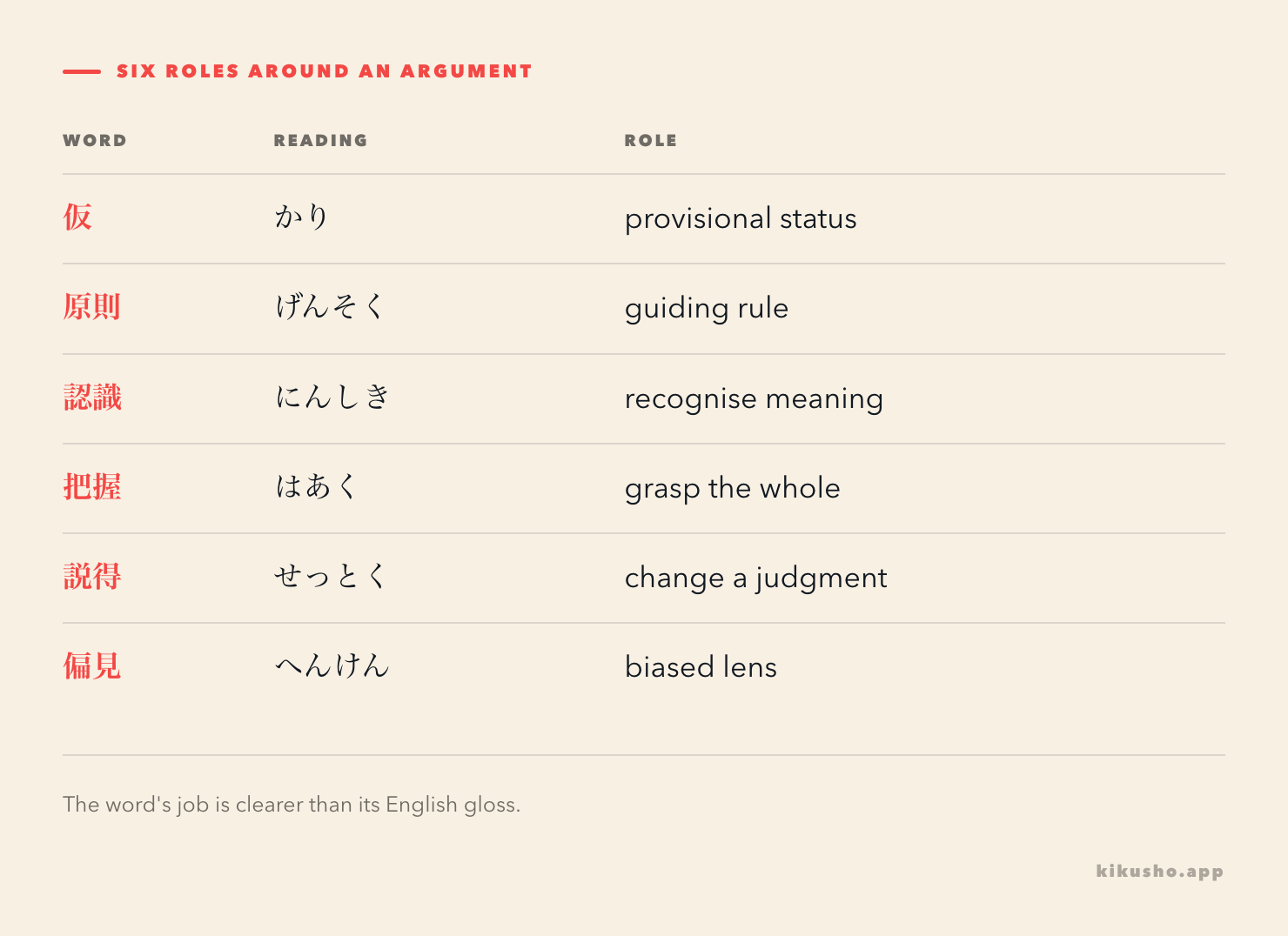
These are the exact six records assigned to this lesson. The first row corrects a source-reading problem: the free word is 仮(かり), not 仮(か) in this sense. The rest are Sino-Japanese compounds with the readings shown in the table.
仮 is かり by itself and カ inside compounds
As a noun, 仮(かり) marks something that is not yet final, permanent or fully established. It commonly modifies another noun with の.
調査が終わるまで、これは仮の結論として扱う。
ちょうさが おわるまで、これは かりの けつろんとして あつかう。
Until the investigation is complete, we will treat this as a provisional conclusion.
仮に can mean “temporarily” or can introduce a supposition, depending on the sentence. In 仮にこの説明が正しいとしても, it sets up a hypothetical concession: “Even if we suppose this explanation is correct.”
The on-reading カ belongs inside compounds such as 仮定(かてい), 仮説(かせつ) and 仮称(かしょう). Reading a compound is not evidence that the single character is pronounced the same way as a standalone noun. The dictionary entries for 仮(かり) and the character 仮 separate the free kun-reading from the on-readings used in compounds.
原則 describes the usual rule without erasing exceptions
原則(げんそく) is a principle or general rule. It can guide conduct, supply a standard for judgment, or describe what normally applies.
原則に従えば、すべての資料を公開すべきだ。
げんそくに したがえば、すべての しりょうを こうかいすべきだ。
If we follow the principle, all the materials should be made public.
Three frames divide its common work:
- 原則に従う: follow a principle
- 原則を守る: uphold a principle
- 原則として: as a rule; in principle
原則として leaves room for a stated exception. It does not mean “without exception.” The N3 reasoning lesson develops the matching frame 原則としてX。ただし、Yは例外だ. When a formal standard is the basis for a judgment, the に則って and に照らして lesson shows how Japanese names that relationship.
認識 notices what a fact means; 把握 takes hold of its shape
認識(にんしき) and 把握(はあく) both concern knowing or understanding. Their central targets differ.
Use 認識する when the point is recognising that something exists, identifying what it is, or understanding its nature and significance.
委員会は、説明に重大な欠陥があると認識している。
いいんかいは、せつめいに じゅうだいな けっかんが あると にんしきしている。
The committee recognises that the explanation has a serious flaw.
Useful combinations include 問題を認識する, 重要性を認識する, 共通認識を持つ, and 認識を改める. The last one means revising how you understand or view something.
Use 把握する when the point is getting a firm grasp of a situation, its details, extent or overall structure.
判断する前に、調査結果の全体像を把握する必要がある。
はんだんする まえに、ちょうさけっかの ぜんたいぞうを はあくする ひつようが ある。
Before making a judgment, we need to grasp the overall picture of the survey results.
Common objects are 状況, 実態, 内容, 傾向 and 全体像. Shogakukan's dictionary entries define 認識 through knowing a matter and understanding its nature or significance, while 把握 includes firmly understanding it. The overlap is real, so treat the distinction as a difference in focus rather than a rule forbidding either word with every neighbouring noun.
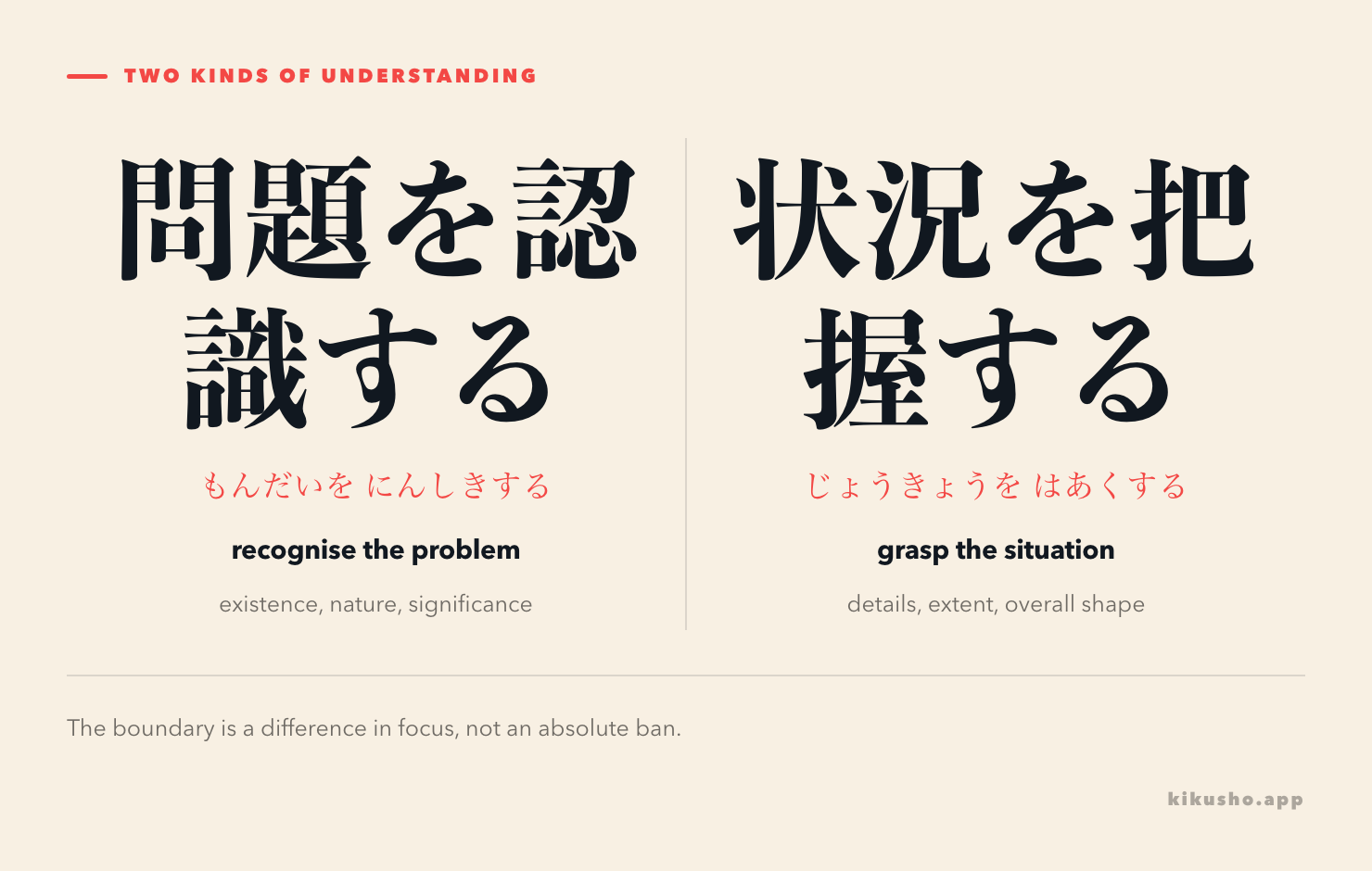
The sequence can be practical: first 問題があると認識する, then gather enough information to 状況を把握する. Recognition establishes what must be faced. Grasping supplies the shape needed for action.
説得 aims to change a person's judgment or choice
説得(せっとく) is persuasion. The person whose judgment you want to change normally takes を.
担当者は委員を説得して、調査の継続に賛成してもらった。
たんとうしゃは いいんを せっとくして、ちょうさの けいぞくに さんせいしてもらった。
The person in charge persuaded the committee member to support continuing the investigation.
To state the requested action, use 人にVよう説得する:
住民に計画を見直すよう説得された。
じゅうみんに けいかくを みなおすよう せっとくされた。
They were persuaded by residents to reconsider the plan.
In the passive sentence, 住民に marks the persuaders. In the active pattern 住民を説得する, residents would be the people being persuaded.
説明する gives information so that someone can understand. 説得する tries to move that person's view or decision. A clear explanation can therefore have 説得力(せっとくりょく), persuasive force, without guaranteeing that the listener is persuaded. Kotobank's 説得 entry centres on bringing someone to understanding and acceptance rather than simply forcing compliance.
偏見 can distort every later step
偏見(へんけん) is a prejudiced or one-sided view held without an adequate factual basis. It is stronger than merely having a different opinion.
出身地への偏見が、応募者の評価に影響してはならない。
しゅっしんちへの へんけんが、おうぼしゃの ひょうかに えいきょうしては ならない。
Prejudice about a person's place of origin must not affect the evaluation of an applicant.
Use 偏見を持つ for holding a prejudice, 偏見にとらわれる for being bound by it, and 偏見をなくす for eliminating it. The dictionary definition emphasises a fixed judgment without an objective basis, especially toward a group or its members.
先入観(せんにゅうかん) is a preconception formed in advance. It may prove favourable, unfavourable or simply mistaken. 偏見 foregrounds unfair bias. The words can overlap, but they do not make every prior expectation a prejudice.
One paragraph can move through all six roles
担当者は、これは仮の結論にすぎないと認識していた。まず資料全体を把握し、原則に照らして判断すべきだと主張した。しかし、偏見に基づく説明では委員を説得できない。
たんとうしゃは、これは かりの けつろんに すぎないと にんしきしていた。まず しりょうぜんたいを はあくし、げんそくに てらして はんだんすべきだと しゅちょうした。しかし、へんけんに もとづく せつめいでは いいんを せっとくできない。
The person in charge recognised that this was only a provisional conclusion. They argued that the committee should first grasp all the materials and judge them against the principle. An explanation based on prejudice, however, could not persuade the committee members.
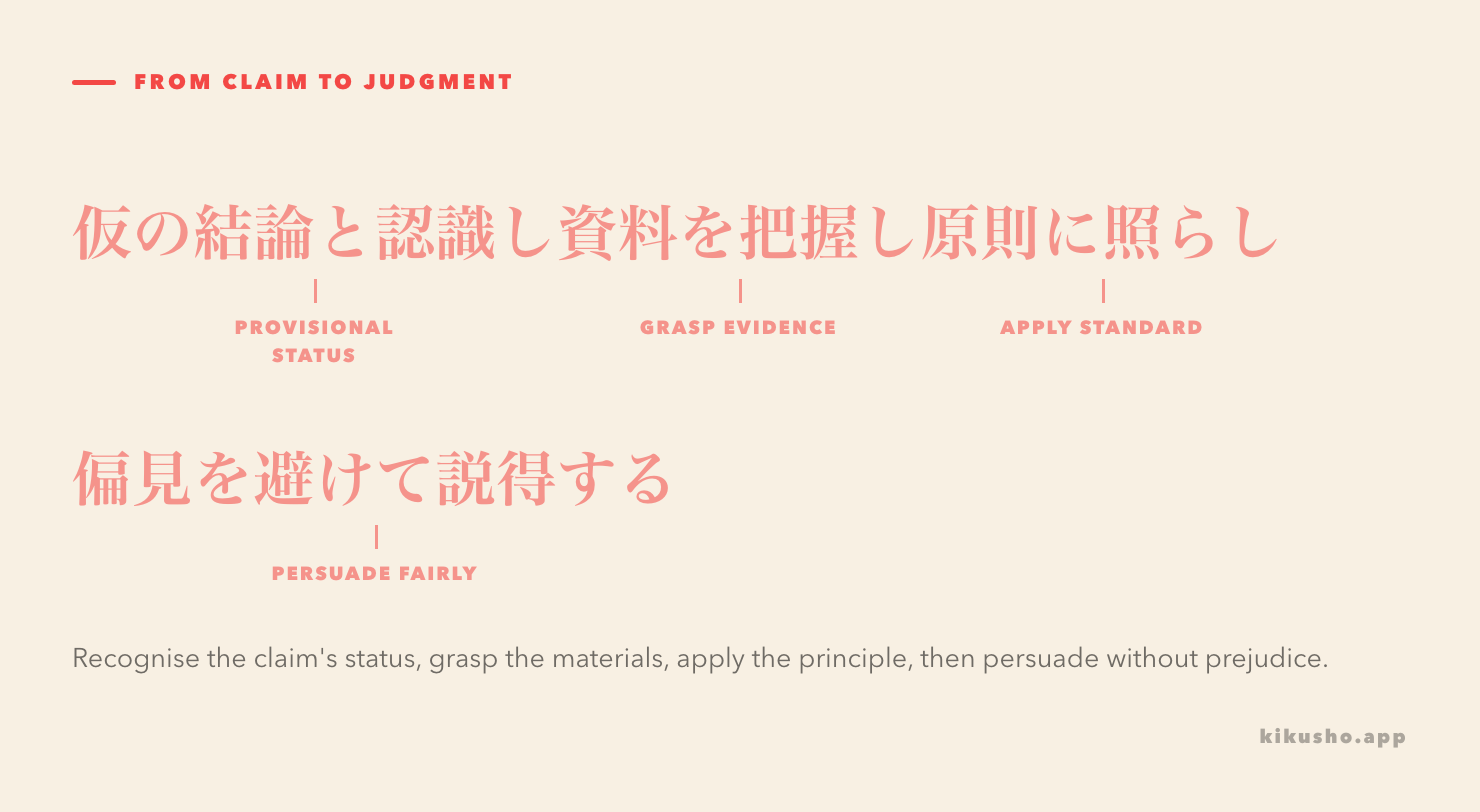
The paragraph does more than place six nouns in one scene. 仮 limits the status of the conclusion. 認識 reports the writer's understanding of that status. 把握 requires enough information for judgment, 原則 supplies the standard, and 偏見 names a threat to the evaluation. 説得 is the desired interpersonal result.
For vocabulary that names the internal structure of a claim, the academic argument lesson separates concepts, definitions, theories and logic. Those words describe the argument's components; this set tracks how a reader or decision-maker handles them.
The N1 label is a study placement with two visible disagreements
The curriculum's dated snapshot groups all six records under N1. Its two baseline files descend from Waller, so they provide one lineage rather than two independent confirmations. Separately maintained JapaneseTest4You pages label 原則, 把握 and 偏見 as N1.
Its 説得 page currently places that word under N2 despite an N1-looking URL. Its 認識 page has an N2 heading while the body prints “JLPT level: N1,” so it is internally inconsistent. These disagreements show why a level label should guide study order rather than determine whether a word is valid Japanese.
The official JLPT FAQ explains that the former Test Content Specifications are no longer published. No current official list assigns every word to a level. The reading correction for 仮 is separate from that level question: dictionaries support かり as the standalone word taught here.
Keep the status and object when you save a sentence
A bare card that says “recognition” for 認識 or “grasp” for 把握 hides the distinction you need in a report. Save enough of the sentence to retain what was recognised, which situation was grasped, or whose judgment the speaker tried to change.
In Kikusho, edit the card so the example preserves a phrase such as 問題を認識する, 全体像を把握する or 委員を説得する. During review, name the role before translating the word. That small demand turns six overlapping glosses into six decisions you can make while reading.
Practice: seven questions
Answer every question before opening the explanations.
1 · Reading. How is 把握 read in 状況を把握する?
- ① はあく
- ② はくあく
- ③ ばあく
- ④ はおく
2 · Provisional status. Choose the word and reading that complete the sentence.
調査中なので、これは( )の結論です。
- ① 仮(か)
- ② 仮(かり)
- ③ 原則(げんそく)
- ④ 偏見(へんけん)
3 · General rule. Which sentence says that applications are normally online while allowing a stated exception?
- ① 原則として申請はオンラインだが、緊急の場合は窓口でも受け付ける。
- ② 偏見として申請はオンラインだが、窓口を説得する。
- ③ 仮を申請して、オンラインを認識する。
- ④ 申請は原則を把握したので、例外がない。
4 · Target of understanding. Fill the two gaps with the pair that matches each object.
担当者は問題の存在を( 前 )し、次に被害の全体像を( 後 )した。
- ① 前:把握 / 後:認識
- ② 前:認識 / 後:把握
- ③ 前:説得 / 後:偏見
- ④ 前:原則 / 後:仮
5 · Persuasion. Which sentence naturally means “We persuaded the chair to reconsider the proposal”?
- ① 議長に説得を見直してもらった。
- ② 議長が提案を説得に見直した。
- ③ 議長を説得して、提案を見直してもらった。
- ④ 議長の説得を提案に把握した。
6 · Paraphrase. What is the closest meaning of 計画の危険性を認識している?
- ① They know the plan has risks and understand their significance.
- ② They have memorised every numerical detail of the plan.
- ③ They have persuaded everyone to accept the plan.
- ④ They treat the plan as a temporary name.
7 · Reading the evaluation. Which sentence identifies prejudice rather than a neutral difference of opinion?
- ① 二つの案について意見が分かれている。
- ② 十分な資料を読んでから結論を出した。
- ③ 出身地だけで能力を決めつける偏見が残っている。
- ④ 原則に従って同じ基準を全員に適用した。
Answers and explanations
①, はあく. The first vowel is long: はあく. The other options reverse, voice or replace a sound and are not the reading of 把握.
②, 仮(かり). 仮の結論 is a provisional conclusion. The standalone noun uses かり here. カ appears inside compounds such as 仮定 and 仮説, but the option 仮(か) does not give the free word's reading.
①. 原則として marks the normal rule, and the clause after が states the emergency exception. The sentence does not claim that no exceptions exist. The other choices misuse the target nouns and particles.
②, 認識 / 把握. The person first recognises that the problem exists, then grasps the overall extent of the damage. Reversing the pair is not impossible in every imaginable sentence, but it misses the focus explicitly supplied by 存在 and 全体像 here.
③. 議長を説得する marks the chair as the person being persuaded. 提案を見直してもらう states the resulting action. The other options attach 説得 to the proposal or use particles that do not express this relationship.
①. 危険性を認識する means recognising that the risk exists and understanding its significance. It does not by itself mean mastering every detail, persuading other people or assigning a temporary name.
③. Judging ability solely from a person's place of origin is a fixed evaluation without an adequate factual basis, so 偏見 fits. A disagreement, evidence-based conclusion or uniform application of a rule does not by itself establish prejudice.
Common questions
Is the standalone word 仮 read か or かり?
Read the standalone noun 仮 as かり when it means something temporary, provisional or assumed, as in 仮の結論. カ is the on-reading found in compounds such as 仮定, 仮説 and 仮称. The inventory's proposed か reading is therefore corrected in this lesson rather than taught as a free word.
What is the difference between 認識 and 把握?
認識 often concerns recognizing that something exists or understanding its nature and significance. 把握 focuses on getting a firm grasp of a situation, its details or its overall shape. The words overlap, but 問題を認識する and 状況を把握する show their common centers.
Are all six words officially assigned to JLPT N1?
No current official exhaustive JLPT vocabulary list exists. This lesson follows a dated N1 reference inventory, while JapaneseTest4You places 説得 under N2 and gives inconsistent N1/N2 labelling for 認識. Treat N1 as a study placement, not an official guarantee.