On this page
にとどまらず and はおろか both move beyond a first item, but they organize that move differently. Use にとどまらず when a scope spreads past a boundary; use はおろか when the second item is more surprising than the first on an understood scale.
この制度は大企業にとどまらず、中小企業にも導入されている。
この せいどは だいきぎょうに とどまらず、ちゅうしょうきぎょうにも どうにゅうされている。
This system has been introduced not only at large corporations but also at small and medium-sized companies.
彼は専門用語はおろか、基本的な単語さえ理解していない。
かれは せんもんようごは おろか、きほんてきな たんごさえ りかいしていない。
He does not understand even basic words, let alone technical terminology.
The first sentence traces adoption from one business group into another. The second builds a scale: technical terms are difficult, basic words are easier, and failure even at the easier level is the striking claim.
Ask whether the sentence draws a map or a scale
| Relationship | Choose | Typical shape |
|---|---|---|
| A is one boundary; the same phenomenon reaches B | Aにとどまらず、Bも/まで | scope map |
| A is expected; B is more surprising | Aはおろか、Bさえ/すら/も | scale |
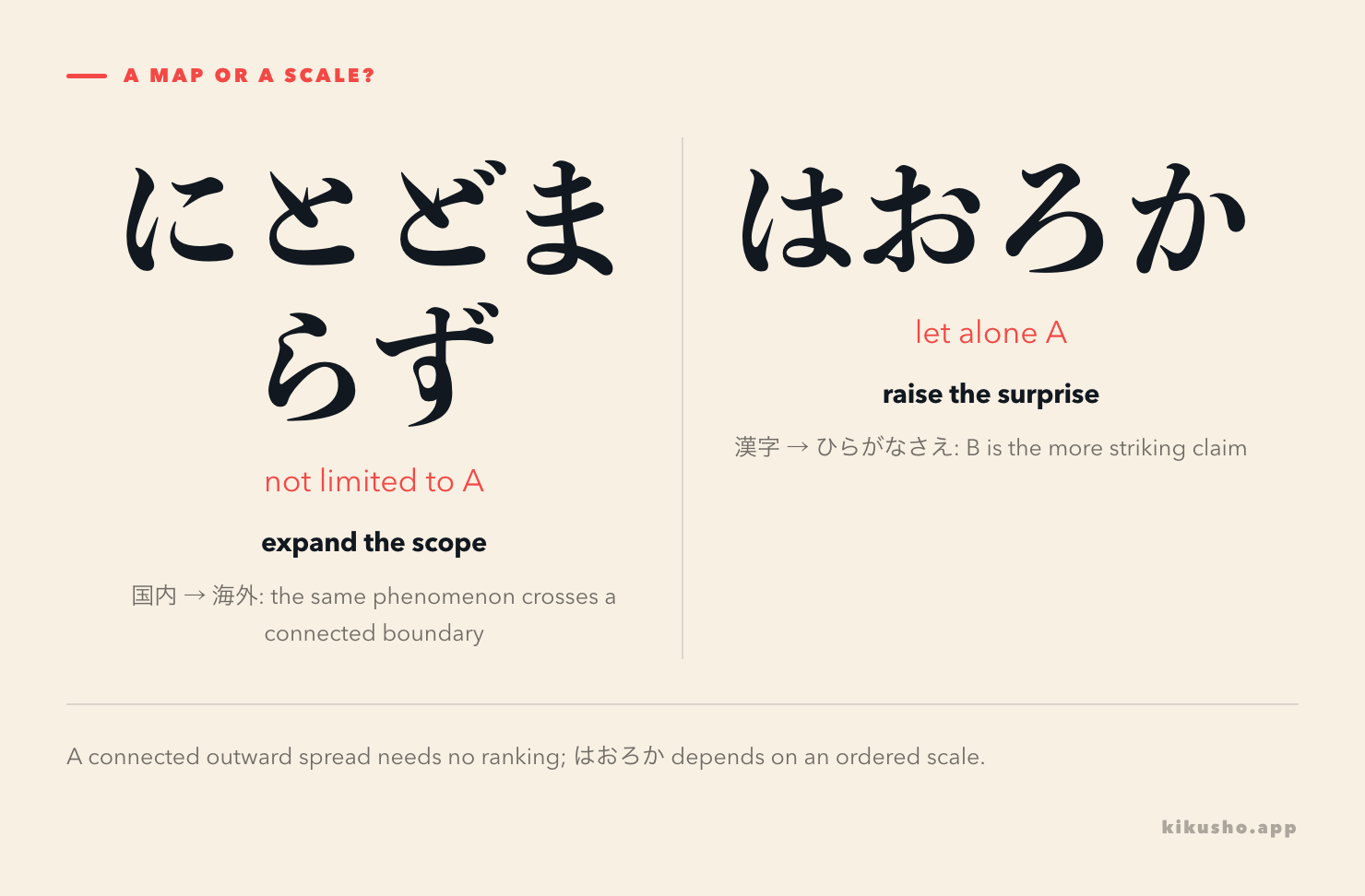
Both can translate as “not only A but also B.” That translation cannot tell you whether B is simply outside A's boundary or rhetorically stronger. The particles and the relationship between the nouns do.
にとどまらず expands beyond a boundary
にとどまらず(にとどまらず, ni todomarazu) combines に, the verb とどまる “remain; stay within,” and the negative connective ず. The whole expression means that something does not stop at A.
大雨の影響は交通機関にとどまらず、地域の医療にも及んだ。
おおあめの えいきょうは こうつうきかんに とどまらず、ちいきの いりょうにも およんだ。
The effects of the heavy rain extended beyond transportation to local medical care.
Transportation and medical care are connected areas affected by the same rain. No item must be easier, harder, better or worse. B is simply farther outside the initial boundary.
The structure is formal and common in reports, analysis and institutional writing. Bunpro's にとどまらず reference gives noun and dictionary-form verb attachment, labels the register formal and stresses outward expansion related to the original scope.
Nouns and actions can define the first boundary
With a noun:
この作品は国内にとどまらず、海外でも高く評価された。
この さくひんは こくないに とどまらず、かいがいでも たかく ひょうかされた。
This work was highly praised not only domestically but overseas as well.
With a dictionary-form verb:
研究チームは原因を特定するにとどまらず、再発防止策も提案した。
けんきゅうチームは げんいんを とくていするに とどまらず、さいはつぼうしさくも ていあんした。
The research team went beyond identifying the cause and also proposed preventive measures.
Nouns and な-adjectives can take である before the pattern in formal prose: 問題は経済的であるにとどまらず、社会的でもある. JLPT Sensei's にとどまらず lesson independently records N1 placement and the noun, verb, adjective and だけ attachments.
Common verbs in B reveal the spatial metaphor: 広がる, spread; 及ぶ, reach; 影響する, affect; 進出する, expand into. Positive and negative developments both work:
- 支援は資金提供にとどまらず、人材育成にも及ぶ。
- 被害は沿岸部にとどまらず、内陸部にも広がった。
はおろか moves to the more surprising claim
はおろか(はおろか, wa oroka) places A before a more surprising B. The speaker treats A as obvious or already beyond question, then uses B to reveal how extreme the actual situation is.
けがのため、走るのはおろか、立つことさえできない。
けがの ため、はしるのは おろか、たつことさえ できない。
Because of the injury, I cannot even stand, let alone run.
Running is harder than standing. In a negative sentence, saying that running is impossible would not be surprising once standing is impossible. The sentence therefore presents running as A and the easier action standing as the stronger evidence in B.
その町には映画館はおろか、本屋すらない。
その まちには えいがかんは おろか、ほんやすら ない。
The town does not even have a bookstore, let alone a cinema.
さえ, すら, まで and も often mark B. They help make the scalar jump visible. The Japanese-teacher guide from たのすけ gives N + はおろか and V dictionary + の/こと + はおろか, describes B as the surprising point, and notes the form's stiff tone and its frequent negative environment.
Positive はおろか still needs a stronger B
Although negative inability and absence are common, the construction can extend upward in a positive claim:
彼女の演奏は国内はおろか、海外でも高く評価されている。
かのじょの えんそうは こくないは おろか、かいがいでも たかく ひょうかされている。
Her performances are highly regarded not only domestically but overseas too.
Recognition at home is plausible; overseas recognition is the more impressive claim. The scale runs in the opposite surface direction from the negative example, but B remains rhetorically stronger.
JLPT Sensei's はおろか lesson and Bunpro's independent reference both place the expression at N1 and describe it as “let alone” or “not to mention.” The official JLPT does not publish an exhaustive grammar syllabus, so N1 is a preparation estimate rather than an official exclusive assignment.
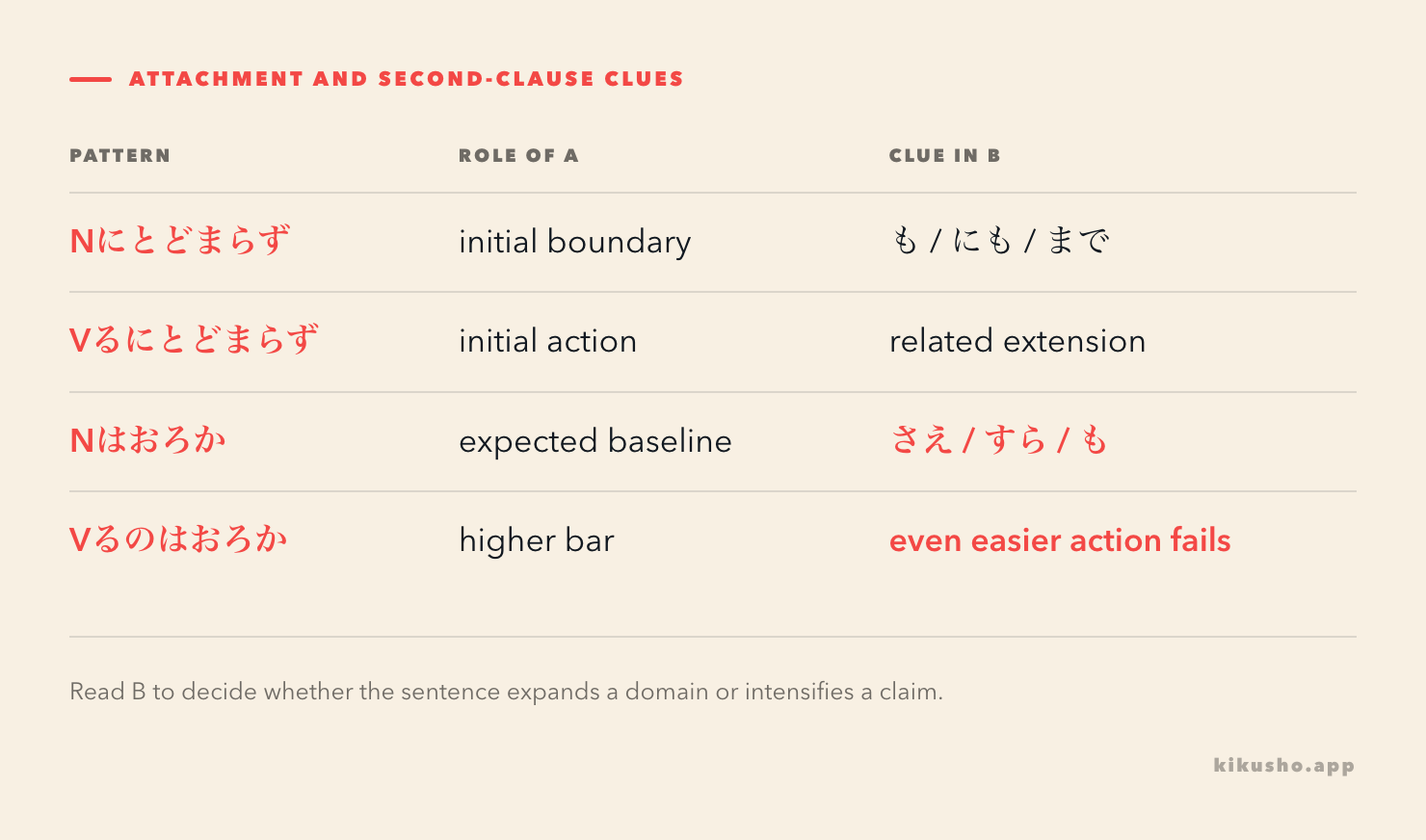
| Check | にとどまらず | はおろか |
|---|---|---|
| common attachment | N/V辞書形 + にとどまらず | N + はおろか; Vる + の/ことはおろか |
| role of A | initial boundary | expected or obvious point |
| role of B | connected wider scope | more surprising point |
| B markers | も, にも, まで | さえ, すら, まで, も |
| polarity | positive or negative | often negative; positive possible |
| register | formal | stiff, emphatic |
Why swapping them changes the argument
Consider a language course.
受講者は大学生にとどまらず、社会人にも広がっている。
Participants extend beyond university students to working adults.
This maps a population. Neither group is presented as more impressive or more basic.
彼は敬語はおろか、簡単な挨拶さえできない。
He cannot even manage a simple greeting, let alone honorific language.
This ranks skills. Honorific language is difficult; a simple greeting is elementary. The failure at B proves how low the ability is. Replacing はおろか with にとどまらず would describe a neutral expansion of inability across categories and would lose the carefully ordered surprise.
The reverse mismatch also matters. 被害は道路にとどまらず、鉄道にも及んだ naturally traces damage across transport systems. 道路はおろか、鉄道にも被害が及んだ asks the reader to view rail damage as more surprising than road damage. That may be defensible in a particular context, but the sentence now requires a scale that the neutral map did not.
Nearby addition patterns
のみならず and だけでなく add B to A without requiring the same outward-spread metaphor or strong scale. The に加えて and のみならず lesson shows the formal additive structure. にとどまらず is best when “the effect did not stop there” captures the relation.
どころか can reject or reverse an expectation about A before presenting B. はおろか usually accepts A as the obvious baseline and emphasizes B. The どころか and どころではない comparison keeps that reversal separate from scalar “let alone.”
For a card in Kikusho, keep A and B together. Saving only はおろか = let alone discards the scale that determines word order. A full sentence such as 漢字はおろか、ひらがなさえ書けない preserves the hard item, easy item and negative result in one reviewable unit.
Practice: find the hidden relationship
Work through all seven items before opening the explanations.
Question 1 · expansion across domains
Complete: この技術は医療分野( )、教育現場でも利用されている。
- A. はおろか
- B. にとどまらず
- C. すら
- D. どころではなく
Question 2 · failure at an easier level
Complete: 彼は論文( )、短い報告書さえ書いたことがない。
- A. にとどまらず
- B. に加えて
- C. はおろか
- D. にもまして
Question 3 · select the verb frame
Which sentence correctly says the company goes beyond selling devices and also repairs them?
- A. 会社は機器を販売するにとどまらず、修理も行う。
- B. 会社は機器を販売してはおろか、修理も行う。
- C. 会社は機器を販売するはおろか、修理も行う。
- D. 会社は機器を販売したにとどまらず、修理も行う。
Question 4 · nominalize before はおろか
Complete: 足が痛くて、階段を上る( )、平地を歩くのさえつらい。
- A. にとどまらず
- B. ことはおろか
- C. であるにとどまらず
- D. までに
Question 5 · positive scale
Which completion makes B a stronger positive claim?
この作家は国内はおろか、( )。
- A. 地元ではあまり知られていない
- B. 海外でも文学賞を受賞している
- C. 国内にとどまっている
- D. 本を書いてください
Question 6 · map or scale
Read: 感染は一つの学校にとどまらず、市内の複数の学校に広がった。 Why is にとどまらず appropriate?
- A. The schools form a connected widening scope.
- B. The second school is easier than the first.
- C. The speaker changes the subject.
- D. The sentence asks someone to spread the infection.
Question 7 · two different extensions
Choose the pair for this report:
停電の影響は住宅地(甲)、工業地域にも及んだ。病院では手術(乙)、簡単な検査さえ行えなかった。
- Scope then scale: 甲 にとどまらず / 乙 はおろか
- Scale then scope: 甲 はおろか / 乙 にとどまらず
- Two neutral additions: 甲 に加えて / 乙 に加えて
- Two reversals: 甲 どころか / 乙 どころか
Open the answer key
1 — B, にとどまらず. The same technology spreads from medicine into a connected second domain, education. The sentence draws a scope map and does not rank one field as easier or more surprising.
2 — C, はおろか. A paper is the harder task; the short report in B is easier. Saying that he has never written even B creates the intended negative scale.
3 — A. A dictionary-form verb can precede にとどまらず. Selling defines the initial business activity, and repairs extend the company's service beyond that boundary.
4 — B, ことはおろか. The verb 上る is nominalized with こと before はおろか. Climbing stairs is harder than walking on level ground, and the inability to do even the easier action is the surprising claim.
5 — B. Winning a literary prize overseas goes beyond expected domestic recognition and supplies a stronger positive B. A weakens the claim, C stops the expansion, and D is a request.
6 — A. The infection reaches beyond one school into several related locations. No difficulty scale is needed; the verbs 広がる and 及ぶ support outward scope.
7 — Scope then scale. The outage spreads geographically from residences to an industrial area, so 甲 takes にとどまらず. Surgery is a demanding procedure while a simple test is easier; inability to conduct even the latter makes 乙 はおろか.
Let B reveal the structure
Choose にとどまらず when B shows where the same activity, effect or population spread after crossing A's boundary. Choose はおろか when B makes the claim more striking than A, often with さえ, すら, まで or も.
If both English translations say “not only,” inspect the nouns instead. A connected map points to にとどまらず. An ordered scale with a surprising second point points to はおろか.
Common questions
What is the difference between にとどまらず and はおろか?
にとどまらず says a connected effect or activity extends beyond A into B. はおろか treats A as expected and adds B as an even more surprising claim, often on a difficulty or degree scale.
What comes before にとどまらず?
A noun, a dictionary-form verb, or a predicate made formal with である can precede にとどまらず. The following clause commonly marks the wider scope with も, まで or にも.
What comes before はおろか?
A noun commonly precedes はおろか. A verb is usually nominalized with の or こと, as in 歩くのはおろか. The surprising second item often takes さえ, すら, まで or も.
Is はおろか always negative?
No, but negative contexts are especially common. In 漢字はおろか、ひらがなさえ書けない, failure at the easier second item is striking; positive uses can extend from an expected domain to a more impressive one.