On this page
These eight N3 records move a project from disorder to a settled result: you organise material, bring opinions together, prepare for trouble, solve a problem and confirm that the work is finished. They also separate two spellings of おさめる, transitive まとめる from intransitive まとまる, and active 片付ける from result-focused 片付く.
The N4 prerequisite teaches everyday preparation, tidying and replacement. This N3 lesson shifts the viewpoint toward systems, results and the state reached after someone has acted.
Eight records organise actions and results
| Headword | Reading | Grammar | Core meaning | Anchor phrase |
|---|---|---|---|---|
| 収める | おさめる | Transitive ichidan verb | put inside; capture; obtain a result | 成功を収める |
| 納める | おさめる | Transitive ichidan verb | pay or deliver what is due | 税金を納める |
| 解決 | かいけつ | Noun / する | solve or resolve a problem, case or doubt | 問題を解決する |
| 片付く | かたづく | Intransitive godan verb | become tidy; get finished or settled | 仕事が片付く |
| 整理 | せいり | Noun / する | sort, arrange and clarify | 資料を整理する |
| 備える | そなえる | Transitive ichidan verb | prepare for; equip; possess what is needed | 地震に備える |
| まとまる | まとまる | Intransitive godan verb | come together; become coherent or settled | 意見がまとまる |
| まとめる | まとめる | Transitive ichidan verb | gather, organise, summarise or conclude | 意見をまとめる |
Several English translations overlap. The particles and the result tell you whether someone actively organises material, whether it becomes coherent, or whether a difficult matter simply reaches a settled state.
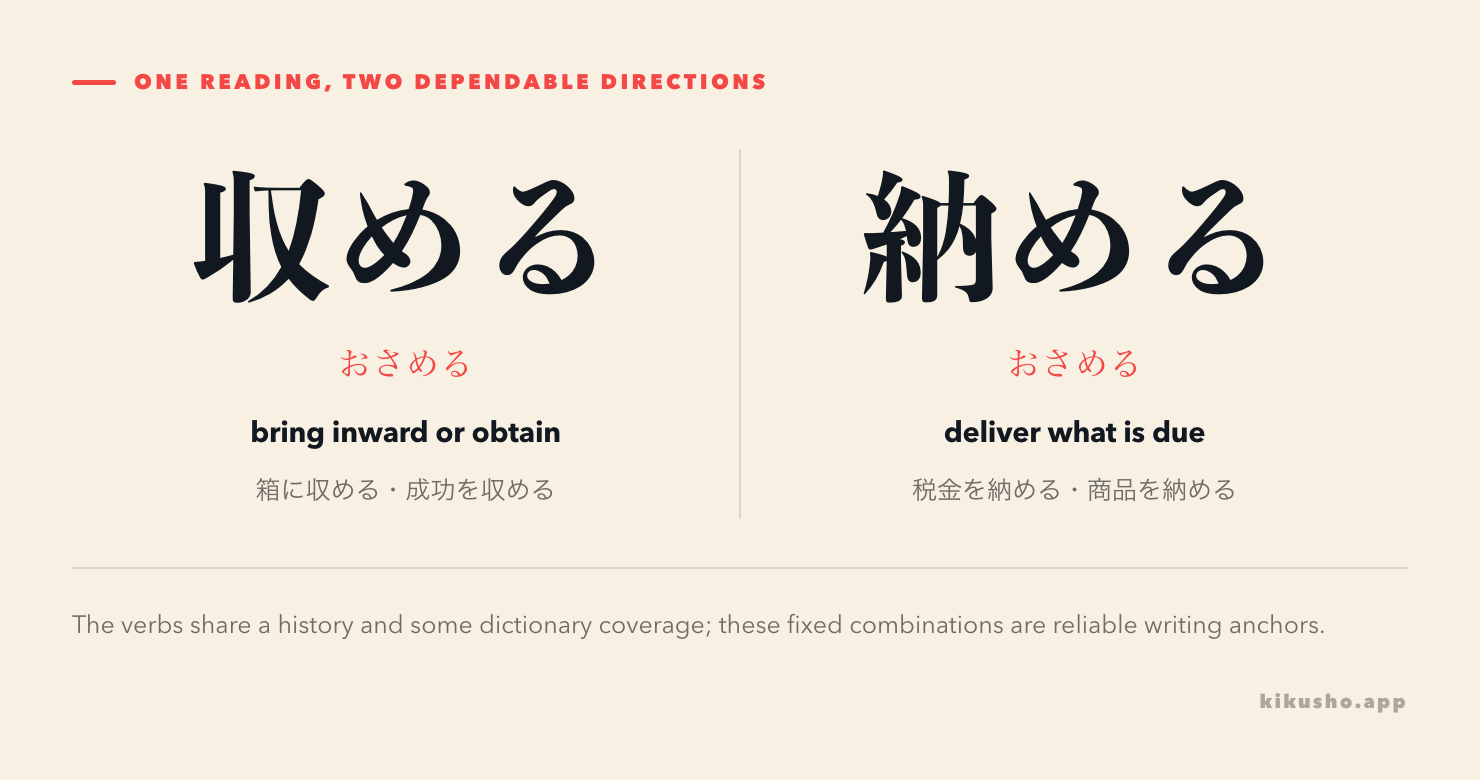
収める brings inward; 納める delivers to the proper recipient
Both verbs are read おさめる, but their stable written combinations point in different directions.
収める often brings something within a space, record or possession. It also presents a favourable result as something obtained.
- 品物を箱に収める: place an item in a box
- 景色を写真に収める: capture scenery in a photograph
- 成功を収める: achieve success
- よい成績を収める: obtain good results
- 争いを丸く収める: bring a dispute to an amicable close
チームは新しい方法を試し、大きな成果を収めた。
チームは あたらしい ほうほうを ためし、おおきな せいかを おさめた。
The team tried a new method and achieved major results.
納める commonly sends money or goods to the person, organisation or place entitled to receive them.
- 税金を納める: pay taxes
- 会費を納める: pay membership fees
- 授業料を納める: pay tuition
- 商品を店に納める: deliver goods to a shop
参加者は今月末までに会費を納めます。
さんかしゃは こんげつまつまでに かいひを おさめます。
Participants will pay the membership fee by the end of this month.
Kanjipedia’s 同訓異義 note gives the compact distinction: 収める puts something in order and inside, while 納める delivers tax or goods. Shogakukan records the wider shared history and additional senses. Learn dependable combinations rather than assuming one English verb covers every spelling.
整理 sorts material; まとめる makes one usable whole
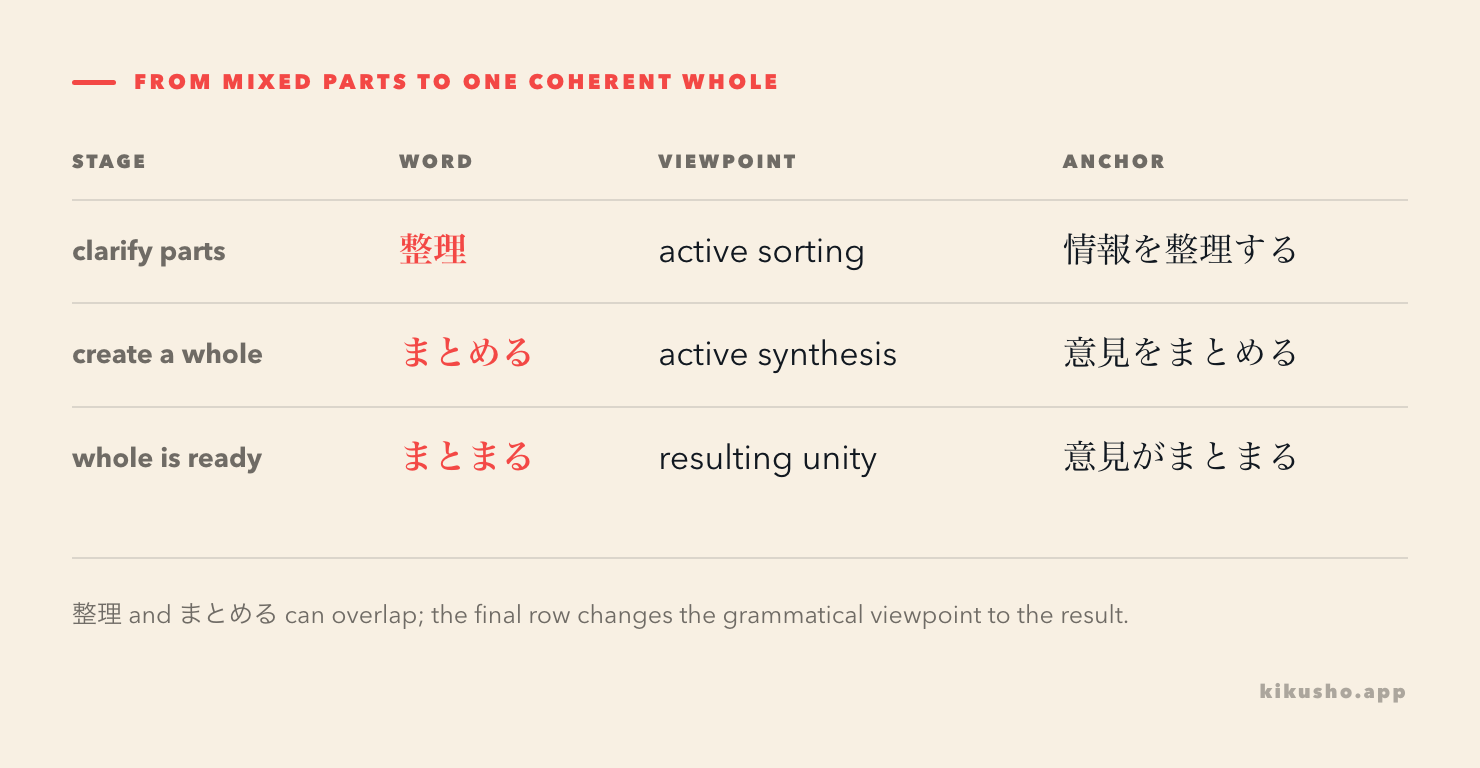
整理(せいり)する takes material that is mixed, scattered or hard to follow and puts it into an intelligible order. The object may be physical or abstract:
- 書類を整理する: sort documents
- 写真を年代順に整理する: arrange photographs chronologically
- 情報を整理する: organise information
- 考えを整理する: sort out one’s thoughts
まず質問を種類別に整理してから、答えを考えましょう。
まず しつもんを しゅるいべつに せいりしてから、こたえを かんがえましょう。
First organise the questions by type, and then consider the answers.
まとめる brings several elements into one group, coherent account, decision or conclusion. It can bundle belongings, summarise a report, coordinate people or reconcile opinions.
担当者は三人の意見を一つの提案にまとめた。
たんとうしゃは さんにんの いけんを ひとつの ていあんに まとめた。
The person in charge brought three people’s views together into one proposal.
整理 can be an earlier stage: categories and relationships become clear. まとめる then produces a single usable whole. The boundary is not rigid; 考えを整理する and 考えをまとめる can describe nearby stages of thinking.
まとまる reports that the whole has come together
まとまる is the intransitive partner of まとめる. The plan, discussion, writing or group takes が and reaches unity, coherence or agreement without naming the organiser as the grammatical actor.
話し合いの結果、来月の計画がまとまった。
はなしあいの けっか、らいげつの けいかくが まとまった。
As a result of the discussion, next month’s plan came together.
Compare the viewpoints:
- 部長が意見をまとめた: the manager brought the opinions together
- 意見がまとまった: the opinions came together; agreement was reached
- 文章がよくまとまっている: the writing is well organised and coherent
- 商談がまとまる: the business negotiation is concluded
Shogakukan’s まとまる entry covers collection into one whole, agreement and completion. Its まとめる entry gives the corresponding active work of collecting, arranging and settling. Current Bunpro material also places まとめる at N3.
解決 names a solution; 片付く reports a settled result
解決(かいけつ)する directly says that a problem, dispute, case or doubt is solved. It supports both viewpoints:
- 担当者が問題を解決した: the person in charge solved the problem
- 問題が解決した: the problem was resolved
- 事件を解決する: solve a case
- 疑問が解決する: a doubt is cleared up
The dictionary definition covers successful handling of a troubled matter and making an unclear point understandable.
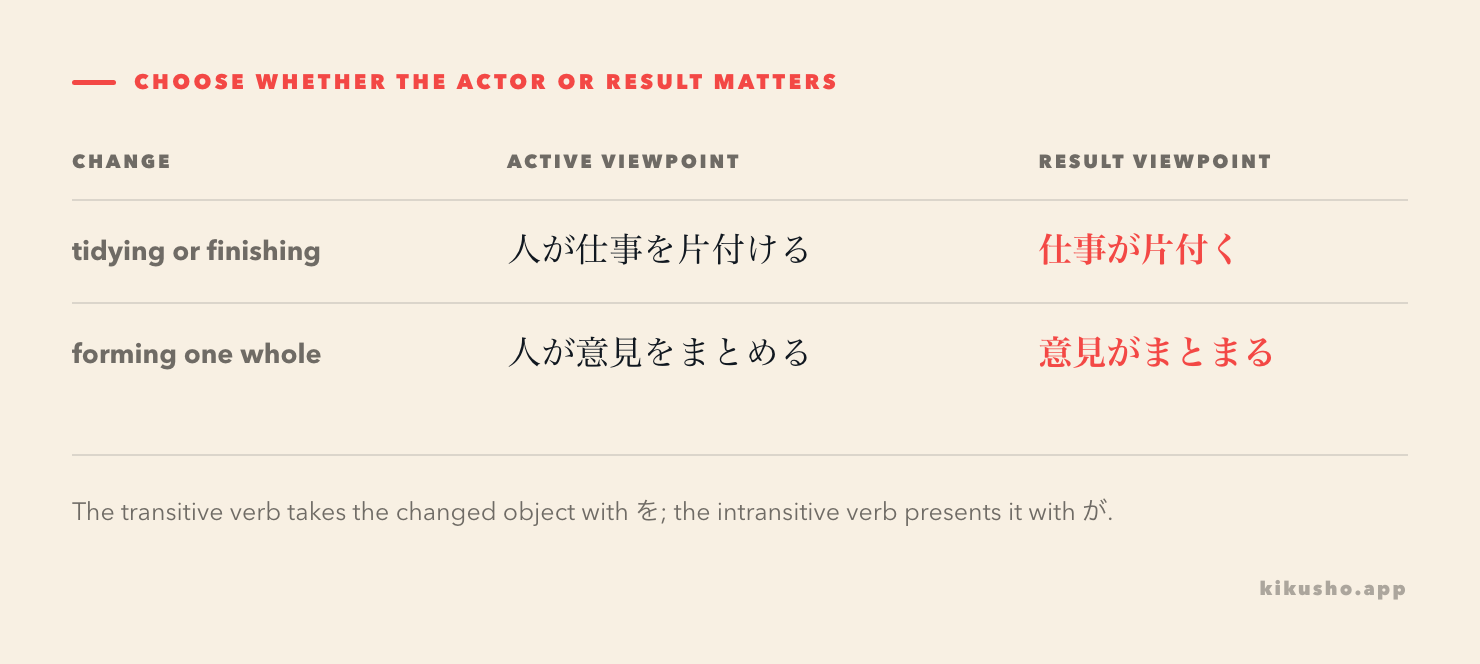
片付く(かたづく) describes the resulting state after tidying, finishing or settling. It is the intransitive partner of N4 片付ける.
資料を全部棚に戻したので、会議室が片付いた。
しりょうを ぜんぶ たなに もどしたので、かいぎしつが かたづいた。
We returned all the materials to the shelves, so the meeting room is tidy now.
やっと急ぎの仕事が片付いた。
やっと いそぎの しごとが かたづいた。
The urgent work is finally finished.
For problems, 解決する foregrounds finding or reaching the solution. 片付く presents a troublesome matter as settled and no longer pending. Shogakukan records a room becoming orderly, a matter taking shape and a difficult issue being settled.
備える prepares for an event or equips a person and place
備える(そなえる) has three connected frames.
With a future event plus に, it means to prepare for or take precautions against it:
地震に備えて、飲み水を三日分保存している。
じしんに そなえて、のみみずを みっかぶん ほぞんしている。
We store three days of drinking water in preparation for an earthquake.
With equipment plus を, it means to furnish or equip: 建物は非常口を備えている, the building has an emergency exit. With an ability, qualification or quality, it means to possess it: 必要な知識を備える, possess the necessary knowledge.
Shogakukan records all three: preparation for a future situation, equipment kept ready for use and possession of required qualities. Bunpro currently places the word at N3. The N4 preparation lesson teaches 準備, 用意 and 支度; 備える adds a future risk, installed provision or lasting capacity.
One public event uses all eight records
市民会館では防災説明会に備えて、職員が資料を整理していた。担当者は住民から集めた意見を一つの案にまとめ、話し合いの結果、避難計画がまとまった。会場には非常口と予備の電源が備えてある。印刷会社は資料を前日までに会館へ納め、職員は届いた資料を棚に収めた。開始時刻の問題も解決し、準備の仕事がすべて片付いた。
Staff 整理する the material and まとめる comments into one proposal. The plan then まとまる. The hall 備える emergency facilities. The printer 納める documents to the hall, while staff 収める them on a shelf. A scheduling problem undergoes 解決, and the remaining work finally 片付く.
In Kikusho, keep the participant and particle with each captured word. A card for おさめる should retain the spelling and its object; a card for an intransitive result should retain が. Those cues are more useful than an isolated English gloss.
N3 includes two documented placement disagreements
Kikusho’s September 2026 inventory places all eight records in this N3 lesson. The retained Waller/Tanos source family also contains N2 observations for 納める and 片付く, so their placement is disputed inside that lineage. A separate Japanesetest4You index confirms 解決 and 整理 at N3 but does not establish the provenance of its full list.
Independent current Bunpro pages place 備える and まとめる at N3. The official JLPT FAQ states that the current test publishes no exhaustive vocabulary list. N3 is therefore a transparent study placement, not a promise that a word belongs exclusively to one exam level.
The N1 problem-handling lesson continues from this set with 備わる, the response terms 処置・処分・対処, and the removal and recovery contrasts 取り除く・排除・補充・取り戻す.
Practice: choose the spelling, actor and result
Answer every question before opening the explanation panel.
1 · Same reading, different direction. Which spelling completes 税金を__?
- A. 収める
- B. 納める
- C. 修める
- D. 治める
2 · Achieved result. Choose the natural phrase for “achieve major success.”
- A. 大きな成功を収める
- B. 大きな成功を納める
- C. 大きな成功が片付ける
- D. 大きな成功に備える
3 · Reading. How is 備える read?
- A. たくわえる
- B. そろえる
- C. そなえる
- D. かまえる
4 · Sorting before synthesis. A researcher first groups survey answers by topic. Which action fits?
- A. 回答を整理する
- B. 回答がまとまる
- C. 回答を納める
- D. 回答が片付ける
5 · Active or resulting agreement? Complete the pair.
司会者が意見を( 前 )。その結果、計画が( 後 )。
- A. 前 まとまった / 後 まとめた
- B. 前 片付いた / 後 整理した
- C. 前 まとめた / 後 まとまった
- D. 前 解決した / 後 納めた
6 · Finished work. Which sentence reports the result without naming the worker?
- A. 私が仕事を片付けた。
- B. 仕事が片付いた。
- C. 仕事を片付いた。
- D. 仕事が片付けた。
7 · Solution or tidiness? A technical fault no longer blocks the system because engineers found its cause and fixed it. Which phrase is most explicit?
- A. 技術的な問題を解決した
- B. 故障に税金を納めた
- C. 故障を棚に収めた
- D. 故障が意見をまとめた
8 · Preparing for risk. Complete: 停電__備えて、予備の電源を用意した。
- A. を
- B. が
- C. に
- D. と
9 · Equipped building. Which sentence naturally means “The building has an emergency exit”?
- A. 建物は非常口を備えている。
- B. 建物は非常口にまとまっている。
- C. 建物は非常口を納めている。
- D. 建物が非常口を解決している。
10 · Connected event. Which summary matches the public event?
- A. Staff paid the opinions as tax and the printer solved the shelf.
- B. Staff organised information, brought views together, prepared for emergencies and finished the remaining work.
- C. The plan remained scattered, no facilities were available and the delivery was refused.
- D. Every verb described a person actively changing an object with を.
Answers and explanations
B, 納める. Tax is money delivered to the authority entitled to receive it. 収める is used for placing inside, recording and obtaining results.
A, 大きな成功を収める. 成功 and 成果 conventionally pair with 収める when a favourable result is achieved.
C, そなえる. 備える prepares for an event, equips a place or describes possessing a needed quality.
A, 回答を整理する. The researcher actively sorts mixed answers into categories before producing one synthesis.
C: 前 まとめた / 後 まとまった. The moderator acts on opinions with transitive まとめる; the plan reaches a coherent result with intransitive まとまる.
B, 仕事が片付いた. 片付く is intransitive, so the completed work takes が. Sentence A is also grammatical but names the active worker and uses 片付ける, contrary to the prompt.
A. 解決 directly presents the cause or problem as solved. The other choices assign payment, storage or opinion-organising relations to a technical fault.
C, に. A future event or risk takes に in the frame X に備える.
A. Equipment takes を with 備える. The building is presented as furnished with an emergency exit.
B. The passage moves from 整理 and まとめる through まとまる and 備える to delivery, storage, 解決 and the final result 片付く.
Common questions
What is the difference between 収める and 納める?
Both are read おさめる. 収める commonly puts something inside a space or record and obtains a result, as in 箱に収める and 成功を収める. 納める commonly delivers money or goods to the party that should receive them, as in 税金を納める and 商品を納める.
What is the difference between 片付く and 片付ける?
片付く is intransitive: a room becomes tidy, or work and a problem get settled. 片付ける is transitive: someone tidies the room or finishes the work. The changed thing usually takes が with 片付く and を with 片付ける.
What is the difference between まとまる and まとめる?
まとまる is intransitive: ideas, negotiations or material come together as a coherent whole. まとめる is transitive: someone gathers, organises, summarises or brings those elements to a conclusion.
How do you use 備える?
Use event に備える for preparing against or for a future event, such as 地震に備える. Use equipment or quality を備える when a place or person is equipped with it, such as 非常口を備える or 知識を備える.