On this page
This N3 set maps what happens when people want different outcomes. You can 願う for a result, 求める action from someone, 断る an invitation, 辞退 a formal offer, 命じる an action, 禁止 it, 許す it, or 諦める the goal.
The planned title says “promises,” but 約束(やくそく) is not one of the nine assigned headwords. The actual lesson concerns wishes, requests, refusals, commands and permission around a decision.
At N1, the same decision chain becomes more institutional. The N1 lesson on requests, consent and refusal distinguishes 申し出る and 要請, 指示 and 指令, four kinds of acceptance, and 拒否 versus 拒絶.
Nine words define the direction of the decision
| Headword | Grammar | Core meaning | Anchor phrase |
|---|---|---|---|
| 諦める(あきらめる) | Ichidan verb | give up a goal or hope | 夢を諦める |
| 禁止(きんし) | Noun / する | prohibit; a ban | 使用を禁止する |
| 断る(ことわる) | Godan verb | refuse or decline | 誘いを断る |
| 辞退(じたい) | Noun / する | formally decline or withdraw | 出場を辞退する |
| 願う(ねがう) | Godan verb | wish, hope or request | 成功を願う |
| 命じる(めいじる) | Ichidan verb | order, command or appoint | 退場を命じる |
| 命令(めいれい) | Noun / する | an order or command | 命令に従う |
| 求める(もとめる) | Ichidan verb | seek, request or demand | 説明を求める |
| 許す(ゆるす) | Godan verb | permit or forgive | 外出を許す |
Read the object first. It reveals whether a person rejects an offer, abandons their own goal, seeks a result, controls another person's action or removes blame.
断る refuses; 辞退 formally steps away; 諦める abandons a goal
断る(ことわる) is the broad everyday verb for not accepting an invitation, request, offer or proposal. Its object is what the speaker rejects: 誘いを断る, 依頼を断る, 申し出を断る. Shogakukan records both declining and the separate sense of notifying someone in advance, seen in 前もって断る and 断りなく.
その日は予定があったので、友達の誘いを断った。
そのひは よていが あったので、ともだちの さそいを ことわった。
I already had plans that day, so I declined my friend's invitation.
辞退(じたい)する is more formal. Someone declines something proposed to them or withdraws from a place, role, right or participation. The dictionary definition highlights stepping back from what was recommended or giving up an acquired position or right: 出場を辞退する, 内定を辞退する, 受賞を辞退する.
けがが治らなかったため、選手は大会への出場を辞退した。
けがが なおらなかったため、せんしゅは たいかいへの しゅつじょうを じたいした。
Because the injury had not healed, the athlete withdrew from the tournament.
諦める(あきらめる) changes the object from an offer to one's own hope, plan or pursuit. The person concludes that realization is unlikely or impossible and stops pursuing it.
一度失敗しただけで、留学の夢を諦める必要はない。
いちど しっぱいしただけで、りゅうがくの ゆめを あきらめる ひつようは ない。
There is no need to give up your dream of studying abroad after only one failure.
The contrast is easiest in one application. You may 会社からの誘いを断る, turn down a company's invitation; 内定を辞退する, formally decline its job offer; or 就職そのものを諦める, give up the goal of finding employment. Kanjipedia defines 諦める as abandoning something after deciding there is no prospect of success.
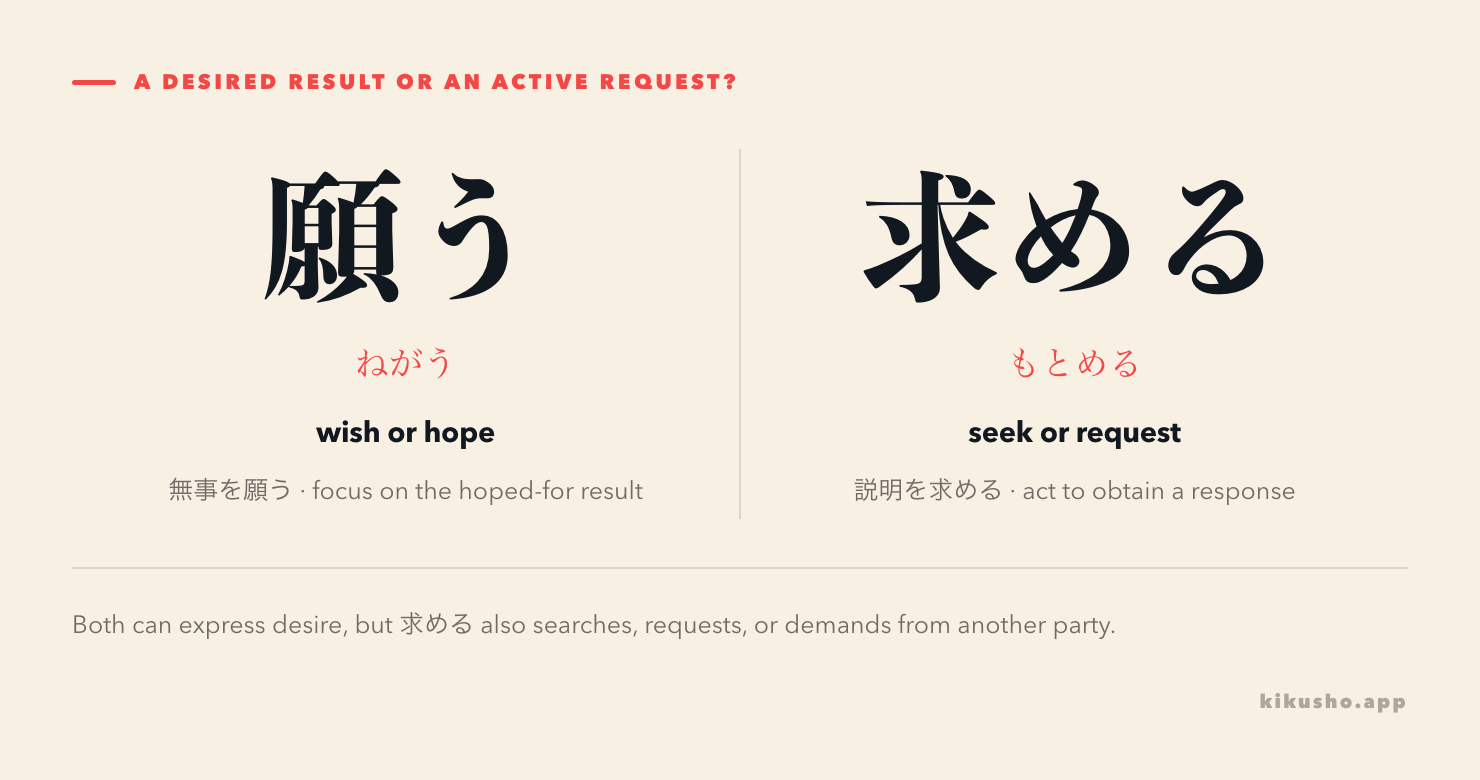
願う imagines a desired result; 求める reaches for one
願う(ねがう) covers prayer, hope and a request that another person do something. Natural patterns include 成功を願う, 無事を願う, Vように願う, and formal request language such as ご理解願います.
私たちは、行方不明者が無事に戻ることを願っている。
わたしたちは、ゆくえふめいしゃが ぶじに もどることを ねがっている。
We hope that the missing person returns safely.
The Japan Foundation's explanation shows ~ように祈る/願う for wishing that a particular state or result comes about. Shogakukan also records the request sense: asking for help, consideration or an action.
求める(もとめる) reaches toward something to obtain it. It can mean seek, search for, want, request or demand: 助けを求める, 仕事を求める, 説明を求める, 謝罪を求める. Shogakukan separates wanting, demanding from another party, searching, and purchasing.
住民は市に対し、計画について詳しい説明を求めた。
じゅうみんは しにたいし、けいかくについて くわしい せつめいを もとめた。
The residents asked the city for a detailed explanation of the plan.
The Shogakukan synonym guide makes the practical difference visible: 願う presents the desired realization, while 求める can act strongly on another party with objects such as 謝罪 or 対応. Compare 平和を願う, hope for peace, with 政府に対応を求める, call on the government to act.
命じる is the act; 命令 is the order
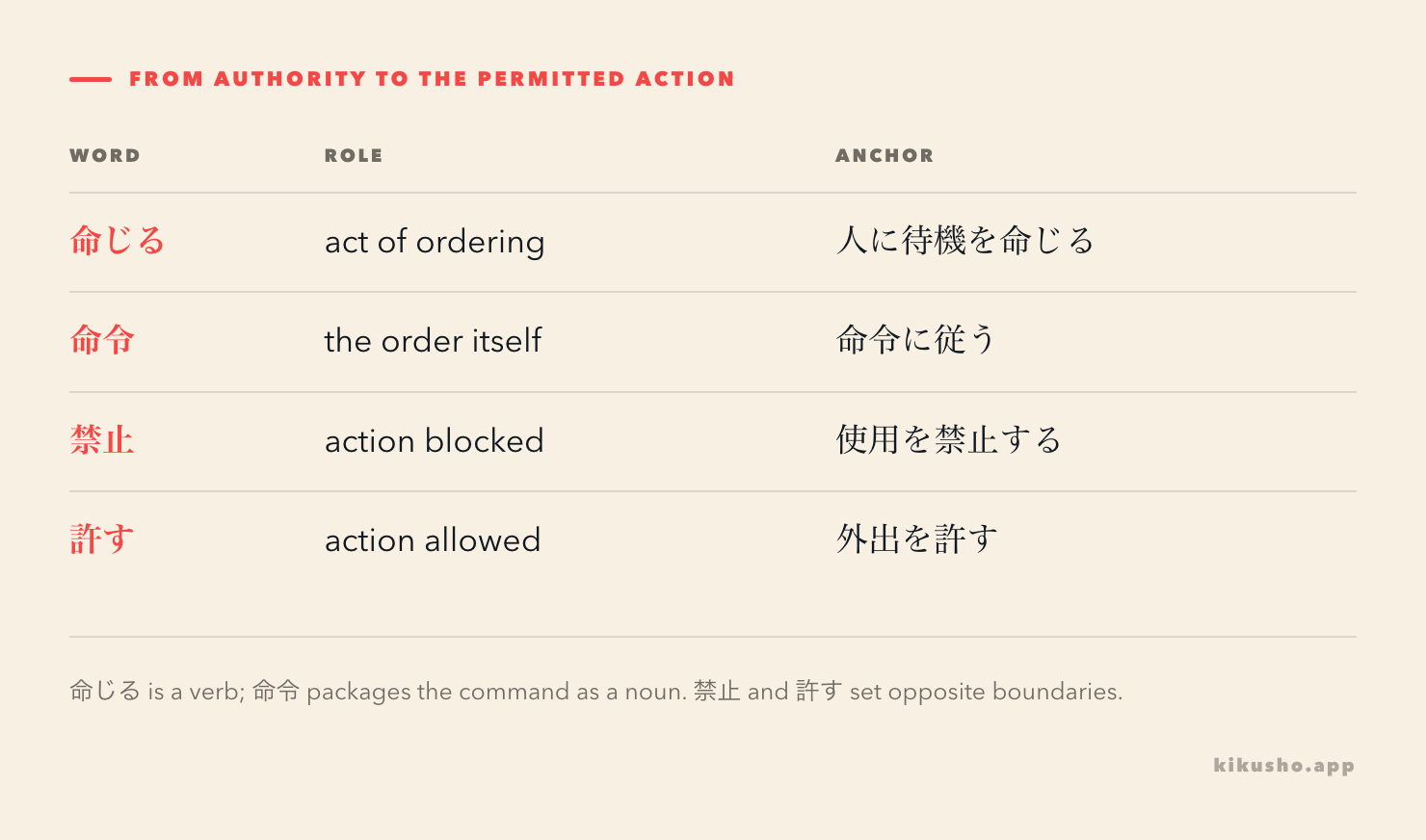
命じる(めいじる) is a verb. The authority orders a person to take an action:
- 部下に待機を命じる: order a subordinate to stand by
- 選手に休むよう命じる: order an athlete to rest
- 担当者に調査を命じる: order the staff member to investigate
It can also appoint someone to a role: 彼を責任者に命じる. The closely related form 命ずる is more literary or formal; Shogakukan records ordering, appointing and naming.
医師は患者に、しばらく安静にするよう命じた。
いしは かんじゃに、しばらく あんせいにするよう めいじた。
The doctor ordered the patient to rest for a while.
命令(めいれい) packages the order as a noun. Its dictionary entry begins with a person of higher status directing a lower-status person to act. Learn it through its particles:
- authority 命令を下す: issues an order
- recipient 命令を受ける: receives an order
- compliance 命令に従う: obeys an order
- resistance 命令に逆らう: defies an order
隊員たちは避難命令を受け、直ちに建物を出た。
たいいんたちは ひなんめいれいを うけ、ただちに たてものを でた。
The members received an evacuation order and immediately left the building.
An ordinary request need not be a 命令. The word implies authority and an expectation of compliance. The Japan Foundation treats 禁止 as one kind of command because it orders someone not to act.
禁止 blocks an action; 許す can allow it
禁止(きんし) names a rule or decision that disallows an action. It appears as 立入禁止, 使用禁止, 撮影禁止, or in the sentence pattern Nを禁止する.
この資料は機密情報を含むため、外部への持ち出しが禁止されている。
この しりょうは きみつじょうほうを ふくむため、がいぶへの もちだしが きんしされている。
Because this document contains confidential information, taking it outside is prohibited.
The grammar form Vてはいけない tells someone an action is not allowed. The noun 禁止 lets the writer name the policy itself. The permission and prohibition lesson teaches that grammar contrast in full.
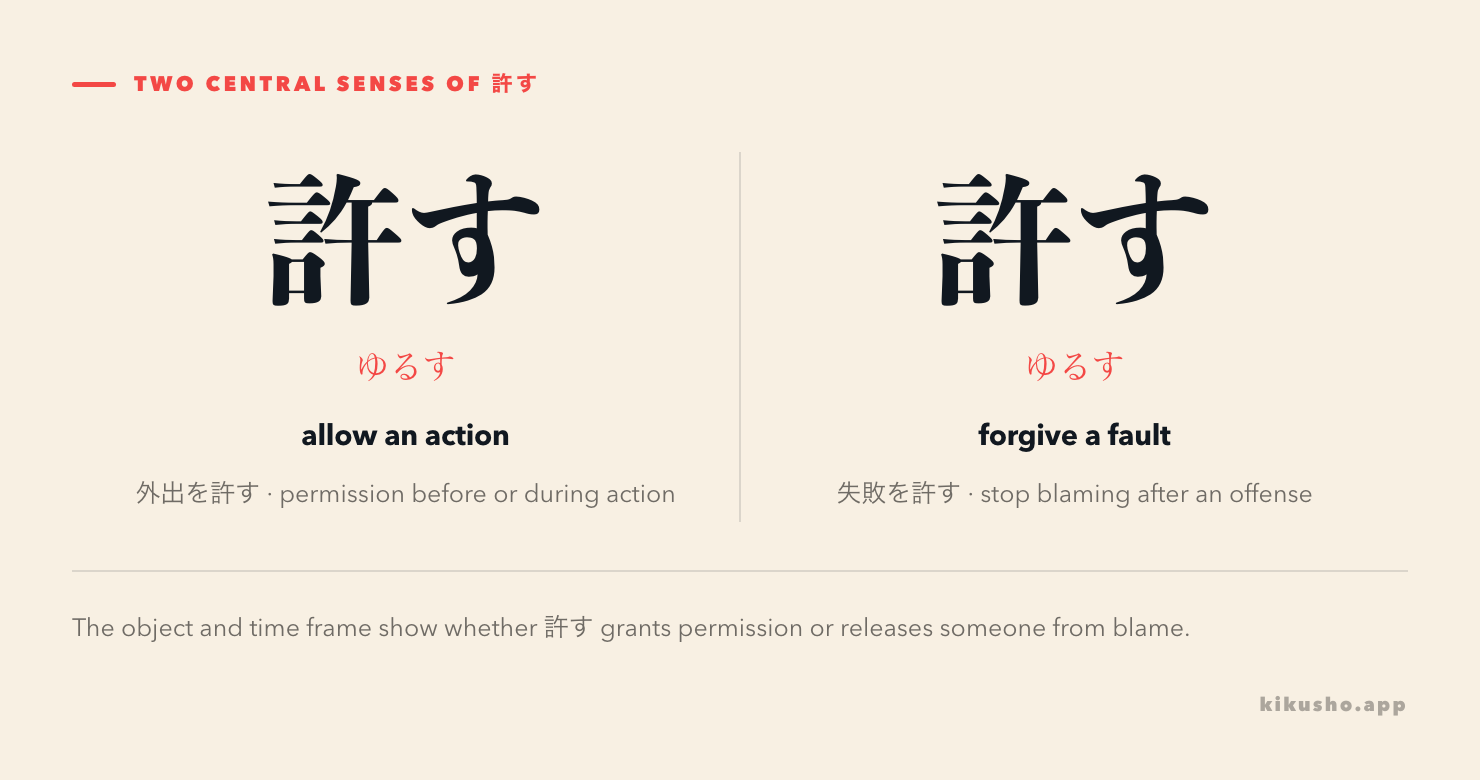
許す(ゆるす) can reverse the practical result by allowing an action: 外出を許す, 参加を許す, 子供が一人で行くのを許す. Shogakukan's entry also records a second central sense: deciding not to blame someone for a mistake or offense.
先生は学生が辞書を使うことを許した。
せんせいは がくせいが じしょを つかうことを ゆるした。
The teacher allowed the students to use a dictionary.
彼は友人の失敗を許し、もう責めないことにした。
かれは ゆうじんの しっぱいを ゆるし、もう せめないことに した。
He forgave his friend's mistake and decided not to blame him anymore.
The object decides the reading of the scene: an action is permitted, while a person, fault or offense is forgiven. In 時間が許せば, “if time permits,” circumstances make the action possible rather than a person granting formal permission.
One selection process uses all nine words
Imagine a student applying to a volunteer program. She 参加を願い, hopes to participate, and the organizers 追加資料を求める, request more documents. They 無断欠席を禁止し, prohibit unexplained absences, and the supervisor 参加者に規則を守るよう命じる. This is a clear 命令, not a suggestion.
The program 週末の外出を許す, permits weekend outings. If a student breaks a minor rule and apologizes, the supervisor may その失敗を許す, forgive it. An applicant can 面接を断る, decline an interview, or formally 参加を辞退する, withdraw from the program. A rejected applicant may feel disappointed, but one rejection does not require them to 目標を諦める, give up the goal.
In Kikusho, save complete frames such as 誘いを断る, 出場を辞退する, 説明を求める, 人に待機を命じる, 命令に従う and 失敗を許す. The particle and object preserve the relationship between the people in the scene.
N3 is a study estimate with visible disagreement
The two Waller-derived baseline files agree on N3 for eight records. 辞退 is split inside that same source family: one retained row places it at N3 and another at N1. Japanesetest4you separately indexes several of the headwords at N3, but its underlying list provenance is not independently established.
Independent teaching resources disagree in the other direction too: Bunpro currently presents 諦める in an N4 vocabulary deck. The official JLPT FAQ explains that the post-2010 exam no longer comes with a complete vocabulary, kanji and grammar catalogue. This lesson uses N3 as a practical sequence and states the disagreement rather than turning it into an official claim.
Practice: nine questions
Finish the nine tasks before revealing the solution notes.
1 · Kanji reading. Which reading belongs to 諦める?
- ① あきらめる
- ② たしかめる
- ③ ながめる
- ④ まとめる
2 · Write じたい. Choose the word for formally declining participation or an offered position.
- ① 自体
- ② 事態
- ③ 辞退
- ④ 時代
3 · Refuse or withdraw. Choose the pair that matches the situations.
友達の食事の誘いを( 前 )。けがのため大会への出場を( 後 )。
- ① 前 断った / 後 辞退した
- ② 前 辞退した / 後 諦めた
- ③ 前 禁止した / 後 許した
- ④ 前 命じた / 後 求めた
4 · Wish or seek action. Choose the pair that keeps the two viewpoints distinct.
家族の無事を( 前 )。警察に詳しい説明を( 後 )。
- ① 前 求める / 後 願う
- ② 前 願う / 後 求める
- ③ 前 許す / 後 断る
- ④ 前 命じる / 後 諦める
5 · Order a person. Complete the sentence.
医師は患者__薬を飲むよう命じた。
- ① を
- ② で
- ③ に
- ④ から
6 · Follow the order. Which phrase means “obey an order”?
- ① 命令を願う
- ② 命令に従う
- ③ 命令を辞退する
- ④ 命令に諦める
7 · Permission or forgiveness. Which interpretation fits the sentence?
母は子供が一人で出かけるのを許した。
- ① She forgave the child for a past mistake.
- ② She ordered the child to go out alone.
- ③ She allowed the child to go out alone.
- ④ She gave up looking for the child.
8 · Name the policy. What does 館内での撮影は禁止されている mean?
- ① Visitors must ask to be photographed.
- ② Photography inside the building is prohibited.
- ③ The building has formally withdrawn from a contest.
- ④ Staff forgive every photography mistake.
9 · Follow the selection process. Choose the only coherent account.
主催者は追加書類を頼み、欠席を認めなかった。応募者は面接を受けないと伝え、正式に参加を取りやめた。
- ① 主催者は書類を求め、欠席を禁止した。応募者は面接を断り、参加を辞退した。
- ② 主催者は書類を諦め、欠席を願った。応募者は面接を命じ、参加を許した。
- ③ 主催者は書類を辞退し、欠席を求めた。応募者は面接を禁止し、参加を願った。
- ④ 主催者は書類を許し、欠席を断った。応募者は面接を求め、参加を命令した。
Answers and explanations
①, あきらめる. This verb abandons a hope, plan or pursuit after the person concludes that success is unlikely.
Choice ③: 辞退. 辞退 is the formal refusal or withdrawal word. 自体 means “itself,” 事態 is a situation, and 時代 is an era.
Choice ①: 前 断った / 後 辞退した. An everyday invitation can be 断る. Withdrawing from formal tournament participation suits 辞退する.
Choice ②: 前 願う / 後 求める. The family hopes for a desired result. The second party actively asks the police to provide an explanation.
Choice ③: に. The recipient of the order takes に; the commanded action is packaged with Vるよう命じる.
Choice ②: 命令に従う. The order is the standard one obeys or follows with に. The other combinations do not express compliance.
Choice ③. The object is the child's action, so 許す means allow. Forgiveness would normally concern the child, a mistake or an offense already committed.
Choice ②. 禁止されている states that the policy disallows photography inside. It does not describe a request, withdrawal or forgiveness.
Choice ①. 求める requests the extra documents, 禁止する disallows absences, 断る rejects the interview, and 辞退する formally withdraws from participation.
Common questions
What is the difference between 断る and 辞退?
断る is the general verb for refusing an invitation, request or offer. 辞退 is a formal noun and suru-verb for declining or withdrawing from an offered role, right, place, award or participation.
What is the difference between 願う and 求める?
願う expresses a wish or asks that a desired situation become real. 求める actively seeks something or asks another party to provide, explain or do it; it can sound more like a demand with objects such as apology or action.
What is the difference between 命じる and 命令?
命じる is the verb “to order,” commonly used as 人に行動を命じる or 人にVるよう命じる. 命令 is the order itself and forms collocations such as 命令を下す, 命令を受ける and 命令に従う.
Does 許す mean both permit and forgive?
Yes. 許す can allow an action, as in 外出を許す, or stop blaming someone for a fault, as in 友人を許す. The object and situation select the sense.