On this page
Use お+verb stem+願います or ご+action noun+願います to make a formal request, especially in notices, announcements and workplace instructions. しばらくお待ち願います asks people to wait; 資料をご確認願います asks them to check a document.
Bunpro gives both attachment patterns and places the construction at N2, while JLPT Sensei records the same N2 placement and the question form 願えますか. These are independent study references, not an official exhaustive JLPT syllabus. Their shared classification is useful evidence for level, but the situation still decides whether the expression sounds appropriately formal or needlessly stiff.
お~願う turns an action into a formal request
The final verb 願う(ねがう) means to wish for or request something. In this pattern it follows a respectful name for the action you want another person to perform. In practice, the ending is usually polite 願います, not plain 願う.
恐れ入りますが、こちらでしばらくお待ち願います。
おそれいりますが、こちらで しばらく おまちねがいます。
We are sorry to trouble you, but please wait here for a moment.
The speaker does not describe their own act of waiting. お待ち names the listener's requested action, and 願います presents it as the speaker's request. That direction matters: the polite wrapping does not make every sentence humble speech about the speaker.
This construction is at home where one voice addresses customers, visitors, employees or an audience. You will meet it on forms, recorded announcements, venue notices and careful business correspondence.
Two attachment patterns cover most examples
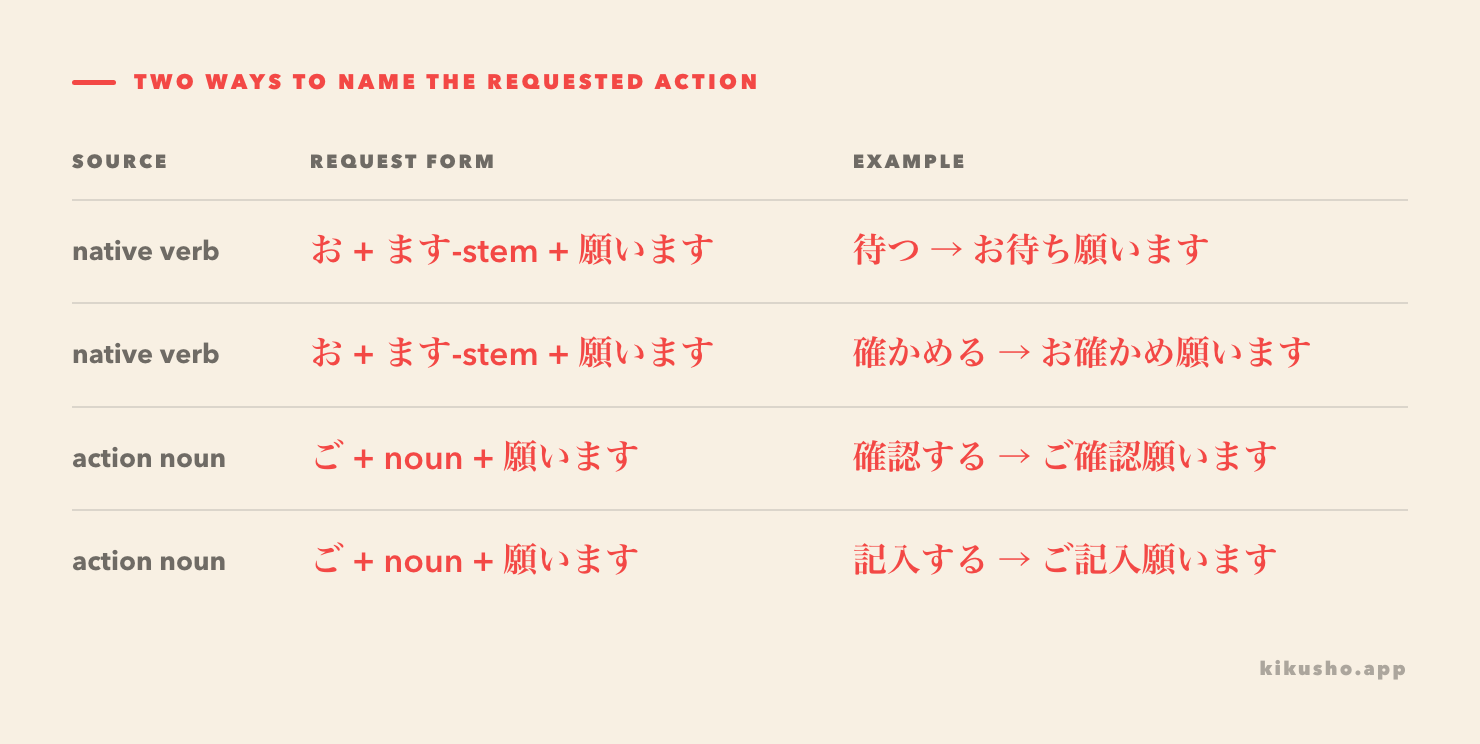
For a native Japanese verb, take its ます-stem, place お before it, and add 願います. For many Sino-Japanese action nouns, place ご before the noun and add 願います directly.
| Source | Requested-action form | Complete request |
|---|---|---|
| 待つ(まつ) | お+待ち | お待ち願います |
| 確かめる(たしかめる) | お+確かめ | お確かめ願います |
| 控える(ひかえる) | お+控え | お控え願います |
| 確認する(かくにんする) | ご+確認 | ご確認願います |
| 記入する(きにゅうする) | ご+記入 | ご記入願います |
| 署名する(しょめいする) | ご+署名 | ご署名願います |
申込書に必要事項をご記入願います。
もうしこみしょに ひつようじこうを ごきにゅうねがいます。
Please enter the required information on the application form.
There is no し between the action noun and 願います. ご確認し願います and ご記入し願います are malformed blends. Treat 確認 and 記入 as action nouns in this frame, then attach 願います directly.
The お/ご choice follows a strong tendency rather than a perfect etymological switch. Native verbs commonly take お, while Sino-Japanese compounds commonly take ご. Learn recurring units such as お待ち願います, お確かめ願います, ご確認願います and ご協力願います instead of trying to generate the pattern with every verb you know.
願います suits notices that expect cooperation
The statement form 願います is polite, but it is still a stated request. A station, office or event organiser can use it when the requested behaviour is part of a procedure shared by everyone.
会場内では、携帯電話の電源をお切り願います。
かいじょうないでは、けいたいでんわの でんげんを おきりねがいます。
Please switch off your mobile phone inside the venue.
入館の際は、受付で身分証明書をご提示願います。
にゅうかんの さいは、うけつけで みぶんしょうめいしょを ごていじねがいます。
When entering, please present identification at reception.
Both sentences name an action that the institution expects. The request is deferential in form, yet the listener is not being invited to negotiate the rule. That combination explains why the pattern can sound courteous in an announcement and oddly official between friends.
The Agency for Cultural Affairs' guidance on request language stresses that an expression's appropriateness depends on the relationship and situation, not on piling up polite material. Here the appropriate situation is usually public, procedural or professionally careful.
願えますか leaves a personal request more open
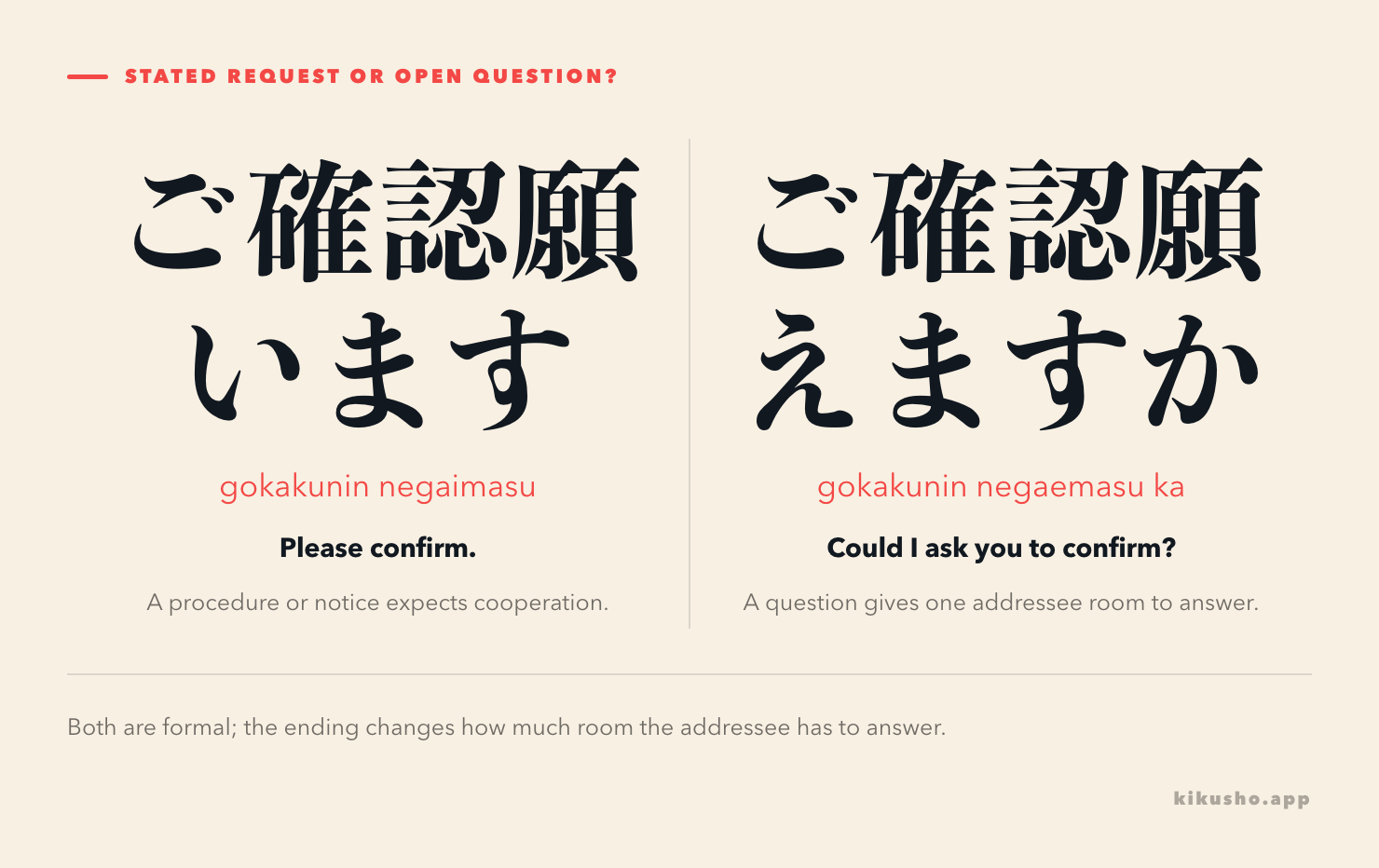
The potential question 願えますか asks whether the listener can grant the request. It retains the formal frame but gives the addressee an explicit place to answer.
もう一度、詳しい経緯をお聞かせ願えますか。
もういちど、くわしい けいいを おきかせねがえますか。
Could you tell me the details once more?
来週までに内容をご確認願えますか。
らいしゅうまでに ないようを ごかくにんねがえますか。
Could I ask you to check the contents by next week?
The contrast is one of stance, not simply present versus potential grammar:
| Ending | How the request lands | Typical setting |
|---|---|---|
| ~願います | stated request; cooperation is expected | notice, announcement, procedure |
| ~願えますか | asks whether the request can be granted | careful request to a particular person |
The question form does not become casual. If you are asking a friend to look at a photo, この写真、見てくれる? fits the relationship better than この写真をお確かめ願えますか.
お~ください and てください occupy wider territory
お待ちください and お待ち願います can point to the same requested action. The difference lies in where each expression feels at home.
お~ください/ご~ください is a productive respectful instruction. It appears in service encounters and public speech, but it can also address one person naturally: こちらにお名前をご記入ください. The lesson on respectful requests with お~ください explains that earlier pattern.
お~願います/ご~願います sounds more institutional and written. It presents the act as something the speaker or organisation requests: こちらにお名前をご記入願います. Bunpro's comparison likewise notes its concentration in formal situations and announcements.
Plain てください is broader still. 少し待ってください is a normal polite request without the administrative distance of お待ち願います. When you want the listener's consent rather than compliance with a procedure, a question such as 見ていただけますか or 確認してもらえますか may fit better.
The pattern does not accept every polite-looking action
Three limits prevent most mistakes.
First, the requested action belongs to the listener or another person whose cooperation is sought. To say what you will do, use an appropriate self-directed form instead: 私が確認いたします, “I will check.” 私がお確かめ願います reverses the roles.
Second, not every verb forms a natural お+stem unit. Very short stems, fixed honorific verbs and ordinary casual actions may prefer a different request pattern. If you have never encountered the unit, do not assume that inserting お and 願います will make it natural.
Third, お願いします is also a complete expression in several other constructions. In コーヒーをお願いします, the requested item is marked by を. In ご確認をお願いします, ご確認 is a noun followed by をお願いします. Those are useful requests, but their structure differs from the compact ご確認願います, which has no を.
This distinction is visible on a form:
内容のご確認をお願いします。
We ask you to check the contents.
内容をご確認願います。
Please check the contents.
The first packages the checking as a requested task. The second attaches 願います directly to the respectful action noun. Both can be correct; combining them as ご確認を願います changes the construction and should not be treated as the target pattern by accident.
Register is the clue that gives the pattern away
When a question offers お待ち願います, look for a formal request aimed at the addressee. When it offers ご確認願います, check that 確認 is an action noun and that no する or を has been inserted between it and 願います.
The sentence around the blank usually supplies a venue, procedure or professional relationship: 受付, 申込書, 館内, お客様, 期日までに. Those words do not create the grammar, but they make its register plausible. A picnic invitation or a sibling's text message points elsewhere.
For study, save the full request rather than a bare translation. Kikusho can keep 身分証明書をご提示願います with its reading, register note and audio, so the form returns with the situation that licensed it. That context is what separates usable keigo from a list of endings.
Practice
Read each request as a line from a notice or a careful exchange, then open the explanations after question 6.
Question 1
Choose the natural request for a formal application notice.
申込書に必要事項を__願います。
ア. ご記入し
イ. ご記入
ウ. お記入して
エ. 記入して
Question 2
Choose the form that asks one person whether they can tell you the details.
詳しい経緯をお聞かせ__。
ア. 願えますか
イ. 願いました
ウ. してください
エ. になりました
Question 3
Complete the announcement with the correct form of 切る.
会場内では、携帯電話の電源を__願います。
Question 4
Put the four pieces in the natural order.
__ __ __ __。
- 願います
- 受付で
- ご提示
- 身分証明書を
Question 5
Read the notice and identify why 願います is suitable.
入館される皆様は、受付でお名前をご記入願います。
Does it describe the writer's action, invite casual conversation, or state a procedure expected of visitors?
Question 6
Correct the attachment error without changing the requested action.
来週までに資料をご確認し願います。
Answers and explanations
Explanation 1
Choose イ. ご記入. 記入 is a Sino-Japanese action noun. The compact request is ご記入願います, with no し between the noun and 願います. 記入してください would be grammatical in another request pattern, but it does not fit before the printed 願います.
Explanation 2
ア. 願えますか. The potential question asks whether the listener can grant the request: お聞かせ願えますか. The other options either change the time, mix two request patterns or create an unrelated respectful construction.
Explanation 3
お切り. Take the ます-stem of 切ります, 切り, and place お before it: 電源をお切り願います. The announcement asks the audience to perform the action.
Explanation 4
2 → 4 → 3 → 1: 受付で身分証明書をご提示願います。 受付で marks the place, 身分証明書を is the object, and ご提示願います is the formal request predicate.
Explanation 5
It states a procedure expected of visitors. The plural audience and reception procedure suit the institutional distance of 願います. The visitors, not the writer, perform 記入.
Explanation 6
来週までに資料をご確認願います。 Remove し. In this pattern the action noun ご確認 attaches directly to 願います.
Common questions
What does お~願う mean in Japanese?
It makes a formal request: お待ち願います means “please wait,” and ご確認願います means “please confirm.” It is especially common in notices, announcements and formal workplace language.
How do you attach 願います to a verb?
With many native Japanese verbs, add お to the ます-stem and follow it with 願います: 待つ becomes お待ち願います, and 確かめる becomes お確かめ願います. Sino-Japanese action nouns commonly take ご, as in ご確認願います.
What is the difference between 願います and 願えますか?
願います states the request and often assumes cooperation, which suits public instructions and notices. 願えますか asks whether the listener can grant the request, so it gives a personal request more room for an answer.
Is お~願う ordinary casual Japanese?
No. The pattern belongs to formal service, business and public language. In an ordinary conversation, てください or a question such as てもらえますか is usually more natural.