On this page
Use いくつ to ask for a count and いくら to ask for a price or amount. Then move from the 数 you count to a 合計, judge whether it covers 全員, and compare the remaining 余裕 with the system's 限界.
These nineteen N3 words form one audit trail. Imagine checking registrations for an event: the questions collect values, the total combines them, proportion words describe coverage, and degree words show how close the plan is to capacity.
The quantity audit has four stages
| Stage | Words | Main decision |
|---|---|---|
| ask and count | 幾つ(いくつ), 幾ら(いくら), 数(かず), 数える, 数(すう), 数字 | What value are we measuring? |
| total | 計, 合計 | Is this a displayed total or an addition? |
| coverage | 全て, 全員, 大半, 大部分 | Does the claim cover things, people or most of a whole? |
| scale and capacity | 少々, 多少, 僅か, 相当, 莫大, 限界, 余裕 | How small, large or close to capacity is it? |
The two entries written 数 have different readings and jobs. The repeated spelling is part of the lesson, not a duplicate.
幾つ and 幾ら ask for different values
幾つ(いくつ) asks how many general objects there are and can also ask age. It is normally written いくつ in everyday text.
会議室はいくつ必要ですか。
かいぎしつは いくつ ひつようですか。
How many meeting rooms do we need?
幾ら(いくら) asks how much, especially a price or sum of money. It too is usually written in kana.
会場代はいくらかかりますか。
かいじょうだいは いくら かかりますか。
How much will the venue cost?
The dictionary entry for 幾ら also covers an unknown degree or amount. In the pattern いくら考えても, “no matter how much I think,” it no longer asks a direct price question. The N5 quantity lesson establishes the basic いくつ versus いくら choice; this N3 set follows the answers through a complete calculation.
数, 数える and 数字 separate amount, action and notation
数(かず) is a count, number or amount considered as a quantity.
参加者の数は昨日より増えました。
さんかしゃの かずは きのうより ふえました。
The number of participants increased from yesterday.
数える(かぞえる) is the action of counting items one by one or treating them as members of a count.
受付が名簿の名前を一人ずつ数えました。
うけつけが めいぼの なまえを ひとりずつ かぞえました。
Reception counted the names on the register one by one.
数(すう) is the on-reading used in number-related compounds and before a counter to mean “several”: 数学, mathematics; 人数, number of people; 数日, several days; 数ページ, several pages. Tokyo Shoseki's language FAQ notes that the isolated character can conventionally receive either reading, while compounds generally guide readers to すう.
数字(すうじ) is a numeral, digit or numerical figure as written or displayed.
申込書の数字を確認してから、人数を数えてください。
もうしこみしょの すうじを かくにんしてから、にんずうを かぞえて ください。
Check the figures on the application forms, then count the people.
A 数字 is the visible figure “75”; the 数 is the quantity it represents; 数える is the action that produces or checks that quantity.
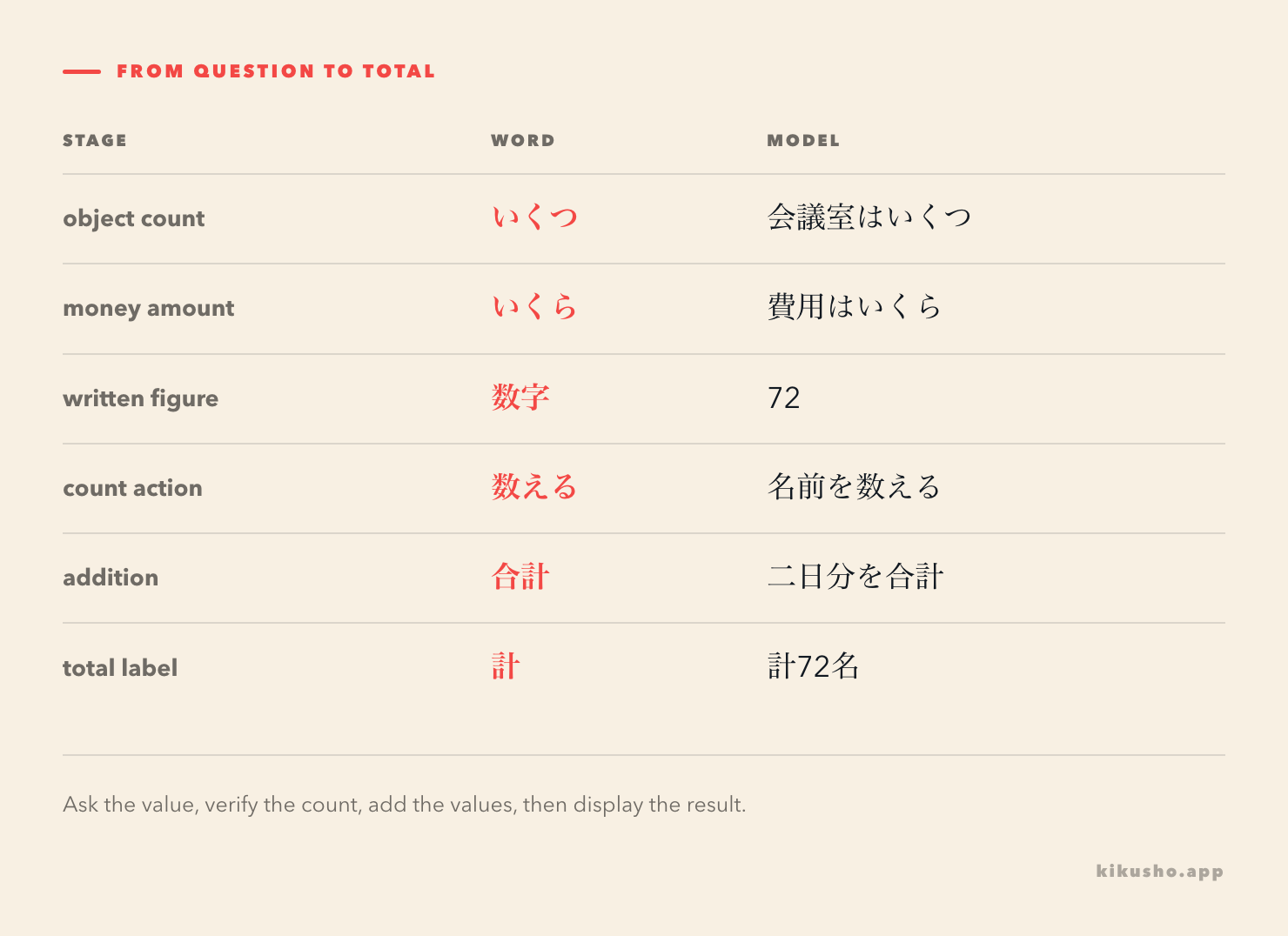
計 labels a total; 合計 performs or names the addition
計(けい) appears as a compact label for the resulting total, especially in tables, receipts and reports.
一日目は三十二名、二日目は四十名、計七十二名です。
いちにちめは さんじゅうにめい、ふつかめは よんじゅうめい、けい ななじゅうにめいです。
Day one has 32 people and day two has 40, for a total of 72.
合計(ごうけい) means adding two or more values together or the sum produced. It works as a noun and with する.
二日間の参加者数を合計すると、七十二名になります。
ふつかかんの さんかしゃすうを ごうけいすると、ななじゅうにめいに なります。
Adding the participant counts for the two days gives 72.
Shogakukan defines 合計 through combining multiple numbers or amounts. The short label 計72名 presents the result; 参加者数を合計する makes the calculation explicit. The separate planning sense seen in 計画 is not the job of 計 in this table label.
全て and 全員 make complete claims
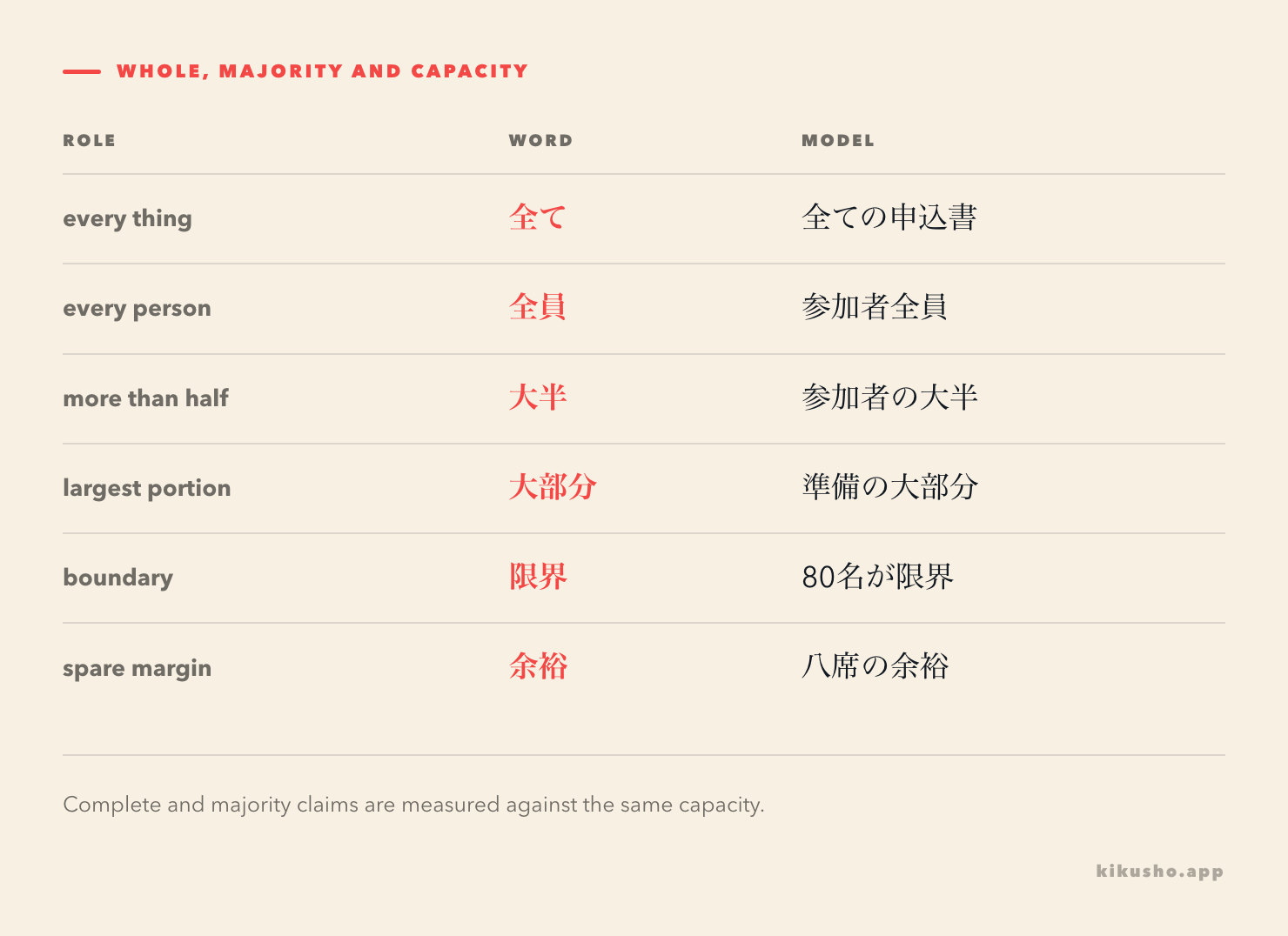
全て(すべて) covers every relevant thing, fact, step or part. It can stand alone or modify a noun with の.
全ての申込書を確認しました。
すべての もうしこみしょを かくにんしました。
We checked every application form.
全員(ぜんいん) means every member or person in a defined group.
参加者全員に名札を渡しました。
さんかしゃ ぜんいんに なふだを わたしました。
We gave a name tag to every participant.
The dictionary definition of 全員 restricts it to all personnel belonging to a group. Use 全ての資料, all documents, but 担当者全員, all staff members.
大半 and 大部分 stop short of all
大半(たいはん) is more than half and, by extension, most of a set.
参加者の大半は電車で来ます。
さんかしゃの たいはんは でんしゃで きます。
Most participants will come by train.
大部分(だいぶぶん) is the greater or largest part of a whole.
会場準備の大部分は前日に終わりました。
かいじょうじゅんびの だいぶぶんは ぜんじつに おわりました。
Most of the venue preparation was finished the day before.
The dictionary entry for 大半 starts from more than half and also records the broader “most” use. 大部分 readily treats preparation, a document or an area as one whole with a large portion. The words overlap, so the noun that follows matters more than an imagined fixed percentage.
Three small-amount words frame the same scale differently
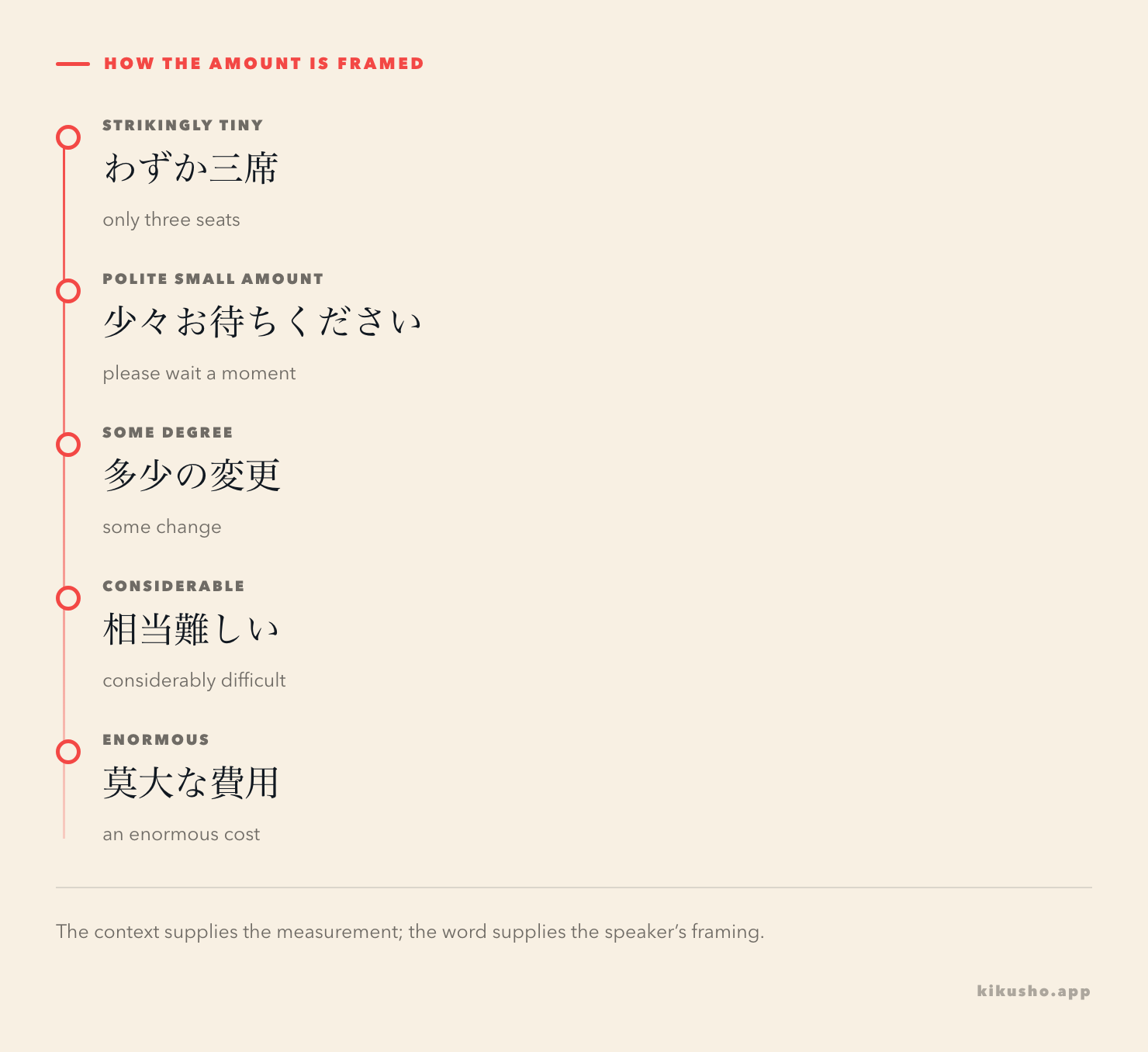
少々(しょうしょう) is a small amount or short time with a polite or formal tone.
確認しますので、少々お待ちください。
かくにんしますので、しょうしょう おまちください。
Please wait a moment while I check.
多少(たしょう) acknowledges some limited amount, degree or variation.
人数には多少の変更があるかもしれません。
にんずうには たしょうの へんこうが あるかもしれません。
There may be some change in the number of people.
僅か(わずか) emphasizes that something is only a very small amount, difference or duration. Kana is common even though the inventory headword is 僅か.
空いている席はわずか三席です。
あいている せきは わずか さんせきです。
Only three seats remain open.
Shogakukan's 多少 entry supports both “how much or how little” and the adverbial “somewhat” sense. 少々 softens a request or names a modest measure; 多少 concedes that some degree exists; わずか makes its smallness salient.
相当 and 莫大 move upward on the scale
相当(そうとう) has three connected uses: a considerable degree, equivalent value, and correspondence to a standard.
この作業には相当時間がかかります。
この さぎょうには そうとう じかんが かかります。
This task will take a considerable amount of time.
一万円相当の機材を借りました。
いちまんえん そうとうの きざいを かりました。
We borrowed equipment worth the equivalent of 10,000 yen.
The dictionary entry for 相当 also gives 年齢に相当する, correspond to an age. Read the frame: 相当 + predicate often means considerably, amount + 相当の + noun gives equivalent value, and Nに相当する marks correspondence.
莫大(ばくだい) is a な-adjective for an extremely large quantity or degree, especially something measurable such as money, assets, data or loss.
大規模な展示会には莫大な費用がかかります。
だいきぼな てんじかいには ばくだいな ひようが かかります。
A large exhibition incurs enormous costs.
Shogakukan's usage note particularly associates 莫大 with quantities such as an amount of money, volume or property. 相当高い is considerably expensive; 莫大な費用 is an enormous cost.
限界 is the boundary; 余裕 is the room before it
限界(げんかい) is the furthest boundary of ability, capacity or possibility.
この会場の収容人数は八十名が限界です。
この かいじょうの しゅうようにんずうは はちじゅうめいが げんかいです。
Eighty people is the capacity limit of this venue.
Useful partners are 限界に達する, reach the limit; 限界を超える, exceed it; and 能力の限界, the limit of one's ability. The dictionary entry describes a boundary beyond which something cannot continue.
余裕(よゆう) is spare room before a limit, whether in time, money, capacity or mental composure.
参加者は七十二名なので、まだ八席の余裕があります。
さんかしゃは ななじゅうにめいなので、まだ はっせきの よゆうが あります。
There are 72 participants, so there is still room for eight seats.
The Kanjipedia entry covers both calm composure and something remaining in reserve. 時間に余裕を持つ leaves time to spare; 余裕がない can mean no spare capacity or no composure.
The N2 quantity, extent and limits lesson continues from capacity into allowed limits, leftovers, whole-field scope, huge finite volume, countless items and true infinity.
Read one registration report from question to margin
会議室はいくつ必要で、費用はいくらか。まず申込書の数字を確認し、参加者の数を数える。二日分を合計した結果は計七十二名だった。全ての申込書に問題はなく、参加者全員に連絡した。大半は電車で来るため、駐車場準備の大部分は不要になった。人数は多少変わる可能性があるが、限界の八十名まで八席の余裕がある。
かいぎしつは いくつ ひつようで、ひようは いくらか。まず もうしこみしょの すうじを かくにんし、さんかしゃの かずを かぞえる。ふつかぶんを ごうけいした けっかは けい ななじゅうにめいだった。すべての もうしこみしょに もんだいはなく、さんかしゃ ぜんいんに れんらくした。たいはんは でんしゃで くるため、ちゅうしゃじょうじゅんびの だいぶぶんは ふように なった。にんずうは たしょう かわる かのうせいが あるが、げんかいの はちじゅうめいまで はっせきの よゆうが ある。
How many meeting rooms are needed, and how much will it cost? First check the figures on the forms and count the participants. Adding both days gives a displayed total of 72. Every form is in order, and every participant has been contacted. Most will come by train, so most parking preparation is no longer needed. The number may change somewhat, but eight seats remain before the limit of 80.
Save the complete frame in Kikusho, not an isolated English label: 計七十二名, 参加者全員, わずか三席, 限界に達する, and 時間に余裕がある each preserve the grammatical clue that selects the word.
Why this set sits in the N3 study sequence
The September 2026 Kikusho snapshot files all nineteen spelling-and-reading records under N3 and records no internal disagreement. Its two baseline files share Waller/Tanos lineage. A separately published JapaneseTest4You N3 index independently lists examples including 合計, 数字 and 余裕, but its underlying list provenance is not treated as a second language authority.
The dictionary and education sources above verify readings, senses and usage rather than exam placement. The official JLPT organisers do not publish an exhaustive vocabulary list. N3 is therefore a practical study order, while the distinctions in this lesson stand on current definitions and original examples.
Practice: audit the values before opening the answers
1 · Cost report reading. Select the reading attached to 莫大な費用.
A. ばくだい
B. ぼうだい
C. まくだい
D. ばくたい
2 · Capacity reading. Select the reading attached to 八席の余裕.
A. ようゆ
B. よゆう
C. よじょう
D. ようじょ
3 · Orthography. Which spelling matches たしょう, “somewhat” or “some”?
A. 対象
B. 多小
C. 多少
D. 大少
4 · Orthography. Which verb means “to count” and is read かぞえる?
A. 数える
B. 加える
C. 超える
D. 支える
5 · People or things. Complete: 参加者__に予定変更を知らせました。
A. 全て
B. 全員
C. 大部分
D. 数字
6 · Add the values. Which sentence explicitly says to add the three costs?
A. 三つの費用を合計する。
B. 三つの費用を全員する。
C. 三つの費用を限界する。
D. 三つの費用を数字する。
7 · Read the small amount. What does 空席はわずか二席です emphasize?
A. Exactly half the seats are open.
B. Every seat is open.
C. Only two seats remain open.
D. The seats are enormously expensive.
8 · Choose the 相当 frame. Which sentence means “This job is considerably difficult”?
A. この仕事は相当難しい。
B. この仕事は相当に相当する。
C. この仕事は相当を数える。
D. この仕事は相当の全員だ。
9 · Majority or complete set. Which claim is strongest?
A. 参加者の大半が回答した。
B. 参加者全員が回答した。
C. 参加者の大部分が回答した。
D. 参加者が多少回答した。
10 · Capacity report. The room holds 80 people and 72 have registered. Complete the manager's accurate summary.
A. すでに限界を超えている。
B. 八席の余裕がある。
C. 参加者はわずか八名だ。
D. 費用は莫大だと分かる。
Use only the registration count and capacity given above; the report supplies no price evidence.
Answers and explanations
1 · A, ばくだい. 莫大 is a な-adjective for an enormous measurable amount or degree. 膨大 is read ぼうだい, but it is a different word.
2 · B, よゆう. 余裕 is spare room, leeway or composure.
3 · C, 多少. 多少 combines 多, much, and 少, little. In this use it acknowledges a limited amount or degree.
4 · A, 数える. 数える is the transitive verb “to count.” 加える means add, 超える means exceed, and 支える means support.
5 · B, 全員. The noun is a group of people, so 参加者全員 means every participant. 全て can cover things or aspects but does not fit this compound slot as written.
6 · A. 合計する explicitly adds multiple numerical values. 計 normally labels the result rather than taking this object and する pattern.
7 · C. わずか highlights the surprising smallness of the remaining count.
8 · A. Adverbial 相当 before 難しい means “considerably.” The other choices misuse its correspondence sense or attach unrelated quantity words.
9 · B. 全員 includes every participant. 大半 and 大部分 stop short of a complete-set claim, while 多少 does not state a participant proportion here.
10 · B. Eighty minus 72 leaves eight seats of spare capacity. The report does not establish any cost, and the registered count has not crossed the limit.
Common questions
When is 数 read かず and when is it read すう?
数 is normally かず when it is an independent native-Japanese noun for a count or amount, as in 人の数. The on-reading すう appears in compounds such as 数字 and in expressions such as 数日, several days. The surrounding word usually reveals the reading.
What is the difference between 計 and 合計?
計 commonly labels the final total in a table or list, as in 計80名. 合計 names the act or result of adding two or more values and can take する, as in 三つの金額を合計する.
What is the difference between 大半 and 大部分?
Both mean most or the greater part. 大半 explicitly starts from more than half and readily describes members or cases. 大部分 often focuses on the largest portion of a thing, task or text. Actual usage overlaps.
How do 少々, 多少 and わずか differ?
少々 is a polite or formal small amount, especially in requests such as 少々お待ちください. 多少 acknowledges some limited amount or degree. わずか emphasizes that an amount, difference or duration is strikingly small.