On this page
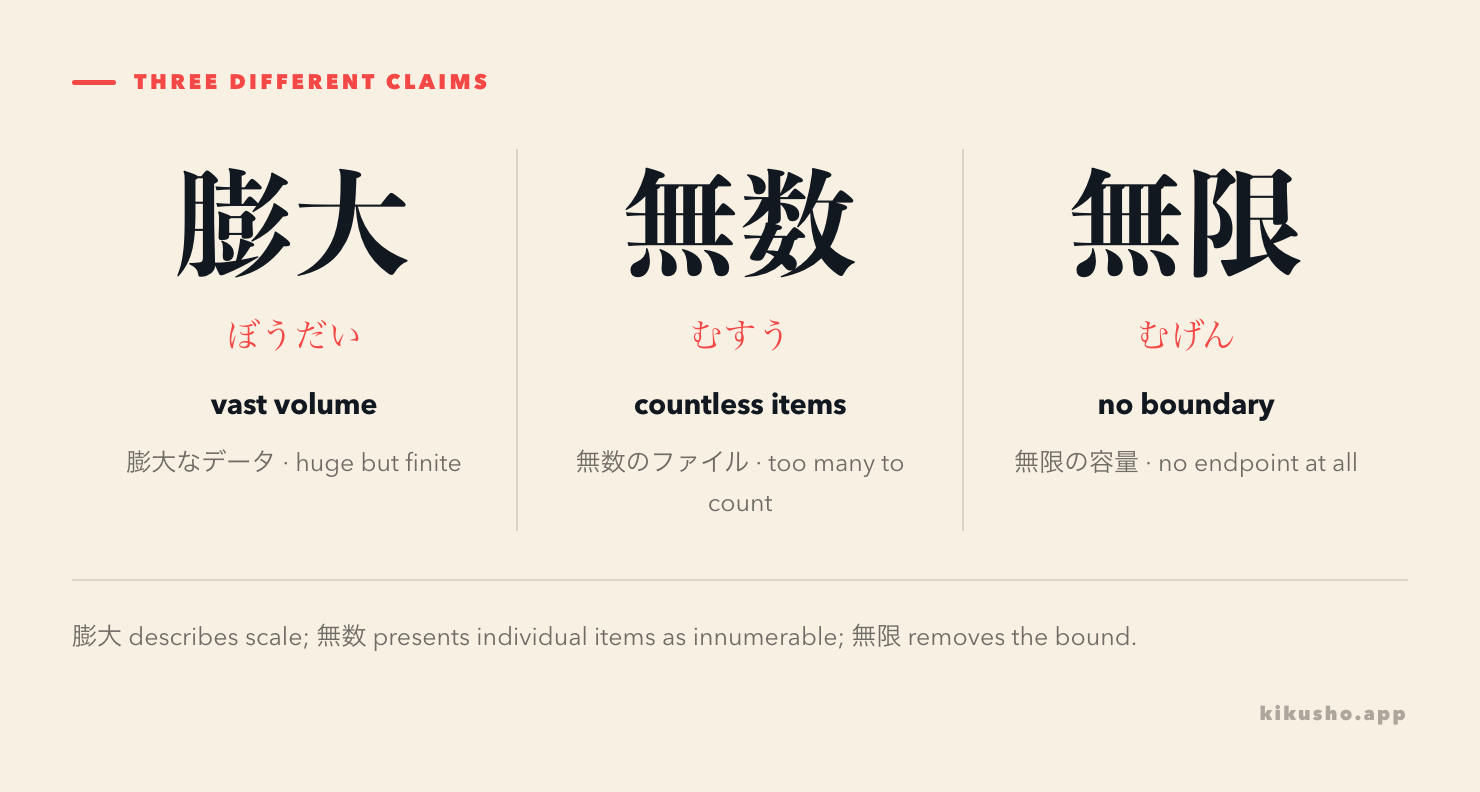
Use 膨大 for a huge but finite volume, 無数 for items too numerous to count, and 無限 only when no boundary exists. Then use 限度, 余る, 幾分 and 全般 to state the rule, the surplus, the degree of change and the scope of the work.
These seven N2 quantity words become easier when they describe one data migration. The team audits operations as a whole, moves an enormous archive containing countless files, sets an upload limit, compresses the data somewhat, and checks how much capacity is left over.
One migration, seven quantity decisions
| Word | Reading | Decision it makes | Useful frame |
|---|---|---|---|
| 余る | あまる | Is there more than we need? | 容量が余る |
| 幾分 | いくぶん | Did the degree change somewhat? | 幾分小さくなる |
| 限度 | げんど | What maximum has been set? | 二GBを限度とする |
| 全般 | ぜんぱん | Does this cover the whole field? | 業務全般 |
| 膨大 | ぼうだい | Is the volume enormous but finite? | 膨大なデータ |
| 無数 | むすう | Are the individual items innumerable? | 無数のファイル |
| 無限 | むげん | Is there truly no boundary? | 無限の可能性 |
The English word “huge” cannot select among all seven. Japanese asks whether you are describing volume, countable members, an absence of bounds, or the relationship between a quantity and a practical maximum.
余る marks a surplus beyond what is needed
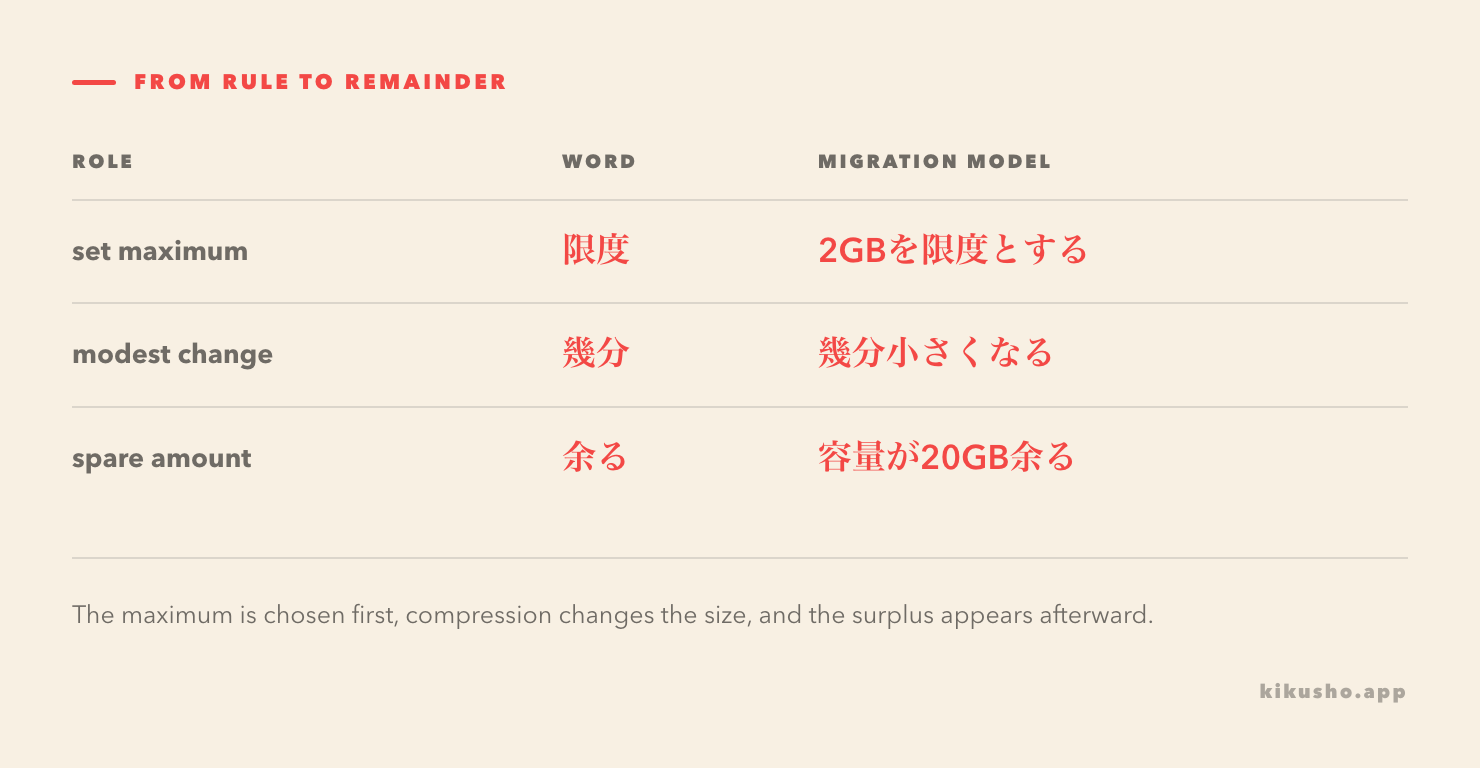
余る(あまる) is an intransitive verb: a quantity, resource or object is left over because there is more than the situation requires.
移行後も保存容量が二十ギガバイト余りました。
いこうごも ほぞんようりょうが にじゅうギガバイト あまりました。
Even after the migration, twenty gigabytes of storage capacity were left over.
The particle が marks what is in surplus. Common partners include 時間が余る, time is left over; お金が余る, money remains unused; and 席が余る, seats are left unfilled. Shogakukan's 余る entry also covers excess, division remainders and something that exceeds a person's ability.
That final sense appears in 手に余る, literally “to exceed one's hands” and practically “to be more than one can handle.”
この量の確認作業は一人の手に余ります。
この りょうの かくにんさぎょうは ひとりの てに あまります。
Checking this volume is more than one person can handle.
残る only says that something remains. 余る adds the judgment that the remainder exceeds present need or capacity. Ten files can 残る because the transfer failed; twenty gigabytes can 余る because the new archive uses less space than expected.
幾分 measures a modest degree or portion
幾分(いくぶん) often works as an adverb meaning “somewhat” or “to some degree.” It is more at home in measured reports and written explanations than in very casual conversation.
圧縮すると、ファイルは幾分小さくなりました。
あっしゅくすると、ファイルは いくぶん ちいさく なりました。
After compression, the files became somewhat smaller.
The sentence reports a real but limited change. It does not claim that the files became tiny. 多少 can often express a similar limited degree, but 幾分 gives the report a calm, slightly formal tone.
As a noun, 幾分 can mean a part or fraction. The pattern 幾分か leaves the exact share unspecified.
作業の幾分かは自動化できます。
さぎょうの いくぶんかは じどうかできます。
Some portion of the work can be automated.
The dictionary entry for 幾分 records both the fractional noun and the adverbial “somewhat” use. In an N2 sentence, first ask whether 幾分 modifies a change or names a portion.
限度 is a chosen or acceptable maximum
限度(げんど) is the maximum degree or boundary accepted for a particular purpose. A policy, contract, budget or safety rule can set it.
一つのファイルは二ギガバイトを限度とします。
ひとつの ファイルは にギガバイトを げんどとします。
Each file is limited to two gigabytes.
The formal frame Nを限度とする sets N as the maximum. Other frequent combinations are 限度額, maximum amount; 限度を超える, exceed the limit; and 我慢にも限度がある, even patience has a limit. These uses follow the set or acceptable bound described in Shogakukan's 限度 entry.
Do not automatically replace 限度 with 限界(げんかい). 限界 is the endpoint inherent in an ability, system or situation.
この装置の処理能力はここが限界です。
この そうちの しょりのうりょくは ここが げんかいです。
This is the limit of the device's processing capacity.
A service may set an upload 限度 of two gigabytes even though the machine's technical 限界 is higher. The dictionary comparison supports 能力の限界 for an inherent capacity and 二週間を限度とする for a chosen maximum.
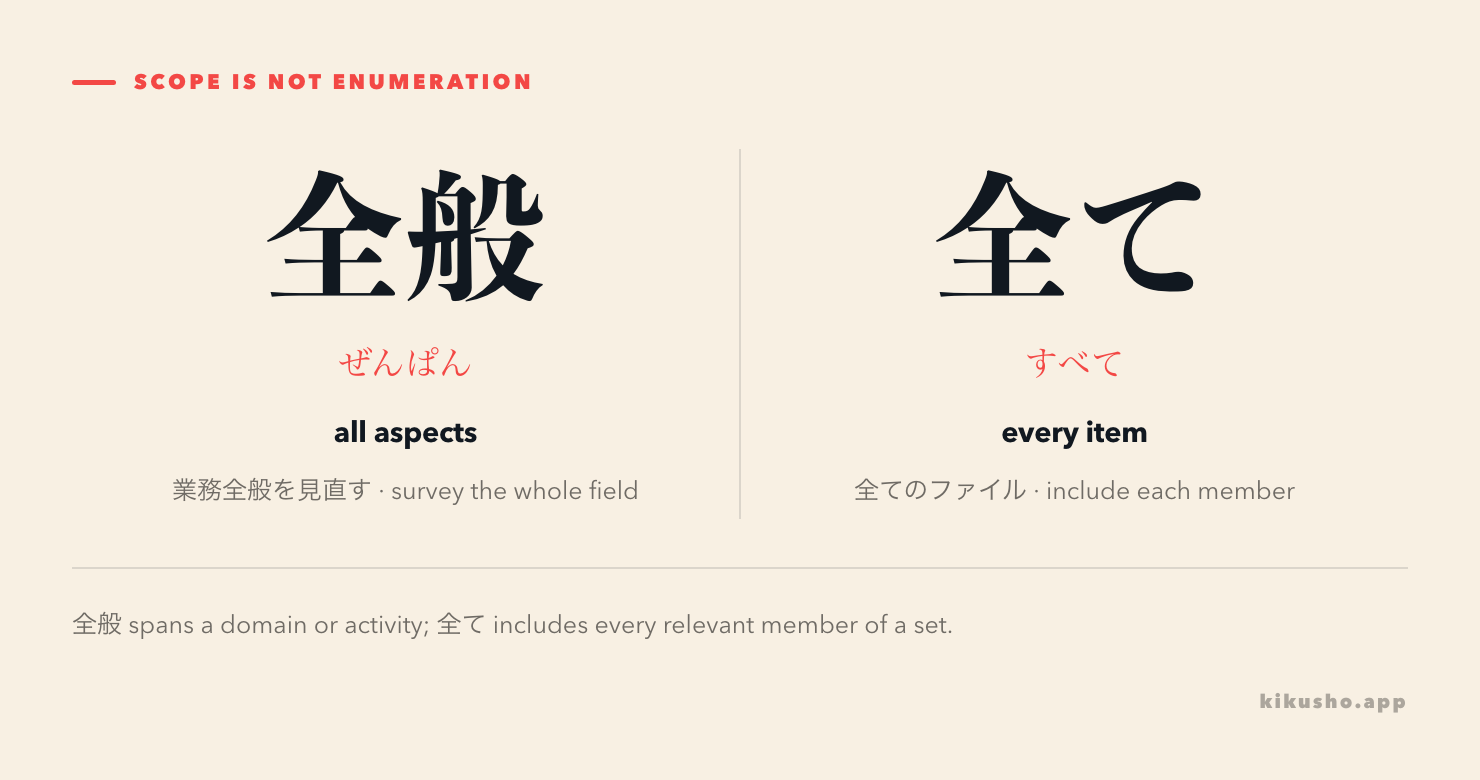
全般 covers all aspects of a field
全般(ぜんぱん) treats a field, activity or subject across its full range.
移行に合わせて、情報管理業務全般を見直しました。
いこうに あわせて、じょうほうかんりぎょうむ ぜんぱんを みなおしました。
Along with the migration, we reviewed information-management operations as a whole.
The team did not merely check one file. It considered access rules, backups, retention, storage and staff procedures across the field. This is the “whole of a matter” sense in the dictionary entry for 全般. 全般に見られる傾向 is a tendency seen throughout, while 全般的な知識 is broad knowledge covering the field.
Compare the focus of these three forms:
- 業務全般を見直す: review all aspects of operations.
- 全てのファイルを確認する: check every file in the relevant set.
- システム全体を停止する: stop the system as one complete whole.
全般 surveys a domain. 全て includes each relevant member. 全体 treats something as one complete entity.
膨大 is enormous in volume but still finite
膨大(ぼうだい) is a な-adjective for something enormous in amount, scale or extent.
旧システムには膨大なデータが保存されています。
きゅうシステムには ぼうだいな データが ほぞんされています。
An enormous volume of data is stored in the old system.
Natural partners include 膨大な資料, a vast collection of materials; 膨大な作業, a massive amount of work; and 膨大な費用, enormous expense. The dictionary definition of 膨大 centers on an extremely large size or quantity. A Japanese broadcaster's usage discussion likewise notes combinations with data, documents and rubbish.
莫大(ばくだい), introduced in the N3 quantity lesson, overlaps with 膨大. 莫大 is especially common with money, assets, losses and other measurable amounts; 膨大 readily describes a mass of data, documents or work. They are tendencies rather than an absolute border, so follow established collocations instead of forcing a rigid rule.
無数 counts rhetorically; 無限 removes the boundary
無数(むすう) literally joins 無, without, and 数, number. It describes individual things as too numerous to count.
保管庫には無数の小さなファイルがあります。
ほかんこには むすうの ちいさな ファイルが あります。
The archive contains countless small files.
The files remain countable in principle, but the speaker presents their number as overwhelming or indeterminate. You will see 無数の星, countless stars; 無数の傷, innumerable scratches; and 無数にある, exist in countless numbers. The 無数 dictionary entry defines the quantity as so great that it cannot be counted.
無限(むげん) uses 限, boundary, instead of 数. It means that there is no limit or endpoint.
クラウドでも保存容量は無限ではありません。
クラウドでも ほぞんようりょうは むげんでは ありません。
Even in the cloud, storage capacity is not infinite.
Frequent forms include 無限の可能性, unlimited possibilities; 無限に続く, continue without end; and 無限大, infinity. The dictionary entry for 無限 contrasts it with anything bounded or finite.
Do not use 無限 as a casual upgrade from “very large.” A one-petabyte archive can be 膨大, and it can contain 無数のファイル in rhetorical description, but its capacity is still finite. 無限 makes a much stronger logical claim.
Read the complete migration report
情報管理業務全般を見直したところ、旧システムには膨大なデータと無数の小さなファイルがあることが分かった。保存容量は無限ではないため、一つのファイルは二ギガバイトを限度とした。圧縮後はデータが幾分小さくなり、新しい保管庫の容量が二十ギガバイト余った。しかし、全てを一人で確認するのは手に余るので、三人で分担する。
じょうほうかんりぎょうむ ぜんぱんを みなおした ところ、きゅうシステムには ぼうだいな データと むすうの ちいさな ファイルが あることが わかった。ほぞんようりょうは むげんでは ないため、ひとつの ファイルは にギガバイトを げんどとした。あっしゅくごは データが いくぶん ちいさくなり、あたらしい ほかんこの ようりょうが にじゅうギガバイト あまった。しかし、すべてを ひとりで かくにんするのは てに あまるので、さんにんで ぶんたんする。
A review of information-management operations found an enormous volume of data and countless small files in the old system. Because storage is not infinite, each file was limited to two gigabytes. Compression made the data somewhat smaller, leaving twenty gigabytes unused in the new archive. However, checking everything is too much for one person, so three people will divide the work.
Save the full frames in Kikusho: 業務全般, 膨大なデータ, 無数のファイル, 二GBを限度とする, 幾分小さくなる and 容量が余る. The particles and noun partners preserve the distinction that a one-word translation loses.
The N1 quantity, extent and limits lesson narrows the lens from large-scale capacity to subsets, minorities, approximate degrees, trace amounts and the scope left for another judgment.
Why these words belong in the N2 sequence
The September 2026 Kikusho inventory places all seven spelling-and-reading records at N2 and records no internal level disagreement. The baseline files share Waller/Tanos lineage, so they count as one provenance family rather than two independent placement authorities. Independent N2 study material also lists examples such as 無数, 限度 and 膨大.
Those placement signals set a practical study order. The current dictionary sources above establish the readings and distinctions. The official JLPT organisers do not publish an exhaustive vocabulary list, so “N2” here describes Kikusho's evidence-based curriculum position rather than a claim that the test owner guarantees these exact words.
Practice: classify the quantity before revealing the key
1 · Reading. Select the reading used in 膨大なデータ.
A. ぼうたい
B. ぼうだい
C. ほうだい
D. ぼくだい
2 · Reading. Select the reading used in 業務全般.
A. ぜんばん
B. せんぱん
C. ぜんぱん
D. ぜんはん
The audit now moves from recognizing sound to writing the policy term.
3 · Policy spelling. Select the kanji compound for げんど, the accepted maximum.
A. 限度
B. 限渡
C. 減度
D. 現度
4 · Word formation. Which pairing correctly explains the two 無 compounds?
A. 無数 = no boundary; 無限 = no number
B. 無数 = extra capacity; 無限 = set maximum
C. 無数 = broad scope; 無限 = modest degree
D. 無数 = no count; 無限 = no boundary
5 · Context. Compression reduced the archive from 480 GB to 450 GB. The writer wants to report a modest change. Complete 圧縮後、データは_小さくなった.
A. 無数
B. 幾分
C. 全般
D. 無限
6 · Context. A policy allows no file larger than two gigabytes. Complete 二ギガバイトを_とする.
A. 全般
B. 余り
C. 限度
D. 無数
7 · Context. The migration finished with twenty gigabytes more capacity than required. Complete 容量が二十ギガバイト_.
A. 余った
B. 無限だった
C. 全般だった
D. 限度だった
8 · Scope. The team reviews access, backups, retention and staff procedures across information management. Choose the expression that covers this full operational domain.
A. 無数の業務
B. 幾分の業務
C. 業務の限度
D. 情報管理業務全般
9 · Contrast. Which line uses the scale words precisely?
A. A finite 600 GB archive is 無限, while every file is 膨大.
B. A two-gigabyte rule is 無数, while spare capacity is 全般.
C. The archive is 膨大, it contains 無数のファイル, and its capacity is not 無限.
D. A modest size reduction is 無限, while an endpoint is 幾分.
10 · Usage. Which sentence most naturally means “This volume of checking is too much for one person to handle”?
A. この確認作業は一人に無限です。
B. この量の確認作業は一人の手に余ります。
C. この確認作業は一人を限度に余ります。
D. この量は一人の全般を超えます。
Finish the audit first; the explanations below connect every answer to the migration model.
Answers and explanations
The migration sequence supplies the reason for each selection: scope, volume, rule, change and remainder stay separate.
- B. 膨大 is read ぼうだい. The voiced だ begins the second part.
- C. 全般 is read ぜんぱん. The initial consonant of 般 becomes p in this compound.
- A. 限度 combines “limit” and “degree” for an accepted or set maximum.
- D. 数 points to number or count, while 限 points to a boundary. 無 cancels each concept.
- B. 幾分小さくなった reports that the files became somewhat smaller.
- C. 二ギガバイトを限度とする sets two gigabytes as the allowed maximum.
- A. 容量が余った says that capacity was left over beyond what the migration needed.
- D. 情報管理業務全般 spans all aspects of the work as a field.
- C. 膨大 describes the archive's huge finite volume, 無数 frames the many individual files, and 無限 is correctly rejected for bounded storage.
- B. 一人の手に余る is the established frame for work that exceeds one person's ability to handle it.
Common questions
What is the difference between 限度 and 限界?
限度 is a set or acceptable maximum, such as a two-gigabyte upload limit. 限界 is the furthest point that an ability, machine or situation can actually reach. A rule can set a 限度 below the system's 限界.
How do 膨大, 無数 and 無限 differ?
膨大 describes an enormous volume that can still be finite. 無数 presents individual things as too numerous to count. 無限 means that no boundary or endpoint exists.
What is the difference between 余る and 残る?
残る neutrally says that something remains. 余る says that more remains than is needed or can be used, as when twenty gigabytes are left over after a migration.
What is the difference between 全般 and 全て?
全般 surveys all aspects of a field or activity, as in operations in general. 全て includes every relevant item, person or step in the set.