On this page
Someone compliments your Japanese, and the reply a native speaker expects is to disagree with them. That reflex, deflecting the praise instead of accepting it, is 謙遜, and it belongs to a small family of N2 words for the moves a relationship keeps asking of you: honour the person above you (敬う), play yourself down (謙遜), comfort the one who is hurting (慰める), share in another's good fortune (慶び), and own a fault (詫びる).
None of the five is hard to translate. The difficulty is register. Four of them are the formal shadow of a word you already know — 敬う of 尊敬する, 謙遜 of 謙虚, 慶び of 喜び, 詫びる of 謝る — and reaching for the plain word at the formal moment is the slip that marks a beginner. The fifth, 慰める, has no plainer twin; it is simply the word.
Five moves a relationship asks of you
These are acts, not moods. Each one is something you do toward another person at a particular hinge in a relationship, and the whole set is the vocabulary of keeping your standing right: raising others, lowering yourself, tending to how someone feels. Learn them together and the pattern does half the work.
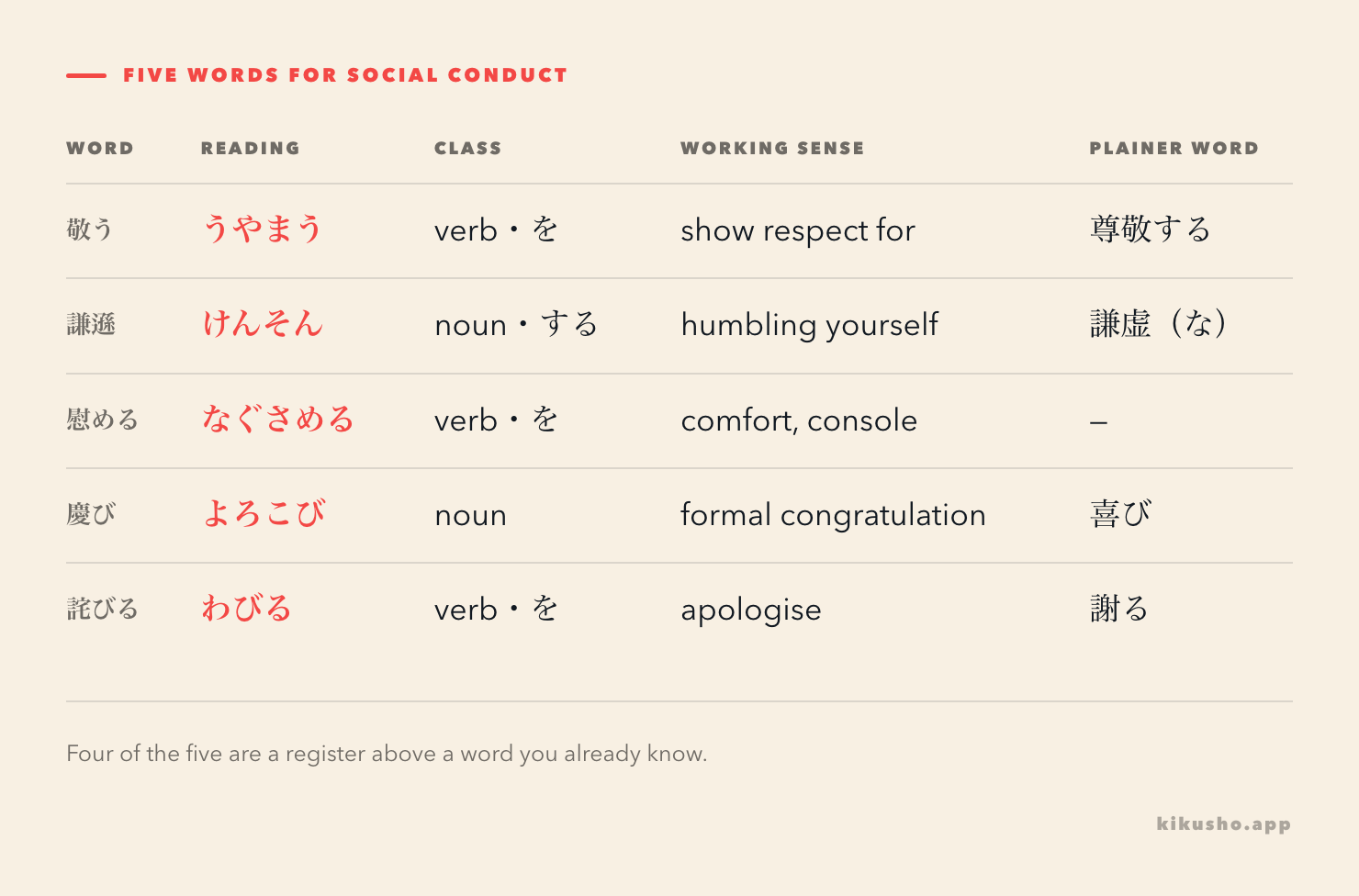
| Word and reading | Class | Working sense | The plainer word it shadows |
|---|---|---|---|
| 敬う(うやまう) | godan verb, takes を | to show respect for, to honour | 尊敬する |
| 謙遜(けんそん) | noun, する-verb | humbling yourself, playing yourself down | 謙虚(な) |
| 慰める(なぐさめる) | ichidan verb, takes を | to comfort, to console | — |
| 慶び(よろこび) | noun | formal congratulation, felicitation | 喜び |
| 詫びる(わびる) | ichidan verb, takes を | to apologise | 謝る |
敬う and 謙遜: raising others, lowering yourself
The two that go together are opposites pointed the same way. 敬う raises the other person; 謙遜 lowers you. Between them they carry the up-and-down that Japanese social life runs on.
敬う is transitive, so the person you respect is its object: 目上の人を敬う, 年長者を敬う, 神を敬う. It is the native verb where a textbook first taught you 尊敬する, and it reads as a degree more formal and more written. You meet it in prose about society and duty far more than in conversation: 若い社員も年長者を敬う. The particle is where it trips people. It is 祖父母を敬う, never 祖父母に敬う.
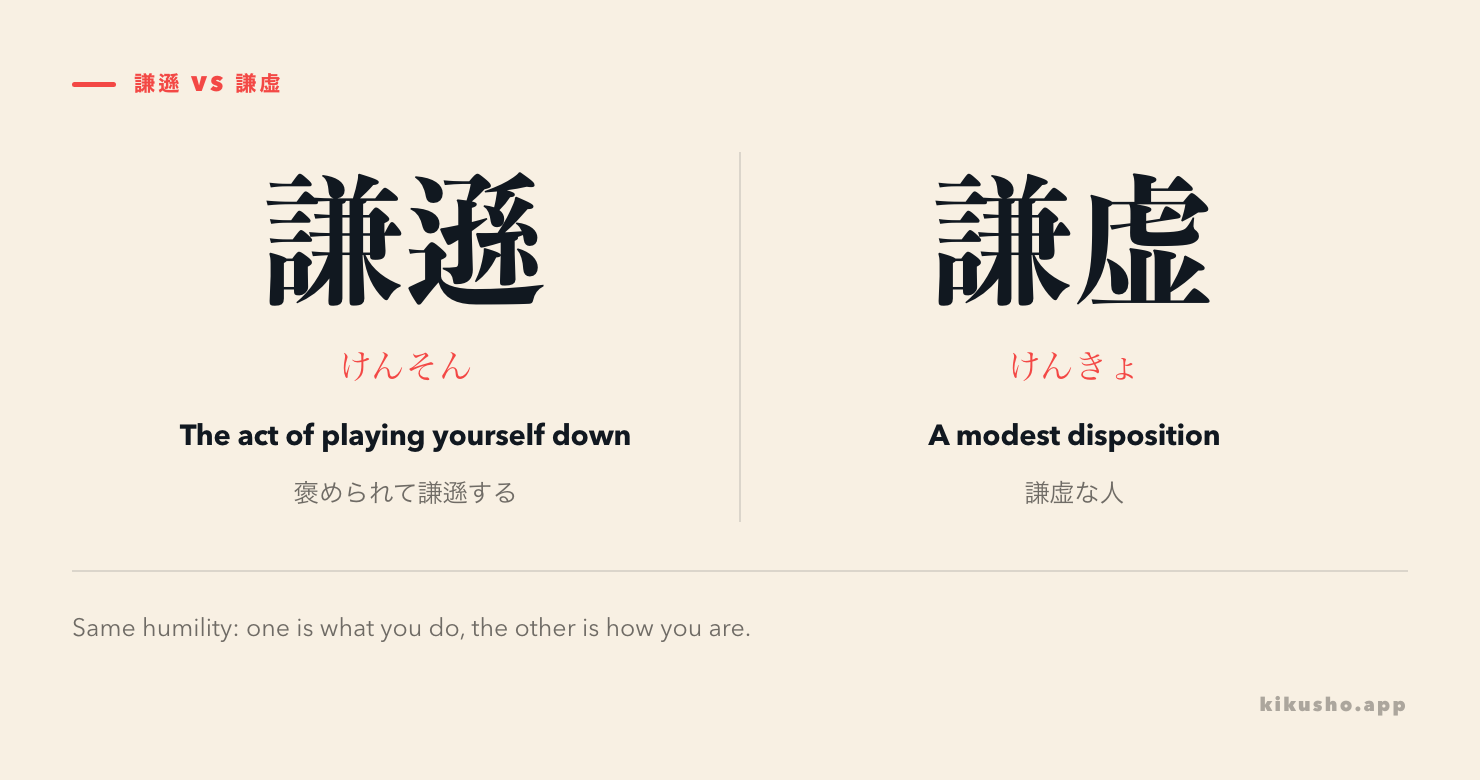
謙遜 is what you do with a compliment you are not allowed to keep. It is close to 謙虚, and the two are listed as synonyms, but they split along a clean line. 謙虚 (けんきょ) is a disposition, a way a person is, and it describes them: 謙虚な人, 謙虚な態度. 謙遜 (けんそん) is the act, usually a spoken one, of talking your own merits down: 褒められても、彼女はいつも謙遜する. When someone protests that they are nothing special and you want to tell them not to be so modest, the word you reach for is theirs: ご謙遜を. The character and attitude words at N2 cover 謙虚 as a trait; this is its verb-shaped cousin.
慰める and 詫びる: the words for when something has gone wrong
Two more acts, both aimed outward, both for the moment a situation has turned.
慰める is to comfort someone who is down. It is transitive, and its object is the person, not the trouble: 試験に落ちて落ち込んでいる友人を慰める. The noun 慰め (なぐさめ) is the comfort itself, as in 慰めの言葉, words of consolation. This is the one word in the set with no formal disguise to keep straight from a casual twin. It is neither high nor low; it is the plain, correct word, which is exactly why it is the first of the five you will actually say.
詫びる is to apologise, and it sits a step above 謝る. 謝る (あやまる) is the everyday spoken apology, the one you say when you bump someone on the train. 詫びる (わびる) is more formal and more written, and its noun お詫び is the one that turns up in a company's statement or a letter: 心からお詫び申し上げます. It takes を: 自分の失礼を詫びる, 非を詫びる. A small warning for readers: it shares its root, and its reading, with 侘びる, the verb behind the aesthetic of 侘び寂び, so the kanji is doing the work of telling apology from quiet desolation. When politeness lives in the grammar of keigo rather than in single words, 詫びる and お詫び are the vocabulary that grammar is built around.
慶び: the joy you write, not the joy you feel
慶び is the odd one, and its trap is not meaning but spelling. Read it aloud and it is よろこび, the same sound as 喜び, the ordinary word for joy. The kanji is the whole difference. 慶 marks an auspicious, celebratory occasion, so 慶び is the felicitation you extend to someone on a happy event, kept almost entirely for formal writing. The everyday joy you feel is 喜び; the congratulation you offer in a New Year card or a formal note is 慶び.
Its natural home is a set phrase. お慶び申し上げます closes a formal greeting the way nothing plainer can, and it is why the word survives at all in modern use, alongside 慶事 (けいじ) for an auspicious occasion.
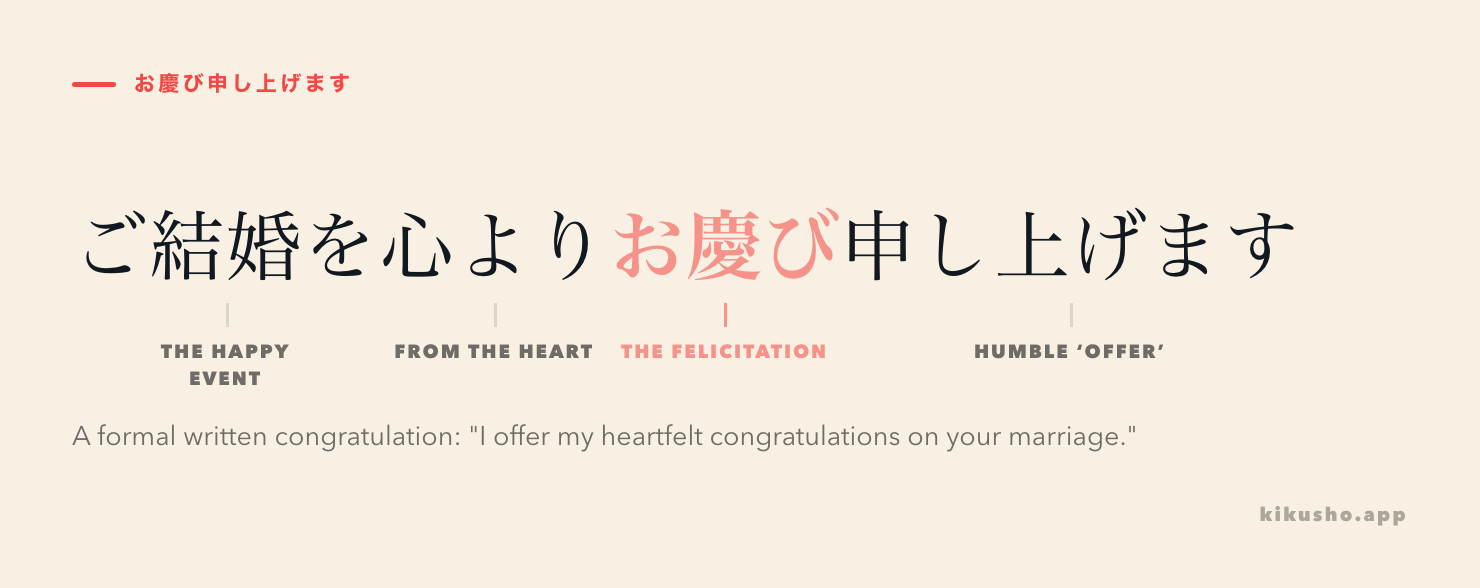
You will most often meet this spelling in a letter's opening line, next to the honorific vocabulary of formal correspondence such as 拝啓 and 敬具. Recognise it there and you will not misread it as a stranger's name.
The three that break the pattern
The set has a shape, and the useful thing is to see where it bends.
- 慰める breaks the register rule. The other four are a formal step above a plainer word; 慰める has no plainer twin, because it is already the neutral, everyday word for comforting someone.
- 慶び breaks the word class. It is the only noun among four verbs, and its difficulty is orthographic. You already know the word by sound and by its common spelling 喜び; what is new is one kanji and one register.
- 謙遜 breaks the direction. 敬う, 慰める and 詫びる all reach toward another person. 謙遜 is the only one that points back at yourself, which is why it feels strange to a learner whose instinct is to accept a compliment, not to talk it down.
Where each one will reach you
You will not choose when these words arrive, and that decides which spelling and reading you need cold. 敬う turns up in written prose about respect and society, so it is a reading you need for the page. 謙遜 arrives in speech the first time someone praises your Japanese and you have to answer. 慰める waits for the day a friend has bad news. 慶び is a card and a letter, read before it is ever said. 詫びる is a formal apology, more often written than spoken, with お詫び carrying it.
That spread is the case for catching them where they land rather than drilling them from a list. When you hit お慶び申し上げます in a New Year message, or hear 謙遜 land in a conversation you were not steering, that is the moment the word is worth keeping — with its reading, and with the note that it sits a register above the plain word you already had. Kikusho is built for that capture: photograph the card, paste the line, or say the phrase, and a review card comes back with the reading, the meaning and a register note on it, checked on screen before you save it. The scheduling runs on FSRS and works offline, which suits a word you met once and will not meet again for a month.
The reward for keeping them is not a test score. It is the first time you deflect a compliment without thinking, or sign a note with the spelling that fits, and the register comes out right on its own.
Practice: check the readings and the register
Keep the answers folded away until you have tried the whole set.
1 · Read the respect verb. Give the reading of the bold word: 目上の人を敬う。
- ① うやまう
- ② けいう
- ③ うやまる
- ④ したがう
2 · Read the felicitation. Give the reading of the bold word: このたびはお慶び申し上げます。
- ① よろこび
- ② けいび
- ③ いわい
- ④ めぐみ
3 · Respect the seniors. Choose the word that fits: 新入社員は、先輩たちを( )べきだ。
- ① 敬う
- ② 慰める
- ③ 詫びる
- ④ 慶ぶ
4 · Comfort a friend. Choose the word that fits: 試験に落ちて落ち込んでいる友人を( )。
- ① 慰めた
- ② 敬った
- ③ 謙遜した
- ④ 詫びた
5 · The formal apology. Which verb is closest in meaning to the bold word? 彼は自分の失礼を心から謝った。
- ① 詫びた
- ② 敬った
- ③ 慰めた
- ④ 謙遜した
6 · The right particle. Which sentence marks the object correctly?
- ① 私たちは祖父母に敬う。
- ② 私たちは祖父母を敬う。
- ③ 私たちは祖父母が敬う。
- ④ 私たちは祖父母で敬う。
Answers and explanations
①, うやまう. 敬う is read うやまう. ② けいう wrongly borrows the on-reading ケイ, which turns up in compounds like 敬語 and 尊敬 but not here; ③ うやまる is the wrong okurigana inflection; ④ したがう writes 従う, "to obey", a different verb.
①, よろこび. 慶び is read よろこび, the same sound as 喜び. ② けいび again reaches for the on-reading ケイ, heard in 慶事; ③ いわい is 祝い, a related idea in a different word; ④ めぐみ is 恵み, "blessing", unrelated.
①, 敬う. New employees should respect their seniors, and 先輩たちを敬う takes を correctly. 慰める (comfort), 詫びる (apologise) and 慶ぶ (rejoice over) do not fit "should ___ their seniors".
①, 慰めた. The friend is downcast after failing, so you comfort them: 慰めた. 敬った (respected) and 謙遜した (were modest about yourself) miss the situation, and 詫びた (apologised) would need a fault the sentence never gives.
①, 詫びた. 謝る and 詫びる both mean to apologise, with 詫びる the more formal, so 詫びた is the closest replacement. 敬った, 慰めた and 謙遜した each name a different act.
②, 私たちは祖父母を敬う。 敬う is transitive and marks its object with を. ① 祖父母に is the frequent particle error; ③ 祖父母が would make the grandparents the ones respecting; ④ 祖父母で is not valid here.
Common questions
What is the difference between 謙遜 and 謙虚?
謙虚 (けんきょ) describes a modest character or attitude, so it works as a description of a person: 謙虚な人. 謙遜 (けんそん) is the act of humbling yourself, especially playing your own achievements down out loud, which is why it behaves like a verb: 褒められて謙遜する.
Is 慶び the same word as 喜び?
They share the reading よろこび. 喜び is the everyday spelling for joy, while 慶び is a rarely used kanji form kept for formal congratulation, as in the letter phrase お慶び申し上げます. The kanji 慶 carries the sense of an auspicious occasion.
Is 詫びる more formal than 謝る?
Yes. 謝る (あやまる) is the everyday spoken apology. 詫びる (わびる) is more formal and literary, and its noun お詫び is what appears in written apologies such as お詫び申し上げます.
Does 敬う take に or を?
を. 敬う is a transitive verb, so the person you respect is its object: 目上の人を敬う, never 目上の人に敬う.