On this page
These twenty N1 Japanese conflict, danger and security words let you identify who creates a threat, what is endangered, how authorities respond and whether a text describes public safety or an armed conflict. The useful work lies in the borders between them: 脅す is not interchangeable with 脅かす, and 治安 does not name every kind of 秩序.
Twenty records divide causes, conditions, responses and institutions
| Word | Reading | Word class | Meaning here | Phrase to remember |
|---|---|---|---|---|
| 争い | あらそい, arasoi | noun | dispute; conflict; contest | 争いを避ける: avoid conflict |
| 戦 | いくさ, ikusa | noun | war; battle | 長い戦: a long war |
| 軍 | いくさ, ikusa | noun; alternate spelling | war; battle | 軍に出る: go to war |
| 脅す | おどす, odosu | transitive godan verb | threaten; intimidate | 人を脅す: threaten someone |
| 怯える | おびえる, obieru | intransitive ichidan verb | be frightened | 物音に怯える: be frightened by a sound |
| 脅かす | おびやかす, obiyakasu | transitive godan verb | threaten; endanger | 安全を脅かす: threaten safety |
| 危機 | きき, kiki | noun | crisis | 危機に直面する: face a crisis |
| 警戒 | けいかい, keikai | noun; suru verb | vigilance; guard against | 警戒を強める: heighten vigilance |
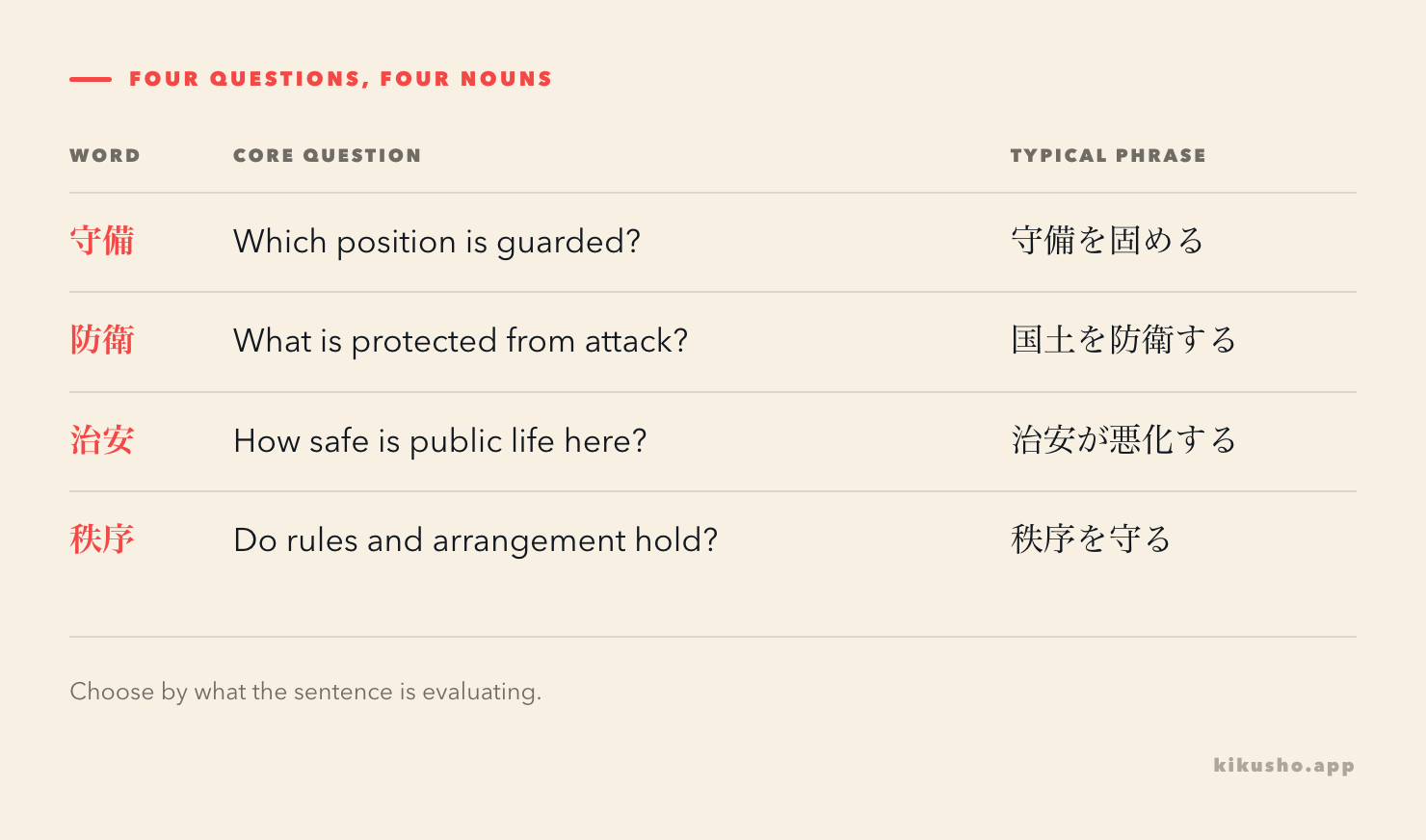
| 守備 | しゅび, shubi | noun; suru verb | defence; guarding a position | 守備を固める: strengthen the defence |
| 侵略 | しんりゃく, shinryaku | noun; suru verb | aggression; invasion | 他国を侵略する: invade another country |
| 征服 | せいふく, seifuku | noun; suru verb | conquest; subjugation; overcoming | 世界を征服する: conquer the world |
| 戦闘 | せんとう, sentō | noun; suru verb | combat; battle | 戦闘を停止する: cease combat |
| 治安 | ちあん, chian | noun | public security; public order | 治安を維持する: maintain public security |
| 秩序 | ちつじょ, chitsujo | noun | order; system | 秩序を守る: preserve order |
| 逃れる | のがれる, nogareru | intransitive ichidan verb | escape; evade | 難を逃れる: escape harm |
| 爆弾 | ばくだん, bakudan | noun | bomb | 爆弾が爆発する: a bomb explodes |
| 避難 | ひなん, hinan | noun; suru verb | evacuation; taking shelter | 高台に避難する: evacuate to high ground |
| 兵器 | へいき, heiki | noun | military weapon; armament | 兵器を廃棄する: dispose of weapons |
| 兵士 | へいし, heishi | noun | soldier | 兵士が任務に就く: a soldier takes up a duty |
| 防衛 | ぼうえい, bōei | noun; suru verb | defence; protection | 国を防衛する: defend a country |
The September 2026 Kikusho audit places every form in this table at N1. Because both baseline files inherited the Waller/Tanos list, they are parallel copies of one lineage rather than separate confirmation. Current N1 resources such as the TRY! N1 vocabulary list place 危機 in advanced study, while the JLPT does not publish an exhaustive current vocabulary list. Treat N1 as a study placement rather than a promise about a future paper.
The apparent exception is 軍(いくさ). An N3 comparison catches the same kanji only as 軍(ぐん); it does not verify this native reading or its war-and-battle sense. A Japanese dictionary entry for 戦 records 戦/軍(いくさ) together. In current prose, expect 戦 for いくさ and 軍(ぐん) in words such as 軍事 and 軍隊.
The prerequisite N3 conflict and security lesson teaches 争う, 戦う, 軍, 軍隊, 攻撃, 武器 and 爆発. This page moves from those broad actions and objects to the distinctions found in reports, policy writing and historical narrative.
脅す targets a person, 脅かす endangers a condition, and 怯える names fear
All three can appear around one event, but they assign different roles.
脅す(おどす) is a deliberate act directed at someone. The object is normally a person or group that receives the threat.
犯人は店員を脅して、金を要求した。
はんにんはてんいんをおどして、かねをようきゅうした。
The offender threatened the shop employee and demanded money.
脅かす(おびやかす) says that something endangers a condition, value or position. The subject does not have to speak or intend anything.
大気汚染が住民の健康を脅かしている。
たいきおせんがじゅうみんのけんこうをおびやかしている。
Air pollution is threatening residents' health.
怯える(おびえる) belongs to the experiencer. The person or animal feels fear, commonly marked by に in phrases such as 物音に怯える and 将来に怯える.
子どもは突然の物音に怯えた。
こどもはとつぜんのものおとにおびえた。
The child was frightened by the sudden sound.
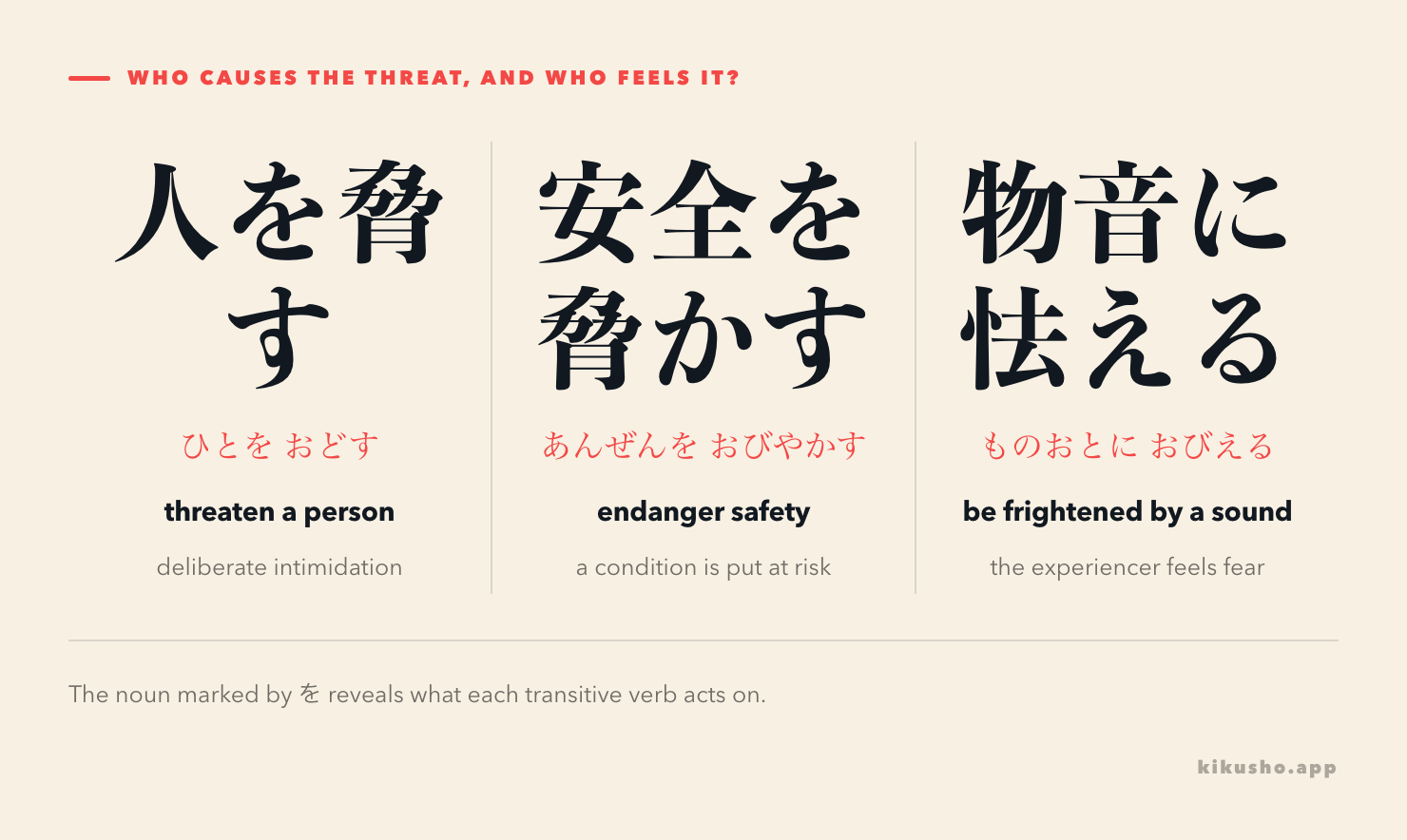
The spelling 脅かす also has the reading おどかす, meaning to frighten or startle. This lesson's inventory record is おびやかす, the reading used in 安全を脅かす. The dictionary entry for 脅かす keeps those readings and uses separate.
A crisis prompts vigilance, evacuation and escape
危機(きき) is a critical situation, not simply the possibility of harm expressed by prerequisite 危険(きけん). A company can face a financial crisis, a species can be in danger of extinction, and a government can try to overcome a political crisis. Common frames are 危機に陥る, 危機に直面する and 危機を乗り越える.
警戒(けいかい) is the watchfulness used before or during a possible threat. You can 台風を警戒する, 周囲を警戒する or 警戒を強める. A warning signal itself is often 警報(けいほう); 警戒 is the guarded stance or action.
避難(ひなん) is movement away from a dangerous place to one considered safe. The destination takes に: 住民は高台に避難した. The dictionary definition covers natural disasters, accidents and human causes, so the word does not imply panic or defeat.
逃れる(のがれる) focuses on getting free from danger, punishment, responsibility or another unwanted state. The thing escaped can take を, even though the verb is intransitive: 難を逃れる, 責任を逃れる, 危機を逃れる. By contrast, the earlier-level 逃げる often presents movement away from a person or place with から.
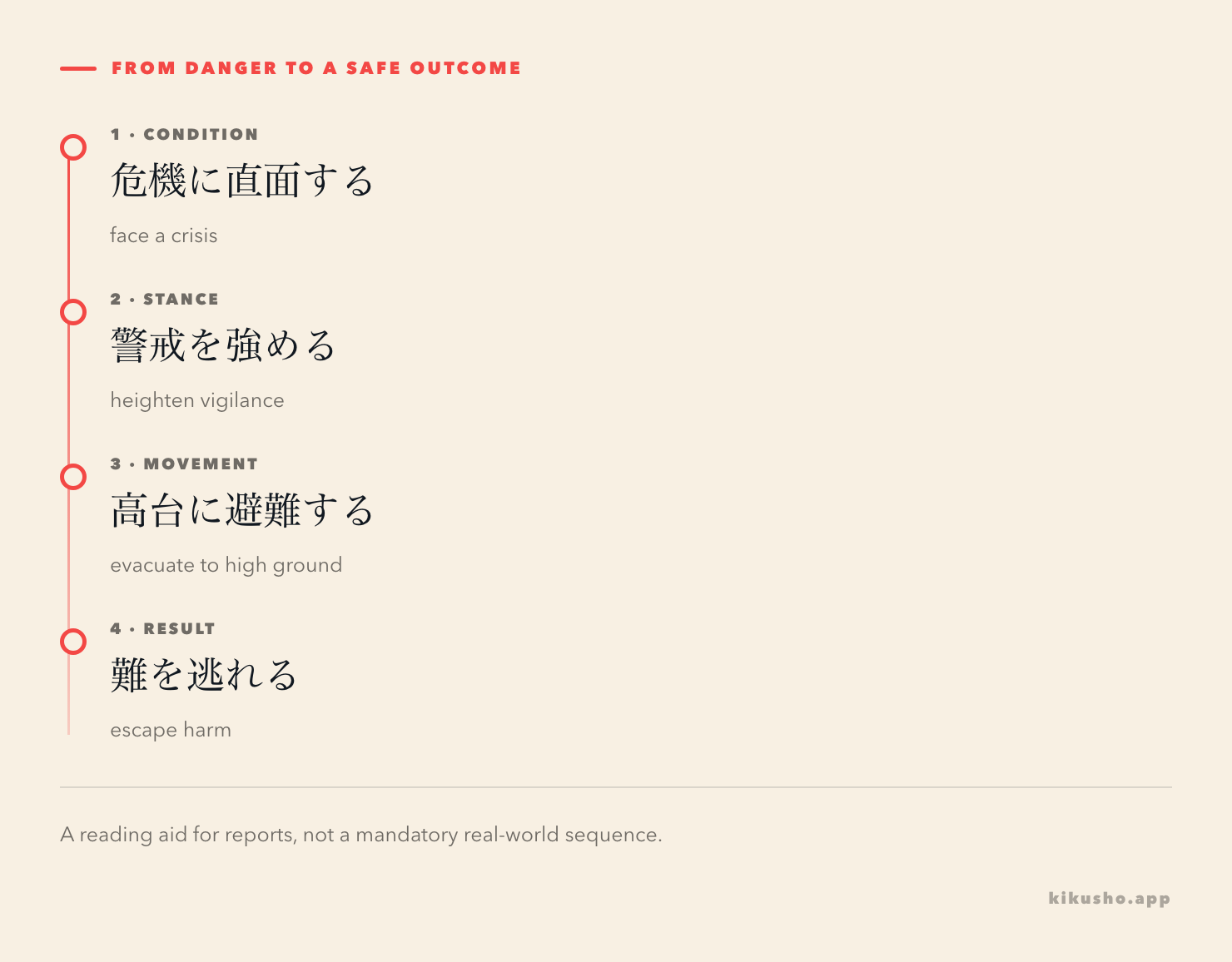
This sequence is a memory aid, not a rule that every emergency follows four stages. It helps you keep the nouns 危機, 警戒, 避難 apart from the result verb 逃れる.
守備 and 防衛 protect; 治安 and 秩序 describe what protection preserves
守備(しゅび) concentrates on a position or assigned area. It is especially common in sport: 守備につく, 守備を固める, 守備範囲. In military or historical prose it can also describe guarding a place.
防衛(ぼうえい) has a wider institutional scale. Countries defend territory, organisations defend systems, and speakers defend a position against an outside threat: 国土を防衛する, 防衛力を強化する. Neither word is confined absolutely to one field, but the position-versus-protection test solves most choices.
治安(ちあん) evaluates public security in a place. It combines naturally with 良い, 悪い, 改善する, 悪化する and 維持する. 秩序(ちつじょ) is the order produced by rules or arrangement, whether in a society, organisation, market or system. You 秩序を守る or 秩序を乱す.
| If the sentence asks about... | Choose | Typical phrase |
|---|---|---|
| guarding a position or playing defence | 守備 | 守備を固める |
| protecting a country, territory or system | 防衛 | 国土を防衛する |
| how safe a district or country is for the public | 治安 | 治安が悪化する |
| whether rules and arrangement hold together | 秩序 | 秩序を維持する |
The nearby N1 law and public-order lesson adds enforcement and judicial terms that often share a paragraph with 治安 and 秩序.
争い can stay local; 侵略, 戦闘 and 征服 specify larger acts or outcomes
争い(あらそい) is the noun related to 争う. It can name a quarrel, dispute, rivalry or conflict without saying that weapons are involved: 土地をめぐる争い, 争いが起きる, 争いを避ける.
戦/軍(いくさ) has an older, literary or historical colour compared with everyday 戦争(せんそう). Both spellings belong to the same dictionary entry. Because 軍 is normally read ぐん in modern compounds, a reader should not guess いくさ whenever that character appears.
侵略(しんりゃく) presents an aggressive entry into another country or territory. It can name the act or the policy: 他国を侵略する, 侵略を受ける. 戦闘(せんとう) is the combat itself, so it can begin, continue or stop: 戦闘が始まる, 戦闘を停止する.
征服(せいふく) focuses on bringing another people or territory under control. It can also be figurative, as in 世界を征服する in fiction or 難関を征服する for overcoming a formidable challenge. It does not serve as a neutral synonym for every invasion or battle.
These words are not a fixed chain. An 争い may never become armed conflict, 戦闘 may occur without conquest, and a writer's choice of 侵略 carries a judgment about aggression.
爆弾 is an object, 兵器 is a category, and 兵士 is a person
爆弾(ばくだん) names a bomb. 爆発(ばくはつ), taught in the N3 lesson, names the event: 爆弾が爆発した says that a bomb exploded, while 爆発が起きた leaves the cause open.
兵器(へいき) is a collective category for equipment used in combat. The dictionary definition includes equipment for attack and defence. 武器(ぶき) is broader in ordinary language and also works figuratively, as when knowledge or experience becomes someone's strength. 兵器 normally retains a military or technical frame.
兵士(へいし) is a soldier serving under military command. It names a person, not the force as an institution. Use 兵士を派遣する, 兵士が任務に就く and 負傷した兵士. The dictionary entry also records a historical legal-system sense, but modern news normally uses the military sense.
The broader political setting appears in the N1 government and international-relations lesson, where 条約, 同盟, 制裁 and 領土 explain the institutions around conflict.
Read the roles before translating the paragraph
Consider this short report:
大雨による洪水の危機が住民の安全を脅かした。自治体は警戒を強め、川の近くに住む人々に高台への避難を呼びかけた。多くの住民は難を逃れ、地域の治安と秩序にも大きな混乱はなかった。
おおあめによるこうずいのききがじゅうみんのあんぜんをおびやかした。じちたいはけいかいをつよめ、かわのちかくにすむひとびとにたかだいへのひなんをよびかけた。おおくのじゅうみんはなんをのがれ、ちいきのちあんとちつじょにもおおきなこんらんはなかった。
Flooding caused by heavy rain threatened residents' safety. The local authority heightened its vigilance and urged people living near the river to evacuate to higher ground. Many residents escaped harm, and public security and social order in the area were not seriously disrupted.
The verbs expose the roles before an English translation does. 危機 is the condition, 脅かした marks what it endangered, 警戒 is the authority's stance, 避難 is the instructed movement, and 逃れた is the result. If you save this paragraph in Kikusho, keep those five links as separate cards rather than flattening them into five versions of “danger.”
Practice the reading, context, paraphrase and usage
1 · Reading. What is the reading of 脅かす in this sentence?
気候変動が生態系を脅かしている。
- おどかしている
- おびやかしている
- おびえている
- おどしている
2 · Reading. How is 秩序 read?
- ちつじょ
- ちっしょ
- しつじょ
- じつじょ
3 · Reading in context. Which reading matches 軍 in the phrase below?
軍に出る
- ぐん
- いくさ
- へい
- つわもの
4 · Meaning in context. Choose the best word.
不審なメールが増えたため、会社は情報漏えいへの( )を強めた。
- 征服
- 警戒
- 守備
- 戦闘
5 · Threat or fear. Choose the best completion.
小さな犬は雷の音に( )いた。
- 脅して
- 脅かして
- 怯えて
- 防衛して
6 · Position or institution. The coach moved a fast player to the outfield to strengthen the team's defence. Which word fits?
- 防衛
- 守備
- 治安
- 秩序
7 · Public security or order. Choose the best word.
夜も安心して歩けるほど、この地域の( )は良い。
- 秩序
- 治安
- 戦
- 危機
8 · Paraphrase. What does 責任を逃れる mean?
- accept responsibility
- assign responsibility
- evade responsibility
- explain responsibility
9 · Action or outcome. Which sentence uses 侵略 naturally?
- 選手がゴールを侵略した。
- 軍隊が隣国を侵略した。
- 住民が高台を侵略した。
- 警察が治安を侵略した。
10 · Object, category or person. Choose the best completion.
条約は特定の( )の使用を禁止している。
- 兵士
- 兵器
- 争い
- 避難
11 · Paraphrase. Which sentence is closest to 戦闘を停止した?
- They stopped the fighting.
- They strengthened the defence.
- They avoided a quarrel.
- They completed the conquest.
12 · Usage. Which sentence is most natural?
- 住民は安全な場所を避難した。
- 住民は安全な場所に避難した。
- 住民は安全な場所で逃れた。
- 住民は安全な場所が警戒した。
Answers and explanations
- おびやかしている. In 安全を脅かす and 生態系を脅かす, the reading is おびやかす: something endangers a condition. おどかす means to frighten or startle, while おどす is written 脅す.
- ちつじょ. The voiced じょ belongs to 序 here.
- いくさ. The set phrase here uses 軍(いくさ), war. 軍(ぐん) is the common modern reading in military nouns and compounds, so the surrounding phrase matters.
- 警戒. 警戒を強める means to heighten vigilance against a possible threat. 征服 and 戦闘 concern conflict, while 守備 focuses on guarding a position.
- 怯えて. The dog experiences fear, so 雷の音に怯えていた is natural. 脅す and 脅かす would make the dog or another subject cause a threat.
- 守備. Sport assigns players to 守備 and speaks of 守備を強化する. 防衛 normally widens the frame to a country, territory, institution or system under threat.
- 治安. A place where the public can walk safely has good 治安. 秩序 concerns the presence of organised order and rules, not the usual good/bad safety rating of an area.
- Evade responsibility. 責任を逃れる means to evade or escape responsibility. The unwanted state takes を with 逃れる.
- 軍隊が隣国を侵略した. 他国を侵略する is a standard frame for invading another country. The other objects require verbs such as score, evacuate or maintain.
- 兵器. This word names military weapons or armaments as a category governed by a treaty. 兵士 is a person.
- They stopped the fighting. 戦闘 is combat or fighting, and 停止する means stop. The other options correspond to 防衛, 争いを避ける and 征服.
- 住民は安全な場所に避難した. The safe destination of evacuation takes に. The first choice incorrectly marks the destination with を.
One noun can tell you what kind of danger the writer sees
A final reading habit matters more than memorising a chain of English glosses. When a text chooses 危機, it frames a critical condition; 治安, the safety of public life; 秩序, the structure holding a system together; 侵略, an aggressive act; and 戦闘, the fighting itself. Those nouns reveal the writer's frame, and the verbs then tell you who acts, who responds and who escapes.
Common questions
What is the difference between 脅す and 脅かす?
脅す(おどす) usually presents a person deliberately threatening or intimidating someone. 脅かす(おびやかす) presents something as endangering a condition, value or position, as in 安全を脅かす. The kanji 脅かす can also be read おどかす when it means to frighten or startle someone.
What is the difference between 守備 and 防衛?
守備(しゅび) focuses on guarding an assigned position or playing defence, especially in sport. 防衛(ぼうえい) is broader protection against an external threat, often of a country, territory, organisation or system.
What is the difference between 治安 and 秩序?
治安(ちあん) is public security in a place, so it can improve, worsen or be maintained. 秩序(ちつじょ) is the order produced by rules, arrangement or organisation, so people preserve it or disturb it.
Can 軍 be read いくさ?
Yes. Dictionaries record いくさ with both 戦 and 軍, meaning war or battle. 戦 is the spelling learners are more likely to meet in current prose. The common reading of standalone 軍 in modern compounds and military contexts is ぐん, so context and the written form matter.