On this page
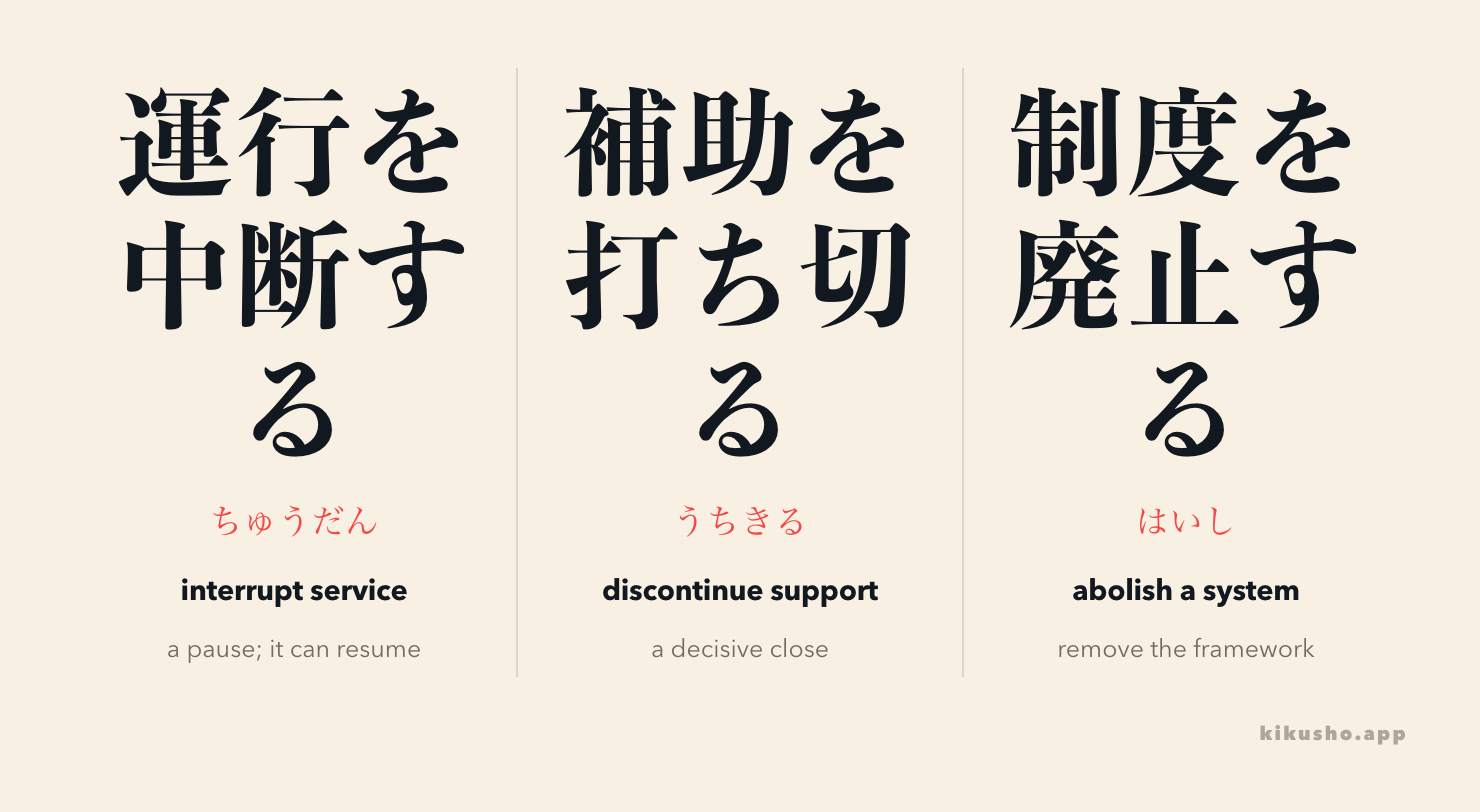
At N1, “stop” often describes an institutional decision, a broken flow or a limited consequence. 中断(ちゅうだん) pauses a process; 打ち切る(うちきる) ends it decisively; 廃止(はいし) abolishes the underlying system. Against those endings, 出現(しゅつげん) and 発生(はっせい) describe something newly appearing, while 途絶える(とだえる) describes an existing connection disappearing.
A municipal transport report gives the words one setting. A pilot route is interrupted, its subsidy is cut off, a new fault occurs, communication fails, and officials record the limited impact that remains.
Ten N1 words in one public report
| Word | Reading | Core frame | Report meaning |
|---|---|---|---|
| 中断 | ちゅうだん | 運行を中断する | interrupt service |
| 打ち切る | うちきる | 協議を打ち切る | discontinue talks decisively |
| 廃止 | はいし | 制度を廃止する | abolish a system |
| 終わる | おわる | 実験が終わる | an activity ends |
| 途絶える | とだえる | 連絡が途絶える | contact ceases |
| 出現 | しゅつげん | 症状が出現する | a sign appears |
| 発生 | はっせい | 障害が発生する | an incident occurs |
| 止まる | とどまる | 被害が局地に止まる | remain limited to an area |
| 止める | とどめる | 変更を最小限に止める | keep a change to a minimum |
| 留める | とどめる | 記憶に留める | retain in memory |
The N2 formal-boundaries lesson introduces suspension, closing an application window and official termination. This N1 set asks a sharper question: did the process pause, end by decision, disappear from use, or simply remain within a limit?
中断, 打ち切る and 廃止 name three different endings
中断(ちゅうだん) is a noun and する-verb. It stops a process in the middle without asserting that it is over forever.
大雨のため、バスの運行を一時中断しました。
おおあめのため、バスの うんこうを いちじ ちゅうだんしました。
Because of heavy rain, we temporarily interrupted bus service.
打ち切る(うちきる) is a transitive godan compound verb. It commonly takes a program, talks, publication, support measure or investigation as its object:
市は採算が取れない路線への補助を打ち切りました。
しは さいさんが とれない ろせんへの ほじょを うちきりました。
The city discontinued subsidies for unprofitable routes.
Unlike 中断, 打ち切る carries a final, often unilateral decision. 廃止(はいし) goes further: it is a noun and する-verb for abolishing an institution, regulation, route, practice or policy itself.
来年度から紙の定期券制度を廃止します。
らいねんどから かみの ていきけん せいどを はいしします。
From the next fiscal year, we will abolish the paper commuter-pass system.
打ち切る ends an ongoing measure; 廃止する removes the framework that made the measure possible. Kanjipedia’s entry for the kanji 止 lists 廃止 among words for ending or discontinuing something.
終わる is neutral; 途絶える says a flow has vanished
終わる(おわる) is the neutral intransitive verb for an activity, event or period reaching an endpoint: 実証実験は今月末で終わる. An independent study index files the same word at N5, so the N1 inventory record is a known level disagreement; here it is a prerequisite contrast for the formal choices around it.
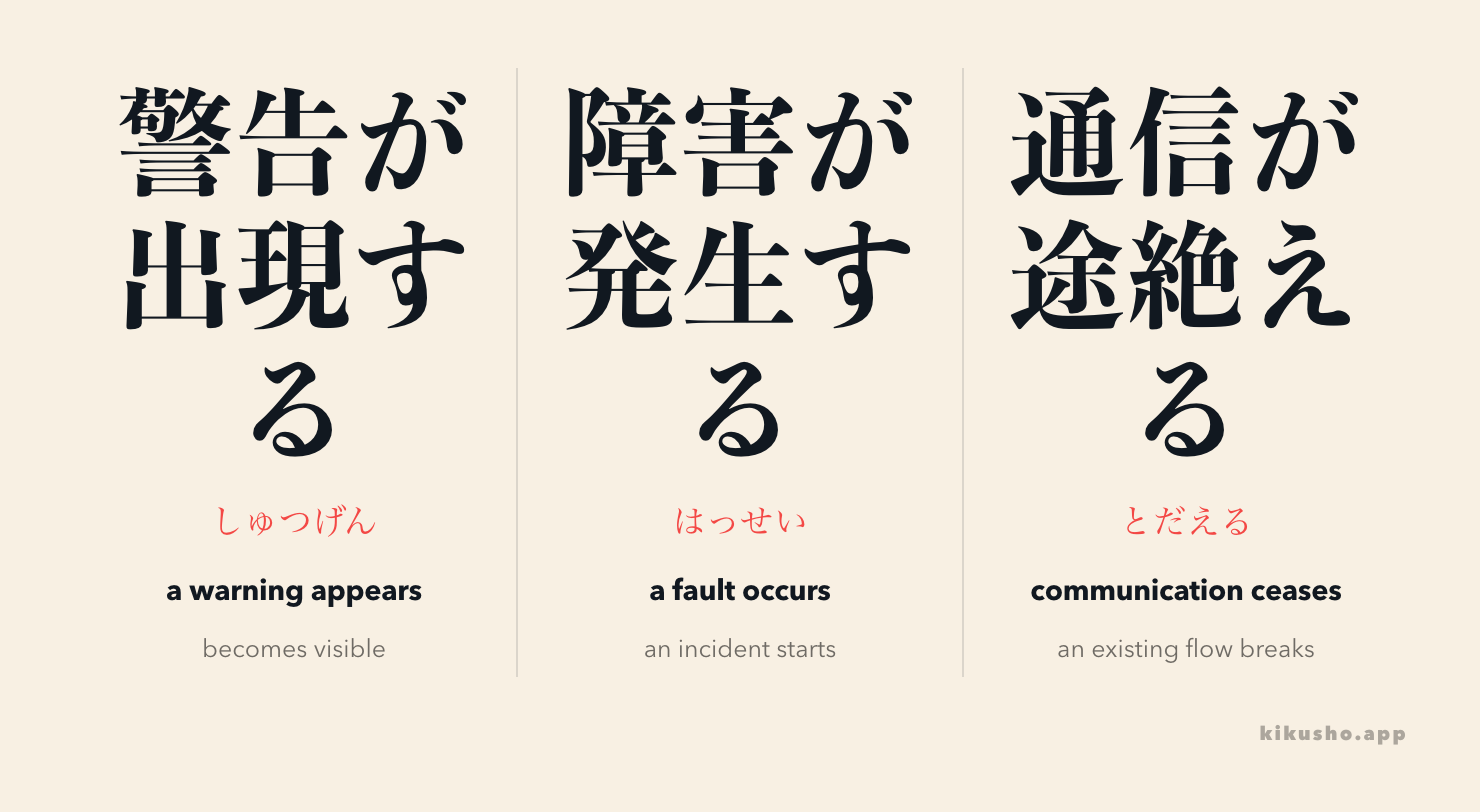
途絶える(とだえる) says traffic, contact, supply, tradition or communication that had been continuing ceases or is broken:
山間部では通信が数時間途絶えました。
さんかんぶでは つうしんが すうじかん とだえました。
Communication was cut off for several hours in the mountain area.
Kanjipedia defines 途絶える as traffic or communication ceasing in the middle. 終わる can describe any bounded event; 途絶える requires a continuing flow that breaks.
出現 and 発生 point in the opposite direction
Both words describe something coming into existence, but their typical nouns differ. 出現(しゅつげん) says an object, symptom or pattern becomes visible: 警告表示が出現する. 発生(はっせい) classifies an incident, fault, disaster, cost, conflict or outbreak as occurring: システム障害が発生する.
点検中に、画面上に警告表示が出現しました。
てんけんちゅうに、がめんじょうに けいこく ひょうじが しゅつげんしました。
During inspection, a warning display appeared on the screen.
更新直後に、予約システムの障害が発生しました。
こうしん ちょくごに、よやくシステムの しょうがいが はっせいしました。
Immediately after the update, a reservation-system failure occurred.
とどまる and とどめる: limit versus retain
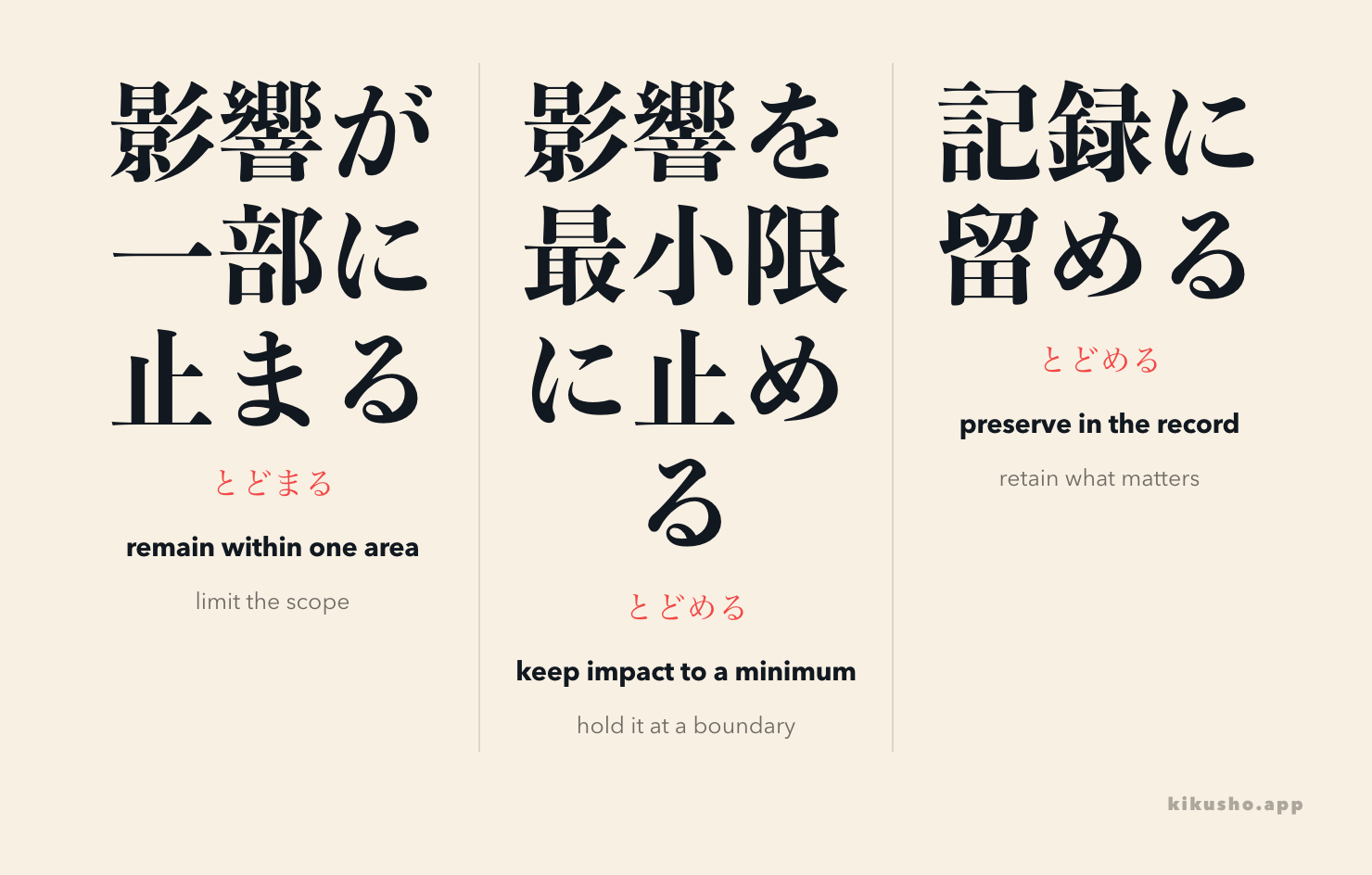
The inventory spelling 止まる(とどまる) is a formal variant meaning “remain limited to.” It often appears with 〜に止まる:
混乱は駅前の一部に止まり、全線には広がりませんでした。
こんらんは えきまえの いちぶに とどまり、ぜんせんには ひろがりませんでした。
The disruption remained limited to one area in front of the station and did not spread across the whole line.
The familiar beginner reading 止まる(とまる) means movement stops. Here, the reading and pattern change: 被害が一部にとどまる limits scope.
止める(とどめる) means stop, end or keep something at a limit: 影響を最小限に止める. 留める(とどめる) emphasises retaining or preserving: 教訓を記録に留める. Kanjipedia’s entry for 留める gives retaining, fastening and preserving something in memory.
Read the transport report
大雨のため、バスの運行を一時中断した。通信が途絶えた地域では、予約システムの障害も発生した。市は採算が取れない実証実験への補助を打ち切り、来年度には制度そのものを廃止する予定である。ただし、混乱は駅前の一部に止まり、影響を最小限に止めることができた。警告表示の出現時刻と対応の教訓は記録に留める。
おおあめのため、バスの うんこうを いちじ ちゅうだんした。つうしんが とだえた ちいきでは、よやくシステムの しょうがいも はっせいした。しは さいさんが とれない じっしょう じっけんへの ほじょを うちきり、らいねんどには せいどそのものを はいしする よていである。ただし、こんらんは えきまえの いちぶに とどまり、えいきょうを さいしょうげんに とどめることが できた。けいこく ひょうじの しゅつげん じこくと たいおうの きょうくんは きろくに とどめる。
Because of heavy rain, bus operation was temporarily interrupted. In areas where communication failed, a reservation-system failure also occurred. The city ended subsidies for an unprofitable demonstration project and plans to abolish the system itself next fiscal year. However, the disruption remained limited to one area in front of the station, and we kept the impact to a minimum. We will preserve the time the warning display appeared and the lessons from the response in the record.
Why these words are taught at N1
Kikusho’s September 2026 inventory assigns these ten spelling-and-reading records to N1. Independent lists place 終わる at N5 and pair the headword 止まる with とまる rather than this formal とどまる. These are level and reading collisions, not proof that the same lexical item has one stable exam label. The JLPT organisers do not publish a fixed vocabulary syllabus, so read the noun, particle, register and chosen kanji before deciding what kind of boundary the sentence describes.
Practice: classify the boundary before opening the key
1 · Broken flow. Choose the kana pronunciation that matches 途絶える in 通信が途絶える.
- A とぎれる
- B とだえる
- C たえる
- D とどまる
2 · Visible sign. In 症状が出現する, choose the kana for 出現.
- A しゅつげん
- B しゅっけん
- C でげん
- D しゅつけん
3 · Orthography. Which word is はいし, “abolition”?
- A 配止
- B 廃止
- C 廃始
- D 排紙
4 · Context. The meeting pauses because of an emergency and will resume later. Fill 会議を一時_.
- A 廃止する
- B 打ち切る
- C 中断する
- D 途絶える
5 · Context. The city permanently removes the paper-pass system. Fill 制度を_.
- A 出現する
- B 廃止する
- C 留まる
- D 中断する
6 · Usage. Which phrase means that disruption did not spread beyond one district?
- A 混乱を一部に止める
- B 混乱が一部に止まる(とどまる)
- C 混乱が一部に打ち切る
- D 混乱を一部に途絶える
7 · Usage. Which line correctly distinguishes appearance from occurrence?
- A 画面に警告が出現し、障害が発生した。
- B 画面に警告が発生し、障害が出現した。
- C 画面に警告を出現し、障害を発生した。
- D 画面が警告に出現し、障害を発生した。
8 · Paraphrase. What does 協議を打ち切った most strongly imply?
- A The talks paused briefly and will certainly resume.
- B The talks were brought to a decisive end.
- C The talks became visible to the public.
- D The talks remained within a limit.
9 · Kanji choice. Which phrase means “preserve the lesson in the record”?
- A 教訓を記録に止める(とどめる)
- B 教訓を記録に留める(とどめる)
- C 教訓が記録に途絶える
- D 教訓を記録に廃止する
10 · Combined report. Choose the only coherent sequence.
- A 通信が途絶える → 障害が発生する → 運行を中断する
- B 通信を発生する → 障害を途絶える → 運行が廃止する
- C 通信が留める → 障害を出現する → 運行を止まる
- D 通信を中断する → 障害が打ち切る → 運行を出現する
Transport report answer key
- B — とだえる. A continuing flow such as communication ceases.
- A — しゅつげん. 出現 is an appearance or manifestation.
- B — 廃止. It abolishes a system, regulation or service.
- C — 中断する. A temporary interruption leaves resumption possible.
- B — 廃止する. The system itself is permanently removed.
- B — 混乱が一部に止まる(とどまる). The disruption remains within a limited scope.
- A — 画面に警告が出現し、障害が発生した. The warning appears; the fault occurs.
- B — The talks were brought to a decisive end. 打ち切る is more final than 中断.
- B — 教訓を記録に留める(とどめる). 留める preserves or retains.
- A — 通信が途絶える → 障害が発生する → 運行を中断する. Each noun takes the matching event verb.
Store the complete frame: 運行を中断する, 補助を打ち切る, 制度を廃止する, 連絡が途絶える, 障害が発生する, 影響が一部にとどまる, 影響を最小限にとどめる, and 記録に留める. The writer’s choice tells you whether something pauses, ends, disappears, begins, remains limited or is preserved.
Common questions
What is the difference between 中断, 打ち切る and 廃止?
中断 is a break that may be followed by resumption. 打ち切る is a decisive discontinuation of a program, negotiation or publication. 廃止 is the abolition of a system, rule or service itself.
How do 途絶える and 発生 differ?
途絶える says an existing flow such as contact, supplies or traffic ceases. 発生 says a new event, problem or outbreak occurs.
Why can とどめる be written 止める or 留める?
止める emphasizes stopping or putting an end to something. 留める often means retain, preserve or keep something at a level, in a place or in memory. Context and the writer’s chosen kanji make the emphasis clear.