On this page
The six assigned N4 words describe different boundaries: 開く(ひらく) opens or holds an event, 起こす(おこす) wakes or causes, 止む(やむ) says something ceases, 止める(とめる) stops a thing, 止める(やめる) quits an activity, and 終わり(おわり) names the end. The most important contrast is hidden in one spelling: 音楽を止める(とめる) means “stop the music,” while 音楽の練習を止める(やめる) means “quit music practice.”
A neighborhood festival gives every word a clear job. Volunteers hold the event, wake a late helper, wait for the rain to stop, stop a speaker, decide whether to quit an activity, and clean up at the end.
Six N4 words on one festival day
| Word | Reading | Core frame | Meaning here |
|---|---|---|---|
| 開く | ひらく | 祭りを開く | hold or open a festival |
| 起こす | おこす | 弟を起こす | wake one's younger brother |
| 止む | やむ | 雨が止む | the rain stops |
| 止める | とめる | 音楽を止める | stop the music |
| 止める | やめる | 練習を止める | quit practice |
| 終わり | おわり | 祭りの終わり | the end of the festival |
Do not memorize the English word “stop” by itself. Save the whole frame and reading: 雨がやむ, 音楽をとめる, 練習をやめる. The noun and particle tell you which event the sentence describes.
開く(ひらく) opens something out or holds an event
開く(ひらく) is a godan verb with both transitive and intransitive uses. At N4, two practical transitive frames are especially useful:
公園で秋祭りを開きます。
こうえんで あきまつりを ひらきます。
We will hold an autumn festival in the park.
受付で案内の紙を開きました。
うけつけで あんないの かみを ひらきました。
I opened the information sheet at reception.
The common picture is something becoming open or being opened out. A folded paper spreads open; an event becomes available to participants. Kanjipedia's entry for 開く(ひらく) includes opening a closed thing, founding or starting something, and holding an event.
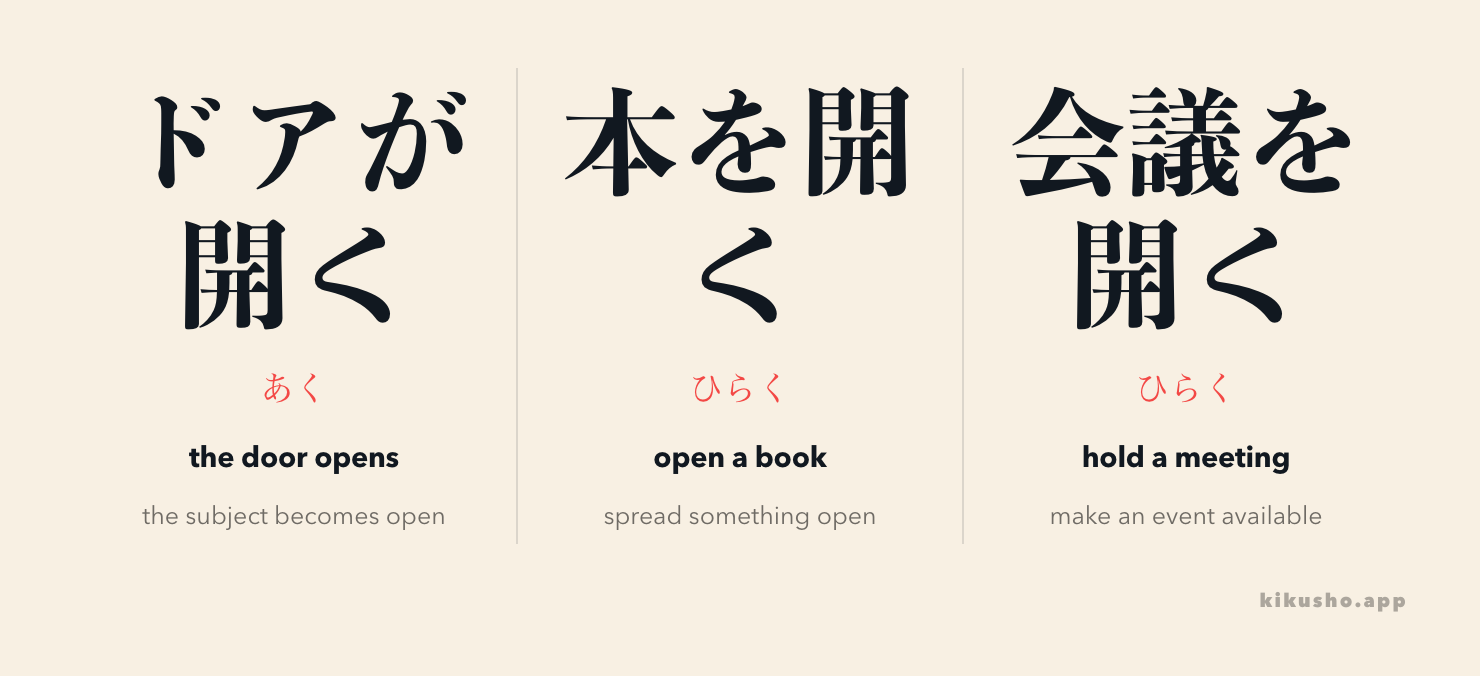
The spelling 開く also has the reading あく. The N5 starting-and-stopping lesson teaches ドアが開く(あく), “the door opens.” Keep these frames separate:
- ドアが開く(あく): the door becomes open.
- 本を開く(ひらく): someone opens a book.
- 会議を開く(ひらく): someone holds a meeting.
The kana changes the word even though the kanji does not. In a reading question, first inspect the noun and particle; 会議を strongly points to ひらく.
起こす(おこす) wakes someone and causes an event
起こす(おこす) is a transitive godan verb. Its first everyday use is the partner of 起きる(おきる):
母は七時に弟を起こしました。
ははは しちじに おとうとを おこしました。
My mother woke my younger brother at seven.
The person who becomes awake takes を because another person causes the change. Compare:
- 弟が起きる: my younger brother wakes up.
- 母が弟を起こす: my mother wakes my younger brother.
The same causative idea extends beyond sleep. 起こす can mean to bring about, trigger or cause something:
ぬれたコードは事故を起こすかもしれません。
ぬれた コードは じこを おこすかも しれません。
A wet cable may cause an accident.
大きな音を起こさないでください。
おおきな おとを おこさないで ください。
Please do not make a loud noise.
It can also describe raising the upper body: 体を起こす, “sit up / raise one's body.” The meanings share one direction: an agent makes a person, state or event come into being. Kanjipedia lists making someone stand, waking someone and causing something to begin; JapaneseTest4You's 起こす entry likewise illustrates waking and causing.
Three different ways to say “stop”
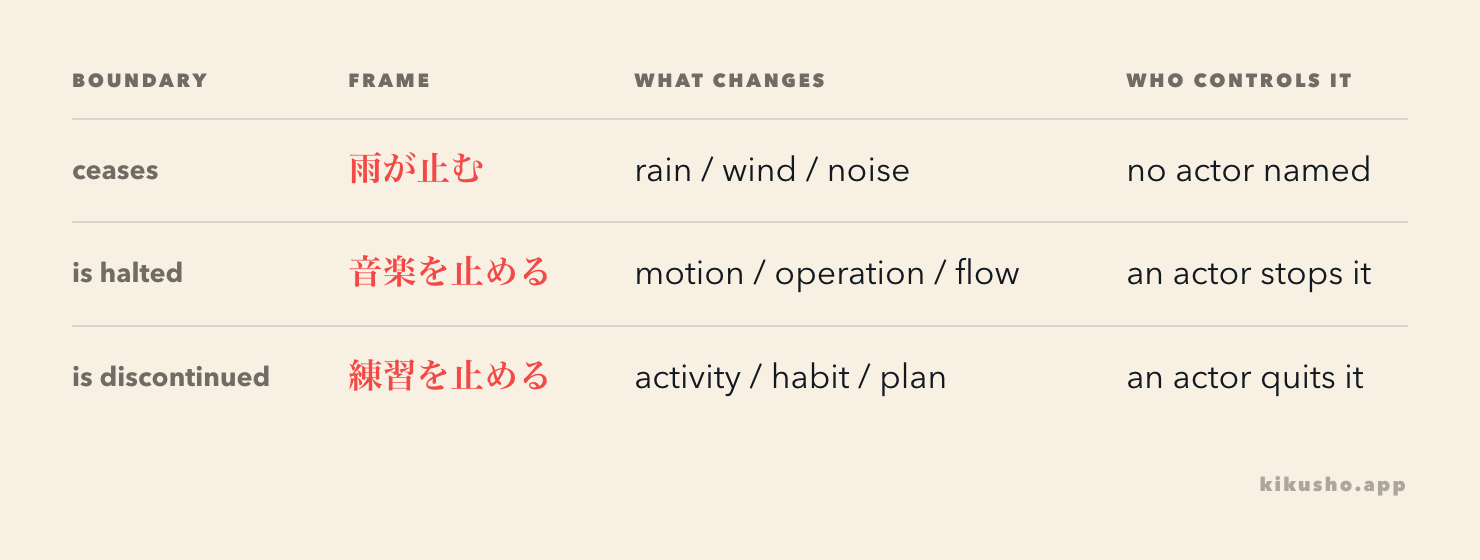
English reuses “stop” for weather, machines and personal decisions. Japanese makes you choose who controls the boundary.
| Situation | Japanese frame | Control |
|---|---|---|
| The rain ceases | 雨が止む(やむ) | the phenomenon ends |
| A volunteer stops the music | 音楽を止める(とめる) | an actor halts a thing |
| A volunteer quits practice | 練習を止める(やめる) | an actor discontinues an activity |
This is more than a pronunciation detail. The reading changes the lexical item and therefore the kind of object that naturally appears with it.
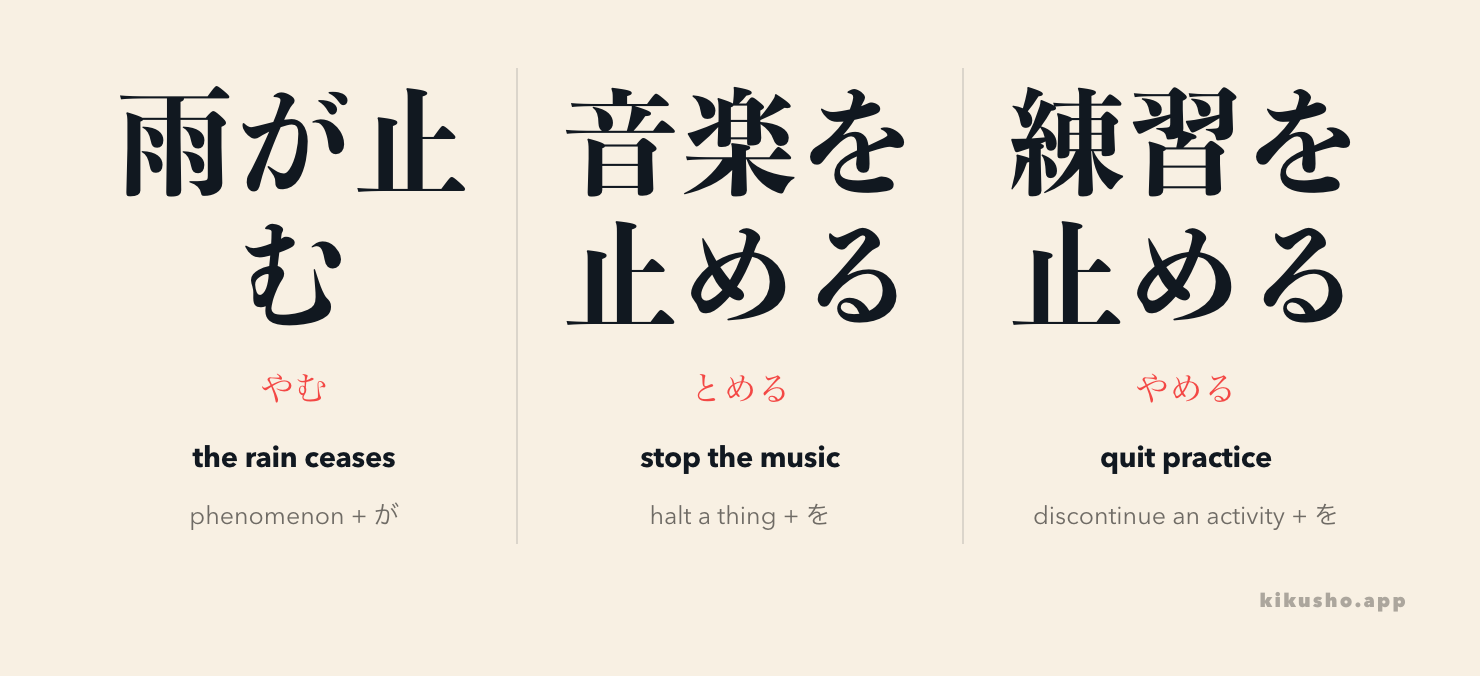
止む(やむ): rain, wind or noise ceases
止む(やむ) is an intransitive godan verb. The continuing phenomenon is the subject, normally marked with が:
雨が止んだら、祭りを始めます。
あめが やんだら、まつりを はじめます。
When the rain stops, we will begin the festival.
夜になっても、風が止みませんでした。
よるに なっても、かぜが やみませんでした。
Even after night fell, the wind did not stop.
Common subjects include 雨, 雪, 風, 音, 声 and 痛み. The form changes regularly: 止む → 止みます → 止んだ. The て-form and past form use ん: 止んで, 止んだ.
No person directly stops the rain in 雨が止む. The sentence reports that the ongoing phenomenon comes to an end. That is why 雨を止める(とめる) would express a different, unusual idea: someone or something actively makes the rain stop.
JapaneseTest4You identifies 止む(やむ) as N4 vocabulary and gives examples with rain, storms and sound ceasing.
止める(とめる): someone halts, parks or holds a thing
止める(とめる) is a transitive ichidan verb. The moving, operating or continuing thing takes を:
雨が強くなったので、音楽を止めました。
あめが つよく なったので、おんがくを とめました。
Because the rain became heavy, we stopped the music.
車を入口の前に止めないでください。
くるまを いりぐちの まえに とめないで ください。
Please do not park your car in front of the entrance.
It can halt movement (車を止める), operation (機械を止める), a flow (水を止める) or another person's motion (友達を止める). The shared idea is that an actor prevents something from continuing or fixes it in place.
The polite and past forms preserve the reading: とめます, とめました. A vocabulary question may show only 止める, so use the object as your clue. A vehicle, machine, music or flowing substance usually favors とめる. JapaneseTest4You's N4 entry for 止める(とめる) includes stopping, parking and preventing.
止める(やめる): someone quits an activity or cancels a plan
止める(やめる) is also a transitive ichidan verb, but its object is typically an activity, habit, job, plan or repeated behavior:
雨でも、祭りの準備を止めません。
あめでも、まつりの じゅんびを やめません。
Even if it rains, we will not stop preparing for the festival.
けがをしたので、ダンスの練習を止めました。
けがを したので、ダンスの れんしゅうを やめました。
I quit dance practice because I was injured.
明日の外出は止めましょう。
あしたの がいしゅつは やめましょう。
Let's cancel tomorrow's outing.
In ordinary modern writing, やめる is often written in kana, which prevents confusion. When you see 止める, read the sentence rather than guessing from the kanji. Kanjipedia's 止める(やめる) entry distinguishes discontinuing something already in progress from cancelling a plan.
A useful exam shortcut is to name the object:
- 車・機械・音楽・水を止める → usually とめる.
- 仕事・練習・たばこ・計画を止める → usually やめる.
Some contexts can support either reading with a change in viewpoint. 音楽をとめる means press pause or make the sound cease; 音楽をやめる can mean give up music as an activity or career. The surrounding sentence decides.
終わり(おわり) names the endpoint
終わり(おわり) is a noun, not the verb 終わる. It labels the final part or endpoint of an event, period, story or place:
祭りの終わりに、みんなで写真を撮りました。
まつりの おわりに、みんなで しゃしんを とりました。
At the end of the festival, everyone took a photo together.
この道の終わりに小さな神社があります。
この みちの おわりに ちいさな じんじゃが あります。
There is a small shrine at the end of this road.
Two frames cover many N4 contexts:
- Nの終わり: the end of N — 夏の終わり, the end of summer.
- Nの終わりに: at the end of N — 授業の終わりに, at the end of class.
To make a full predicate, use 終わる:
祭りは九時に終わります。
まつりは くじに おわります。
The festival ends at nine.
Compare 祭りの終わり (a noun phrase, “the end of the festival”) with 祭りが終わる (a clause, “the festival ends”). Kanjipedia's entry for the kanji 終 records both the verb sense “to end” and the noun sense “end/final point.” The action-phases lesson develops the verb 終わる and the compound pattern Vます + 終わる.
Read the whole festival day
日曜日、公園で秋祭りを開きました。朝、母がまだ寝ていた弟を起こしました。昼前から雨が降りましたが、一時ごろに止みました。ステージの係は雨の間だけ音楽を止めました。ダンスのチームは練習を止めず、屋根の下で続けました。祭りの終わりに、参加者はごみを集めてから写真を撮りました。
にちようび、こうえんで あきまつりを ひらきました。あさ、ははが まだ ねていた おとうとを おこしました。ひるまえから あめが ふりましたが、いちじごろに やみました。ステージの かかりは あめの あいだだけ おんがくを とめました。ダンスの チームは れんしゅうを やめず、やねの したで つづけました。まつりの おわりに、さんかしゃは ごみを あつめてから しゃしんを とりました。
On Sunday, we held an autumn festival in the park. In the morning, my mother woke my younger brother, who was still asleep. It rained from before noon, but stopped around one. The stage worker stopped the music only while it was raining. The dance team did not quit practicing and continued under a roof. At the end of the festival, the participants collected the trash and then took a photo.
Follow the boundaries in order. 開く establishes the event, 起こす causes a person to wake, 止む reports the rain's natural endpoint, 止める(とめる) halts the sound, 止める(やめる) would discontinue the practice, and 終わり names the event's final part.
Why these words are taught at N4
Kikusho's September 2026 reference inventory assigns these exact spelling-and-reading records to this N4 lesson. Independent study references also list 起こす, 止める(とめる) and 止む at N4, while broad lists include 終わり. One secondary source places the headword 開く(ひらく) at N5, illustrating why level labels differ across publishers.
That difference does not change the reading and usage taught here. The JLPT organisers do not publish a fixed vocabulary list, so no third-party level label is definitive. Kikusho keeps the reference-inventory placement, records the disagreement and verifies each lexical item by its reading, sense and sentence frame.
Practice: choose the boundary before opening the key
1 · Rain reading. In 雨が止む, select the kana for the final verb.
- A とむ
- B やむ
- C とめる
- D やめる
2 · Meeting reading. In 会議を開く, select the reading of the final verb.
- A あく
- B あける
- C ひらく
- D ひらける
3 · Written form. Pick the spelling for おこす, “to wake someone / cause something.”
- A 起こす
- B 起きる
- C 怒る
- D 起こる
4 · One spelling, two sounds. Pick the form that can represent both とめる and やめる in this lesson.
- A 止まる
- B 辞める
- C 終める
- D 止める
5 · Rain boundary. The rain naturally comes to an end. Fill the gap in 一時に雨が_.
- A 止めました(とめました)
- B 止めました(やめました)
- C 止みました
- D 終わりでした
6 · Sound control. A worker presses the control so the speakers become silent. Fill the gap in 係の人が音楽を_.
- A 止めました(とめました)
- B 止めました(やめました)
- C 止みました
- D 開きました
7 · Personal decision. Mika gives up dance practice because of an injury. Fill the gap in みかさんはダンスの練習を_.
- A 止みました
- B 止めました(とめました)
- C 止めました(やめました)
- D 起こしました
8 · Noun frame. Select the sentence that uses 終わり as a noun.
- A 祭りが終わりに九時です。
- B 祭りの終わりに写真を撮りました。
- C 祭りを終わり写真です。
- D 祭りに終わりを九時です。
9 · Actor and affected person. Interpret 母が弟を起こしました.
- A The younger brother woke up by himself.
- B The mother became angry with her younger brother.
- C The mother woke her younger brother.
- D The younger brother caused a problem.
10 · Meaning created by the reading. Select the pair that contrasts “stop the sound” with “quit music as an activity.”
- A 音楽が止む/音楽が終わり
- B 音楽をとめる/音楽をやめる
- C 音楽をひらく/音楽をおこす
- D 音楽がとめる/音楽がやめる
Festival answer key
- B — 止む is やむ. The subject 雨が names a phenomenon that ceases.
- C — 会議を開く is かいぎをひらく. The event frame selects ひらく, not あく.
- A — 起こす. 起きる means to wake up; 起こる means to occur.
- D — 止める. Context and furigana distinguish とめる from やめる.
- C — 止みました. The rain is the subject and ends without a named controller.
- A — 止めました(とめました). A worker actively halts the music output.
- C — 止めました(やめました). Practice is an activity that Mika quits.
- B — 祭りの終わりに写真を撮りました. Nの終わりに means “at the end of N.”
- C — The mother woke her younger brother. 弟を is the person affected by the transitive 起こす.
- B — 音楽をとめる/音楽をやめる. とめる halts the sound; やめる gives up music as an activity.
A reliable review card should preserve the decisive context: 会議をひらく, 弟をおこす, 雨がやむ, 音楽をとめる, 練習をやめる, and 祭りのおわり. Reading the noun and particle first turns a spelling collision into a predictable choice.
Common questions
What is the difference between 止む, 止める and 止める?
止む(やむ) says that rain, wind, noise or another continuing phenomenon ceases. 止める(とめる) says someone stops or parks a moving thing. 止める(やめる) says someone quits an activity, habit, job or plan.
How can the same spelling 止める have two readings?
Context identifies the word. 車を止める is とめる because a vehicle is brought to a stop; 練習を止める is やめる because an activity is discontinued. Kana or furigana removes the ambiguity when needed.
What does 開く(ひらく) mean at N4?
It can mean to open something that spreads out, such as a book, and to hold or open an event, meeting or shop. 会議を開く means to hold a meeting.
Is 終わり a verb?
No. 終わり is the noun “end.” Use 祭りの終わり for the end of the festival and 終わりに for at the end. 終わる is the related verb “to end.”