On this page
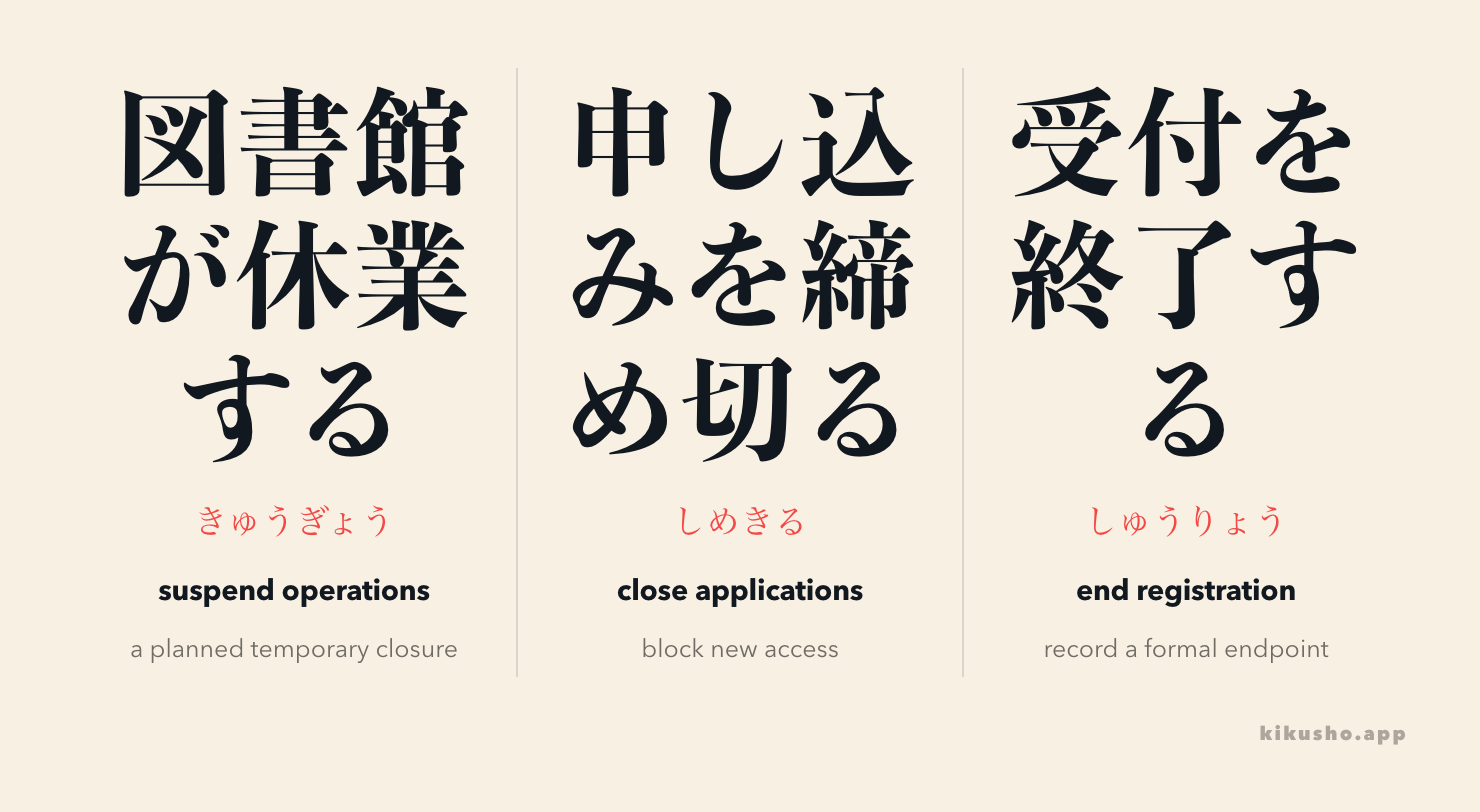
The six assigned N2 words describe formal boundaries rather than simple physical stopping. 休業(きゅうぎょう) suspends operations, 締め切る(しめきる) closes a window completely, 終了(しゅうりょう) records a formal end, and 生ずる(しょうずる) describes a consequence arising. The two readings of 留まる separate something that remains (とどまる) from something that catches attention (とまる).
A city library’s renovation notice makes those differences visible. The library suspends service, closes applications, announces the end of a program, explains a problem that arose, and tells readers what will remain and what is worth noticing.
Six N2 boundary words in one public notice
| Word | Reading | Core frame | Meaning in the notice |
|---|---|---|---|
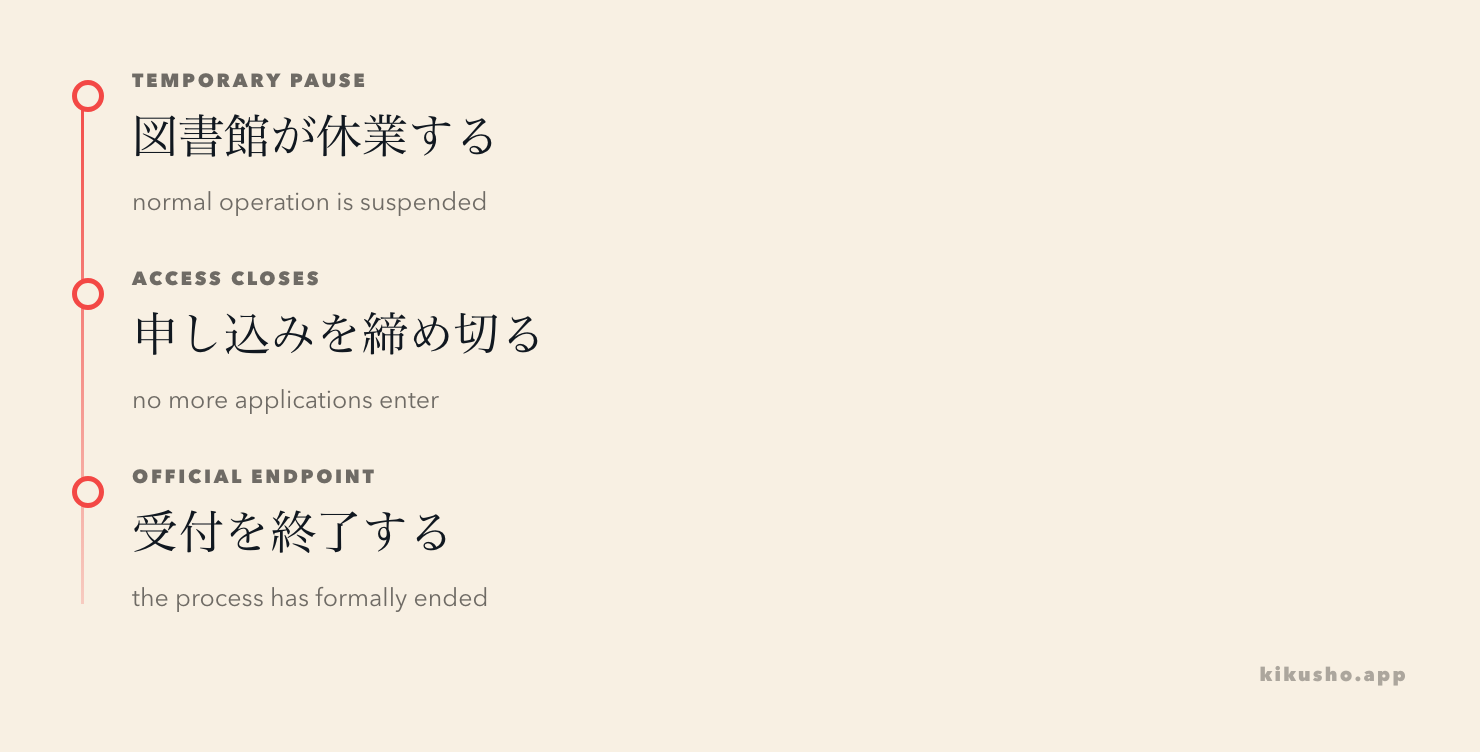
| 休業 | きゅうぎょう | 図書館が休業する | suspend operations |
| 締め切る | しめきる | 申請を締め切る | close applications completely |
| 終了 | しゅうりょう | 受付を終了する | bring registration to a formal end |
| 生ずる | しょうずる | 不便が生ずる | inconvenience arises |
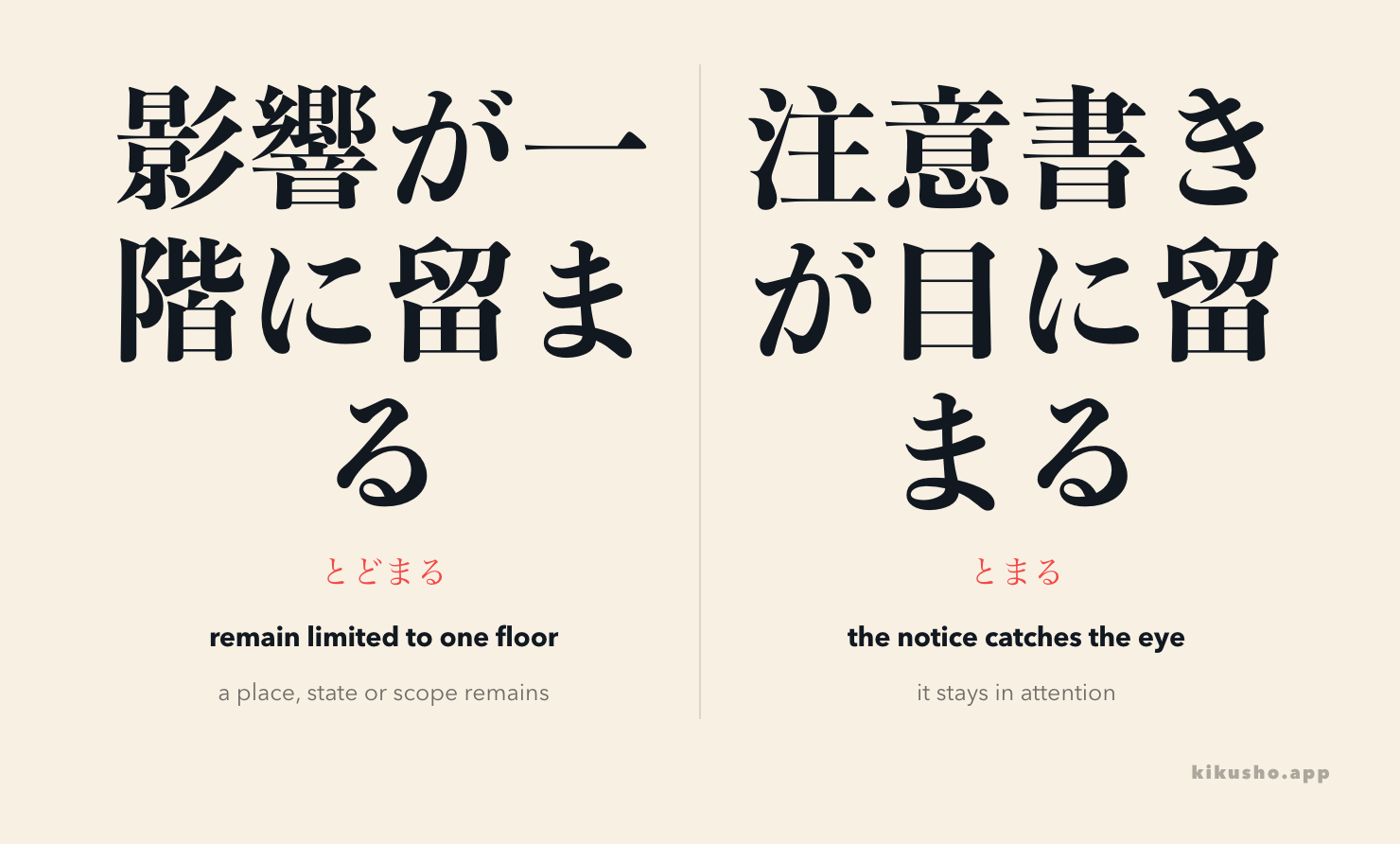
| 留まる | とどまる | 被害が一部に留まる | remain limited to one area |
| 留まる | とまる | 目に留まる | catch the eye |
The N3 project-boundaries lesson handles an ordinary timeline: work begins, problems arise, deadlines move and a finished result appears. This N2 lesson looks at the wording used in notices, reports and policy statements when a service crosses a boundary or a result remains. The N1 reporting-boundaries lesson then distinguishes interruption, decisive discontinuation and abolition.
休業(きゅうぎょう) is a temporary suspension of work or business
休業 is a noun and する-verb. It means that a business, office, school or service takes a break from operating:
改修工事のため、市立図書館は来週から二週間休業します。
かいしゅう こうじのため、しりつ としょかんは らいしゅうから にしゅうかん きゅうぎょうします。
Because of renovation work, the municipal library will suspend operations for two weeks from next week.
休業中も返却ポストは利用できます。
きゅうぎょうちゅうも へんきゃくポストは りようできます。
The return box can still be used during the closure.
The word does not itself mean that the organisation disappears. It normally suggests a pause in business or work, with context supplying the length and reopening plan. Kanjipedia defines 休業 as taking a break from business or work, including temporary closure.
締め切る(しめきる) closes access completely
締め切る is a transitive godan compound verb. Its original physical image is closing something tightly, but an important N2 use is ending access to a process:
修理期間中の利用者登録は金曜日に締め切ります。
しゅうり きかんちゅうの りようしゃ とうろくは きんようびに しめきります。
Registration for use during the repair period closes on Friday.
定員に達したため、申し込みを締め切りました。
ていいんに たっしたため、もうしこみを しめきりました。
Because capacity was reached, we closed applications.
The thing marked by を is the window being closed: 申し込みを締め切る, 受付を締め切る, 応募を締め切る. Do not confuse this verb with 締め切り, the noun “deadline.” A deadline can arrive; a person or organisation 締め切る the applications. Kanjipedia’s 締める entry supplies the core image of closing and fastening tightly.
終了(しゅうりょう) records a formal end
終了 is a noun and する-verb used for a process, program, event, screen or service that has reached its endpoint:
午後五時をもって、臨時サービスを終了します。
ごご ごじを もって、りんじサービスを しゅうりょうします。
The temporary service will end at 5 p.m.
受付終了後は、新しい申請を受け付けません。
うけつけ しゅうりょうごは、あたらしい しんせいを うけつけません。
After registration closes, no new applications will be accepted.
終わる is the neutral everyday verb “end.” 終了 is more institutional and pairs naturally with notices, procedures and interface messages. Kanjipedia defines 終了 as something ending or being brought to an end, with 開始 as its counterpart.
生ずる(しょうずる) is a formal form of “arise”
生ずる is a formal literary or administrative variant related to N3 生じる(しょうじる). It often describes an effect, obligation, discrepancy, expense or inconvenience arising from conditions:
工事中は騒音などの不便が生ずる場合があります。
こうじちゅうは そうおんなどの ふべんが しょうずる ばあいが あります。
During the construction, inconvenience such as noise may arise.
変更によって追加の費用が生ずることはありません。
へんこうによって ついかの ひようが しょうずることは ありません。
The change will not result in additional costs.
In formal writing, 不便が生ずる, 差が生ずる and 必要が生ずる are common. The N3 reading 生じる is the more usual modern form in general prose; the N2 item 生ずる carries a stiffer register. Both present the result as arising, normally with が.
留まる has two readings with different frames
The same spelling matters here because neither reading means simply “stop.” Both connect to the idea of remaining, but their preferred contexts differ.
留まる(とどまる): remain, stay or be limited
留まる(とどまる) is an intransitive godan verb. It describes remaining in a place, position, state or limited scope:
影響は図書館の一階に留まりました。
えいきょうは としょかんの いっかいに とどまりました。
The impact remained limited to the library’s first floor.
彼は退職後も顧問の立場に留まっています。
かれは たいしょくごも こもんの たちばに とどまっています。
He remains in an advisory position after retirement.
The subject is what remains; the limit often takes に or にとどまる. Kanjipedia’s とどまる entry gives staying in the same place, position or state, being delayed, and remaining behind.
留まる(とまる): catch attention or be fixed
留まる(とまる) is familiar in fixed expressions such as 目に留まる and 心に留まる:
入り口の小さな注意書きが利用者の目に留まりました。
いりぐちの ちいさな ちゅういがきが りようしゃの めに とまりました。
The small notice at the entrance caught the users’ attention.
その説明は強く記憶に留まりました。
その せつめいは つよく きおくに とまりました。
That explanation remained strongly in my memory.
Here the expression is about an object remaining in someone’s attention, not a train stopping. Kanjipedia’s same-sound guide for とまる distinguishes 留まる for being fixed or attracting notice from 止まる for movement or continuation ending.
Read the library notice as a whole
改修工事のため、市立図書館は二週間休業します。代替サービスの利用申請は金曜日に締め切り、受付は午後五時に終了します。工事中は騒音などの不便が生ずる場合がありますが、影響は一階に留まる見込みです。入口の注意書きにも目を留めてください。
かいしゅう こうじのため、しりつ としょかんは にしゅうかん きゅうぎょうします。だいたいサービスの りよう しんせいは きんようびに しめきり、うけつけは ごご ごじに しゅうりょうします。こうじちゅうは そうおんなどの ふべんが しょうずる ばあいが ありますが、えいきょうは いっかいに とどまる みこみです。いりぐちの ちゅういがきにも めを とめてください。
Because of renovation work, the municipal library will suspend operations for two weeks. Applications to use the alternative service close on Friday, and registration ends at 5 p.m. During construction, inconvenience such as noise may arise, but the impact is expected to remain on the first floor. Please also notice the information sheet at the entrance.
The notice has a deliberate order. 休業 suspends the service; 締め切る blocks new access; 終了 names the official end; 生ずる introduces a possible consequence; とどまる limits its scope; and 目に留める asks the reader to pay attention.
Why these words are taught at N2
In Kikusho’s September 2026 source snapshot, these six spelling-and-reading combinations are assigned to N2, and both baseline lists place them there. The distinction between 生ずる and the more common N3 生じる, and the two readings of 留まる, needs sentence-level verification because the spelling alone does not identify the intended word.
The JLPT organisers do not publish a fixed vocabulary list, so level labels in study resources are not an official syllabus. The article therefore teaches the verified readings, register and frames rather than treating a level label as a definition.
Practice: read the notice before opening the key
1 · Formal ending. Choose the reading of 終了 in 受付を終了する.
- A しゅうりょう
- B しゅうり
- C おわり
- D しゅうりょく
2 · Remaining in scope. Choose the reading of 留まる in 影響が一階に留まる.
- A とまる
- B とどまる
- C とめる
- D りゅうまる
3 · Written form. Which word is きゅうぎょう, a temporary suspension of business or work?
- A 休行
- B 急業
- C 休業
- D 休止
4 · Word formation. Which compound is correctly formed for “end of registration”?
- A 終了受付
- B 受付終了
- C 終受付了
- D 受終了付
5 · Closing access. Capacity has been reached, so the organisation closes applications. Fill 申し込みを_.
- A 休業します
- B 締め切ります
- C 終了します
- D 留まります
6 · Consequence. Construction may create additional inconvenience. Fill 不便が_場合があります.
- A 生ずる
- B 締め切る
- C 休業する
- D 留める
7 · Fixed expression. A poster catches a visitor’s eye. Fill ポスターが目に_.
- A 留まりました(とどまりました)
- B 留まりました(とまりました)
- C 止まりました
- D 終了しました
8 · Service notice. Pick the line that announces a planned temporary library closure correctly.
- A 図書館は改修のため二週間休業する。
- B 図書館を改修のため二週間休業する。
- C 図書館が二週間を休業する。
- D 図書館に休業を締め切る。
9 · Paraphrase. What does 影響は一階に留まる見込みです say?
- A The first floor will certainly close forever.
- B The impact is expected to be limited to the first floor.
- C The first floor will attract everyone’s attention.
- D The impact will be extended to every floor.
10 · Usage. Which sequence matches the order in a formal notice?
- A 休業する → 申し込みを締め切る → 受付を終了する
- B 受付を留まる → 休業を生ずる → 目に終了する
- C 生ずる → 図書館をとどまる → 休業を締め切る
- D 終了を目に留まる → 申し込みが休業する → 締め切る
Library notice answer key
- A — しゅうりょう. 終了 is the formal noun and する-verb for an endpoint.
- B — とどまる. The impact remains limited to a scope.
- C — 休業. It is a temporary suspension of ordinary operation.
- B — 受付終了. The compound names the end of registration.
- B — 締め切ります. An organisation closes the application window.
- A — 生ずる. A consequence such as inconvenience may arise.
- B — 留まりました(とまりました). 目に留まる is the fixed expression “catch the eye.”
- A — 図書館は改修のため二週間休業する. The service or institution is the subject of the temporary closure.
- B — The impact is expected to be limited to the first floor. に留まる limits the scope.
- A — 休業する → 申し込みを締め切る → 受付を終了する. The service pauses, access closes, and the formal process ends.
Keep the decisive frame with each item: 休業中, 申し込みを締め切る, 受付終了, 不便が生ずる, 影響が一階に留まる, and 目に留まる. N2 formal Japanese becomes clearer once you know whether the sentence suspends, closes, ends, produces, limits or attracts attention.
Common questions
What is the difference between 休業 and 閉店?
休業 is a temporary suspension of business or work, often with a planned reopening. 閉店 means a shop closes; depending on context, it can refer to closing for the day or closing permanently.
What is the difference between 締め切る and 終了?
締め切る means to close something completely, especially a submission, registration or application window. 終了 is the formal noun or する-verb for an event, process or service reaching its end.
How do とどまる and とまる differ when both are written 留まる?
とどまる means to remain, stay or be limited to a place, state or scope. とまる commonly appears in fixed expressions such as 目に留まる, “catch someone’s eye,” where an object remains in attention.