On this page
An N1 economic report rarely presents one isolated number. It follows money from its 財源 into 資金, through a 事業 and a 市場, then asks whether the result is 収益, 利潤 or 損失. These 13 records give each stage a precise Japanese label.
Thirteen records cover conditions, funding, operations and results
| Word | Reading | Word class | Meaning here | Phrase to remember |
|---|---|---|---|---|
| インフレ | いんふれ, infure | noun | inflation | インフレが続く: inflation continues |
| 株式 | かぶしき, kabushiki | noun | shares; stock issued by a company | 株式を発行する: issue shares |
| 好況 | こうきょう, kōkyō | noun; na-adjectival use | prosperity; favourable business conditions | 好況を背景に: against a strong economy |
| 財源 | ざいげん, zaigen | noun | source of funds or revenue | 財源を確保する: secure a funding source |
| 財政 | ざいせい, zaisei | noun | public finance; financial condition | 地方財政: local-government finances |
| 資金 | しきん, shikin | noun | funds; money available for a purpose | 資金を調達する: raise funds |
| 市場 | しじょう, shijō | noun | market as an economic field or mechanism | 市場に参入する: enter a market |
| 収益 | しゅうえき, shūeki | noun | earnings; proceeds; accounting revenue | 収益を上げる: generate earnings |
| 事業 | じぎょう, jigyō | noun | enterprise; operation; organised project | 事業を展開する: develop operations |
| 損失 | そんしつ, sonshitsu | noun | loss; amount or value lost | 損失を被る: incur a loss |
| 不況 | ふきょう, fukyō | noun | recession; economic slump | 不況に陥る: fall into recession |
| 利潤 | りじゅん, rijun | noun | profit; economic surplus | 利潤を確保する: secure a profit |
| 流通 | りゅうつう, ryūtsū | noun; suru verb | distribution or circulation of goods and money | 流通網を整える: improve a distribution network |
Kikusho's September 2026 reference inventory assigns all 13 spelling-and-reading records to N1. The two baseline files inherit the same Waller/Tanos family, so their agreement is one lineage rather than independent confirmation. Current N1 study material independently supports several of the records, including 好況, 利潤 and the N1 placements collected for 資金, 利潤 and 流通. 市場(しじょう) has the clearest boundary issue because other lists place the spelling 市場 at N3 while teaching the reading いちば. The official JLPT does not publish an exhaustive current vocabulary list, so these levels organise study rather than guarantee a future item.
好況 and 不況 describe activity; インフレ describes prices
好況(こうきょう) is a phase in which production, investment, employment or spending is vigorous. 不況(ふきょう) is the opposite phase, when economic activity is weak. Their most useful partners show movement or duration.
- 好況に転じる: turn toward prosperity
- 好況が続く: favourable conditions continue
- 不況に陥る: fall into recession
- 不況から脱する: emerge from a slump
- 長引く不況: a prolonged recession
好況を背景に、企業の設備投資が増えました。
こうきょうを はいけいに、きぎょうの せつびとうしが ふえました。
Capital investment by companies increased against a strong economy.
長引く不況で、消費者は支出に慎重になっています。
ながびく ふきょうで、しょうひしゃは ししゅつに しんちょうに なって います。
The prolonged recession has made consumers cautious about spending.
インフレ abbreviates インフレーション. It describes a sustained rise in the general price level, not every isolated price increase. The Bank of Japan's explanation contrasts sustained consumer-price increases with sustained decreases, or deflation.
インフレが続き、原材料だけでなく生活必需品の価格も上昇しています。
インフレが つづき、げんざいりょうだけでなく せいかつひつじゅひんの かかくも じょうしょうして います。
Inflation continues, and prices are rising for daily necessities as well as raw materials.
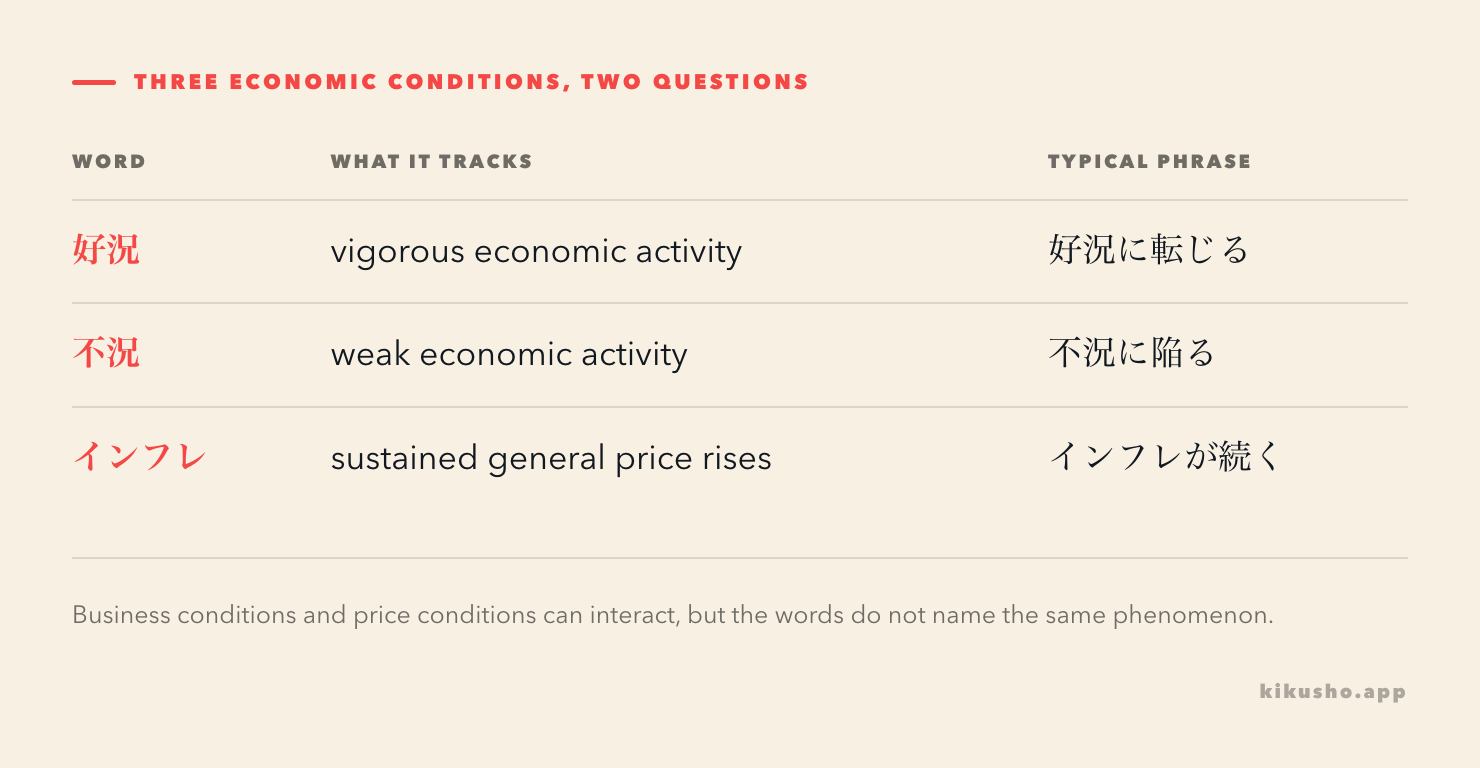
Do not build a mechanical sequence in which every 好況 causes インフレ or every 不況 prevents it. Economic reports often discuss them together, but the nouns answer different questions.
財源 is the source, 資金 is usable money, and 財政 is the public system
財源(ざいげん) answers “where will the money come from?” Tax revenue, user fees, subsidies or borrowing may become a measure's 財源. The dictionary definition centres on the source that produces necessary revenue.
- 恒久的な財源: a permanent funding source
- 財源を確保する: secure a source of funds
- 税収を財源とする: use tax revenue as the funding source
市は子育て支援を拡充するための財源を探しています。
しは こそだてしえんを かくじゅうする ための ざいげんを さがして います。
The city is looking for a funding source to expand childcare support.
資金(しきん) is money or readily usable purchasing power held for an activity. A company needs 運転資金 for daily operations and 設備資金 for facilities. It can 資金を集める, 調達する, 投入する or 回収する. The financial education glossary explains that companies may raise business funds through borrowing, bonds or shares.
会社は新工場を建設する資金を株式の発行で調達しました。
かいしゃは しんこうじょうを けんせつする しきんを かぶしきの はっこうで ちょうたつしました。
The company raised funds to build a new factory by issuing shares.
財政(ざいせい) presents the larger acquisition, management and expenditure of money, especially by a national or local government. The Ministry of Finance terminology uses revenue sources, annual revenue and expenditure as parts of that system.
- 国の財政: national public finance
- 地方財政: local public finance
- 財政赤字: fiscal deficit
- 財政を立て直す: restore the finances
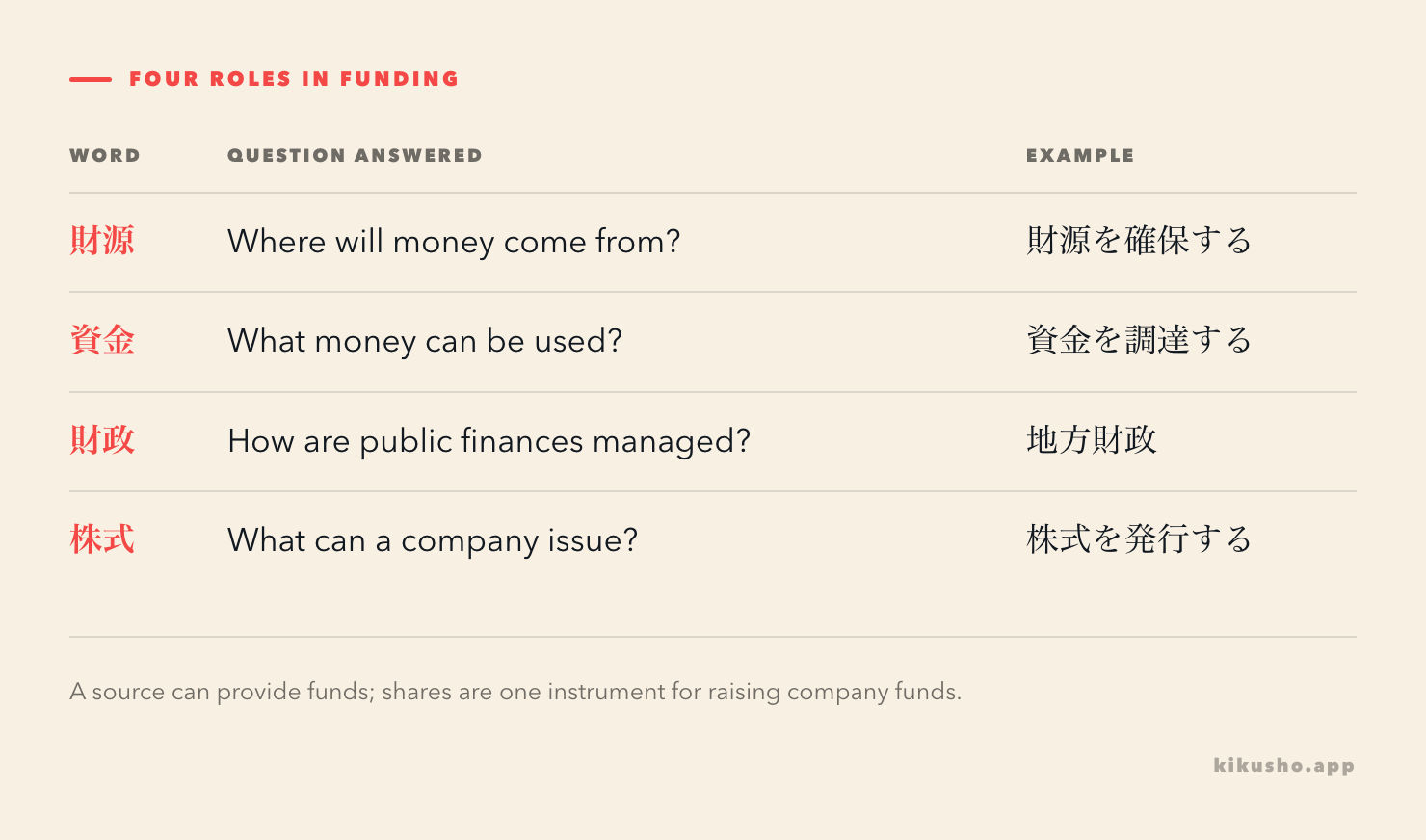
The sentence 財政が厳しいので財源を確保できず、事業の資金が不足した can contain all three. The government's overall finances are strained, the specific source has not been secured, and the project consequently lacks spendable funds.
株式 is a funding instrument traded in a 市場
At N3, 株(かぶ) can name an individual share and has plant, stump and strain senses. 株式(かぶしき) is the formal company-and-securities term. A company issues 株式 to obtain capital; investors acquire, hold and trade them. J-FLEC defines 株式 as something a company issues to raise business funds and explains that later trades between investors do not themselves send that sale price to the issuer.
- 株式を発行する: issue shares
- 株式を取得する: acquire shares
- 株式を保有する: hold shares
- 株式市場: stock market
- 株式投資: equity investment
The assigned 市場(しじょう) is an abstract arena in which supply, demand and transactions meet.
- 国内市場/海外市場: domestic or overseas market
- 市場規模: market size
- 市場に参入する: enter a market
- 市場を開拓する: develop a market
その企業は株式市場から資金を集め、再生可能エネルギー市場に参入しました。
その きぎょうは かぶしきしじょうから しきんを あつめ、さいせいかのうエネルギーしじょうに さんにゅうしました。
The company raised funds through the stock market and entered the renewable-energy market.
The same spelling read 市場(いちば) refers more often to a physical marketplace. The N3 prerequisite lesson teaches that contrast directly.
事業 and 流通 describe what the organisation does
事業(じぎょう) is an organised undertaking, project or operation. A company can run a profitable business, but governments and nonprofit organisations also conduct 事業. This makes it wider and more institutional than everyday 商売.
- 新規事業を始める: start a new enterprise
- 事業を展開する: develop or operate a business
- 事業を拡大する: expand operations
- 事業から撤退する: withdraw from a business
- 公共事業: public works or a public project
流通(りゅうつう) is movement through a system. In commerce it covers the distribution of goods from producers toward consumers and the circulation of money. It also extends to air, water and information. The dictionary entry keeps these senses together through the idea of unobstructed movement.
会社は地方で事業を拡大するため、商品の流通網を整備しました。
かいしゃは ちほうで じぎょうを かくだいする ため、しょうひんの りゅうつうもうを せいびしました。
The company improved its distribution network to expand operations in regional areas.
収益 enters the account; 利潤 or 損失 describes the result
収益(しゅうえき) broadly presents earnings or proceeds generated by an activity. In accounting, 収益 is value entering through sales or other earning activities. It is set against 費用, expenses. The Accounting Standards Board material explains that a company's profit for a period is obtained by subtracting expenses from revenue.
- 収益を上げる: generate earnings
- 収益が伸びる: earnings grow
- 収益性が高い: have high profitability
- 営業収益: operating revenue
利潤(りじゅん) means profit or economic surplus after costs. It is common in economics and discussions of enterprise behaviour: 利潤を追求する, pursue profit; 利潤を確保する, secure a profit. Ordinary language lets 収益 overlap with profit, but a formal account does not make 収益 a guaranteed synonym of the final 利益 or 利潤.
損失(そんしつ) is value lost or a negative financial result. Natural patterns include 損失が生じる, a loss arises; 損失を出す, post a loss; 損失を被る, incur or suffer a loss; and 損失を補填する, cover a loss.
売上による収益は増えましたが、輸送費が急増し、最終的には損失が生じました。
うりあげによる しゅうえきは ふえましたが、ゆそうひが きゅうぞうし、さいしゅうてきには そんしつが しょうじました。
Revenue from sales increased, but transport costs surged and the final result was a loss.
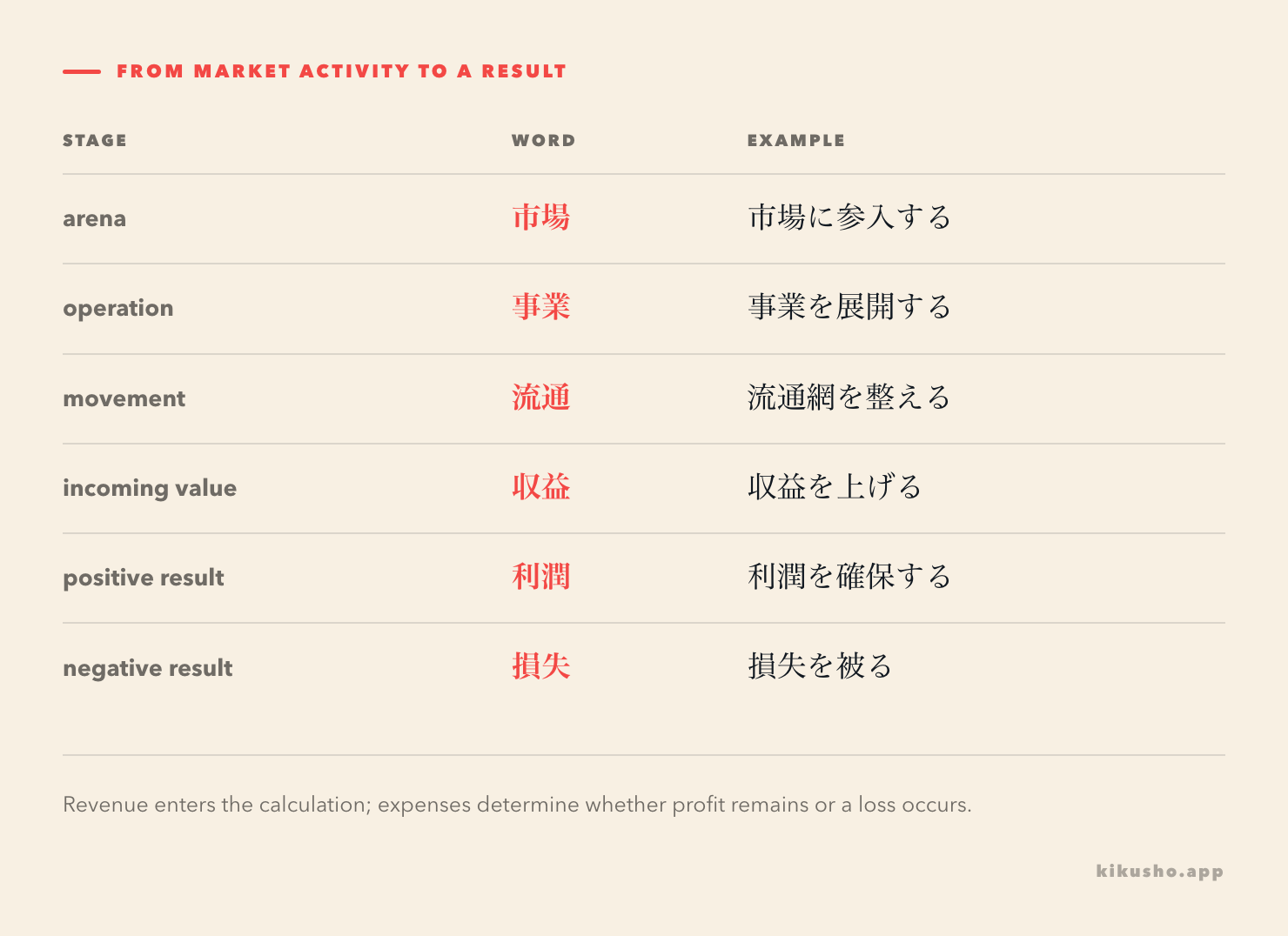
One regional investment report uses every record once
長引く不況で市の財政は厳しい状況でしたが、物流拠点を整備する事業の財源として国の補助金が決まりました。運営会社は株式を発行して追加の資金を調達し、地域の流通網を作り直しました。インフレによる建設費の上昇で初年度は損失を計上したものの、新しい市場を開拓した結果、二年目には収益が伸び、利潤を確保しました。その後、地域経済も好況に転じました。
ながびく ふきょうで しの ざいせいは きびしい じょうきょうでしたが、ぶつりゅうきょてんを せいびする じぎょうの ざいげんとして くにの ほじょきんが きまりました。うんえいがいしゃは かぶしきを はっこうして ついかの しきんを ちょうたつし、ちいきの りゅうつうもうを つくりなおしました。インフレによる けんせつひの じょうしょうで しょねんどは そんしつを けいじょうしたものの、あたらしい しじょうを かいたくした けっか、にねんめには しゅうえきが のび、りじゅんを かくほしました。そのご、ちいきけいざいも こうきょうに てんじました。
A prolonged recession had strained the city's finances, but a national subsidy was approved as the funding source for a project to develop a logistics hub. The operator issued shares to raise additional funds and rebuilt the regional distribution network. Although inflation-driven construction costs produced a loss in the first year, developing a new market increased revenue and secured a profit in the second. The regional economy later turned toward prosperity.
The paragraph does not claim that one project changed an entire economy. It is a vocabulary scenario. Its grammar shows the useful chain: a 財源 makes 資金 available; 株式 can help raise more; a 事業 changes 流通; and the resulting 収益, costs and 損失 determine whether any 利潤 remains.
The N2 continuation supplies 売上, 為替, 商業 and 商社 for company reports. The N1 personal-finance lesson adds debt, repayment and asset vocabulary that often surrounds 資金調達.
Practice the readings and economic roles
1 · Market reading. Which reading fits 株式市場?
- いちば
- しじょう
- しかば
- いちじょう
2 · Funding-source spelling. Choose the kanji for ざいげん.
- 財原
- 材源
- 財源
- 財元
3 · Weak business conditions. Complete the sentence.
景気が悪化し、国は深刻な( )に陥った。
- 好況
- 不況
- 流通
- 収益
4 · Price-level concept. Which situation most directly describes インフレ?
- Consumer prices keep rising across the economy.
- One shop discounts one product for a day.
- A company changes its distribution route.
- A city identifies a subsidy for one project.
5 · Money ready for use. A company borrows money to build a factory. What does it 調達する?
- 財政
- 財源
- 資金
- 好況
6 · Public system. Which word names a local government's overall revenue, expenditure and financial condition?
- 財政
- 株式
- 利潤
- 事業
7 · Shares and company funding. Which sentence is coherent?
- 企業は株式を発行して資金を調達した。
- 企業は不況を発行して市場を読んだ。
- 企業は財政を流通して好況を被った。
- 企業は損失を株式に発音した。
8 · Distribution. Choose the best word.
生産者から消費者まで商品を届ける( )網を整える。
- 財源
- 流通
- 利潤
- 好況
9 · Incoming value. Which word best fills the accounting contrast ( )から費用を差し引いて利益を計算する?
- 収益
- 損失
- 不況
- 株式
10 · Natural loss pattern. Which sentence uses 損失 naturally?
- 新事業で大きな損失を被った。
- 新事業を損失で発行した。
- 損失が市場を資金した。
- 財源に損失を好況した。
11 · Report paraphrase. What does 好況を背景に企業収益が伸びた mean?
- Strong economic conditions accompanied growth in corporate earnings.
- Inflation eliminated every company's expenses.
- A physical marketplace moved to another city.
- The government replaced shares with a funding source.
12 · Source versus available funds. A subsidy is selected to pay for a public project, but it has not yet been transferred. In that report, what is the subsidy first called?
- the project's 財源
- the company's 利潤
- the economy's 好況
- the product's 流通
Answers and explanations
- しじょう. 株式市場 is an abstract stock market, so 市場 is read しじょう.
- 財源. 財源 identifies the source from which required money will come.
- 不況. 景気が悪化する and 陥る describe entry into an economic slump.
- Consumer prices keep rising across the economy. インフレ requires a sustained broad rise in the price level, not one isolated price movement.
- 資金. The company raises usable money for construction. The loan may be one source, but the money deployed is 資金.
- 財政. 財政 covers the government's wider system and condition of revenue, expenditure and financial management.
- 企業は株式を発行して資金を調達した. A company can issue shares as one way to raise business funds.
- 流通. 流通網 is the distribution network that carries goods through the commercial system.
- 収益. In the accounting frame taught here, expenses are subtracted from revenue to calculate profit.
- 新事業で大きな損失を被った. 損失を被る is a standard pattern for incurring a financial loss.
- Strong economic conditions accompanied growth in corporate earnings. 好況 names favourable business conditions, and 収益が伸びた says earnings grew.
- the project's 財源. The subsidy is first the identified source. Once received and available for use, the money can be discussed as 資金.
Track the noun's question before translating the paragraph
When several financial nouns appear together, ask what each one answers. 財源 asks where money originates, 資金 asks what can be deployed, 市場 asks where exchange occurs, 事業 asks what organised activity is underway, and 流通 asks how goods or money move. 収益, 利潤 and 損失 then tell you which stage of the result the writer is measuring.
Common questions
What is the difference between 市場(いちば) and 市場(しじょう)?
市場(いちば) usually names a concrete marketplace where people buy and sell goods. 市場(しじょう) usually names an abstract economic market, as in 国内市場, 株式市場 and 労働市場. Institutional names can be exceptions, so learn the reading with the complete expression.
What is the difference between 財源, 資金 and 財政?
財源 is the source from which money for a measure or expense will come. 資金 is money or purchasing power available for a particular activity. 財政 is the wider system and condition of obtaining, managing and spending public money, especially by a national or local government.
What is the difference between 収益 and 利潤?
収益 broadly names earnings, proceeds or accounting revenue produced by an activity. 利潤 is profit, especially the surplus left after costs and a term common in economics. Ordinary usage overlaps, but formal accounts calculate 利益 from 収益 and 費用 rather than using 利潤 as every profit line.
Are 好況 and インフレ the same thing?
No. 好況 is a phase of vigorous economic activity. インフレ is a sustained general rise in prices. They can occur together, but one word describes business conditions and the other describes the price level.