On this page
These six N3 Japanese trade and economy words describe a marketplace, the business conducted there, what buyers want, what sellers provide, one form of investment and the currency used for payment. The first distinction is visible before any economics begins: 市場 is normally いちば for a physical marketplace and しじょう for an abstract economic market.
Six records assign a place, an activity, two forces, an asset and money
| Word | Reading | Word class | Meaning here | Phrase to remember |
|---|---|---|---|---|
| 市場 | いちば, ichiba | noun | marketplace; market as a concrete place | 市場で魚を買う: buy fish at the market |
| 株 | かぶ, kabu | noun; counter | share; stock; plant clump or stump | 株を買う: buy shares |
| 供給 | きょうきゅう, kyōkyū | noun; suru verb | supply; provision | 電力を供給する: supply electricity |
| 商売 | しょうばい, shōbai | noun; suru verb | business; trade; occupation | 商売を始める: start a business |
| 需要 | じゅよう, juyō | noun | demand; need backed by buyers | 需要が高まる: demand rises |
| 通貨 | つうか, tsūka | noun | currency | 現地の通貨: local currency |
Kikusho's September 2026 inventory assigns these six spelling-and-reading records to N3. Five sit there consistently across the internal evidence. 通貨, however, is filed once at N3 and once at N2 in two files from the same Waller/Tanos lineage. That mismatch signals an uncertain boundary inside one source family. A current Bunpro vocabulary entry independently places 通貨 at N3. The JLPT does not publish an exhaustive current vocabulary list, so neither label guarantees a future test item.
市場 changes reading when the place becomes a system
The assigned word 市場(いちば) is a place you can enter. Stalls or shops bring sellers, buyers and goods together.
- 魚市場(うおいちば): fish market
- 市場で野菜を買う: buy vegetables at the market
- 朝早く市場へ行く: go to the market early in the morning
この市場では、新鮮な魚や野菜を売っています。
この いちばでは、しんせんな さかなや やさいを うって います。
This market sells fresh fish and vegetables.
The same kanji are usually read 市場(しじょう) when the word means an economic field or mechanism without one physical location.
- 国内市場(こくないしじょう): domestic market
- 海外市場(かいがいしじょう): overseas market
- 労働市場(ろうどうしじょう): labour market
- 株式市場(かぶしきしじょう): stock market
海外市場で、この製品の需要が高まっています。
かいがい しじょうで、この せいひんの じゅようが たかまって います。
Demand for this product is rising in overseas markets.
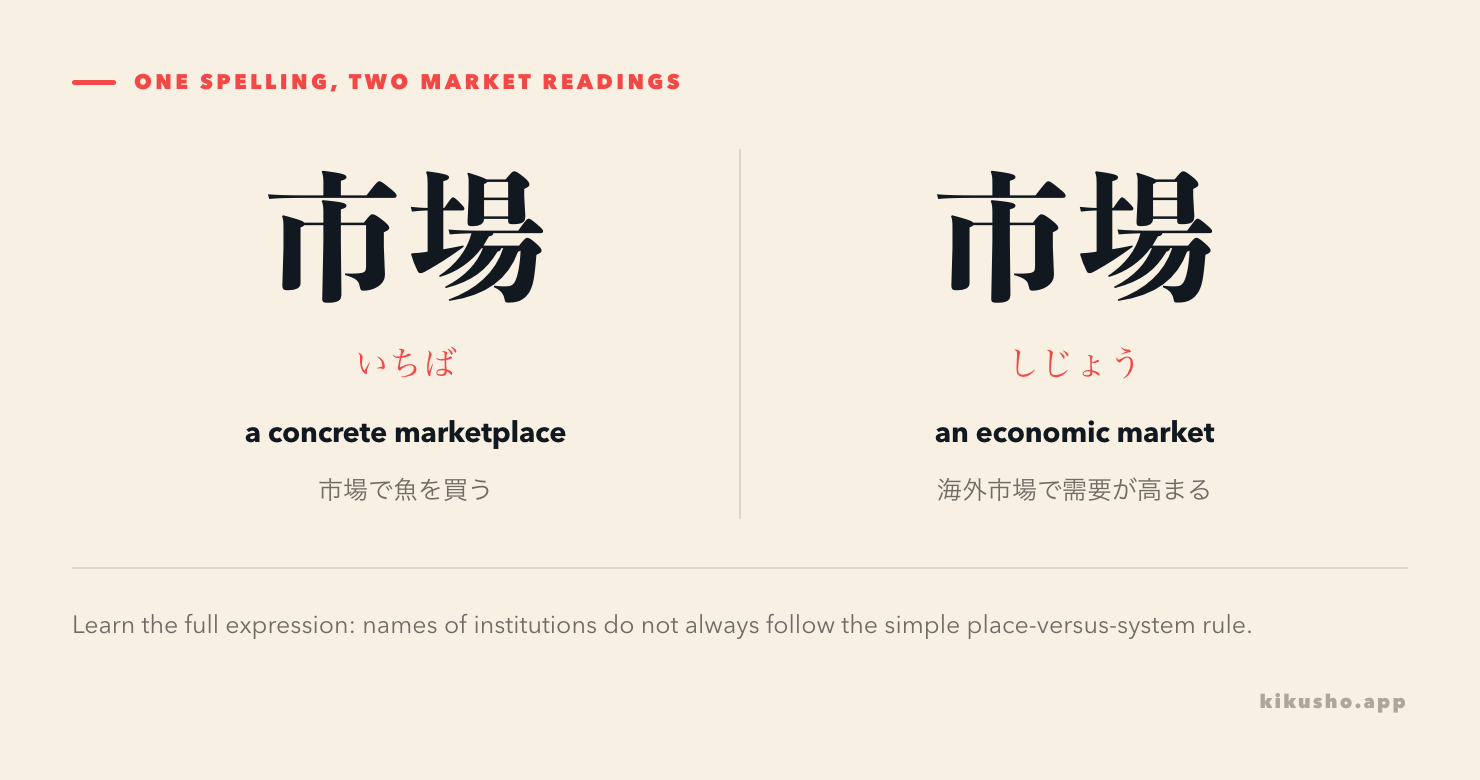
The dictionary explanation describes this concrete-versus-abstract split and also notes that real usage is not perfectly uniform. Names of wholesale institutions can contain 市場 yet use しじょう. Learn the whole expression rather than deciding from the kanji alone.
需要 is what buyers seek; 供給 is what sellers make available
需要(じゅよう) is demand for a product, service or resource. It can rise, fall, exist or be met.
- 需要が高い: demand is high
- 需要が増える: demand increases
- 需要が減る: demand decreases
- 需要に応える: meet demand
夏は冷たい飲み物の需要が増えます。
なつは つめたい のみものの じゅようが ふえます。
Demand for cold drinks increases in summer.
供給(きょうきゅう) is the act or quantity of providing goods, services or resources. The provider can take が, the thing supplied を, and the receiver に.
- 商品を供給する: supply goods
- 町に水を供給する: supply water to the town
- 供給が不足する: supply is insufficient
- 安定して供給する: supply steadily
この工場は町に電力を供給しています。
この こうじょうは まちに でんりょくを きょうきゅうして います。
This plant supplies electricity to the town.
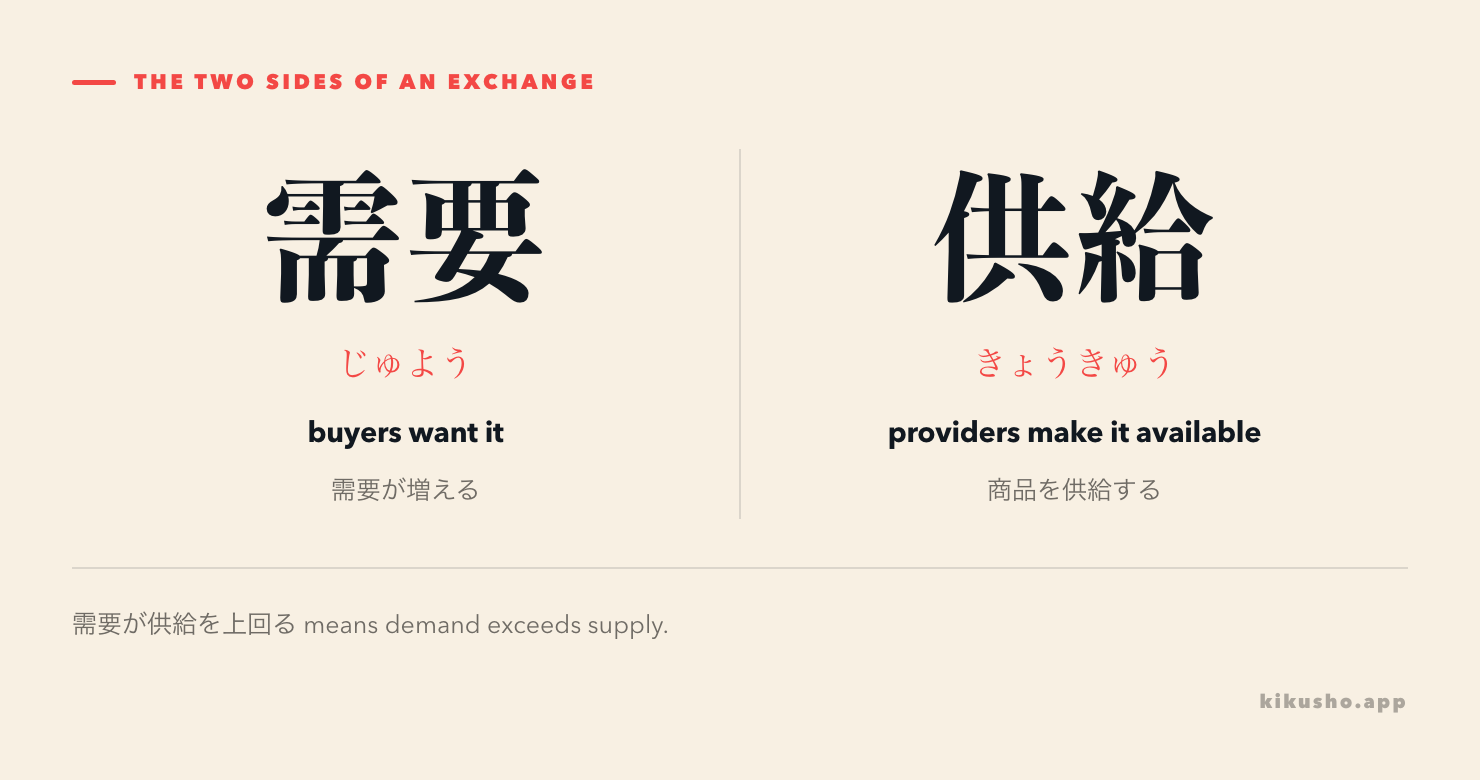
The two become 需給(じゅきゅう), supply and demand together. The demand definition connects economic 需要 to a wish to purchase supported by buying power; 供給 includes both providing what is needed and putting goods on a market for sale.
需要が供給を上回ったため、価格が上がりました。
じゅようが きょうきゅうを うわまわった ため、かかくが あがりました。
Prices rose because demand exceeded supply.
This sentence names a relationship, not a universal promise about every price. For vocabulary study, the important structure is AがBを上回る: A exceeds B.
商売 is the work of earning through business
商売(しょうばい) usually presents buying, selling or another activity pursued as a livelihood. It can be the commercial activity or the person's occupation.
- 商売を始める: start a business
- 商売をする: conduct business
- 商売がうまくいく: business goes well
- 商売になる: be commercially viable
- 客商売(きゃくしょうばい): customer-facing work
両親は駅の近くでパンを売る商売をしています。
りょうしんは えきの ちかくで パンを うる しょうばいを して います。
My parents run a business selling bread near the station.
The dictionary entry covers commerce for profit and work used to make a living. English “trade” can mislead here. 貿易(ぼうえき) is international trade; 取引(とりひき) is a transaction or business dealing; 商売 can be the ongoing livelihood behind many transactions.
株 is an asset; 通貨 is the recognised means of payment
In finance, 株(かぶ) means a share or stock in a company.
- 会社の株を買う: buy shares in a company
- 株を売る: sell shares
- 株を持つ: own shares
- 株価が上がる: the share price rises
兄はその会社の株を少し持っています。
あには その かいしゃの かぶを すこし もって います。
My older brother owns a few shares in that company.
The word is highly polysemous. The dictionary entry for 株 also records a stump or plant clump, a biological strain, older rights and a person's standing. バラを二株植える counts two rose plants; 株を二百株買う counts two hundred shares. Financial neighbours such as 会社, 株価, 株主 and 売買 settle the sense.
通貨(つうか) is a currency used and recognised for payment. It is more institutional than ordinary お金.
- 日本の通貨: Japan's currency
- 外国通貨: foreign currency
- 現地通貨: local currency
- 共通通貨: common currency
空港で円を現地の通貨に両替しました。
くうこうで えんを げんちの つうかに りょうがえしました。
I exchanged yen for the local currency at the airport.
The currency reference discusses banknotes, coins and other payment media within a monetary system. In an ordinary shop you can say お金を払う. 通貨 becomes useful when countries, exchange, circulation or monetary policy are the subject.
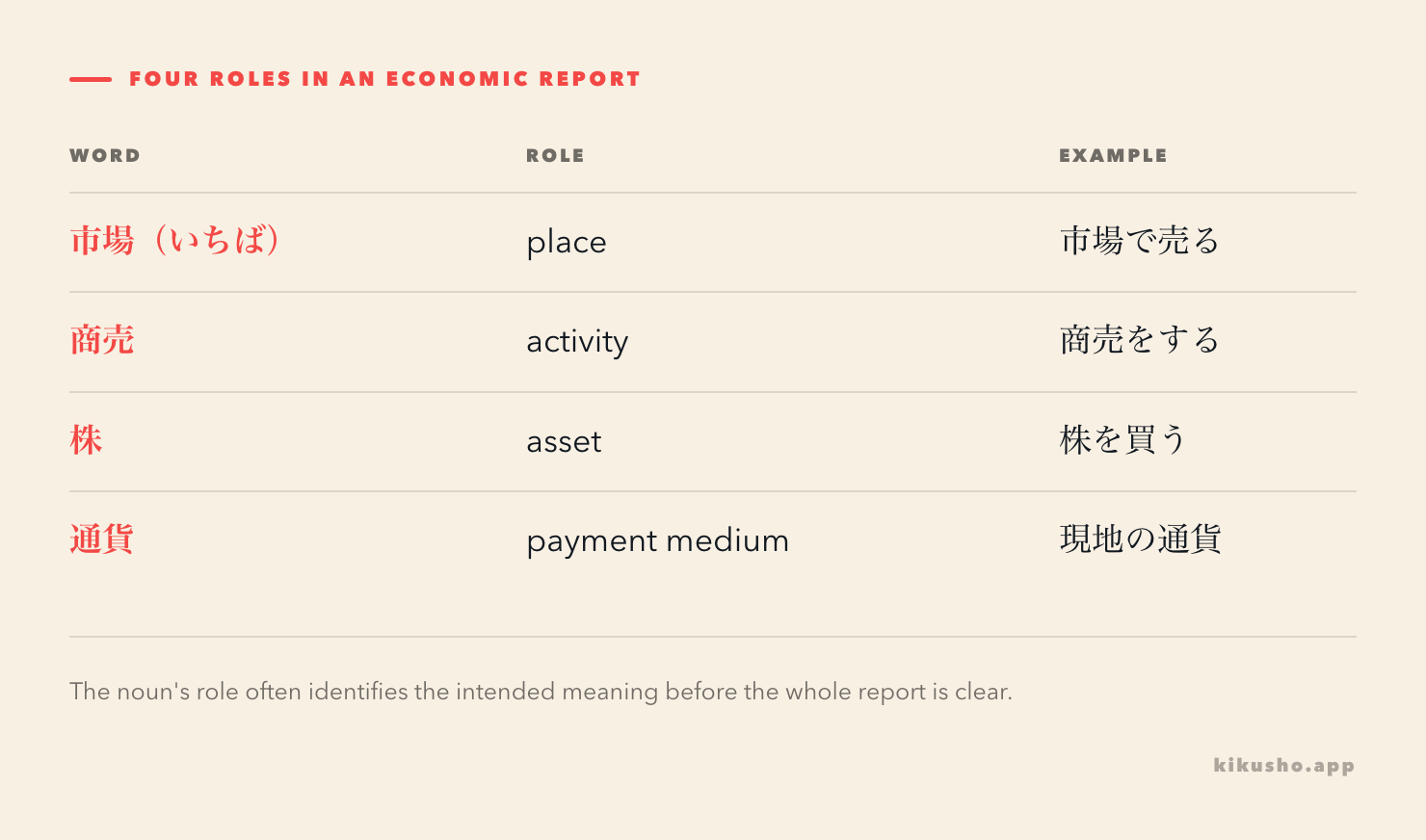
One local report gives every word a separate job
この町の市場では、魚を売る商売が盛んです。今年は観光客が増えて魚の需要が高まりましたが、悪天候で供給が減り、値段が上がりました。冷蔵設備を作る会社の株も注目されています。その会社は海外から部品を買うため、二つの通貨で支払いをしています。
この まちの いちばでは、さかなを うる しょうばいが さかんです。ことしは かんこうきゃくが ふえて さかなの じゅようが たかまりましたが、あくてんこうで きょうきゅうが へり、ねだんが あがりました。れいぞう せつびを つくる かいしゃの かぶも ちゅうもくされて います。その かいしゃは かいがいから ぶひんを かう ため、ふたつの つうかで しはらいを して います。
The business of selling fish thrives in this town's market. This year, more tourists raised demand for fish, but bad weather reduced supply and prices rose. Shares in a company that makes refrigeration equipment are also attracting attention. That company pays in two currencies to buy parts from overseas.
The first 市場 is いちば because it is a town location. 商売 names the livelihood there. 需要 belongs to buyers and 供給 to available fish. 株 shifts from goods to ownership in a company, while 通貨 tells you how an international payment is denominated.
The N2 trade and investment lesson continues with 貿易, 輸出, 輸入, 投資, 資本 and exchange-rate vocabulary. The N3 personal-finance lesson provides the everyday payment and banking words around this report.
If you capture the report in Kikusho, save 市場 with its reading and one neighbour. A card that keeps only the kanji and “market” cannot tell you whether the source described a row of stalls or an economic system.
Practice the readings, contexts and economic roles
1 · Kanji reading. In this sentence, how is 市場 read?
母と市場で野菜を買いました。
- しじょう
- いちば
- いちじょう
- しば
2 · Reading by sense. Which reading normally fits 国内市場, the domestic economic market?
- いちば
- しじょう
- しば
- いちじょう
3 · Orthography. Choose the kanji for きょうきゅう.
- 供給
- 共級
- 供急
- 教給
4 · Kanji reading. How is 需要 read?
- じゅきゅう
- じゅよう
- しゅよう
- じょうよう
5 · Buyers' side. Complete the sentence.
暑くなり、冷たい飲み物の( )が増えた。
- 供給
- 通貨
- 需要
- 株
6 · Provider's side. A company delivers water to several towns. Which word names that action?
- 供給
- 需要
- 商売
- 市場(いちば)
7 · Livelihood. Which sentence uses 商売 naturally?
- 父は駅前で花を売る商売をしている。
- 父は駅前で通貨を商売に読んでいる。
- 父は市場を需要に商売した。
- 父は株が商売を供給した。
8 · Financial or botanical. Which phrase certainly uses the financial sense of 株?
- バラを三株植える
- 木の株に座る
- 会社の株を買う
- 新しい菌株を調べる
9 · Currency. Choose the best word.
日本の( )は円です。
- 商売
- 通貨
- 需要
- 供給
10 · Paraphrase. What does 需要が供給を上回った mean?
- Supply exceeded demand.
- Demand exceeded supply.
- The market moved to another building.
- The currency replaced the shares.
11 · Usage. Which sentence has a natural particle pattern?
- 工場が町に電力を供給する。
- 工場を町が電力に供給する。
- 工場に町を電力が供給する。
- 工場で町を電力に需要する。
12 · Connected meaning. A report says 観光客が増え、魚の需要が高まった. What changed?
- More tourists wanted to buy fish.
- More fish became a new currency.
- The physical market changed its reading.
- The company stopped doing business.
Answers and explanations
- いちば. Buying vegetables at a concrete marketplace selects 市場(いちば).
- しじょう. 国内市場 presents the abstract economic market, for which しじょう is the normal reading.
- 供給. 供給(きょうきゅう) means supply or provision.
- じゅよう. 需要 is demand. Do not confuse it with 需給(じゅきゅう), the combined term for supply and demand.
- 需要. Hot weather increases buyers' demand for cold drinks. 供給 would describe what sellers make available.
- 供給. 町に水を供給する uses に for the receiver and を for the thing supplied.
- 父は駅前で花を売る商売をしている. 商売 names the parent's ongoing business or livelihood. The other choices combine economic nouns without valid roles.
- 会社の株を買う. Company and buying select shares or stock. Roses use the plant counter, 木の株 is a stump, and 菌株 is a biological strain.
- 通貨. The yen is Japan's currency. お金 would work in broad everyday contexts, but a country's recognised currency is 通貨.
- Demand exceeded supply. In AがBを上回る, A is greater than B. Here 需要 is A and 供給 is B.
- 工場が町に電力を供給する. The provider takes が, the recipient takes に and the supplied resource takes を.
- More tourists wanted to buy fish. 観光客が増え identifies more potential buyers, and 需要が高まった states that demand rose.
Economic nouns reveal whose side of the exchange you are reading
When a report says 需要, follow the buyers; when it says 供給, follow the provider and available quantity. 商売 asks whether the activity supports a livelihood, 株 moves the focus to ownership, and 通貨 moves it to payment. Those roles make an economic paragraph readable even before every price or policy term is familiar.
Common questions
Is 市場 read いちば or しじょう?
Both readings exist. 市場(いちば) usually presents a concrete marketplace where people buy and sell goods. 市場(しじょう) usually presents an abstract economic market, as in 国内市場 or 株式市場. This lesson's assigned inventory record is いちば.
What is the difference between 需要 and 供給?
需要(じゅよう) is demand: the desire and purchasing ability for goods or services. 供給(きょうきゅう) is supply: making goods, services or resources available. A common contrast is 需要が供給を上回る, demand exceeds supply.
Does 株 only mean company shares?
No. 株(かぶ) can mean a share or stock, but it also names a plant clump or stump, a biological strain and several older kinds of position or right. Words such as 株価, 株主 and 株を買う clearly select the financial sense.
What is the difference between お金 and 通貨?
お金 is the ordinary broad word for money. 通貨(つうか) refers to currency recognised and circulated as a means of payment, especially when comparing countries or monetary systems.