On this page
Learn the word, but keep the sentence it came from. On its own a word gives you one thing: you will recognise it the next time you see it. The sentence it lived in gives you the rest, which is the particle the word demands, the words it habitually travels with, and the register that tells you whether you would actually say it out loud. That gap is the difference between a word you know and a word you can use, and it is why "just learn single words, it's faster" saves a few seconds now and quietly bills you for them later.
A word on its own gives you recognition, not use
A single-word card, with 会う on the front and "to meet" on the back, trains exactly one skill: seeing 会う and remembering it means meet. That is recognition, and it is worth having. You will read faster for it. But it is only half of what knowing a word turns out to mean. The other half is retrieval from nothing, when someone asks about your weekend and you have to build 友達に会った with no prompt in front of you at all.
Recognition does not carry you there. Reading a word and summoning it cold are two different skills, and the second is built by recalling the word, not by seeing it again. A bare word card only ever trains the first. The sentence is where the second one gets its raw material. Not because you memorise the sentence, but because everything you need to produce the word, everything about how it attaches to the rest of the clause, is in the sentence and nowhere else.
The sentence carries the particle the word demands
Ask a dictionary what 会う means and it says "to meet." What it cannot tell you, because it does not fit in a gloss, is that 会う takes に and not を. In Japanese you meet with a person: 友達に会う. Learn the word alone and nothing stops you saying 友達を会う, which is the single commonest way to get this verb wrong. You will keep getting it wrong, too, because the card never mentioned the particle in the first place.
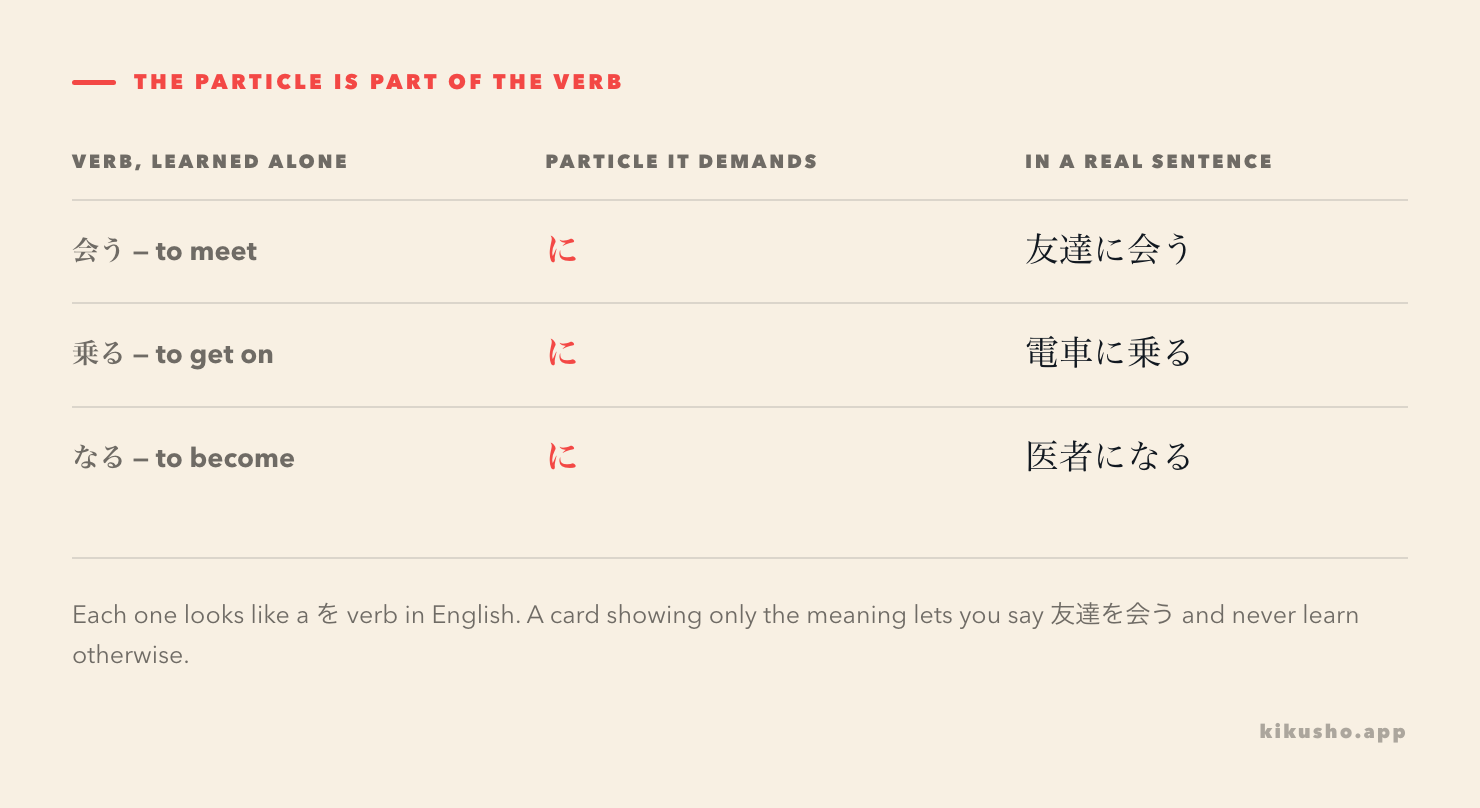
A particle is not decoration on a verb. It is part of it, the way a preposition is part of an English phrasal verb: "look" and "look after" are not the same word, and neither are 会う on a card and 友達に会う in the wild. The sentence is the smallest unit that carries the particle, which makes the sentence the smallest thing actually worth learning.
It carries the company the word keeps
Even with the right particle, words are picky about their companions. You do not "take" a cold in Japanese, you "pull" one: 風邪をひく. You do not "have" a promise, you "protect" it: 約束を守る. These pairings, a noun and the one specific verb that idiomatically goes with it, are collocations, and they are almost never predictable from the two meanings laid side by side. Translate "keep a promise" straight and you arrive at 約束を持つ, which a Japanese speaker will understand and never once say.
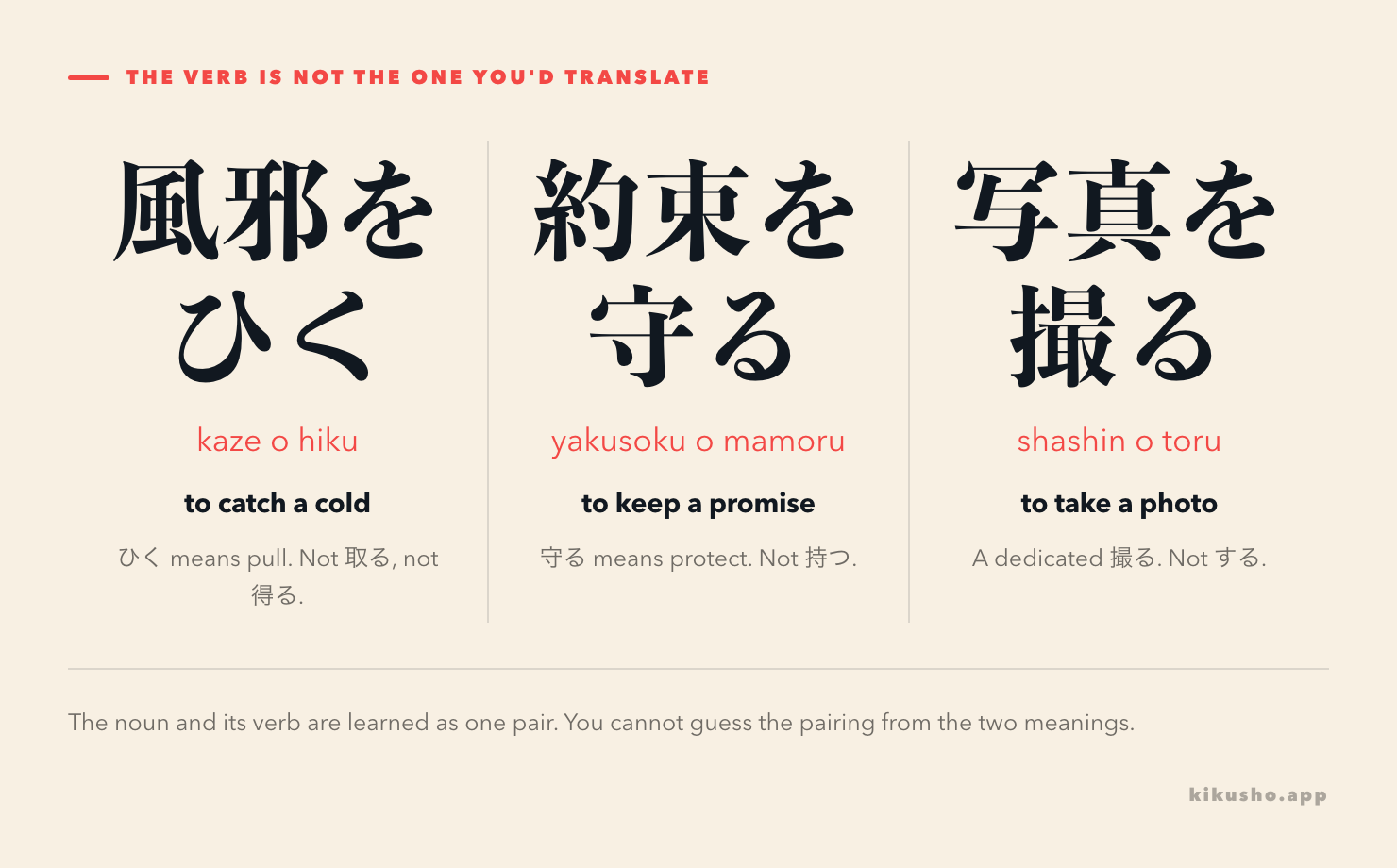
A single-word card teaches you 風邪 and 守る as two separate facts and leaves you to work out how they combine, which is the one thing you cannot work out. The sentence hands you the combination already assembled. Collect enough of them and you stop building phrases word by word and start reaching for the one that already exists, which is most of what sounding natural turns out to be.
Transitive or intransitive: the sentence settles which you learned
Japanese is full of verb pairs that look alike and split one job between them. One verb describes a thing happening on its own; the other describes someone making it happen. 開く and 開ける both live under the English word "open." A door opens by itself with 開く; you open a door with 開ける. Learn either one from a card glossed only "open" and you have no way of knowing which half of the pair you are holding.
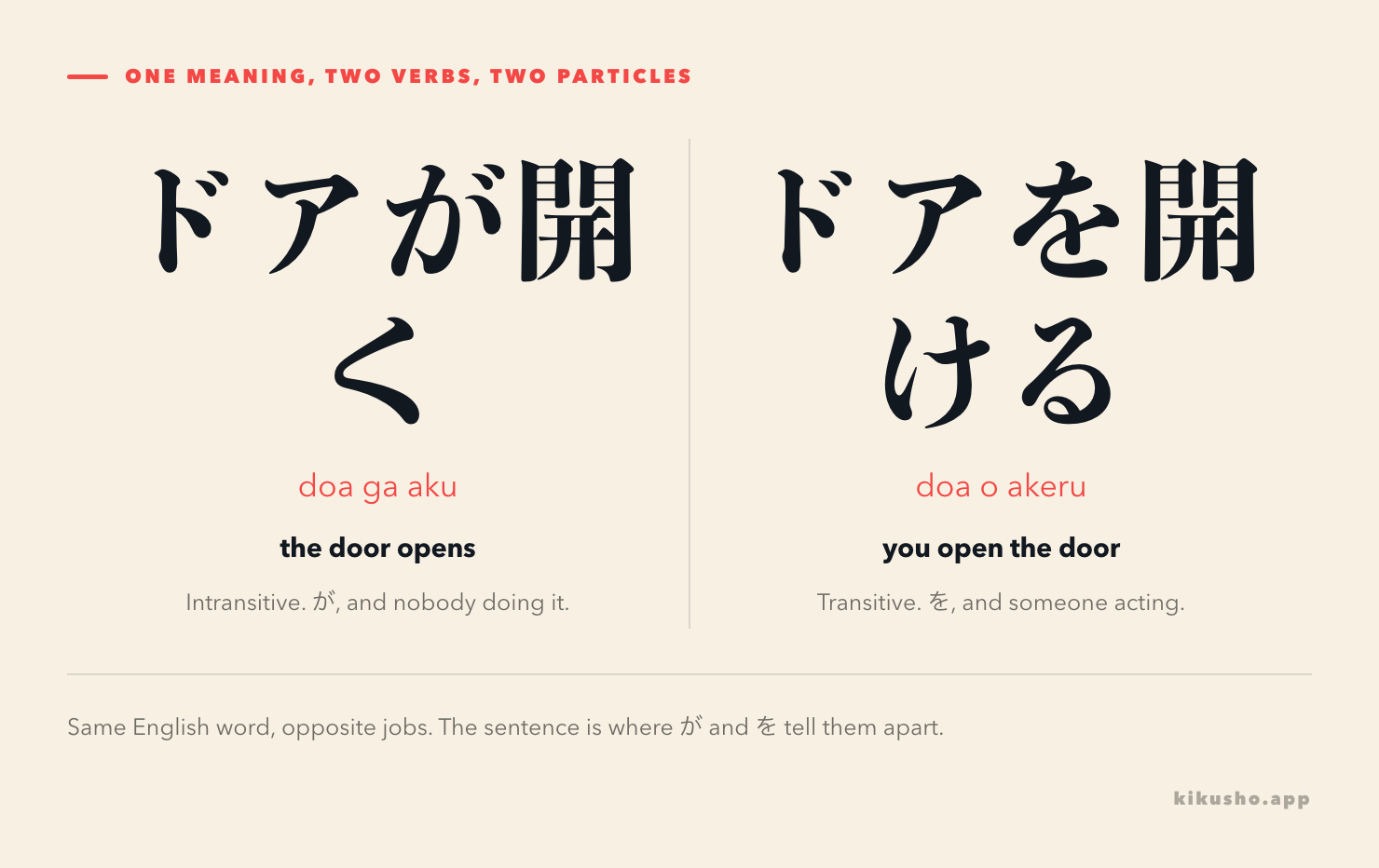
The sentence settles it in a single stroke, because the two verbs take different particles and the particle is sitting right there. ドアが開く has が and nobody doing the opening; ドアを開ける has を and someone behind it. This is the same fact as the particle section, seen from the far side, and that is the whole point. The grammar a word needs is not a separate subject you study after the vocabulary. It is fastened to the word, and the sentence is where it stays fastened.
It tells you the register, whether you'd say it out loud
A word also carries a register, and the citation form on a flashcard strips it clean off. 食べる and 召し上がる both mean "eat." One you say to a friend; the other you say about your guest, and choosing wrong is not a small slip. Some words are almost only ever written and land stiffly when spoken; some are casual to the edge of rude in the wrong room. None of that fits on the back of a one-word card, and a learner working from bare glosses tends to produce a flat, register-less Japanese where every word is the dictionary one. That is a real part of why textbook Japanese sounds stiff: it teaches the safe citation form and leaves the register behind.
The sentence keeps the register attached because a real sentence comes from a real situation. You saw 召し上がる on a menu, or heard it from a waiter, and that situation is the register. The context is exactly what you throw away when you copy the headword onto a card and drop the rest.
You don't memorise the sentence, you anchor the word to it
The objection to all of this is that sentences are more to remember, and drilling whole sentences sounds slow. But you are not memorising the sentence. The card still tests one word. The sentence sits underneath it as the context that supplies the particle, the company and the register, and as a second, richer cue when you go to recall it. A word floating alone has one hook into memory, its meaning. The same word inside 友達に会った has several: the friend, the past tense, the situation you were in when you met it. More hooks means more ways back to the word when you need it.
It is also why a sentence you met yourself beats one lifted from a textbook. A word you actually ran into arrives with a moment attached, where you were and what you were reading, and that moment is a retrieval cue no stranger's example sentence can hand you. The sentence is not extra work bolted onto the word. It is the part of the encounter you would otherwise be discarding.
This is the part Kikusho is built around. When you capture a word, from a photo, your voice, or pasted text, the card comes back with an example sentence already on it, taken from where the word was used. The sentence arrives with the word instead of being something you have to construct and staple on afterwards, and you can play its audio or turn any word in it into a new card by selecting it.
Won't I only be able to use the word in that one sentence?
This is the fair worry: anchor 会う to 友達に会う and maybe all you have learned is that one phrase. In practice the opposite happens, because what the sentence taught you is the frame, not the furniture. The particle, the transitivity, the register carry over unchanged to the next friend, the next appointment, the next person you go to meet. What is specific to the sentence, the friend and the past tense, is exactly the part you drop without thinking, because it was never the word.
You confirm the frame the second time you meet the word, in a different sentence, and the two encounters generalise each other. That is an argument for keeping the sentences, not for stripping them: two sentences with 会う, both showing に, teach the particle far more firmly than seeing 会う twice on a bare card ever could. The word is what stays constant across the sentences; the sentences are what show you the shape of the space it moves in.
When a single word is genuinely enough
None of this means every word needs a sentence. A concrete noun is usually just itself. 椅子 is a chair, 駅 is a station, and there is no particle drama, no register question, nothing a sentence would add that the picture in your head does not already supply. Place names, numbers, most nouns you can point at: a bare card is fine, and pretending otherwise only slows you down.
The sentence earns its place for the words that actually do something in a clause. Verbs, adjectives that take a particular particle, anything whose politeness is not obvious, anything you would only ever use in combination with something else — the way a degree adverb like 全然 is ungrammatical without a negative verb after it. If you are unsure which kind of word you are holding, that uncertainty is itself the answer. Keep the sentence, because a word you are not sure how to use is precisely the word whose sentence you will be glad you kept.
Common questions
Should I learn Japanese words in sentences or on their own?
Learn the word, but keep the sentence it came from. On its own a word gives you recognition: you will know it when you see it. The sentence carries what you need to actually use it, which is the particle the verb takes, the words it habitually pairs with, and the register that tells you whether you would say it out loud.
Doesn't learning whole sentences take much longer?
You are not memorising the sentence. The card still tests a single word; the sentence sits underneath as context, giving the word its particle and register and a second, richer cue for recall. It costs a few seconds more to keep, and it is the difference between recognising a word and being able to produce it.
Are there words that don't need a sentence?
Yes. Concrete nouns you can point at, like a chair, a station, a place name or a number, rarely need one, because there is no particle or register question for a sentence to settle. The sentence pays off most for verbs, for adjectives that take a specific particle, and for any word whose politeness level is not obvious.