On this page
For an N4 counter list, learn the noun and its full counted phrase together: 本を一冊, 猫が三匹, and 店が二軒 tell you more than isolated suffixes. The twelve counters below cover occurrences, floors, books, vehicles, servings, objects, buildings, animals and pairs of footwear; their readings do not change in one uniform way.
These twelve belong together because the noun decides
Each entry is a counter suffix (助数詞) attached to a number. The noun determines the counted unit; the number says how many. If you need the sentence pattern or the everyday fallback 〜つ, start with the general counter guide and Japanese numbers. This page is the next step: a compact reference for selecting a particular suffix and saying its complete form.
This lesson sits in the N4 vocabulary study path. The Kikusho reference inventory places eight of these forms at N5, 軒 at N4, and 足, 頭 and 羽 at N2. They are grouped here for practice rather than treated as twelve newly introduced N4 test words. The JLPT does not publish an exhaustive official word list, so those level labels are source-based study estimates.
The set itself: twelve nouns and counted phrases
The reading after 〜 is the counter's base reading. The final column gives the whole number-plus-counter reading. Every row is a phrase you can put into a sentence, not a guess from a kanji alone.
| counter (base reading) | what it counts | noun + counted phrase (whole reading) |
|---|---|---|
| 〜回 (かい) | occurrences of an action | 練習を三回 (さんかい): practise three times |
| 〜階 (かい) | a building floor | 図書館は三階 (さんかい/さんがい): the library is on floor three |
| 〜冊 (さつ) | bound books, notebooks, magazines | 本を一冊 (いっさつ): one book |
| 〜台 (だい) | vehicles and machines | 車が二台 (にだい): two cars |
| 〜杯 (はい) | cupfuls and servings in a cup or bowl | お茶を一杯 (いっぱい): one cup of tea |
| 〜匹 (ひき) | small animals, including cats | 猫が三匹 (さんびき): three cats |
| 〜本 (ほん) | long, thin things such as pens | ペンを一本 (いっぽん): one pen |
| 〜枚 (まい) | flat things such as sheets or tickets | 切手を三枚 (さんまい): three stamps |
| 〜軒 (けん) | houses and small shops | 店が二軒 (にけん): two shops |
| 〜足 (そく) | pairs of footwear | 靴を一足 (いっそく): one pair of shoes |
| 〜頭 (とう) | large animals such as cattle | 牛が二頭 (にとう): two cattle |
| 〜羽 (わ) | birds; rabbits in a traditional usage | 鶏が二羽 (にわ): two chickens |
Tokyo University of Foreign Studies' counter chart checks the common forms and their number readings. Tofugu's counter reference confirms the noun groups; the Japanese counter dictionary clarifies animal and object boundaries. The examples above are original short phrases built from those checked uses.
回 and 階 sound alike until context supplies the unit
One round of practice is 一回 (いっかい); the first floor is 一階 (いっかい). もう一回練習します means you will practise once more. 図書館は一階です locates the library on the first floor. Neither counter can replace the other without changing the meaning.
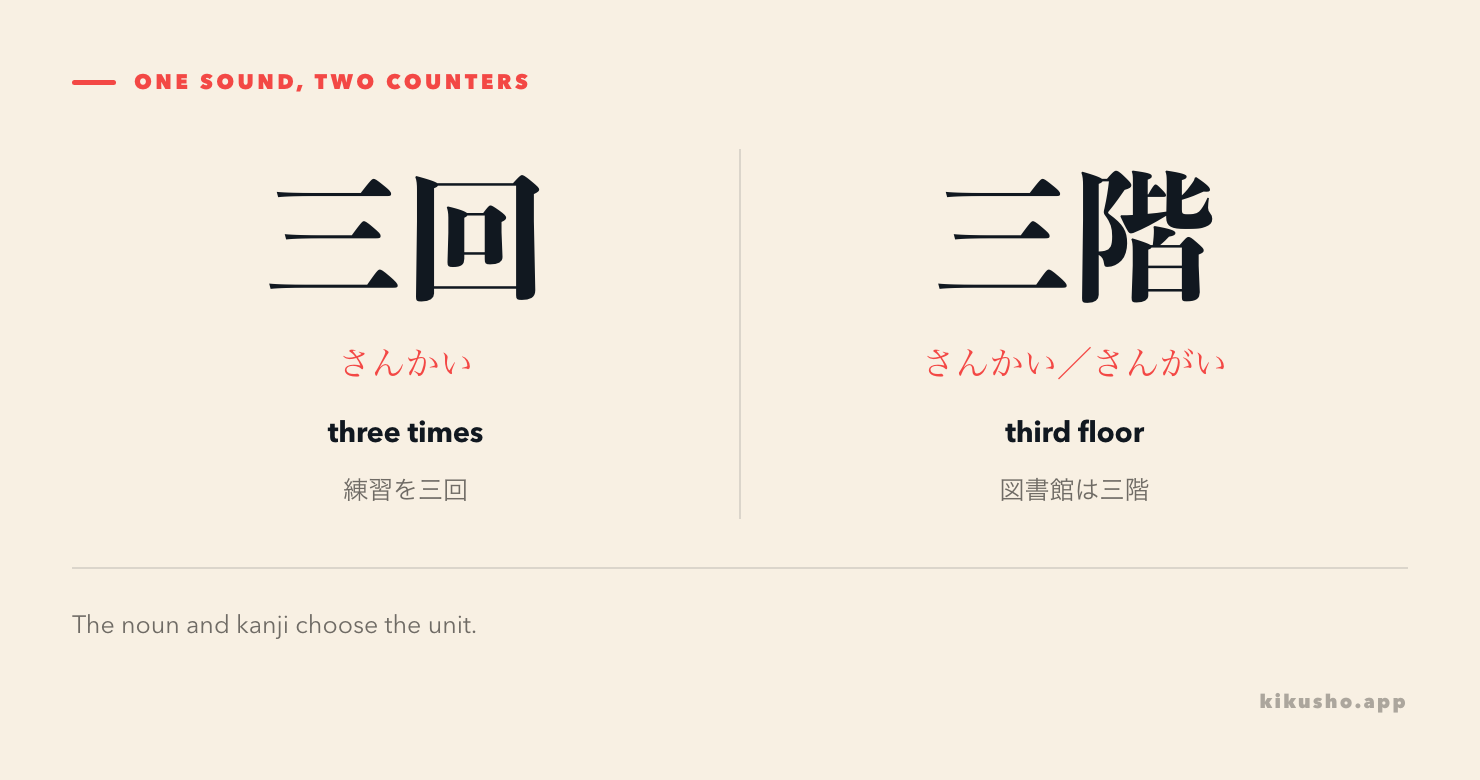
At three, 三回 is さんかい; 三階 is さんかい or さんがい in the university chart. The question forms split too: 何回 (なんかい) asks how many times; 何階 (なんがい) asks which floor. Learn the kanji and surrounding noun before inferring meaning from sound.
Some changes are shared; others stay local
The familiar は-row group changes when a number joins it: 一本 いっぽん, 一匹 いっぴき, 一杯 いっぱい; at three, 三本 さんぼん, 三匹 さんびき, 三杯 さんばい. The general guide explains this sound pattern in detail.
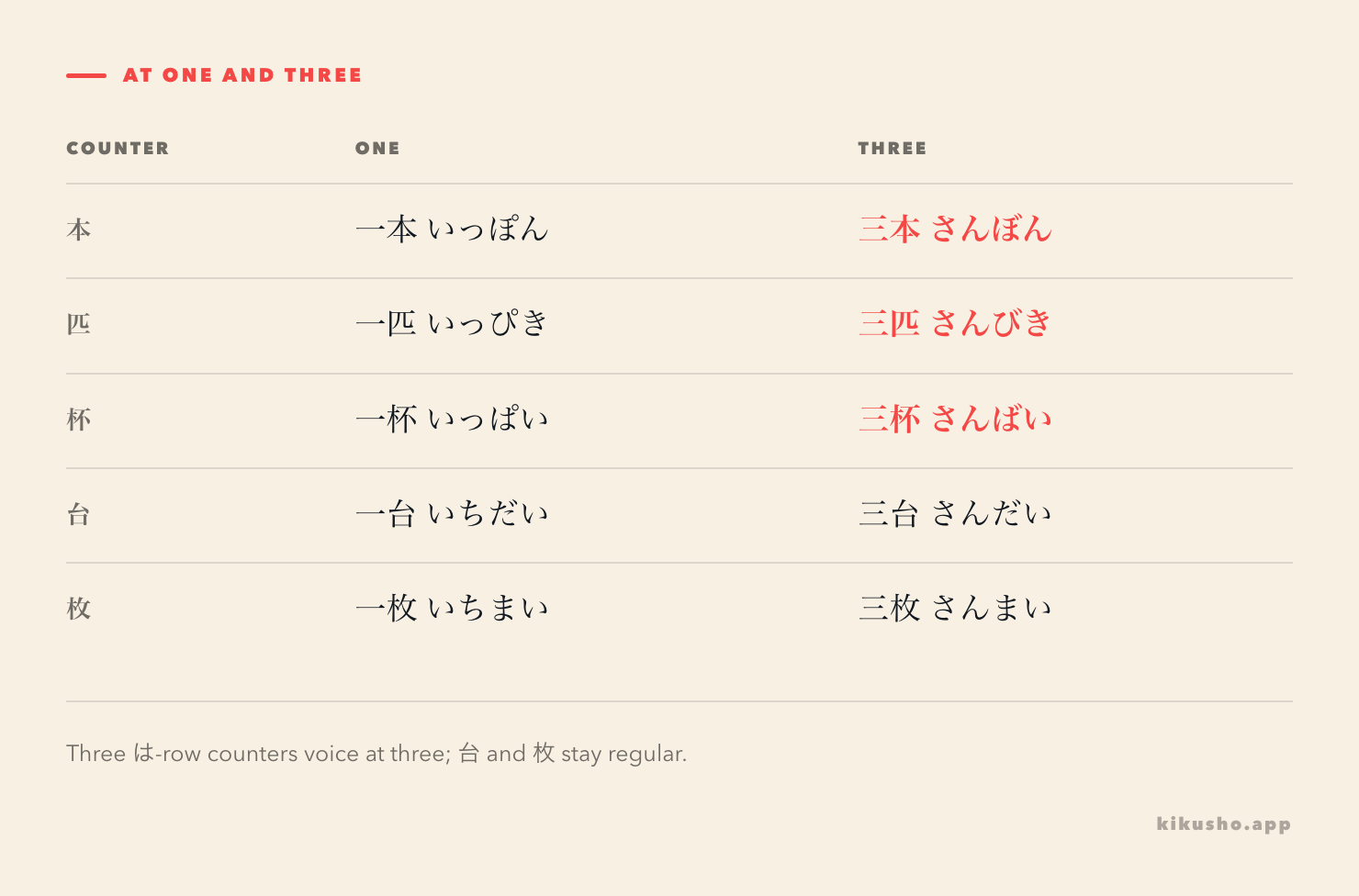
台 and 枚 stay regular in this sample: 三台 さんだい, 三枚 さんまい. 冊 changes at one to 一冊 いっさつ, but 六冊 is ろくさつ. 階 permits two three-form readings as shown above. A single rule for a supposed “second tier” would teach the wrong thing; use the complete phrase, then consult a chart for a new number.
The edge cases are about the counted unit
本 as a noun means “book”; 〜本 as a counter counts a pen, bottle or other long thing. A book is 一冊, not 一本. 一足 (いっそく) means a pair of shoes, while one unpaired shoe is not a full 足. The counter dictionary's shoe entry makes that unit explicit.
Animal counters have a similar boundary: 匹 is the ordinary choice for cats, 頭 for cattle and other large animals, and 羽 for birds. Rabbits can traditionally take 羽, but 匹 is also used; these are conventional noun-counter pairings, not a biological rule. The counter dictionary's animal guide and Tofugu's animal examples show the overlap. For buildings, 軒 counts a house or small shop; 階 identifies a floor inside one. The dictionary's building guide treats them as distinct units.
When you meet a counter on a sign or receipt, keep the noun and number with it. Kikusho can turn text or a photo highlight into a card whose example sentence keeps that pairing in view, so 店が二軒 need not become an isolated けん to review later.
Try the noun choice and the whole reading
All solutions follow Question 6. Each question has one best answer unless it asks for more than one reading.
Question 1
In 図書館は三階です, which readings are supported for 三階?
- a) さんかい only
- b) さんがい only
- c) さんかい and さんがい
Question 2
Fill the counter in 本を一___借りました (I borrowed one book).
- a) 本
- b) 冊
- c) 台
Question 3
Complete 靴を二___買いました to mean I bought two pairs of shoes.
- a) 枚
- b) 本
- c) 足
Question 4
Which pair matches the ordinary animal counters for these nouns?
- a) 猫を三頭; 牛を二匹
- b) 猫を三匹; 牛を二頭
- c) 猫を三羽; 牛を二杯
Question 5
Choose the whole reading of 三杯 in お茶を三杯飲みました.
- a) さんはい
- b) さんぱい
- c) さんばい
Question 6
What does もう一回練習しました say?
- a) I practised once more.
- b) I practised on the first floor.
- c) I practised one book.
Answers and explanations
Answer 1
c) Both さんかい and さんがい are recorded for 三階 in the university chart. The one-reading options omit an accepted pronunciation. 三回, the occurrence counter, is さんかい only in that chart.
Answer 2
b) 冊. 本を一冊 is ほんをいっさつ, one bound book. 〜本 is for a long thing such as a pen; 台 counts machines or vehicles.
Answer 3
c) 足. 靴を二足 is くつをにそく, two pairs of shoes. 枚 counts flat things and 本 long things; neither specifies paired footwear.
Answer 4
b). 猫を三匹 (ねこをさんびき) and 牛を二頭 (うしをにとう) match the usual small-versus-large animal contrast. a) reverses it; c) uses the bird counter for a cat and the serving counter for cattle.
Answer 5
c) さんばい. At three, 杯 voices to ば in the checked chart. さんはい leaves it unchanged; さんぱい uses the ぱ sound of 一杯 (いっぱい).
Answer 6
a). 回 counts occasions, so もう一回 means once more. A floor would be 階; a book would take 冊.
Keep the next unfamiliar counter beside its noun
This list is closed because JL48 assigns these twelve forms. When a new counter appears, write down the whole phrase: 名詞 + 数字 + 助数詞, with the reading of the last two parts. That note answers the two questions a bare suffix cannot: what is being counted, and how is the counted phrase said?
Common questions
Which counter counts books in Japanese?
Use 〜冊 (さつ) for a bound book: 本を一冊 (いっさつ). 本 also means book as a noun, but the counter 〜本 (ほん) counts long, thin things such as pens.
Do 回 and 階 have the same reading?
Both have the base reading かい and make 一回 and 一階 いっかい. 回 counts occurrences and 階 names building floors. 三回 is さんかい; 三階 can be さんかい or さんがい.
Does 一足 mean one shoe or one pair?
一足 (いっそく) counts one pair of footwear, such as a pair of shoes or socks. One unpaired shoe is not a full 一足.