On this page
You pressed the wrong button once: ~ばかりに can single out that act as the cause of an unwelcome result. ~あまり instead highlights an extreme degree, such as anxiety so strong that the prepared words will not come.
The useful distinction is “all because of that” versus “so much … that.” A mistake is one possible cause for ばかりに, not a requirement. An unwanted outcome is common with あまり, not its entire meaning. This N2 grammar comparison teaches those two causal constructions while making their overlap visible.
Ask whether the cause is singled out or its degree is extreme
Imagine describing a presentation that went badly. Did one act lead to the problem, and do you now regret that act? Or did a feeling become so strong that you could not perform normally?
| What you want to foreground | Construction | What to check in the cause |
|---|---|---|
| This particular circumstance led to the unwelcome result | ~ばかりに | An action, quality or situation being singled out |
| The degree was so great that the result followed | ~あまり | An intense action, feeling or state |
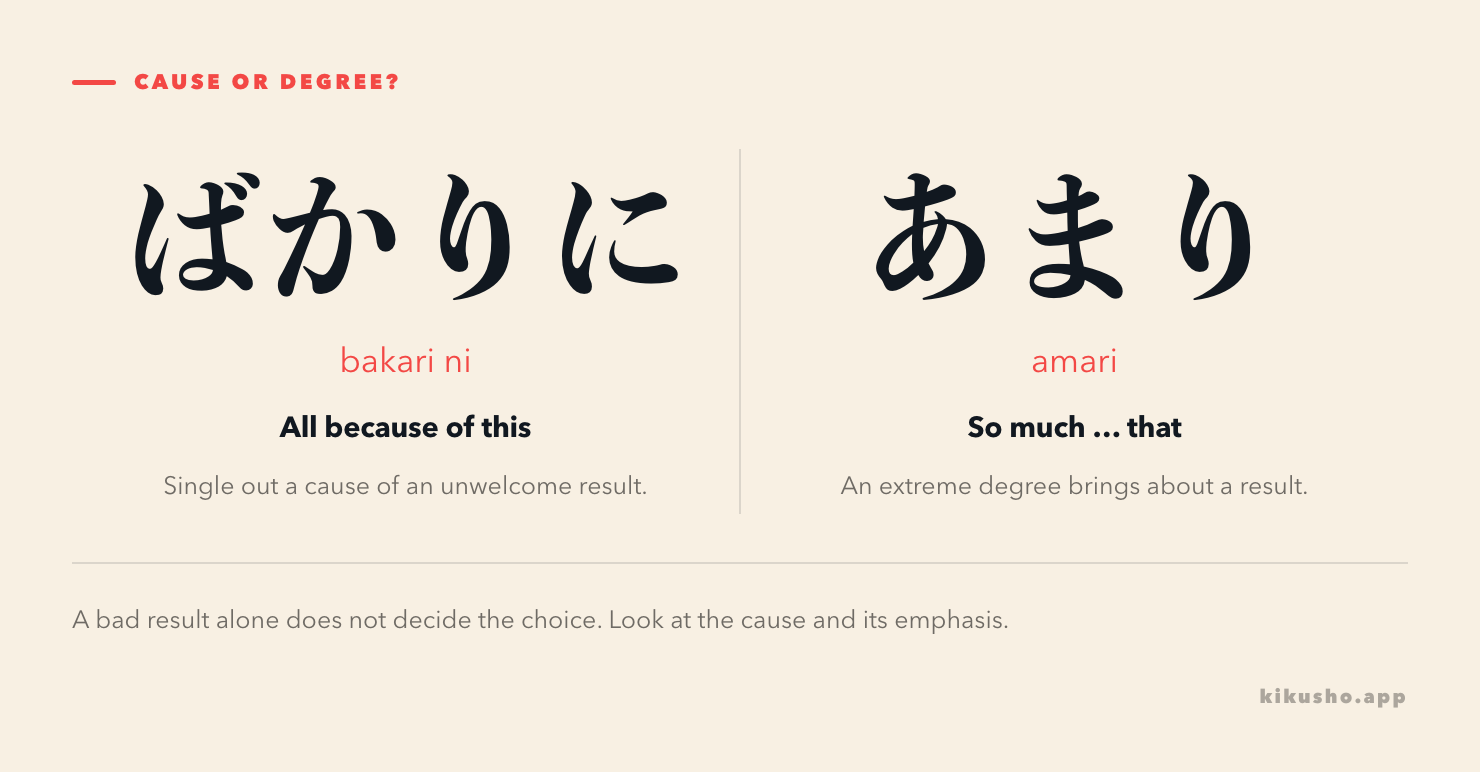
A bad result alone does not decide the choice. Both can precede one. Read what comes before the connector, including the noun link or verb form, then ask what the speaker is emphasizing.
For a general explanation without either emphasis, the earlier から and ので comparison gives you the basic reason connectors.
~ばかりに picks out the circumstance that led to trouble
Here is the wrong-button incident:
違うボタンを押したばかりに、作業を最初からやり直すことになった。
ちがうボタンをおしたばかりに、さぎょうをさいしょからやりなおすことになった。
“All because I pressed the wrong button, I had to redo the work from the beginning.”
押した is the plain past of 押す(おす), “press.” やり直す(やりなおす)means “redo.” The cause is a single act; nothing says the person pressed the button excessively. ばかりに presents that act as the reason the work had to be repeated.
JLPT Sensei's causal ばかりに lesson describes this emphasis on a reason for a negative result. A translation with a plain “because” can communicate the sequence, but it loses some of the speaker's rueful focus on this cause.
The circumstance need not be a foolish decision:
新人であるばかりに、意見を聞いてもらえなかった。
しんじんであるばかりに、いけんをきいてもらえなかった。
“Just because I was a newcomer, my opinion was not heard.”
新人(しんじん)is a newcomer or new employee; 意見(いけん)is an opinion. Being new is not a mistake. The speaker sees it as the circumstance behind being ignored. Likewise, a useful skill or a kind disposition can lead to an unwanted burden in a particular situation.
Treat “that was the cause” as the speaker's presentation. The construction does not prove that every other contributing factor has been ruled out.
Keep the predicate form before ばかりに
| Cause type | Example attachment | Reading |
|---|---|---|
| Plain verb, including past | 押したばかりに | おしたばかりに |
| Completed negative verb predicate | 確認しなかったばかりに | かくにんしなかったばかりに |
| い-adjective | 安いばかりに | やすいばかりに |
| な-adjective | 親切なばかりに | しんせつなばかりに |
| Noun with である | 新人であるばかりに | しんじんであるばかりに |
Plain predicates belong inside these examples, even if the result ends politely. Do not attach ばかりに to 押しました here. 確認しなかった means “did not check”; the negative predicate can itself be the regretted cause.
References also show である after な-adjectives, and Bunpro lists な as another noun link. The examples and noun exercise on this page use である. That is different from adding the ordinary sentence-final だ directly: 新人だばかりに is not the connection being taught.
~あまり makes the intensity responsible for the result
At the presentation, the problem might instead be nerves:
緊張のあまり、用意した言葉が出てこなかった。
きんちょうのあまり、よういしたことばがでてこなかった。
“I was so nervous that the words I had prepared would not come.”
緊張(きんちょう)is nervousness or tension. The noun takes の before あまり. The clause describes the degree of nervousness that produced the difficulty, without identifying a single mistaken act.
The cause can be expressed with a verb too:
答えを間違えるのを心配するあまり、手を挙げられなかった。
こたえをまちがえるのをしんぱいするあまり、てをあげられなかった。
“I worried so much about getting the answer wrong that I could not raise my hand.”
心配する(しんぱいする)means “worry”; 手を挙げる(てをあげる)is “raise one's hand.” あまり highlights the worry's intensity. It does not mean you worried only once.
Bunpro's あまり explanation describes degree and attachment. Katsukawa's teaching comparison with ~すぎて gives particular attention to being overwhelmed by a feeling. Do not substitute あまり mechanically for every English “too much,” regardless of the action and context.
Nouns need の; adjective forms need their own link
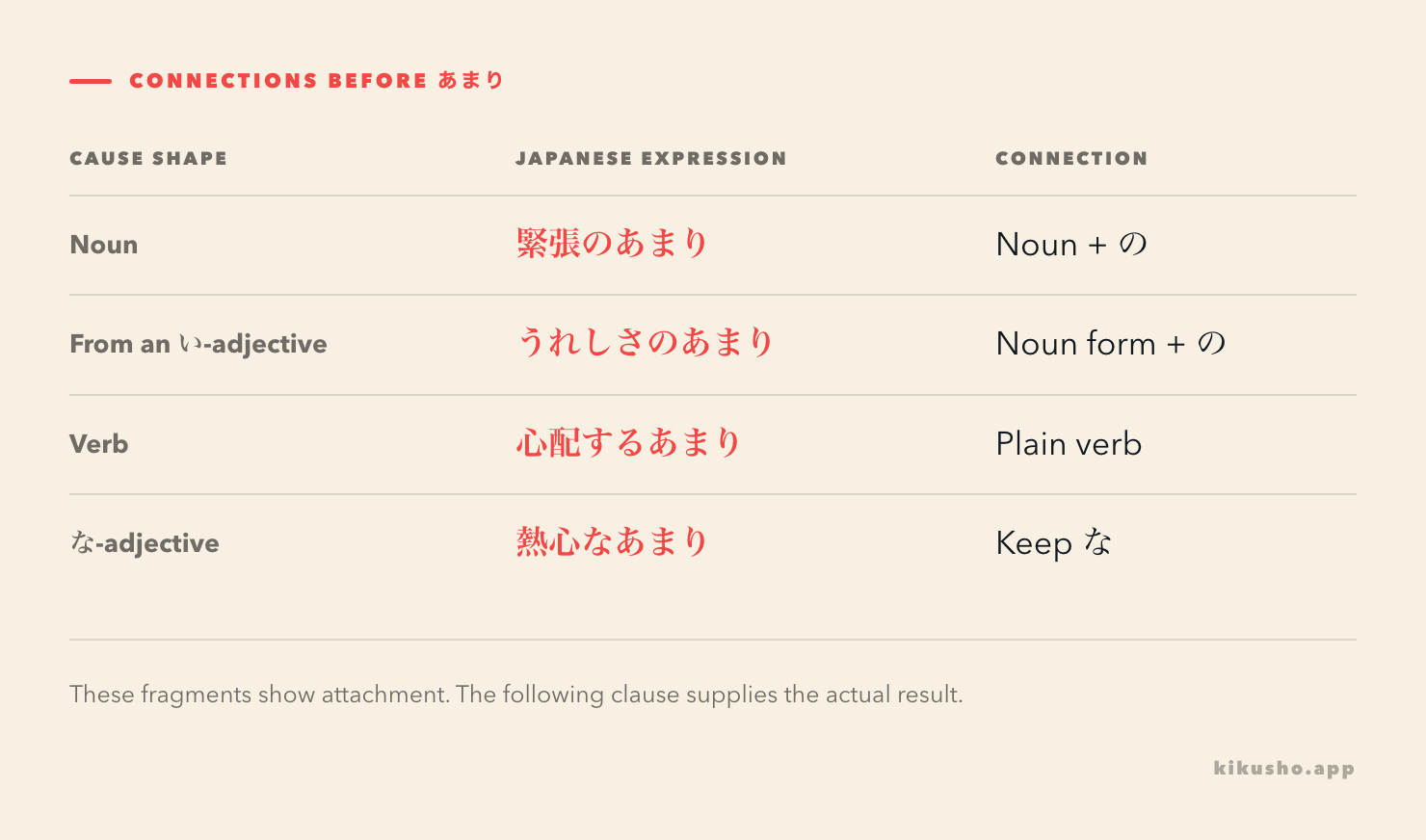
| Cause shape | Example attachment | Reading and meaning of the cause |
|---|---|---|
| Noun + の | 緊張のあまり | きんちょうのあまり; nervousness |
| Noun formed from an い-adjective + の | うれしさのあまり | うれしさのあまり; happiness, from うれしい |
| Plain verb | 心配するあまり | しんぱいするあまり; worrying |
| Past verb predicate | 驚いたあまり | おどろいたあまり; having been surprised |
| な-adjective + な | 熱心なあまり | ねっしんなあまり; being enthusiastic or devoted |
The plain verb before あまり can be nonpast or past. A nonpast 心配するあまり can still precede a past result such as 挙げられなかった. Do not force it into a ます-stem pattern: 心配しあまり is not the formation above.
For い-adjectives, the table uses a noun form before の, such as うれしさ. It does not prescribe a bare adjective stem followed by あまり, and not every adjective has an interchangeable noun ending in み.
The overlap changes the emphasis, not grammaticality
Suppose a long explanation has inconvenienced the listener. Both sentences can describe it:
| Sentence | Reading | Emphasis in this context |
|---|---|---|
| 彼は熱心なばかりに、説明が長くなった。 | かれはねっしんなばかりに、せつめいがながくなった。 | His enthusiasm is singled out as the cause of the unwelcome length. |
| 彼は熱心なあまり、説明が長くなった。 | かれはねっしんなあまり、せつめいがながくなった。 | He was so enthusiastic that his explanation grew long. |
熱心 is the same な-adjective in both, and 説明が長くなった is the same result. The first frames the quality as the cause; the second foregrounds how strong it was. A question asking for the only grammatical connector between these two would be unfair without more constraints.
Katsukawa's direct comparison separates the singled-out reason from the extreme degree. This is a distinction in how you explain the incident, rather than a division between causes you chose and causes you could not control.
An intense feeling does not always end badly
The examples so far have had unfortunate results. A joyful reaction is possible too:
うれしさのあまり、友達の手を強く握った。
うれしさのあまり、ともだちのてをつよくにぎった。
“I was so happy that I clasped my friend's hand tightly.”
The sentence supplies intensity and a reaction. It need not describe a failure. JLPT Sensei's あまり page also includes joy-driven reactions. Whether the result is regrettable comes from the sentence and situation.
The focus of the ばかりに examples here is causal regret. Bunpro additionally describes uses driven by eagerness with たい, “want to.” That boundary matters: this comparison is not a claim that every sentence containing ばかりに reports a disaster.
Two earlier-looking forms can also distract you. ~たばかり describes an event as recent, while this ~ばかりに singles out a cause; the three-way ばかり lesson covers the recent and repeated-action patterns. The familiar negative adverb あまり … ない, “not very/much,” is an earlier use, discussed in the degree-adverb lesson, rather than the cause-and-result construction practised here.
Bunpro labels both causal constructions Standard. Neither makes the whole sentence polite on its own. For a warning about what might happen rather than the cause of a reported incident, continue to the section's ~かねる and ~かねない comparison.
N2 is the comparison's place in the study sequence
The source inventory assigns あまり to N3 and ばかりに to N2, following JLPT Sensei. Bunpro places both at N3, including the same causal ばかりに use. This lesson keeps the N2 editorial placement while revisiting the earlier construction and making the disagreement explicit.
The official JLPT FAQ explains why exhaustive specifications are not published. These reference placements help sequence study; they do not establish official boundaries for every grammar form.
A phrase you meet in a story may already contain both the cause and the result. Paste that passage into Kikusho and check the drafted example before saving. For 緊張のあまり, keeping what followed the nerves is more useful than reducing the expression to “because.” The fields remain editable, so you can preserve the event and the degree together.
Six exercises to attempt as a group
The exercises use the N2 grammar task categories in the official item table: form selection, sentence composition and text grammar. All six are original. Decide your choices and ordering before moving into the answer section.
Question 1 — form selection. Complete the noun connection in 新人( )ばかりに、意見を聞いてもらえなかった.
A. である
B. だ
C. の
D. で
Question 2 — form selection. Supply the link in 緊張( )あまり、声が小さくなった. 声(こえ)means “voice.”
A. な
B. だ
C. の
D. で
Question 3 — form selection. You specifically want to foreground the intensity of the worry, rather than merely give a reason or single out a regretted cause. Choose the connector for 答えを間違えるのを心配する( )、手を挙げられなかった.
A. ばかりに
B. あまり
C. ので
D. から
Question 4 — sentence composition. Put the cause first in __ __ ★ __。 Use these four pieces once. Which piece belongs at ★?
A. あまり
B. 出てこなかった
C. 用意した言葉が
D. 緊張の
Question 5 — sentence composition. Assemble __ __ ★ __。 with the cause before the result, meaning “All because I did not save it, I had to rewrite the text.” Which piece fills ★? 保存する(ほぞんする)means “save”; 文章(ぶんしょう)is a text or passage.
A. 書き直すことになった
B. 文章を
C. 保存しなかった
D. ばかりに
Question 6 — text grammar. Read the account and choose the pair that connects each stated cause to its result. 受付(うけつけ)is reception; 荷物(にもつ)means luggage.
初めてホテルの受付を一人で担当した。緊張の(甲)、客の名前を忘れた。その名前を確かめなかった(乙)、別の客の荷物を渡してしまった。
A. 甲ばかりに / 乙あまり
B. 甲あまり / 乙ばかりに
C. 甲あまり / 乙あまり
D. 甲ばかりに / 乙ばかりに
Keep your six selections beside you for the explanations below.
Answers and explanations
Answer 1. A: である. 新人であるばかりに supplies the noun predicate connection. だばかりに is not this attachment; のばかりに wrongly transfers the noun link from のあまり, and でばかりに leaves the predicate unfinished. The newcomer circumstance, not a chosen mistake, is presented as the cause of being ignored.
Answer 2. C: の. 緊張のあまり means “so nervous that …”; the full sentence says the voice grew quiet. 緊張 is a noun here, so use の rather than the な-adjective link. だあまり and であまり do not form this causal noun pattern.
Answer 3. B: あまり. 心配するあまり explicitly presents the worry as extreme enough to prevent raising a hand. ばかりに would single out worrying as the cause of the regrettable result; ので and から would give a general reason. Those alternatives are not rejected as universally ungrammatical. They fail this question's stated instruction to foreground the degree.
Answer 4. C: 用意した言葉が. The order is D → A → C → B: 緊張のあまり、用意した言葉が出てこなかった。 The noun cause takes の, followed by あまり; the prepared words are the subject of the negative result. Moving that subject to the beginning can produce a grammatical sentence, but would violate this exercise's required cause-first frame.
Answer 5. B: 文章を. The order is C → D → B → A: 保存しなかったばかりに、文章を書き直すことになった。 Read it as ほぞんしなかったばかりに、ぶんしょうをかきなおすことになった。 Not saving is the cause; rewriting the passage is the consequence. The negative past predicate stays intact before ばかりに, and 文章を supplies what was rewritten.
Answer 6. B: 甲あまり / 乙ばかりに. “I handled hotel reception on my own for the first time. I was so nervous that I forgot the guest's name. All because I did not check that name, I handed over another guest's luggage.” 緊張のあまり connects the noun and its extreme degree. The second cause is a completed negative action, 確かめなかった(たしかめなかった), “did not check,” which takes causal ばかりに. A and D break the noun attachment at 甲; C incorrectly treats the failure to check as the affirmative intense action or state required by this あまり pattern. 渡してしまった(わたしてしまった)reports the unwanted handover; it does not turn the cause into a different construction.
Common questions
What is the difference between bakari ni and amari?
In the causal comparison, ~ばかりに singles out a circumstance as the reason for an unwelcome result, often with regret. ~あまり emphasizes the extreme degree of an action or state: so much that something happened. When the same cause can be viewed either way, both can be grammatical with different emphasis.
Must the cause before bakari ni be a mistake?
No. The cause can be a regretted action, but it can also be a quality or circumstance, such as being a newcomer. The speaker presents that cause as the reason for the undesirable result. It does not mean the person acted wrongly or chose the circumstance.
Does amari always introduce a bad result?
No. The causal construction often describes an unwanted or unexpected result of an extreme feeling or state. It can also describe a reaction to joy. The result clause tells you what happened and whether it was unwelcome; the word あまり does not by itself mean a disaster.
Are bakari ni and amari both N2 grammar?
This comparison is in the N2 study sequence. JLPT Sensei places ~ばかりに at N2 and causal ~あまり at N3; Bunpro places both at N3. The project inventory keeps those observations rather than hiding the disagreement. These are editorial study labels, not an exhaustive official JLPT grammar syllabus.