On this page
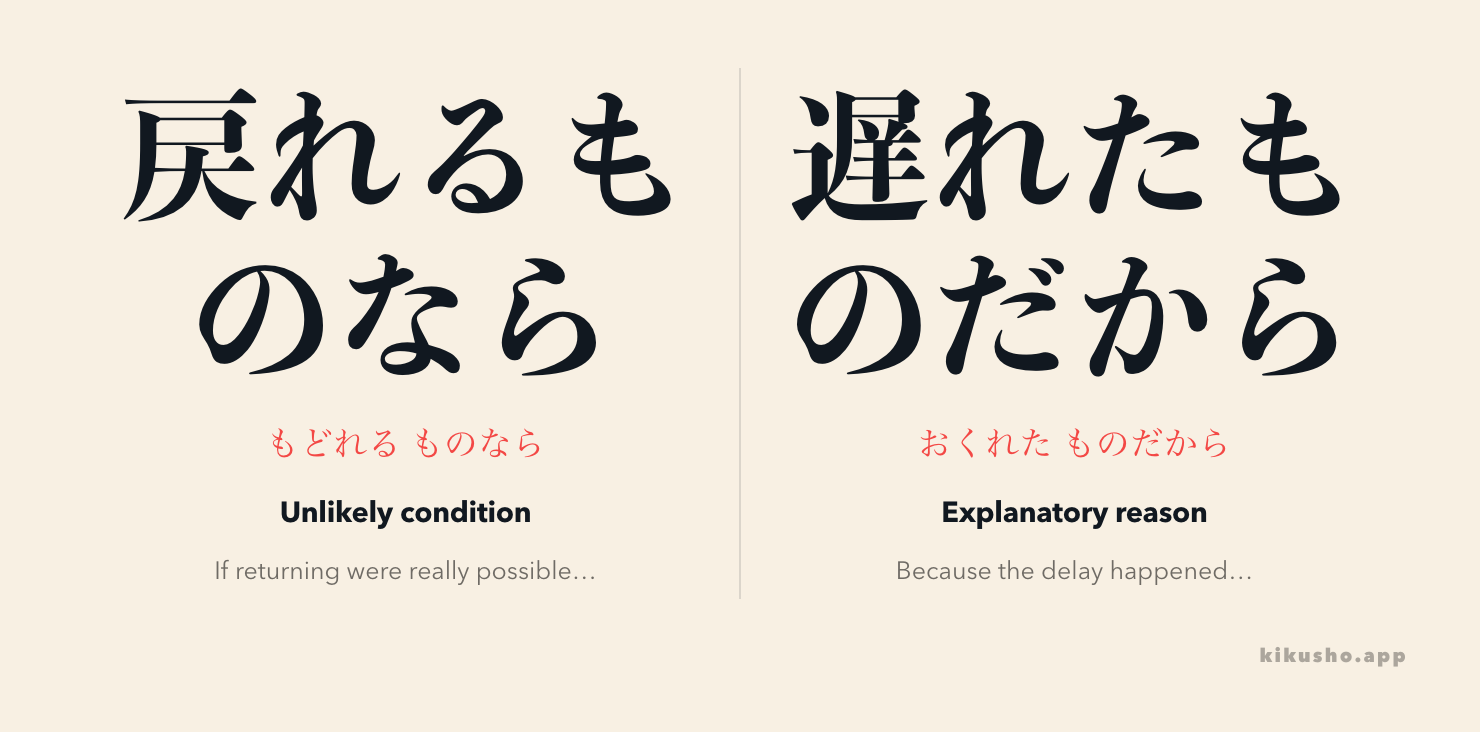
Use ~ものなら when the first clause is an unlikely condition: “if it were really possible.” Use ~ものだから when the first clause explains why a result happened, often with the speaker defending or accounting for what followed. The shared もの does not give the two endings the same logic.
The decision is condition or reason
Ask what the first clause does before translating either ending. A condition opens a hypothetical route to the main clause. A reason looks backward and accounts for an event, choice or apology.
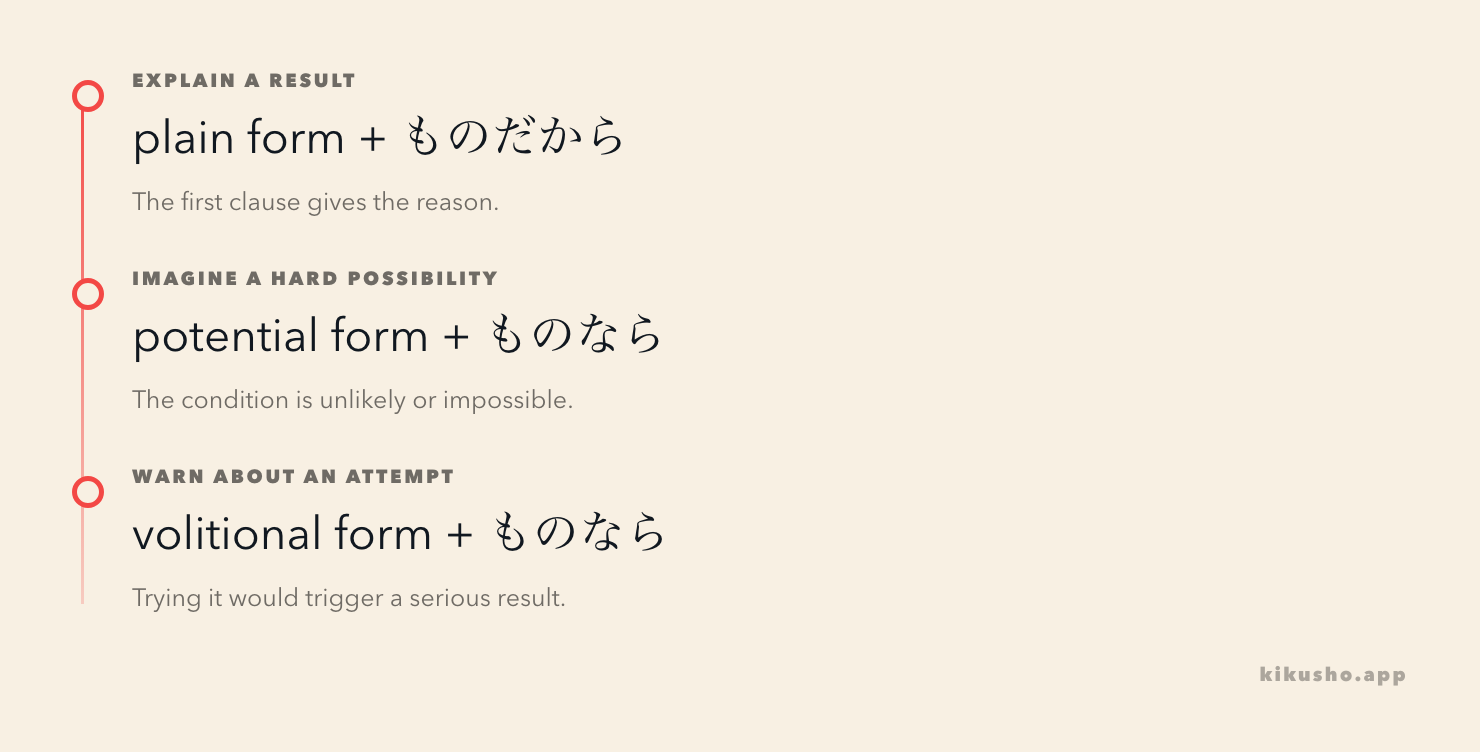
| What the first clause does | Core form | Speaker's stance | Typical continuation |
|---|---|---|---|
| Sets a hard-to-realise condition | potential verb + ものなら | “I doubt this is possible, but if it were…” | a wish, intention or challenge |
| Warns about attempting an action | volitional verb + ものなら | “If someone were to dare / so much as do this…” | a serious or unwelcome result |
| Gives an explanatory reason | plain form + ものだから | “This circumstance explains what happened” | a result, apology or justification |
The Japan Foundation's teaching article on subordinate-clause uses of もの treats these forms side by side. It identifies two ものなら patterns and distinguishes explanatory ものだから from ordinary から. JLPT Sensei separately places both ものなら and ものだから at N2. Those placements help sequence study; they are editorial estimates rather than an official item list.
~ものなら tests an unlikely possibility
The central pattern places ものなら after a potential verb:
子供のころに戻れるものなら、戻りたい。
こどもの ころに もどれる ものなら、もどりたい。
If I could return to my childhood, I would like to.
戻れる is the potential form of 戻る, “return.” The speaker is not calmly planning a possible trip. Returning to childhood is understood to be impossible, and the main clause states the wish that would follow if the impossible condition could somehow be met.
会えるものなら、もう一度会って謝りたい。
あえる ものなら、もういちど あって あやまりたい。
If I could meet them, I would like to meet once more and apologise.
The meeting may not be literally impossible, but the speaker presents it as difficult or beyond their control. Ordinary 会えるなら can also mean “if meeting is possible.” Adding もの makes the low feasibility more prominent. The Japan Foundation notes that potential-form ~ものなら is close to ~なら, but more strongly presents the condition as generally or realistically hard to realise.
This pattern often repeats the lexical verb across the two clauses: 戻れるものなら戻りたい, やれるものならやってみろ. Repetition is common because the first clause challenges feasibility and the second states the desired or demanded action. It is not a mechanical requirement. 会えるものなら、謝りたい works because the intended consequence is clear without repeating 会う.
The volitional pattern warns about an attempted action
A second ものなら pattern uses the volitional form:
この秘密を話そうものなら、みんなを困らせることになる。
この ひみつを はなそう ものなら、みんなを こまらせる ことに なる。
If I were to reveal this secret, I would end up causing trouble for everyone.
Here 話そう is the volitional form of 話す. The meaning is not “if speaking were possible.” It frames even attempting or daring to do the action as the trigger for a serious consequence. The Japan Foundation describes this as an emphatic “if someone were to do such a thing” pattern and illustrates it with negative outcomes.
Keep the two attachments distinct:
- 話せるものなら: if speaking it were possible.
- 話そうものなら: if someone were to attempt or dare to speak.
The form before ものなら tells you which reading is available. A plain noun or adjective does not enter this pattern merely because ordinary なら can follow it. 静かなら勉強できます is an ordinary condition, “If it is quiet, I can study.” 静かなものなら does not replace it with an N2 version.
~ものだから accounts for what happened
~ものだから supplies a cause or reason. It often appears when the speaker explains conduct, softens a refusal or gives context for an apology.
道が混んでいたものだから、約束の時間に遅れました。
みちが こんでいた ものだから、やくそくの じかんに おくれました。
The roads were crowded, so I was late for the agreed time.
The congestion is not a hypothetical condition. It is the speaker's explanation for an actual late arrival. Plain から could also state the cause. ものだから presents the circumstance as an account of how the unwanted result came about, which is why it frequently sounds like justification or excuse.
すみません。不慣れなものですから、時間がかかってしまいました。
すみません。ふなれな ものですから、じかんが かかって しまいました。
I'm sorry. Since I am inexperienced, it ended up taking time.
ものですから is the polite version. It fits an apology because the speaker is explaining the circumstance that led to the problem. The shorter もんだから and もんで are conversational. They do not make the explanation more formal or more objective.
Attachment changes after nouns and な-adjectives
| Before ~ものだから | Attachment | Example |
|---|---|---|
| Verb | plain form | 急いでいたものだから, because I was in a hurry |
| い-adjective | plain form | 忙しいものだから, because I am busy |
| な-adjective | な + ものだから | 不慣れなものだから, because I am inexperienced |
| Noun | な + ものだから | 新人なものだから, because I am new here |
Do not copy the な from the noun pattern onto verbs. 遅れたなものだから is malformed; 遅れたものだから is the plain-past verb followed directly by the grammar ending.
The result can be left understood when the apology or request already supplies it:
返事が遅くなって、すみません。旅行中だったものですから。
へんじが おそく なって、すみません。りょこうちゅう だった ものですから。
Sorry for the late reply. I was travelling, you see.
The second sentence explains the apology. Its result, “I could not reply sooner,” does not have to be repeated.
Why an order does not normally follow ~ものだから
The explanatory force places a limit on the main clause. The Japan Foundation contrasts ordinary から with ものだから and states that commands, invitations and requests do not normally follow the latter.
雨が降っているから、傘を持っていってください。
あめが ふっているから、かさを もっていって ください。
Because it is raining, please take an umbrella.
Here から gives the speaker's reason for requesting an action. Replacing it with 雨が降っているものだから、傘を持っていってください would force an explanatory or self-justifying ending into a directive. If you need to motivate a command or invitation, ordinary から is the natural choice.
This limit also helps when both English translations begin with “because.” Ask whether the second clause reports what resulted or tells the listener what to do. A reported late arrival accepts ものだから. An umbrella instruction calls for から.
The endings cannot trade places
Compare a pair that shares most of its vocabulary:
帰れるものなら、今すぐ帰りたい。
If I could go home, I would like to go now.
電車が止まったものだから、帰れなかった。
Because the train stopped, I could not go home.
The first clause of the first sentence is unreal or hard to realise; the second states a wish. The first clause of the second sentence reports a cause; the second reports its result. Exchanging the endings would not preserve the relationship between the clauses.
This is also why reading only もの is insufficient. Japanese has several constructions built on it. ~ものの marks concession, while ~ものだ and ~ものではない cover expectations, recollection, advice and reflective reactions. The material after もの, and the form before it, jointly determine the construction.
If you capture one of these endings from a message, keep both clauses on the card. 遅れたものだから without its result loses the explanation it was built to give; 会えるものなら without the wish loses the low-probability contrast. Kikusho can turn pasted text or a spoken phrase into an editable card, so preserve the cause and result or the condition and wish before saving it for review.
Practice: decide before you translate
Question 1 — grammar choice. You know that returning to the past is impossible, but you state a wish. Complete the sentence: 十年前に戻れる( )、やり直したい。
- ① ものだから
- ② ものなら
- ③ ものの
- ④ ものです
Question 2 — grammar choice. You are explaining an actual late arrival: バスが来なかった( )、遅刻してしまいました。
- ① ものなら
- ② ものの
- ③ ものだから
- ④ ものではない
Question 3 — attachment. Which form correctly completes まだ不慣れ( )、作業に時間がかかります as an explanation?
- ① ものだから
- ② なものだから
- ③ だものなら
- ④ のものだから
Question 4 — sentence composition. Arrange the pieces into “If I could meet the author, I would like to ask about this ending”: この結末について / 会えるものなら / 聞いてみたい / 作者に.
Question 5 — connected text. Choose the pair that completes this exchange.
A:どうして昨日の会議を休んだんですか。
B:急に熱が出た( X )、休みました。今日も参加できる( Y )、参加したいのですが、まだ熱があります。
- ① X ものなら / Y ものだから
- ② X ものだから / Y ものなら
- ③ X ものの / Y ものだから
- ④ X ものなら / Y ものの
Question 6 — form and meaning. What does 一言でも文句を言おうものなら、彼はすぐ怒る present?
- ① A calm, likely plan to complain
- ② A reason the speaker already complained
- ③ An attempt that would trigger an unwelcome result
- ④ A recollection of repeated complaints
Question 7 — correction. The intended meaning is “Because it is dangerous, please do not enter.” Why is 危険なものだから、入らないでください a poor choice here, and which ending should replace ものだから?
Answers and explanations
Answer 1. ② ものなら. 戻れるものなら places ものなら after the potential form and presents returning ten years as an unreal or extremely difficult condition. ものだから would give a reason, ものの would introduce a concession, and ものです would not build the requested condition.
Answer 2. ③ ものだから. The bus's failure to arrive is an actual reason for the late arrival. The result 遅刻してしまいました is reported, not wished for. ものなら would require a hypothetical condition, while ものの would mean “although.”
Answer 3. ② なものだから. 不慣れ is a な-adjective, so it takes な before ものだから. The completed clause is まだ不慣れなものだから. A verb or い-adjective would attach directly; だ and の do not supply the required form here.
Answer 4. 作者に会えるものなら、この結末について聞いてみたい。 会える is the potential form of 会う, and ものなら marks the meeting as hard to realise. 作者に identifies the person met; この結末について gives the topic of the hoped-for question.
Answer 5. ② X ものだから / Y ものなら. The sudden fever explains an actual absence, so X needs ものだから. The speaker then imagines participating if it is possible despite the continuing fever, so Y needs potential-form 参加できるものなら.
Answer 6. ③. 言おう is the volitional form of 言う. Volitional + ものなら frames the attempted complaint as the trigger for the unwelcome consequence 彼はすぐ怒る. It is neither an explanation of a completed complaint nor an ordinary plan.
Answer 7. Use 危険だから、入らないでください. The main clause is a request or prohibition directed at the listener. Explanatory ものだから normally leads to a result, apology or justification rather than a command, invitation or request. Ordinary から can supply the reason for the instruction.
Common questions
What is the difference between ~ものなら and ~ものだから?
~ものなら introduces a condition that the speaker considers very difficult or unlikely to realise: “if it were really possible.” ~ものだから gives a reason for a result, often as an explanation or excuse: “because that was the situation.”
What form comes before ~ものなら?
The main N2 pattern uses a verb in the potential form, such as 戻れるものなら. A second pattern uses the volitional form, such as 言おうものなら, to mean that if someone were to attempt the action, a serious or unwelcome result would follow.
Can a noun or な-adjective come before ~ものだから?
Yes. Add な: 学生なものだから and 不慣れなものだから. Verbs and い-adjectives attach in their plain form, as in 道が混んでいたものだから and 忙しいものだから.
Are ~もんなら and ~もんだから different grammar?
They are conversational contractions of ~ものなら and ~ものだから. The underlying conditional or explanatory meaning remains, but もん is more casual and should not be inserted into formal writing merely for variety.