On this page
会議は一時間ばかり続いた estimates its length. 会議は長引くばかりだ says it keeps dragging on, while 会議は長引いたばかりか、結論も出なかった adds a worse fact: it ran long and produced no conclusion.
The deciding clue comes immediately before and after ばかり. A number sets an approximate boundary, a dictionary-form change verb points along one continuing path, and か opens an emphatic addition.
The test that separates all three
Do not translate ばかり first. Identify its attachment and ask what the sentence does next.
| Form | Shape | What it does |
|---|---|---|
| approximate ばかり | duration or distance + ばかり | gives a rough amount |
| trend ばかりだ | change verb in dictionary form + ばかりだ | says the change keeps moving one way |
| additive ばかりか | plain form / noun + ばかりか, then B | retains A and adds a stronger B |
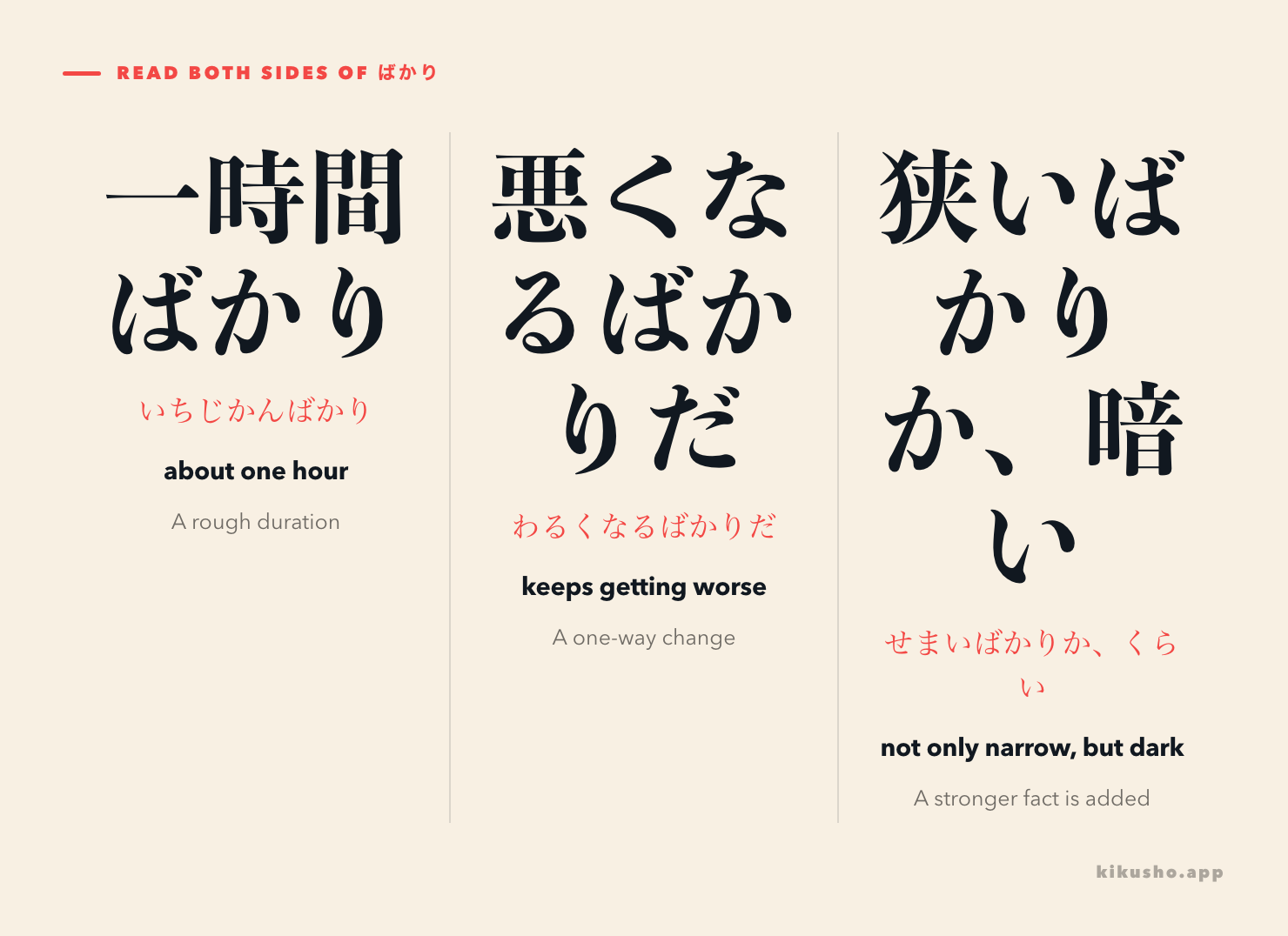
These are separate constructions, not one meaning stretched across different endings. They also differ from Nばかり, “nothing but N,” Vたばかり, “just did,” and Vてばかりいる, “does nothing but V.” The earlier ばかり comparison teaches those three forms.
A duration or distance plus ばかり is approximate
In this N2 inventory item, ばかり follows a number expressing time or distance and means “about” or “approximately.” It makes the figure a useful estimate rather than an exact measurement.
三十分ばかり待ちました。
さんじゅっぷんばかりまちました。
I waited for about thirty minutes.
二キロばかり歩くと、海が見えてきます。
にキロばかりあるくと、うみがみえてきます。
After walking about two kilometres, the sea comes into view.
JLPT Sensei's N2 entry limits this stated use to nouns of time or distance. A broader teacher reference lists number + ばかり as an approximate-number construction, but also notes that it is not especially common. This lesson therefore keeps its examples inside the assigned, well-supported scope.
Particles can follow the whole approximate amount:
駅まで一時間ばかりで着きます。
えきまでいちじかんばかりでつきます。
We will reach the station in about an hour.
Here で marks the amount of time within which arrival occurs. It does not belong inside ばかり. Likewise, 一週間ばかり滞在した means “stayed for about a week”; the duration works adverbially without needing another particle.
Do not import the “nothing but” reading simply because the same kana appear. 本ばかり読んでいる restricts the choice to books. 一時間ばかり読んでいた estimates how long the reading lasted. The noun type settles the intended reading before context adds nuance.
Dictionary-form Vるばかりだ traces a one-way trend
The N2 trend pattern attaches ばかりだ to the dictionary form of a verb that expresses change:
change verb in dictionary form + ばかりだ
修理しないと、この機械の状態は悪くなるばかりだ。
しゅうりしないと、このきかいのじょうたいはわるくなるばかりだ。
Unless it is repaired, this machine's condition will only keep getting worse.
The pattern draws a line through successive states. 悪くなる, 増える, 減る, 上がる and 下がる fit because they can describe movement in a direction. JLPT Sensei's ばかりだ page and an authored Japanese-teacher overview both give dictionary-form attachment and a continuing, usually negative development.
対策をしなければ、利用者は減るばかりだ。
たいさくをしなければ、りようしゃはへるばかりだ。
Without countermeasures, the number of users will keep falling.
Although unwelcome trends are typical, the grammar's core is direction, not a built-in word meaning “bad.” The speaker often chooses it because the change appears unchecked. A neutral continuing action such as 本を読み続ける is better expressed with 続ける; Bunpro's comparison separates simple continuation from the “more and more” force of ばかりだ.
Past だった places the assessment in a past period while the change verb stays in dictionary form:
当時、店の売り上げは下がるばかりだった。
とうじ、みせのうりあげはさがるばかりだった。
At that time, the shop's sales just kept falling.
The critical contrast is 下がるばかりだった versus 下がったばかりだった. The first describes repeated downward movement. The second contains Vたばかり and says the fall had happened recently. One consonant marks a different construction.
ばかりか keeps A and adds a stronger B
Aばかりか、Bも/さえ/まで means “not only A, but also B.” The speaker usually presents B as a further, more striking extension of A.
このホテルは駅から遠いばかりか、部屋も狭い。
このホテルはえきからとおいばかりか、へやもせまい。
This hotel is not only far from the station; its rooms are also small.
A remains true. B does not replace it. This inclusive relationship matches ばかりでなく, but ばかりか is more written and carries stronger emphasis. The Japan Foundation's formation notes show its frequent partnership with も, まで and さえ; MLC's N2 explanation describes it as more literary than だけではなく.
The attachment changes with the word class:
| A | Attachment | Example opening |
|---|---|---|
| Verb | plain form + ばかりか | 約束を破ったばかりか… |
| い-adjective | adjective + ばかりか | 遠いばかりか… |
| な-adjective | adjective + な/である + ばかりか | 不便なばかりか… |
| Noun | noun / noun + である + ばかりか | 雨ばかりか… |
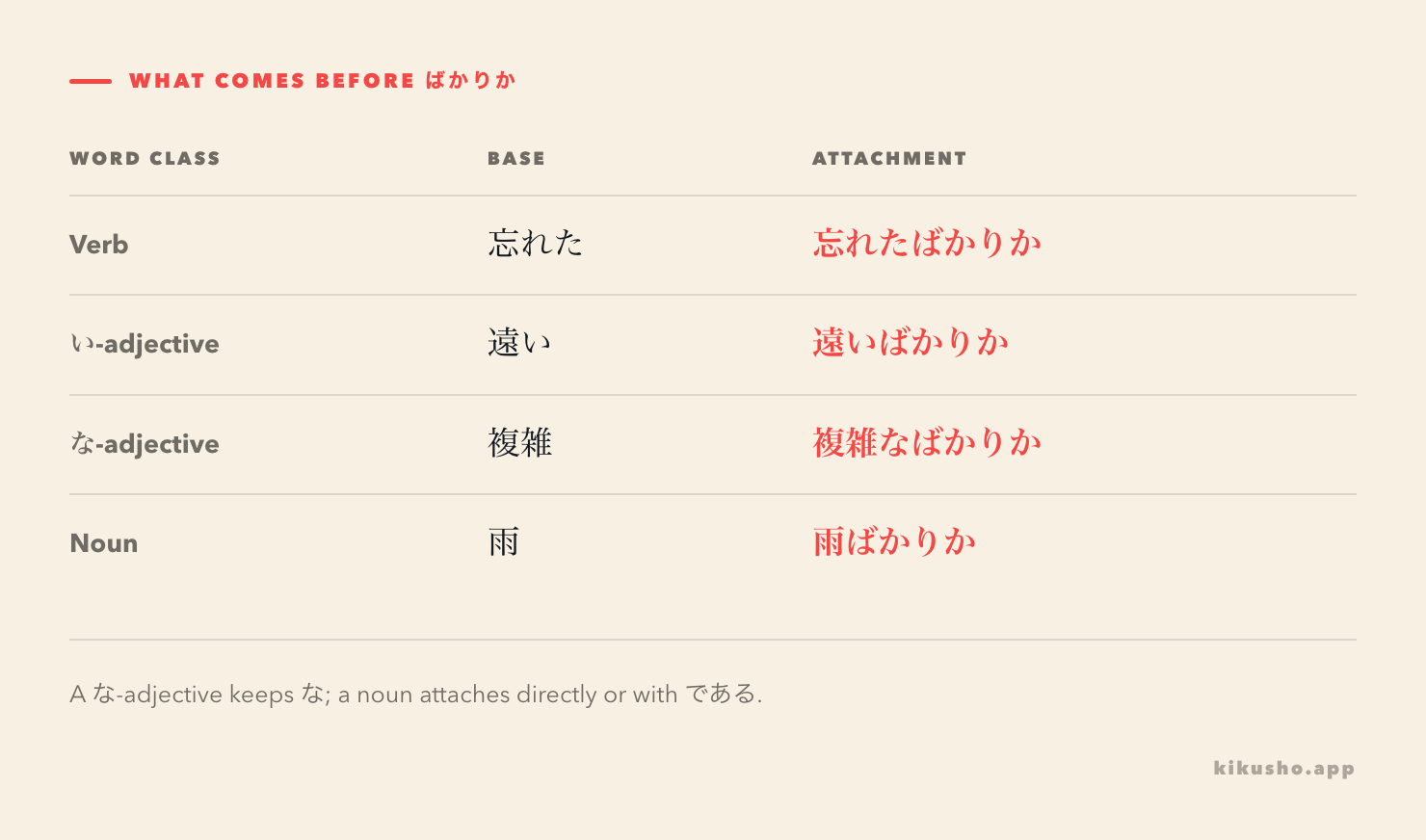
The verb may be past when A is a completed event:
彼は締め切りを忘れたばかりか、資料もなくした。
かれはしめきりをわすれたばかりか、しりょうもなくした。
He not only forgot the deadline but also lost the documents.
This 忘れたばかりか does not mean “he only just forgot.” The following clause and も reveal additive ばかりか. Read the whole connector before assigning a meaning to the past form.
ばかりか does not merely list two peers
Compare a plain addition with an emphatic one:
| Sentence | Focus |
|---|---|
| この店は修理ばかりでなく、販売もしている。 | It repairs and sells; both services are included. |
| この店は修理ばかりか、製造までしている。 | Beyond repair, it even manufactures products. |
The lesson on だけでなく and ばかりでなく handles ordinary inclusion and register. With ばかりか, words such as さえ and まで make the escalation explicit. Positive praise can escalate too: 説明が分かりやすいばかりか、質問にも丁寧に答えてくれる adds considerate answers to clear explanations.
The second part normally states an added fact or condition. Do not use the pattern as a lead-in to a request, command, invitation or intention. 資料を読むばかりか、要点もまとめてください tries to make a request do B's job. For direct instructions, connect the requested actions with a form suited to instructions instead.
If you capture a sentence with ばかり in Kikusho, include enough text to keep both neighbours visible. 一時間ばかり, 増えるばかりだ and 不便なばかりか need different card meanings because the number, verb form and following particle carry the distinction. The editable register note can also preserve that additive ばかりか belongs more readily to written explanation than relaxed conversation.
Practice
Complete all six tasks before reading the explanations. Every answer appears in the single section after the final question.
Question 1. Choose the sentence in which ばかり makes a duration approximate.
- ア. 子どもは漫画ばかり読んでいる。
- イ. 二十分ばかり待ってください。
- ウ. 値段は上がるばかりだ。
- エ. 雨ばかりか、風も強くなった。
Question 2. Complete the trend with the correct form of 増える(ふえる): 何も対策をしなければ、費用は__ばかりだ。
Question 3. Use all four chunks once to mean “The road was not only narrow, but it was also dark.”
- 道は
- 狭いばかりか、
- 暗かった
- その
Question 4. Choose the correct attachment after the な-adjective 複雑(ふくざつ).
この手続きは複雑__、時間もかかる。
- ア. だばかりか
- イ. なばかりか
- ウ. にばかりか
- エ. でばかりか
Question 5. Explain the difference between 売り上げは下がるばかりだった and 売り上げは下がったばかりだった. Which one describes a continuing decline?
Question 6. Read the paragraph and choose the best expression for the blank.
新しい駅ができてから、この町を訪れる人は増えている。休日だけでなく平日も混雑し、ホテルの予約も取りにくくなった。観光客は今後も__。
- ア. 増えたばかりだ
- イ. 増えるばかりだろう
- ウ. 増えるばかりか
- エ. 三十分ばかりだろう
Answers and explanations
Answer 1. イ. 二十分ばかり待ってください. 二十分 is a duration, so ばかり makes it an estimate: “Please wait about twenty minutes.” ア restricts reading material to manga, ウ describes an upward trend, and エ uses ばかりか to add strong wind to rain.
Answer 2. 増える. The pattern takes the dictionary form of a change verb: 費用は増えるばかりだ, “Costs will only keep increasing.” 増えたばかりだ would instead say that the costs have only just increased.
Answer 3. その道は狭いばかりか、暗かった. The order is その → 道は → 狭いばかりか、→ 暗かった. 狭い keeps its final い before the connector. The second property is an added fact about the same road.
Answer 4. イ. なばかりか. 複雑 is a な-adjective, so 複雑なばかりか、時間もかかる means the procedure is not only complicated but also time-consuming. A keeps the plain copula だ where the ordinary な attachment is required; C and D do not form this pattern.
Answer 5. 売り上げは下がるばかりだった describes the continuing decline. 下がる is the dictionary form of the change verb before trend ばかりだった. 下がったばかりだった uses the plain past 下がった before recent-event ばかり and means that sales had only just fallen.
Answer 6. イ. 増えるばかりだろう. The paragraph describes growth that has already produced weekday crowds and scarce hotel rooms, then predicts that the visitor count will keep rising. ア says the count has just increased, ウ needs an added B clause after ばかりか, and エ is an unrelated approximate duration.
Why the level labels disagree
JLPT Sensei places the approximate ばかり, trend ばかりだ, and additive ばかりか rows at N2. Bunpro places bare ばかり and ばかりだ at N3, while the Japan Foundation labels ばかりか with the former Level 2. Kikusho uses N2 as a study label here; the present-day JLPT does not release a complete grammar syllabus that could settle every publisher's classification.
The practical progression is still clear. Noun restriction, Vたばかり, and Vてばかりいる are prerequisites. This N2 lesson asks you to recognize a rarer approximate-number use, a dictionary-form change trend, and a more emphatic written addition without letting their shared spelling erase the syntax.
An AI curriculum review by Codex verified each attachment, reading, translation, restriction, distractor and explained answer against the references above. This page has not received a human language review.
Common questions
What does a number followed by ばかり mean?
In the use taught here, a duration or distance followed by ばかり is approximate: 30分ばかり means about thirty minutes. It does not mean “nothing but thirty minutes.”
What is the difference between Vるばかりだ and Vたばかりだ?
Vるばかりだ describes a change continuing in one direction, often an unwelcome one. Vたばかりだ says that an action was completed recently from the speaker's viewpoint.
How does ばかりか differ from ばかりでなく?
Both add B while retaining A. ばかりか is more written and often presents B as a stronger or more surprising extension; ばかりでなく can make a plainer addition.
Can a request follow ばかりか?
Avoid using a request, command, invitation or intention as the second clause in the pattern taught here. The second part normally states an added fact or condition.