On this page
Put 次第 after a verb stem for “as soon as A is complete,” after a noun with で for “B depends on A,” and use 次第に as one adverb meaning “gradually.” The same spelling hides three different sentence designs, so the attachment is a more dependable guide than the English word “depending.”
This N2 review includes one visible level disagreement. JLPT Sensei labels verb-stem 次第 N2, while Bunpro labels that immediate-sequence use N3. Both references place 次第に at N2, and the noun pattern 次第だ・次第で is also listed at N2 in the sources used here. These are publisher placements rather than boundaries from an official JLPT grammar list.
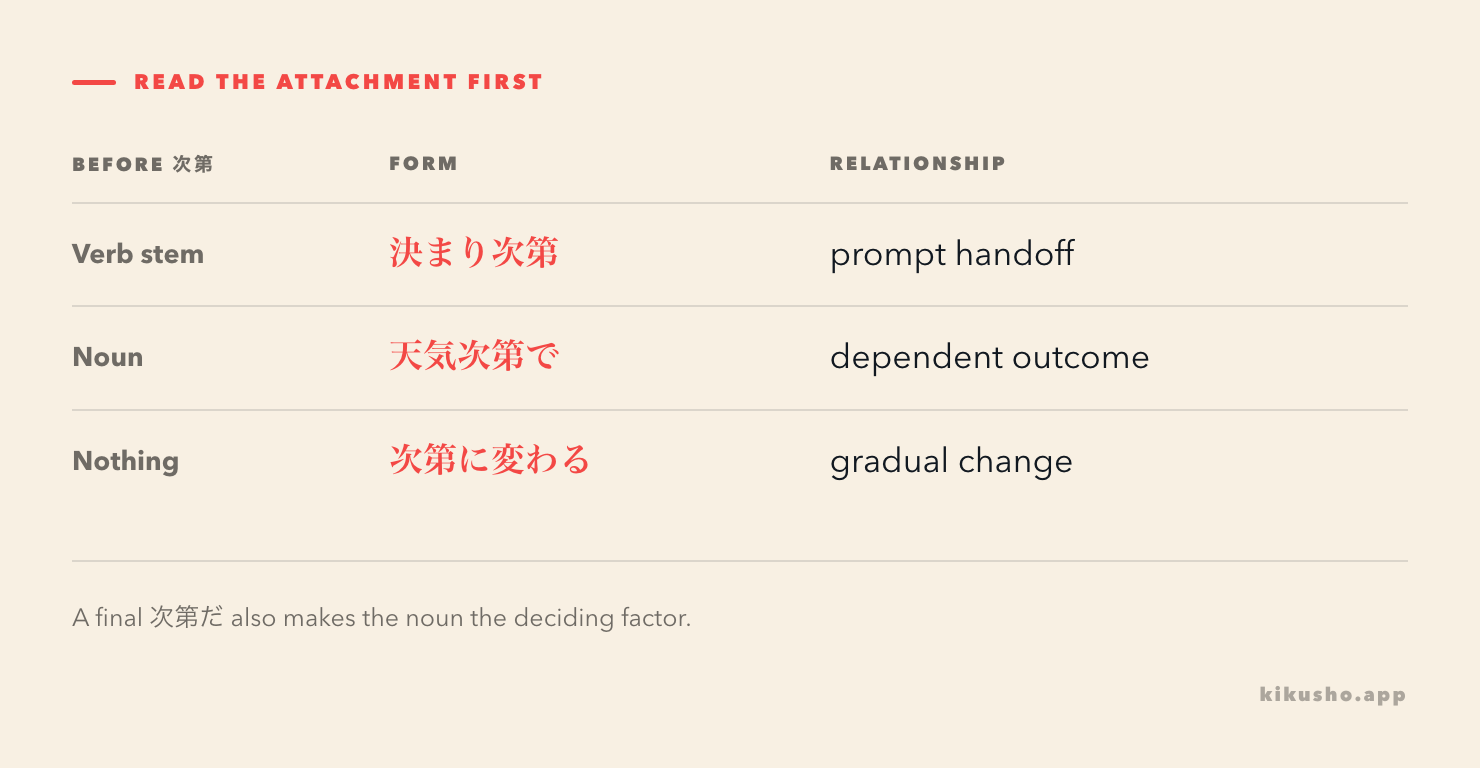
The word before 次第 tells you what the sentence is doing
| Form | Core relationship | Question to ask |
|---|---|---|
| Vます-stem + 次第、B | A completes, then B follows promptly | What must finish before B starts? |
| N + 次第で、B / N + 次第だ | N determines which outcome occurs | What factor controls B? |
| 次第に + change | a state changes progressively | What is changing little by little? |
日程が決まり次第、参加者に連絡します。
にっていがきまりしだい、さんかしゃにれんらくします。
We will contact the participants as soon as the schedule is decided.
参加人数次第で、会場を変更します。
さんかにんずうしだいで、かいじょうをへんこうします。
We will change the venue depending on the number of participants.
午後になると、風は次第に弱くなりました。
ごごになると、かぜはしだいによわくなりました。
In the afternoon, the wind gradually weakened.
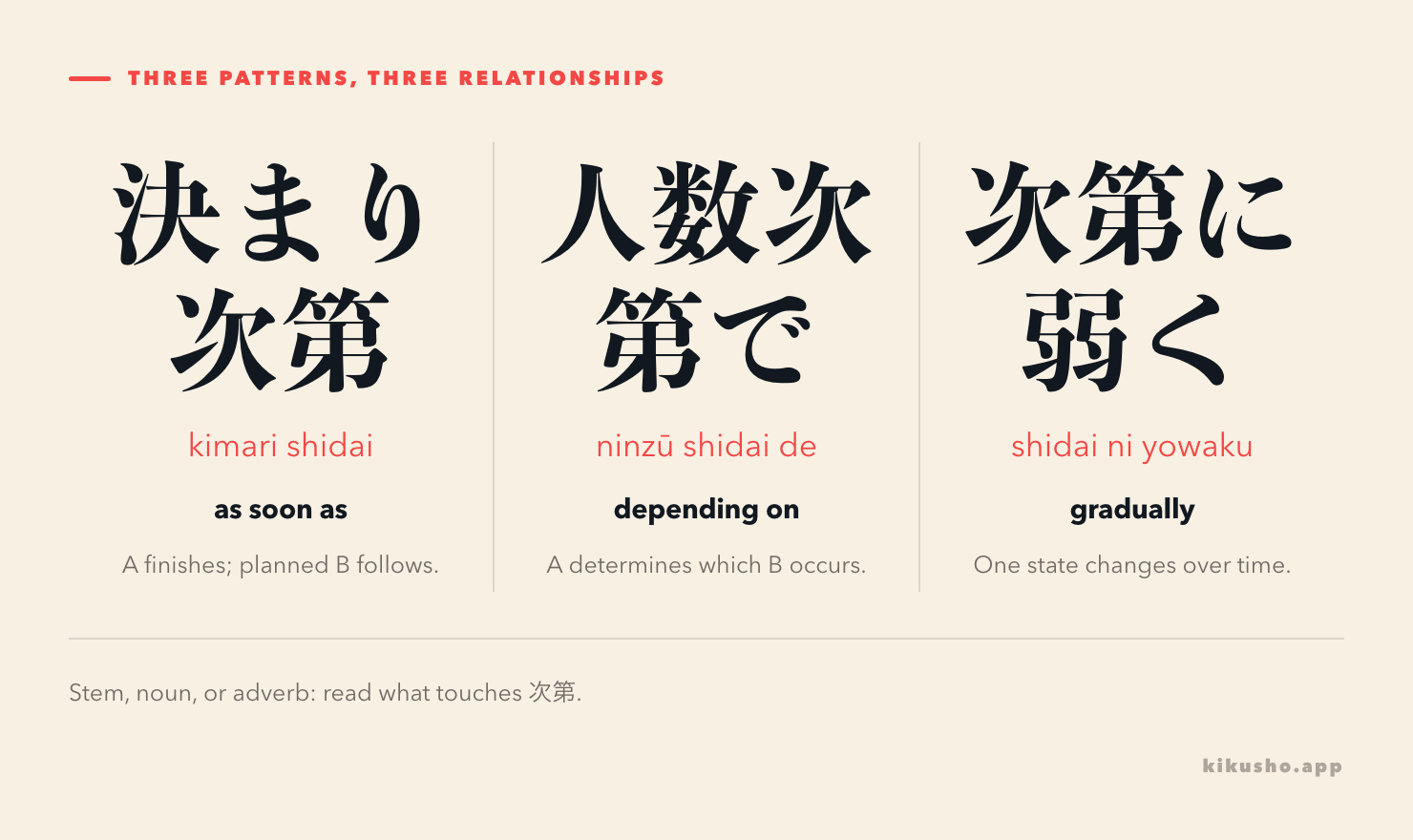
The first sentence contains a handoff: the decision is completed, and contact follows. The second contains a variable: different attendance numbers may produce different venues. The third contains neither a handoff nor alternative outcomes; it tracks one change over time.
Verb-stem+次第 promises a prompt next action
Remove ます from the polite form and attach 次第. 分かります becomes 分かり次第; 到着します becomes 到着次第; 準備します becomes 準備し次第, although the action noun 準備ができ次第 is often easier to read.
詳細が分かり次第、メールでお知らせします。
しょうさいがわかりしだい、メールでおしらせします。
We will notify you by email as soon as the details become known.
This construction presents B as the planned or controlled response to A's completion. It is common in notices, service messages and careful workplace language. “As soon as” describes the promised handoff; it does not claim that two accidental events happened at nearly the same instant.
Compare a sudden event:
ドアを開けたとたん、警報が鳴った。
ドアをあけたとたん、けいほうがなった。
The moment I opened the door, the alarm sounded.
The alarm is not the speaker's scheduled follow-up. That belongs to とたん and sudden change, whereas 開き次第、確認します would promise that someone will check as soon as opening is complete. Verb-stem 次第 therefore fits instructions and intentions better than surprises.
Noun+次第で makes the noun the deciding factor
With a noun, 次第 behaves like “depending on” or “is up to.” Mid-sentence, N次第で introduces the factor and a result follows. At the end, N次第だ / N次第です states where the outcome rests.
明日の天気次第で、試合の場所が変わります。
あしたのてんきしだいで、しあいのばしょがかわります。
The match location will change depending on tomorrow's weather.
合格できるかどうかは、これからの準備次第です。
ごうかくできるかどうかは、これからのじゅんびしだいです。
Whether you can pass depends on your preparation from now on.
The factor can be a person, a result, an amount or a method. It must be capable of influencing the outcome in context. The pattern does not itself say that the factor is good or bad; it says the result is not fixed until that factor is known.
N次第では highlights one possible branch, often an exceptional or consequential one:
面接の結果次第では、来月から働けるかもしれません。
めんせつのけっかしだいでは、らいげつからはたらけるかもしれません。
Depending on the interview result, I may be able to start work next month.
The は does not create a fourth meaning. It foregrounds the possibility that under some outcome, the following result may hold.
次第に is one adverb meaning gradually
次第に stands before a phrase describing change. Nothing attaches to its left to create this meaning.
雨がやみ、空が次第に明るくなってきました。
あめがやみ、そらがしだいにあかるくなってきました。
The rain stopped, and the sky gradually began to brighten.
Bunpro describes 次第に as a standard adverb that works with positive or negative changes and sounds somewhat more formal than だんだん. A useful check is whether “little by little” still makes sense. If it does, 次第に is likely the intended pattern.
Do not read に here as a destination marker, and do not look for a deciding noun. 天気次第で says weather determines a result; 天気は次第に回復した says the weather itself improved progressively.
A minimal contrast keeps time and conditions apart
| Intended message | Natural form | Why |
|---|---|---|
| Contact follows completion of a decision | 決まり次第、連絡します | verb stem + immediate planned B |
| Contact method depends on the decision | 決定次第で、連絡方法が変わります | noun + deciding factor |
| Contact becomes more frequent over time | 連絡は次第に増えます | adverb + progressive change |
The second row uses the action noun 決定, not the verb stem 決まり. That visible noun-plus-で shape is what makes the outcome conditional. By contrast, 決まり次第 contains no で and moves directly to the promised next action.
This distinction also prevents an overbroad translation with “according to.” に応じて emphasizes responding or adapting to a scale or situation. 次第で places attention on the factor that decides which result occurs.
What changes when the wrong form is chosen
Suppose a support message intends to promise contact once an investigation finishes:
調査が終わり次第、ご連絡します。
ちょうさがおわりしだい、ごれんらくします。
We will contact you as soon as the investigation is finished.
Writing 調査次第で、ご連絡します no longer promises that sequence. It says the contact depends on the investigation, leaving open whether contact will occur. Writing 次第にご連絡します makes 次第に modify the act of contacting and suggests that contact happens gradually, which is not the intended service message.
The surface difference is small, but the commitment changes: prompt action, conditional action, or progressive change.
Practice
Complete all seven questions before consulting the answer section.
Question 1
Choose the form that promises a reply promptly after confirmation.
内容を確認し__、お返事いたします。
- 次第\
- 次第で\
- 次第に\
- 次第だ
Question 2
Choose the form meaning that the destination depends on the weather.
天気__、行き先を変更する可能性があります。
A. が次第
B. 次第に
C. 次第で
D. を次第
Question 3
Choose the phrase that means “gradually became quiet.”
A. 静かになり次第
B. 次第に静かになった
C. 静か次第で
D. 静かな次第だ
Question 4
Arrange every numbered fragment to complete the announcement.
__ __ __ __。
- ご案内します\
- 決まり\
- 詳しい時間が\
- 次第、
Question 5
Which sentence says that a manager will act after receiving the report?
A. 報告次第で、部長が判断します。
B. 報告を受け次第、部長が判断します。
C. 次第に報告を受け、部長が判断します。
D. 報告次第に、部長が判断します。
Question 6
Read the notice and choose the supported interpretation.
出発時刻は道路の状況次第で変わります。時刻が決まり次第、受付の画面でお知らせします。
A. The departure time gradually changes every day.
B. The road conditions are announced after departure.
C. The time depends on road conditions, and notice follows once it is fixed.
D. The time is already fixed regardless of road conditions.
Question 7
Choose the only sentence describing a progressive change rather than a dependency or handoff.
- 客の人数次第で、席を増やします。\
- 客の人数が分かり次第、席を用意します。\
- 夜になると、客の数は次第に減りました。\
- 予約次第では、席を増やします。
Answers and explanations
Answer 1
1. 確認します loses ます and becomes 確認し before 次第. The sentence promises that the reply follows confirmation.
Answer 2
C. 天気 is the noun that determines the possible destination change, so noun + 次第で expresses dependence.
Answer 3
B. 次第に is the adverb “gradually” and modifies the change 静かになった. The other options create sequence or dependence shapes that do not express progressive change.
Answer 4
3 → 2 → 4 → 1. 詳しい時間が決まり次第、ご案内します promises an announcement once the precise time is decided.
Answer 5
B. 受け is the stem of 受けます, so the manager's judgment follows receipt of the report. A makes the judgment depend on the report's content or nature rather than simply placing it next in sequence.
Answer 6
C. 道路の状況次第で makes road conditions the deciding factor. 決まり次第 then promises that the notice will appear after the time is fixed.
Answer 7
3. 次第に modifies 減りました and describes a gradual decrease. Choice 1 and choice 4 express dependence; choice 2 promises a follow-up after the number becomes known.
When you save a sentence containing 次第, keep the left attachment and the result clause. Kikusho can turn that complete context into an editable card, preserving whether you met 決まり次第, 天気次第で or 次第に変わる instead of reducing all three to one gloss.
Common questions
What is the difference between 次第 and 次第で?
A verb stem plus 次第 means that B will happen promptly once A is complete: 決まり次第、連絡します. A noun plus 次第で means that the noun determines the outcome: 天気次第で、予定が変わります.
Which verb form comes before sequence 次第?
Use the ます-stem without ます: 分かります becomes 分かり次第 and 到着します becomes 到着次第. Do not attach this meaning to a dictionary or た-form verb.
What does 次第に mean?
次第に is an adverb meaning gradually. It describes a progressive change, such as 空が次第に明るくなる, rather than an immediate next action or a deciding factor.
Are these patterns N2 or N3?
Reference lists disagree about verb-stem 次第: JLPT Sensei lists it at N2 and Bunpro at N3. Both list 次第に at N2, while noun 次第だ and 次第で are listed at N2 in the references used here. These are editorial estimates.