On this page
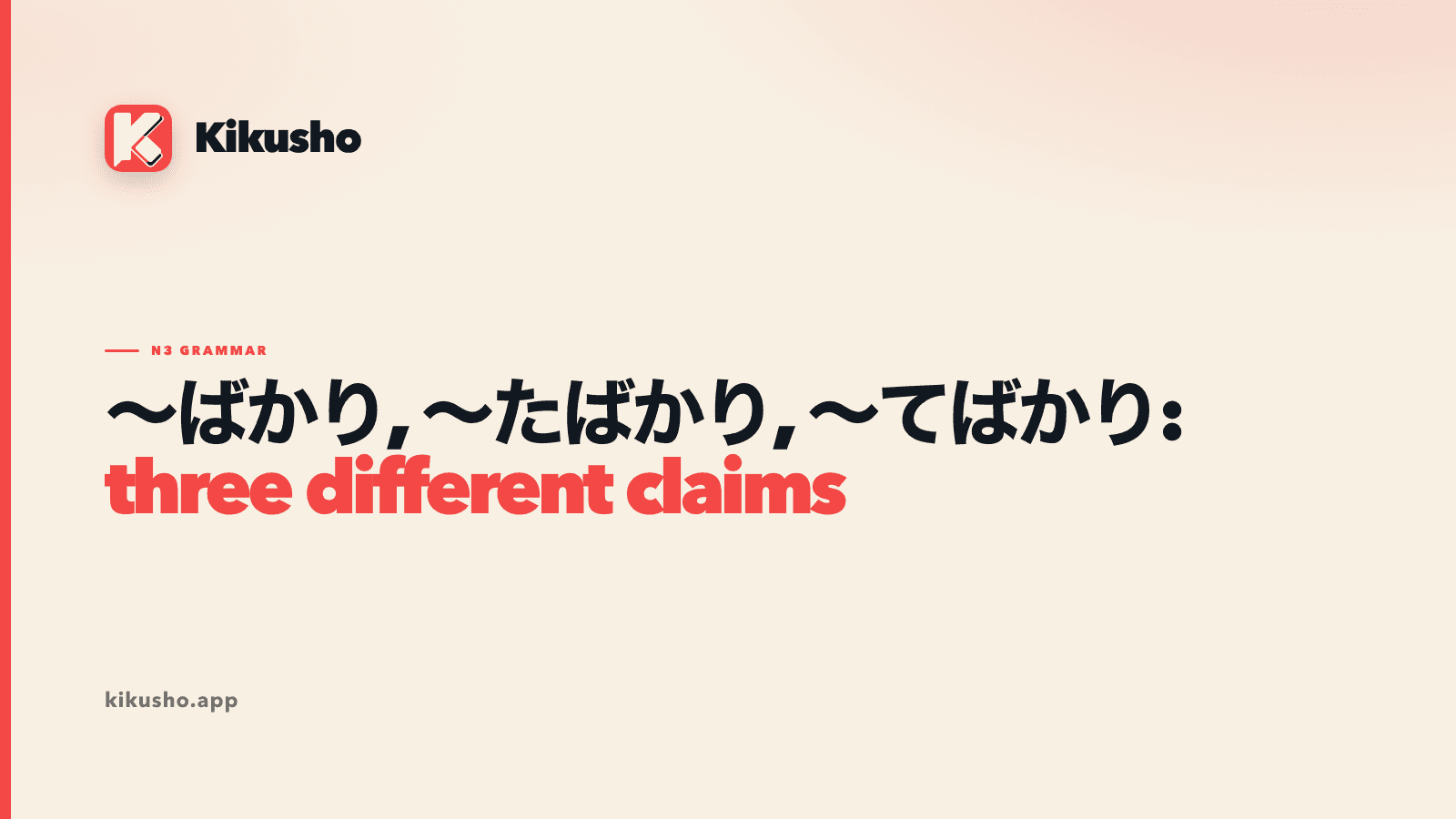
本を読んだばかりです means “I've just read the book”; 本を読んでばかりいます means “I do nothing but read books.” With 本ばかり読んでいます, the restricted choice is books, while 読むばかりで… connects an “only reads” description to another clause.
The English words just and only cover several different claims. To choose the Japanese form, decide whether you are narrowing a choice, calling an event recent, or describing an activity that keeps taking over.
Read the attachment first, then the continuation
This lesson compares four constructions: ばかり, たばかり, てばかりいる and ばかりで. Identify the noun or verb form immediately before ばかり, then check how the sentence continues.
| Construction | Example fragment | Claim to look for |
|---|---|---|
| Noun + ばかり | 本ばかり | Books are the restricted choice or predominant kind. |
| Plain past + ばかり | 読んだばかりです | The reading happened and still feels recent. |
| て-form + ばかりいる | 読んでばかりいます | Reading is the recurring or dominant activity. |
| Restricted description + ばかりで | 読むばかりで… | The limitation is connected to a following clause. |
These are useful together in N3 grammar practice, but some are earlier foundations. JLPT Sensei's bare ばかり page is labelled N4; Bunpro's corresponding page is N3. Both publishers place たばかり at N4. Learn the distinctions without treating the level label as a grammatical rule: the official JLPT FAQ explains that exhaustive vocabulary, kanji and grammar specifications are no longer published.
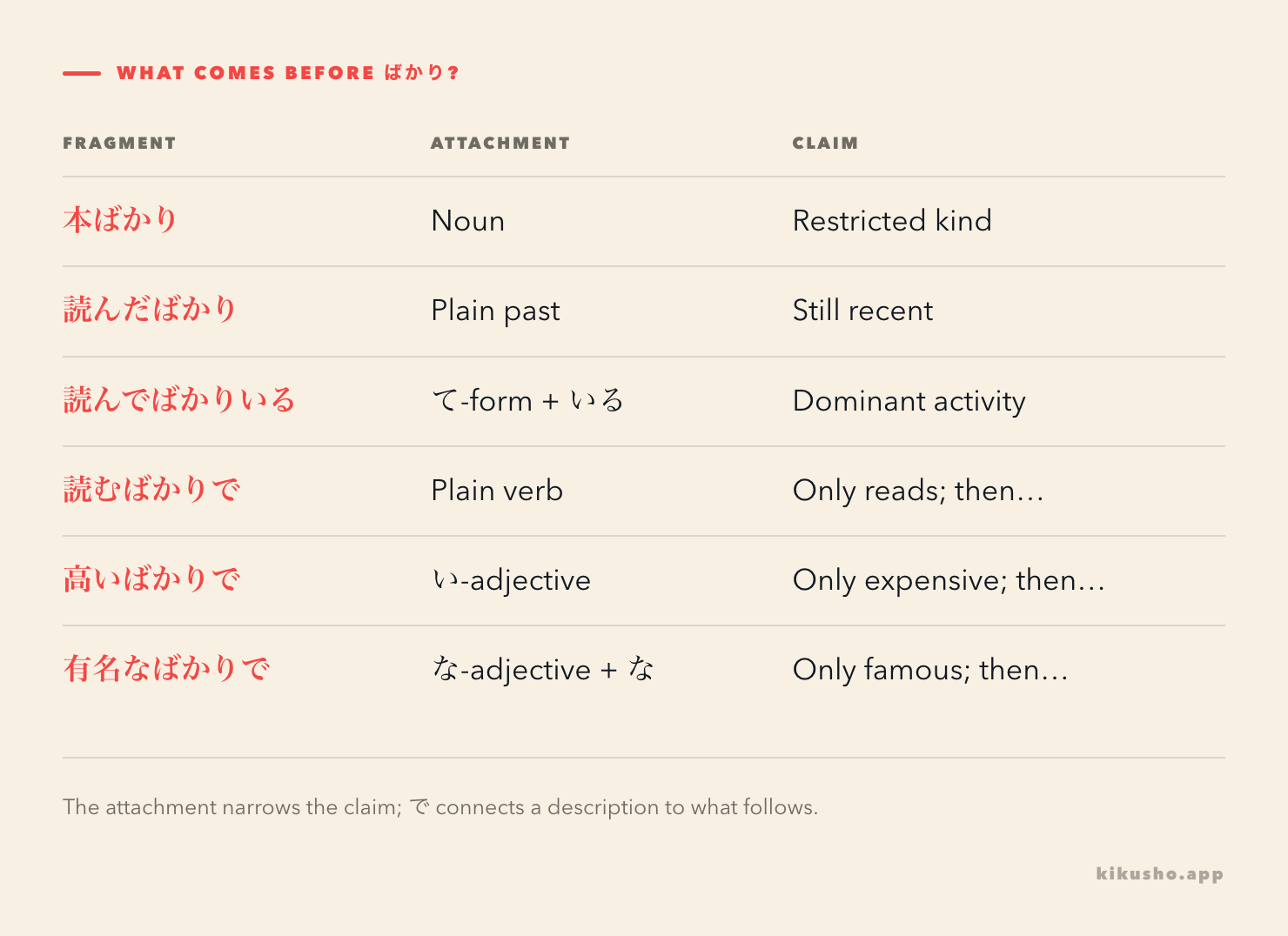
The attachment chart below stays selectable. In particular, 読んだ is the plain past of 読む, even though it ends in だ; 読んで is its て-form.
| Fragment | Reading | Attachment |
|---|---|---|
| 本ばかり | ほんばかり | Noun |
| 読んだばかり | よんだばかり | Plain past |
| 読んでばかりいる | よんでばかりいる | て-form, followed by いる |
| 読むばかりで | よむばかりで | Dictionary-form verb, with a connected clause |
| 高いばかりで | たかいばかりで | い-adjective |
| 有名なばかりで | ゆうめいなばかりで | な-adjective, retaining な |
If those verb forms are uncertain, use the plain-past formation guide and て-form guide before attempting the exercises.
Noun + ばかり restricts what is being chosen
机の上は本ばかりです。
つくえのうえはほんばかりです。
“There are nothing but books on the desk.”
Here, 本 is the category being singled out. The sentence describes the desk's contents; it gives no information about when the books arrived or whether anyone has read them.
本ばかり読んでいます。
ほんばかりよんでいます。
“I read nothing but books.”
This narrows what is read. In a conversation contrasting books with newspapers or magazines, books are the choice that predominates. It need not be a literal claim that there has never been a single exception.
The tone may be critical, surprised or perfectly contented. “Nothing but books” could describe an excellent afternoon. The noun restriction itself does not supply a complaint. This use and the possibility of a non-negative interpretation are illustrated in JLPT Sensei's ばかり explanation.
Past + ばかり measures how recent an event still feels
この本は昨日買ったばかりです。
このほんはきのうかったばかりです。
“I only bought this book yesterday.”
買った identifies the purchase as a past event. ばかり presents it as still new or recent, which might explain why you have not read the book yet.
“Recent” is judged within the situation. You could say:
先月、この町に引っ越したばかりです。
せんげつ、このまちにひっこしたばかりです。
“I moved to this town only last month.”
That makes sense when a month still feels short for becoming familiar with a town. It is not a stopwatch meaning “within the last few seconds.” JLPT Sensei's たばかり examples include intervals longer than the immediate moment.
Use the plain affirmative past before ばかり: 読んだばかり, followed by です for a polite statement. 読みましたばかり is not this formation. Bunpro's たばかり reference also places the past form inside the construction.
The event can itself be a beginning. 授業は始まったばかりです (じゅぎょうははじまったばかりです) means “The class has only just started.” The starting has occurred; the class has not finished.
Before a following noun, add の: 買ったばかりの本 (かったばかりのほん), “a book I just bought.” Tofugu's noun-modification section describes this recent-event use.
For たところ, the useful comparison is the stage immediately after an event, versus how recent it still feels with たばかり. The Japan Foundation's teaching notes explicitly explain the speaker's sense of elapsed time. The fuller ところ lesson covers the before, during and after stages.
てばかりいる singles out the activity that keeps recurring
休みの日は、本を読んでばかりいます。
やすみのひは、ほんをよんでばかりいます。
“On my days off, I do nothing but read books.”
Now 読んで puts the focus on doing the reading. The activity fills the time or keeps recurring. This could be a happy account of a reading holiday, or a complaint about neglecting other tasks; context determines the attitude.
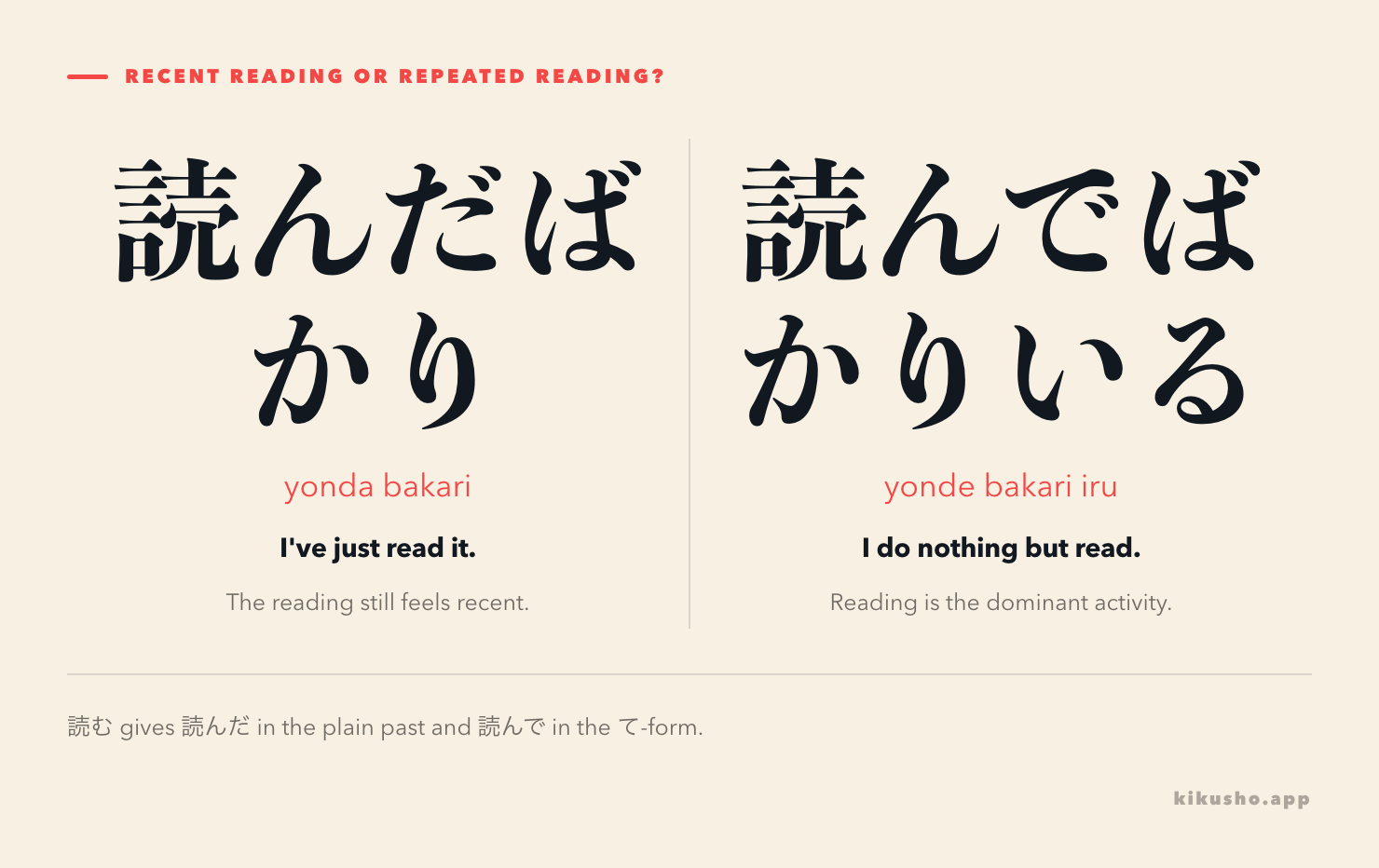
| Form | Reading | Interpretation |
|---|---|---|
| 読んだばかりです | よんだばかりです | I've just read it. |
| 読んでばかりいます | よんでばかりいます | I do nothing but read. |
Keep the て-form intact, including verbs whose form ends in で. For a polite statement, the final いる becomes います; for a polite past account, it becomes いました:
先週の日曜日は本を読んでばかりいました。
せんしゅうのにちようびはほんをよんでばかりいました。
“Last Sunday, I did nothing but read books.”
The repeated-activity meaning survives that change of ending. JLPT Sensei's てばかりいる page gives the て-form construction and its continuations. It is a different claim from a particular reading having happened recently.
ばかりで connects the limitation to another clause
彼は説明を聞くばかりで、質問をしません。
かれはせつめいをきくばかりで、しつもんをしません。
“He just listens to the explanation and doesn't ask questions.”
The first clause describes a restricted activity; the second says what else is happening, or what is missing. Here, listening dominates while questioning is absent.
The で is the connecting form of the auxiliary だ. It joins the description to the following clause; it is not the place or instrument particle. Bunpro's explanation of this connection distinguishes it from particle で. Translate the relationship from the whole sentence rather than assigning で a fixed English “because.”
Several attachments are possible:
| Base | Connected fragment | Reading |
|---|---|---|
| 聞く, plain verb | 聞くばかりで | きくばかりで |
| 聞いている, plain progressive | 聞いているばかりで | きいているばかりで |
| 仕事, noun | 仕事ばかりで | しごとばかりで |
| 高い, い-adjective | 高いばかりで | たかいばかりで |
| 有名, な-adjective | 有名なばかりで | ゆうめいなばかりで |
For example:
その店は有名なばかりで、料理はおいしくありません。
そのみせはゆうめいなばかりで、りょうりはおいしくありません。
“That restaurant is only famous; its food isn't good.”
The な belongs before ばかり. The contrast with disappointing food makes the criticism clear. The verb and adjective formations are set out in JLPT Sensei's ばかりで reference.
A final で does not erase the meaning already established by the attachment. 買ったばかりで、まだ読んでいません (かったばかりで、まだよんでいません) means “I've just bought it and haven't read it yet.” The plain past still supplies recency. That is why identifying only the final string ばかりで is insufficient.
Casual ばっかり and ばっか keep the same attachment
In casual conversation, you may meet ばっかり or ばっか. The small っ matters, but shortening the expression does not merge the meanings:
| Casual fragment | Reading | Claim |
|---|---|---|
| 読んだばっか | よんだばっか | I've just read it. |
| 読んでばっかいる | よんでばっかいる | I do nothing but read. |
Maggie Sensei's authored ばかり lesson gives these spoken variants alongside different attachments. They suit casual exchanges; the full ばかり form is used in the exercises here. The broader spoken-Japanese guide explains why recognising such reductions changes what you hear.
If you capture 読んでばっかいる from a subtitle in Kikusho, keep the preceding verb in the card. Edit its reading to よんでばっかいる and add a register note identifying ばっか as casual ばかり. A card containing only “ばっか = just” would discard the very form that tells you whether the speaker means recency or repeated activity.
Other constructions use ばかり for approximate quantities, a worsening trend, or other connections. Those require their own explanation. The four constructions compared here do not exhaust every use of the word.
Seven questions to identify the claim
Try the full set before reading the answer section below. These original exercises adapt the grammar-selection, sentence-composition and text-grammar tasks named in the official N3 test-item table; they are not official exam questions.
Question 1. Choose the form that specifically says the reading has happened recently.
この本を(____)ばかりです。
A. 読みます B. 読んで C. 読んだ D. 読んでいる
Question 2. What does the restriction apply to in this sentence?
机の上は本ばかりです。
A. How recently the books arrived
B. The kind of things on the desk
C. The absence of books
D. How often someone reads
Question 3. Complete the sentence to describe gaming as an activity that repeatedly dominates the younger brother's time.
最近、弟はゲームを(____)。
A. してばかりいます B. しました C. するところです D. したばかりです
Question 4. Choose the correct attachment for 有名 in this connected description.
その店は有名(____)、料理はおいしくありません。
A. なばかりで B. ばかりで C. たばかりで D. てばかりで
Question 5. Use all four pieces once to form a sentence meaning “This is a book I only bought yesterday.” Which piece belongs at ★?
これは __ __ ★ __ です。
A. 昨日 B. 本 C. 買った D. ばかりの
Question 6. Choose the phrase that fits the whole account.
先月、この町に引っ越しました。(____)、まだ道がよくわかりません。毎日少しずつ覚えています。
A. 来てばかりいるので
B. 来たばかりなので
C. 来るところなので
D. 来たことがないので
Question 7. Change the final いる to its affirmative polite past form.
先週の日曜日は本を読んでばかり(____)。
A. います B. いました C. いません D. いませんでした
Keep your seven choices together; check the requested claim as well as the attachment.
Answers and explanations
Answer 1. C: 読んだ. The complete sentence is この本を読んだばかりです (このほんをよんだばかりです), “I've just read this book.” 読む becomes 読んだ in the plain past. B and D can produce restricted-activity descriptions, but they do not express the requested recent reading. A puts a polite verb ending inside a construction that takes the plain form.
Answer 2. B: the kind of things on the desk. 机の上は本ばかりです (つくえのうえはほんばかりです) describes contents predominantly consisting of books. 本 is a noun, so this instance supplies neither a recent arrival nor a recurring reading activity. It also says the opposite of books being absent.
Answer 3. A: してばかりいます. 最近、弟はゲームをしてばかりいます (さいきん、おとうとはゲームをしてばかりいます) means “Lately, my younger brother does nothing but play games.” する becomes して, and the final いる becomes polite います. B reports a past action, C identifies the stage before playing, and D presents playing as recent. Those are grammatical expressions for other claims.
Answer 4. A: なばかりで. その店は有名なばかりで、料理はおいしくありません (そのみせはゆうめいなばかりで、りょうりはおいしくありません) joins “only famous” to “the food isn't good.” 有名 is a な-adjective; the required な is missing from B. C and D do not form the adjective construction.
Answer 5. D: ばかりの. The order is A → C → D → B: これは昨日買ったばかりの本です (これはきのうかったばかりのほんです), “This is a book I only bought yesterday.” 昨日 places the purchase yesterday, 買ったばかり calls it recent, and の connects that description to 本. D occupies the third blank, ★.
Answer 6. B: 来たばかりなので. The complete account is 先月、この町に引っ越しました。来たばかりなので、まだ道がよくわかりません。毎日少しずつ覚えています。 Its reading is せんげつ、このまちにひっこしました。きたばかりなので、まだみちがよくわかりません。まいにちすこしずつおぼえています。 “I moved to this town last month. Since I've only recently arrived, I don't know the streets well yet. I'm learning them little by little each day.” 来た is the plain past of 来る. With なので, the recent-arrival description explains the unfamiliarity. A describes recurring arrivals, C puts arrival ahead of the speaker, and D denies ever coming; none matches this already-completed move and gradual familiarisation.
Answer 7. B: いました. 先週の日曜日は本を読んでばかりいました (せんしゅうのにちようびはほんをよんでばかりいました) says “Last Sunday, I did nothing but read books.” Conjugate the final いる; retain 読んでばかり. A is affirmative polite nonpast, C negative polite nonpast, and D negative polite past.
For your next subtitle containing ばっか, pause at the word immediately before it. Say that word's form aloud before translating the line. A clearly heard 読んだ or 読んで can settle a distinction that an isolated English “just” leaves open.
Common questions
Does たばかり always mean a few seconds ago?
No. It presents an event as still recent from the speaker's perspective. Yesterday or last month can fit when the context makes that interval feel short. It does not license every old event without a reason to call it recent.
Are all these forms N3 grammar?
This is an N3 comparison with N4 foundations. JLPT Sensei lists bare ばかり and たばかり at N4, while Bunpro lists bare ばかり at N3 and たばかり at N4. The ばかりで and てばかりいる references used here are labelled N3. These are study-list estimates; the JLPT publishes no exhaustive grammar syllabus.
Is ばかり always a complaint?
No. A restricted choice or repeated activity can be described without disapproval. Criticism is common when the surrounding sentence points to something neglected or a disappointing result.
What do ばっかり and ばっか mean in conversation?
They are casual variants of ばかり. Keep the preceding form: 読んだばっか presents recent reading, while 読んでばっかいる describes reading as a recurring or dominant activity. Use the full form for these written exercises.