On this page
A service desk that accepts 予約だけでなく相談も handles both reservations and consultations: だけでなく means “not only A, but B too.” ばかりでなく makes the same addition with a more formal tone. The なく does not cancel the reservations; it cancels the idea that reservations are the limit.
This N3 grammar lesson teaches those two additive constructions, their attachment, and how to read the information after them. There is a level disagreement worth keeping visible: JLPT Sensei lists だけでなく at N3, while Bunpro places it at N4. Both place ばかりでなく at N3. Treat the simpler connector as a useful foundation, not a newly advanced meaning. These labels are estimates, not an official exhaustive JLPT list.
The deciding test is whether the sentence keeps A and adds B
Ask what happens to the first item. If A still holds and B joins it, either connector may work. If the sentence rejects A and replaces it with B, this is a different relationship.
この窓口では、予約だけでなく、相談も受け付けています。
このまどぐちでは、よやくだけでなく、そうだんもうけつけています。
This desk accepts consultations as well as reservations.
The relevant nouns are 予約, reservation, and 相談, consultation. Both belong under the same predicate, 受け付けています, “is accepting.” The second noun's も makes the addition visible. Replacing だけでなく with ばかりでなく preserves the two services; it changes the tone.
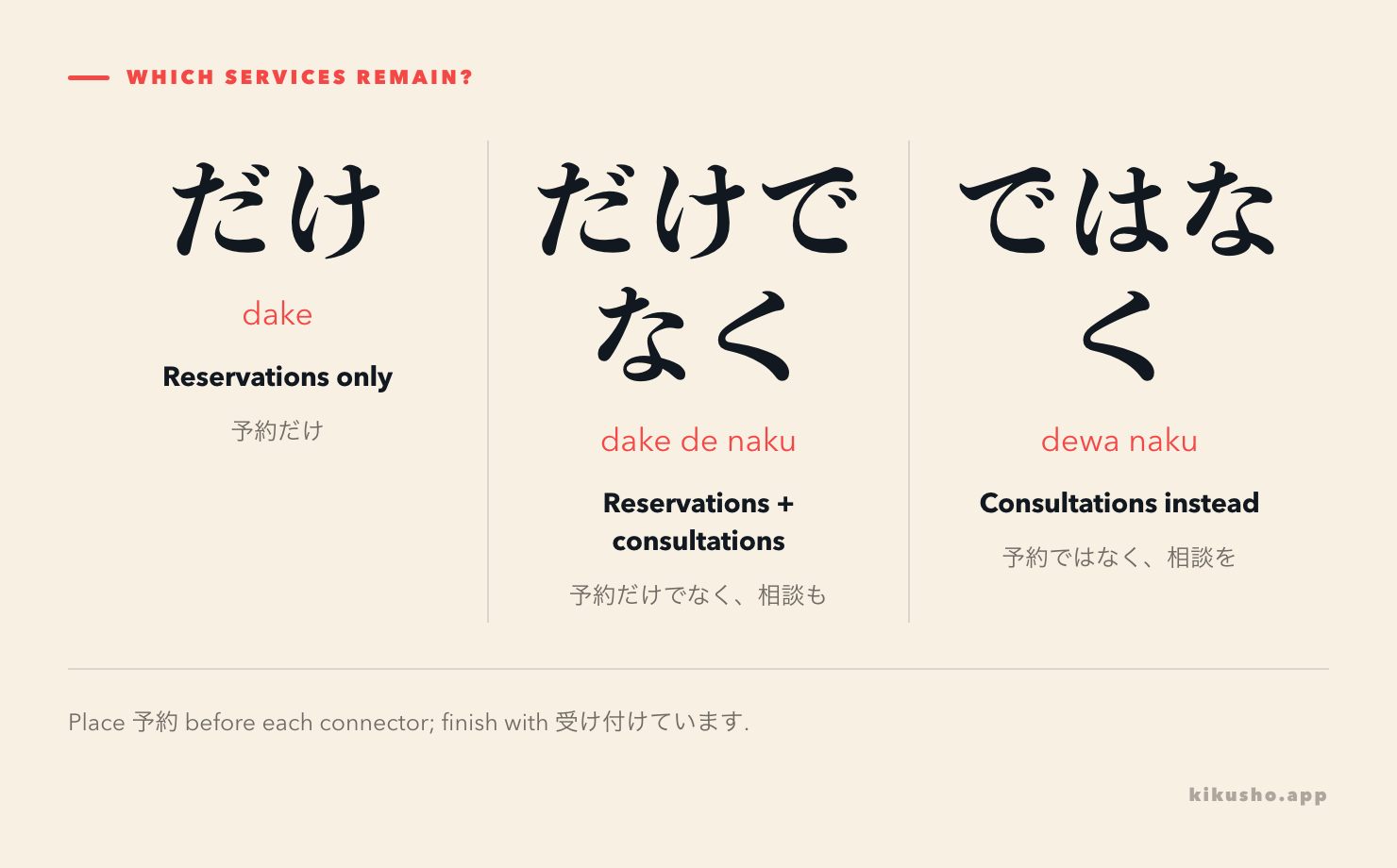
| Frame | Meaning |
|---|---|
| 予約だけ受け付けています | We accept reservations only. |
| 予約だけでなく、相談も受け付けています | We accept reservations and consultations. |
| 予約ではなく、相談を受け付けています | We accept consultations, rather than reservations. |
The last row describes a replacement in this contrast. It is not another way to say “both.” If the first row is unfamiliar, start with だけ and the limit it sets.
Each connector follows the same four attachment patterns
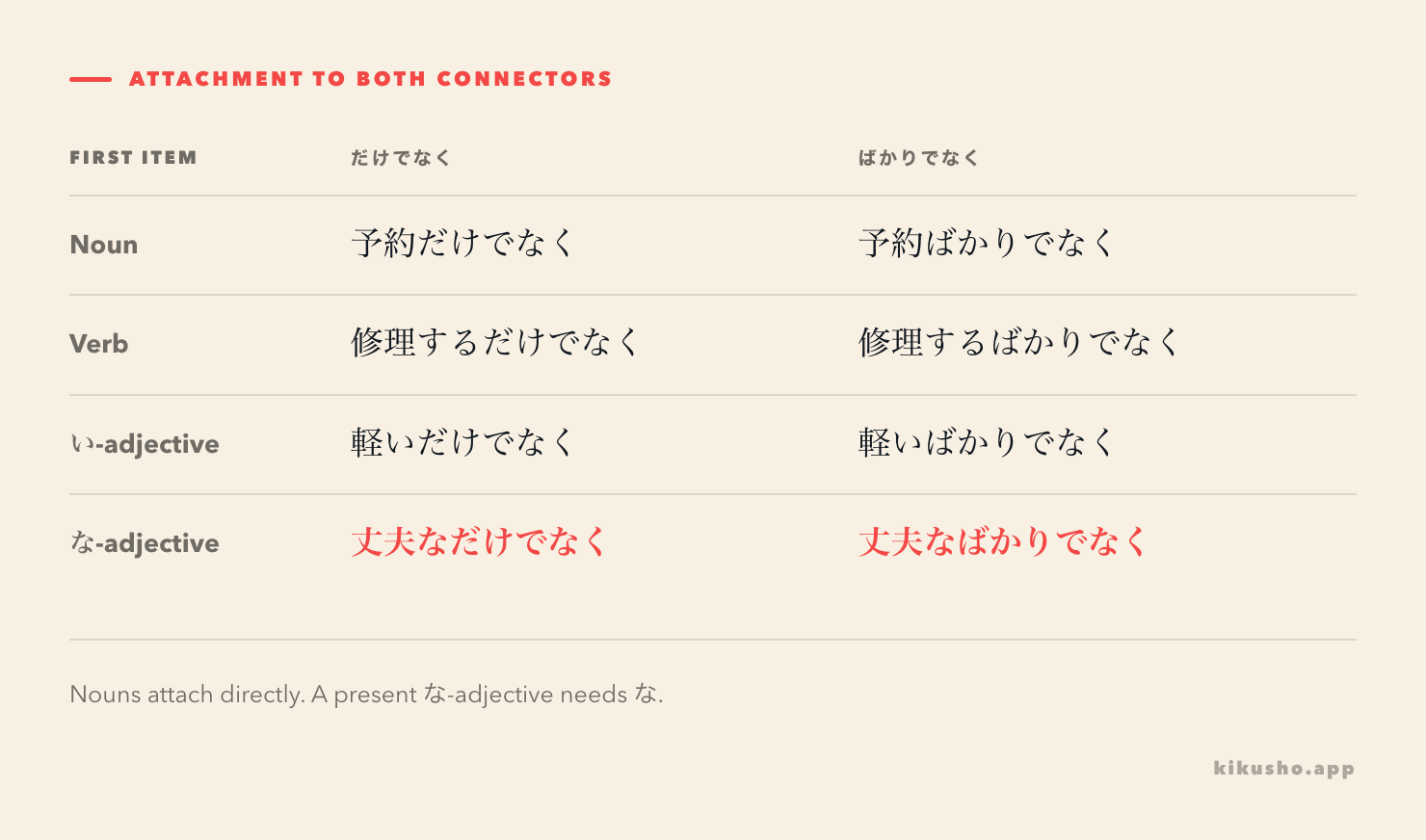
The beginning of the sentence may be a noun, an action, or a property. A present-tense な-adjective needs な before the connector. An い-adjective keeps its final い; a noun does not take an extra な.
| First item | With だけでなく | With ばかりでなく |
|---|---|---|
| Noun: 予約(よやく), reservation | 予約だけでなく | 予約ばかりでなく |
| Verb: 修理する(しゅうりする), repair | 修理するだけでなく | 修理するばかりでなく |
| い-adjective: 軽い(かるい), light | 軽いだけでなく | 軽いばかりでなく |
| な-adjective: 丈夫(じょうぶ), sturdy | 丈夫なだけでなく | 丈夫なばかりでなく |
These are the ordinary attachment patterns given by the separate Sensei lesson on ばかりでなく and Bunpro's lessons. The Japan Foundation's formation chart also records noun + である and な-adjective + である as alternatives in more written wording. You do not need to insert である into an ordinary noun example.
Use a plain predicate before the connector even when the sentence finishes politely:
この店は、時計を修理するだけでなく、電池も交換します。
このみせは、とけいをしゅうりするだけでなく、でんちもこうかんします。
This shop not only repairs watches but also replaces batteries.
修理しますだけでなく is not the attachment taught here. The sentence's final 交換します supplies the polite ending. Plain does not mean that every example must be present-tense: a completed action can use 修理した before the connector when that is the intended event.
だけでなく is the everyday starting point
Compare these descriptions of the same bag:
このかばんは軽いだけでなく、丈夫です。
このかばんはかるいだけでなく、じょうぶです。
This bag is not only light but also sturdy.
ばかりでなく gives the same addition a more formal tone
このかばんは軽いばかりでなく、丈夫です。
このかばんはかるいばかりでなく、じょうぶです。
This bag is not only light but also sturdy.
This version could suit a more formal description. It does not make the bag sturdier, and it does not exclude conversation. Bunpro describes ばかりでなく as the more formal counterpart; だけでなく remains common in speech and writing. A blank with both as options would often have two acceptable answers. Learn the preference without turning it into a false prohibition.
Their overlap includes praise, complaints and ordinary facts
The added information need not be praise. For example, この箱は重いばかりでなく、持ちにくいです says the box is both heavy and hard to carry. Read it as このはこはおもいばかりでなく、もちにくいです. The complaint comes from the properties, not from a rule that ばかりでなく must introduce bad news.
You will also meet だけではなく and ばかりではなく. These retain the additive relationship. Everyday speech often uses だけじゃなくて. Notice the connector's tone separately from the polite or plain ending of the whole sentence.
The second part can add a noun or a complete property
The bag examples have no も. They are complete sentences: lightness and sturdiness are two predicates about the same bag. Both Sensei and Bunpro provide predicate examples without a second-clause も. “Often followed by も” is not “grammatically requires も.”
When B is a noun with a location or other case role, keep the particle that makes that role clear:
この資料は、職場だけでなく、自宅でも読めます。
このしりょうは、しょくばだけでなく、じたくでもよめます。
You can read this material not only at work but also at home.
Here 自宅でも is 自宅 + で + も: home is a place where reading can happen. It is not the concessive “even if” use of でも. The predicate and the noun's role decide the reading. The lesson on も and Japanese lists supplies the basic “also” pattern.
The second part can also be advice:
黙って読むだけでなく、声に出して読んでみてください。
だまってよむだけでなく、こえにだしてよんでみてください。
Try reading aloud as well as reading silently.
There is no blanket ban on requests. The advice asks you to include another activity. The Foundation's lesson likewise applies this additive relationship to using knowledge as well as learning it.
A missing connector changes inclusion, not just style
In the desk example, removing でなく produces 予約だけ, “reservations only.” Removing the whole だけでなく can also erase the relationship you wanted to express. Do not shorten a saved example until it says the opposite of the notice you read.
Watch these three different jobs:
| Expression | What it does here |
|---|---|
| 予約だけ | Limits the service to reservations. |
| 予約だけでなく、相談も | Adds consultations while retaining reservations. |
| 予約ではなく、相談を | Contrasts consultations with reservations. |
Likewise, ばかりでなく is not merely the “just finished” たばかり with a negative ending. The other ばかり patterns distinguish a recent action, predominant items and repeated behaviour. This lesson covers additive ばかりでなく; it does not claim to teach every construction containing ばかり.
Practice
Six original questions follow. Attempt all six before scrolling to the shared answer section. Where a connector is specified, use that connector; you are not being asked to guess a register difference between two grammatical synonyms.
Question 1
Choose the attachment that completes the sentence naturally.
この部屋は静か__、駅にも近いです。
部屋(へや) = room; 静か(しずか) = quiet; 近い(ちかい) = close.
A. だけでなく
B. なだけでなく
C. のだけでなく
D. いだけでなく
Question 2
Choose the expression meaning that both drinks are available.
会議室には、お茶__、コーヒーも用意してあります。
会議室(かいぎしつ) = meeting room; お茶(おちゃ) = tea; 用意(ようい) = preparation.
A. ではなく
B. だけしか
C. ばかりでなく
D. だばかりでなく
Question 3
Put the four chunks in order. Use each once. The beginning and ending are fixed.
この店は、__ __ __ __。
- 相談も\
- だけでなく、\
- 予約\
- 受け付けています
予約(よやく) = reservation; 相談(そうだん) = consultation; 受け付ける(うけつける) = accept an application, booking or request.
Question 4
Put the four chunks in order. Use each once.
この機械は__ __ __ __。
- 使い方も\
- ばかりでなく、\
- 簡単です\
- 軽い
機械(きかい) = machine; 使い方(つかいかた) = how to use something; 簡単(かんたん) = easy, simple.
Question 5
Read the workshop notice and choose the interpretation supported by both additions.
この工作教室には、子どもだけでなく、保護者も参加できます。見学するだけではなく、作品を作ることもできます。道具は会場で貸し出します。
工作教室(こうさくきょうしつ) = craft workshop; 保護者(ほごしゃ) = parent or guardian; 参加(さんか) = participation; 見学(けんがく) = observing; 作品(さくひん) = something made; 道具(どうぐ) = tools; 会場(かいじょう) = venue; 貸し出す(かしだす) = lend out.
A. Only children may attend, and they must watch without making anything.
B. Parents replace children as participants, and only finished works are shown.
C. Children and parents may attend, but parents must only watch.
D. Children and parents may attend; observing and making a work are both possible.
Question 6
Read the service description. What does 画面でも add?
この案内は、紙ばかりでなく、画面でも読めます。受付で紙の案内をもらうことも、スマートフォンで同じ内容を見ることもできます。
案内(あんない) = information guide; 紙(かみ) = paper; 画面(がめん) = screen; 受付(うけつけ) = reception; 内容(ないよう) = content.
A. A screen is another medium for reading the information, alongside paper.
B. Paper copies have been replaced and are no longer available.
C. The smartphone version contains different information from the paper guide.
D. Even if the screen is unreadable, the information must be read on it.
Answers and explanations
Answer 1
B: なだけでなく. 静か is a な-adjective, so its present affirmative attachment is 静かなだけでなく. The room is both quiet and close to the station. The other choices omit な or introduce a noun-linking の or an い ending that 静か does not have.
Answer 2
C: ばかりでなく. お茶 is a noun and attaches directly: お茶ばかりでなく、コーヒーも用意してあります. Tea and coffee have both been prepared. A means “coffee rather than tea,” which fails the requested inclusion. B combines a limiting phrase with しか without its required negative predicate. D inserts the plain copula だ where this noun attachment does not take it. だけでなく would also express the intended addition, so it was deliberately not offered as a competing choice.
Answer 3
3 → 2 → 1 → 4.
この店は、予約だけでなく、相談も受け付けています。
This shop accepts consultations as well as reservations.
The noun 予約 comes before だけでなく; 相談も is the added item under the shared predicate. Starting with 相談も would leave the given bare 予約 without its expected object or focus marking. Reversing the nouns would require changing the chunks, not merely their order.
Answer 4
4 → 2 → 1 → 3.
この機械は軽いばかりでなく、使い方も簡単です。
This machine is not only light but also easy to use.
The い-adjective 軽い attaches directly to ばかりでなく. 使い方も introduces the added point, and 簡単です completes that description. Moving the polite final predicate before the connector would break the required plain attachment. The sentence does not say lightness causes ease of use.
Answer 5
D. 子どもだけでなく、保護者も adds parents or guardians without excluding children. 見学するだけではなく、作品を作ることも adds making something to the possible activities. A imposes two limits the notice removes; B substitutes parents for children; C invents a restriction on parents that the text does not state. The final sentence says tools are lent at the venue, not that a particular activity is compulsory.
Answer 6
A. 紙ばかりでなく retains paper and adds the screen. In 画面でも, で marks the medium and も adds it to the available ways of reading. B contradicts the paper-copy sentence; C contradicts 同じ内容, “the same content”; D mistakes the noun + で + も sequence for a concessive condition. Nothing says the screen is unreadable.
Write the audience beside your example
A product brochure and a message to a friend can describe the same feature differently. Beside a sentence containing ばかりでなく, write where you found it and who it addresses. Beside its だけじゃなくて rewrite, name the friend you would say it to. The difference then has an audience, rather than an unexplained “formal” label.
For a brochure you capture as text in Kikusho, retain the full description and edit its register note to record that audience. Keep the example's connective ending intact: a card headed only 軽い cannot show whether the next feature is added, contrasted or explained. During a later review, cover the second property and supply a plausible continuation for that particular reader.
Common questions
What is the difference between だけでなく and ばかりでなく?
Both mean not only A but also B. だけでなく is common in everyday speech and writing; ばかりでなく generally sounds more formal. The distinction is a register preference, not a rule that changes whether A and B are included.
Must the second clause contain も?
No. も is common when adding a second noun, but two predicates can be connected without it. このかばんは軽いだけでなく、丈夫です means the bag is both light and sturdy.
Are these N3 grammar expressions?
This paired lesson is placed at N3. JLPT Sensei lists both at N3; Bunpro places だけでなく at N4 and ばかりでなく at N3. These are editorial level estimates, since the JLPT publishes no exhaustive grammar syllabus.