On this page
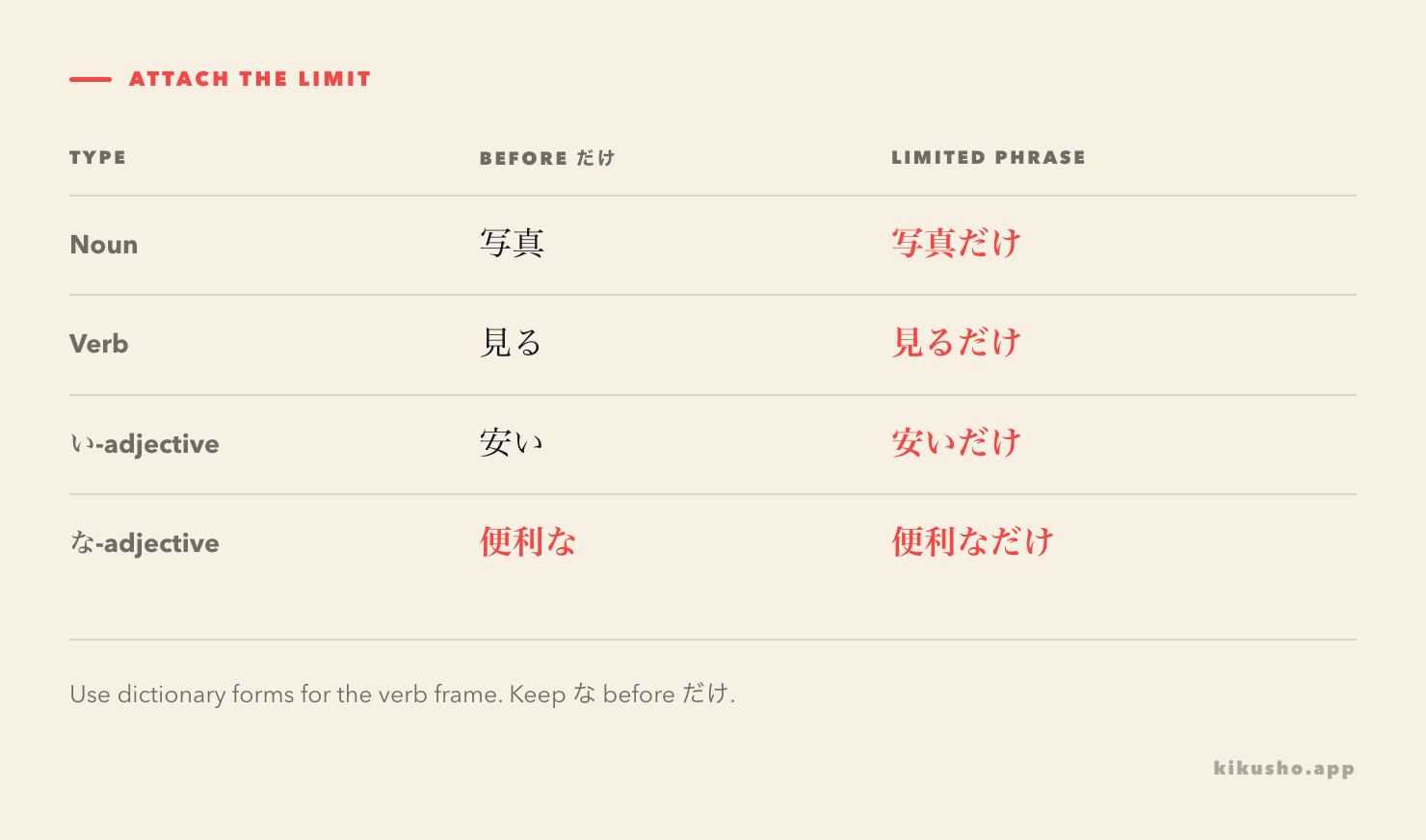
だけ(dake) puts a limit on the phrase it follows: パンだけ食べました means “I ate only bread,” and 見るだけです means “I will just look.” It attaches to nouns, verbs and adjectives, with な needed in the basic な-adjective pattern.
At a bakery, that limit might select bread rather than cake. At a shop, it might distinguish looking from buying. Before translating “only,” identify what the speaker is limiting.
Put だけ after the noun, action or quality being limited
These are the basic attachment patterns. Bunpro's だけ lesson gives all four and places the restriction use at N5; JLPT Sensei's formation table independently confirms them.
| Before だけ | Example | Reading | What is limited |
|---|---|---|---|
| Noun | 写真だけ | しゃしんだけ | photographs, among other things |
| Dictionary verb | 見るだけ | みるだけ | looking, among possible actions |
| い-adjective | 安いだけ | やすいだけ | being cheap, among possible qualities |
| な-adjective + な | 便利なだけ | べんりなだけ | being convenient, among possible qualities |
Complete an action or quality description with です when using polite speech:
このかばんは安いだけです。丈夫ではありません。
この かばんは やすいだけです。じょうぶでは ありません。
This bag is merely cheap. It is not sturdy.
丈夫(じょうぶ) means sturdy here. The speaker acknowledges the price advantage while denying a second quality. Do not replace 安いだけ with 安くだけ: this frame keeps the adjective's い ending.
Likewise, 便利なだけです uses な before だけ. 便利だだけです does not produce the taught attachment. A dictionary-form verb gives 見るだけです, not 見ますだけです. The polite ending comes after the restriction, once the phrase has been built.
Noun restriction chooses a thing without counting it
パンだけ selects bread. It does not say “one bread roll.” Compare two reports about a tray containing bread and other food:
| Report | Reading | What it establishes |
|---|---|---|
| パンだけ食べました。 | パンだけ たべました。 | I ate only bread. |
| パンを一つだけ食べました。 | パンを ひとつだけ たべました。 | I ate only one piece of bread. |
The first leaves the quantity unstated. In the second, 一つだけ restricts the amount. If the tray contains rolls, English can naturally say “I ate only one roll.” The numeral and the setting supply that information; パンだけ does not.
だけ does not automatically mean the restricted number is small. 百人だけ参加しました (ひゃくにんだけ さんかしました), “Only a hundred people participated,” still sets a numerical limit. Whether a hundred counts as disappointing, sufficient or surprisingly many requires context. The Japanese Page's explanation describes restriction of quantity and uses “just one more time” as a separate counted frame.
Moving だけ changes the answer to “only what?”
Consider work arrangements:
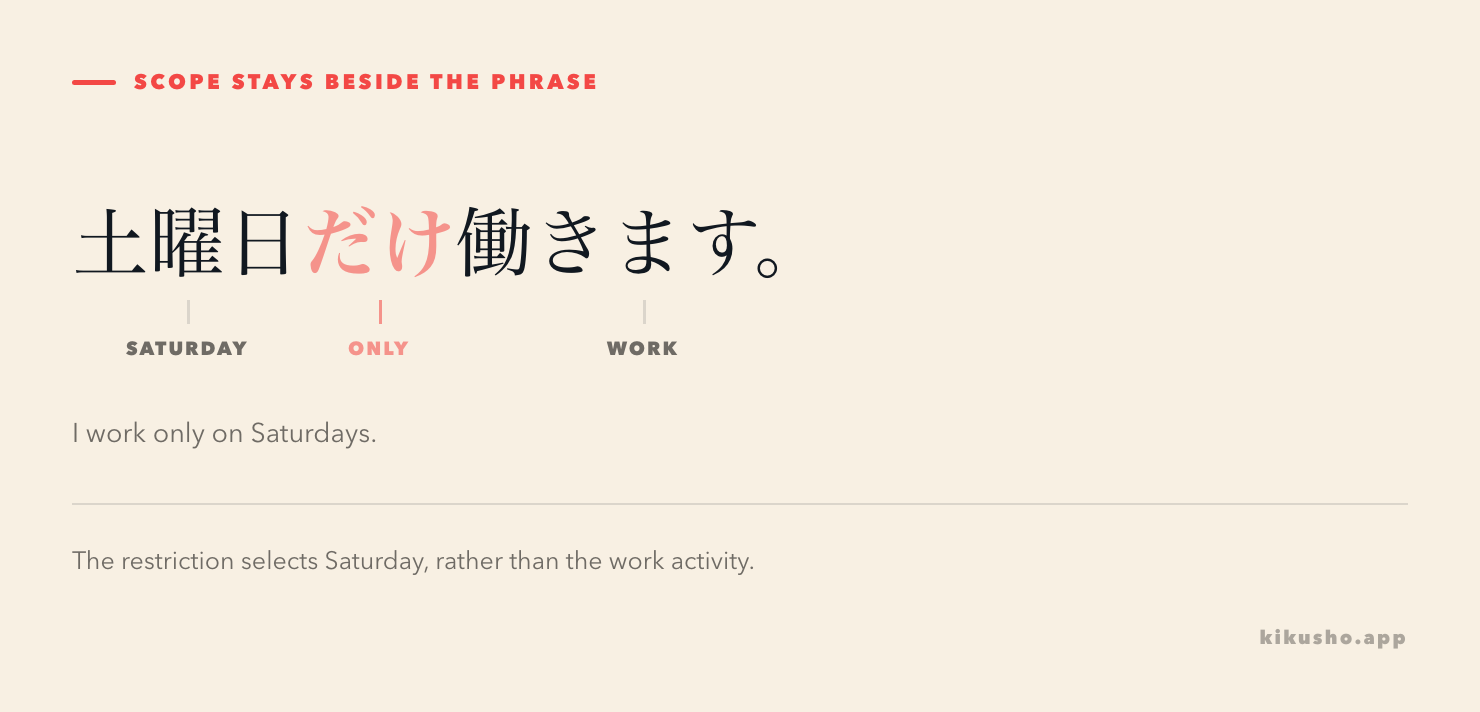
土曜日だけ働きます。
どようびだけ はたらきます。
I work only on Saturdays.
土曜日は働くだけです。
どようびは はたらくだけです。
On Saturdays, I just work.
In the first, 土曜日だけ restricts the workdays. In the second, 働くだけ restricts the activity on Saturdays. The second does not tell you whether the person also works on Tuesdays. It could answer a question about whether Saturday is for work or sightseeing; the relevant alternatives come from that conversation.
A subject or object can also retain its grammatical role after the restriction:
| Phrase in a sentence | Role | Meaning |
|---|---|---|
| 学生だけが来ました。 | 学生だけ is the arriving group | Only students came. |
| パンだけを食べました。 | パンだけ is what was eaten | I ate only bread. |
Read 学生(がくせい) as students and 来ました(きました) as came. だけが and だけを are not rival translations of “only”: が and を give the restricted phrase its role. The object marker can be absent in the shorter パンだけ食べました above. The basic を explanation separates the object from the actor.
This is not a complete chart of particle ordering. Tuttle's N5 grammar cards, card 81, also show にだけ when restricting a person met and だけが when restricting who went. Keep the particle required by the underlying phrase rather than assuming every particle must occupy the same position relative to だけ.
“Just doing” keeps the verb phrase intact
At an exhibition, someone asks whether you are taking photographs or merely viewing them:
今日は写真を見るだけです。
きょうは しゃしんを みるだけです。
Today I will just look at photographs.
写真を見る is the action being limited. Its object marker を remains inside the phrase. The limit here contrasts looking with the other proposed activity; it is not a claim that you have no other human activity today.
Compare 写真だけを見ます, “I look only at photographs.” That restriction concerns the things viewed, such as photographs rather than paintings. The two sentences can overlap in a situation, but their grammar singles out different alternatives.
Verb forms can carry aspect before だけ too: 待っているだけです (まっているだけです) means “I am just waiting.” The ている comparison explains the ongoing form. Do not remove いる and turn this into 待ってだけです. Here the intact plain-form predicate is 待っている.
だけ does not require the negative pattern used with しか
パンだけ食べました uses an affirmative predicate. The comparable パンしか食べませんでした means “I ate nothing but bread” and requires the negative ending. Bunpro contrasts these structures and notes the stronger emphasis often carried by しか~ない.
Do not mechanically write パンだけ食べませんでした to mean “I ate only bread.” Its verb denies eating; it cannot report that you ate the bread as the affirmative sentence does. Negative restriction and the scope of that denial need their own context. The safe test for this lesson is whether the predicate affirms the action you intend to report.
This comparison does not cover every しか construction. It explains why you should not import the negative requirement into ordinary だけ sentences.
An extent phrase can mean “as much as,” rather than exclusion
There is a second useful frame to recognise at a meal:
好きなだけ食べてください。
すきなだけ たべてください。
Please eat as much as you like.
This offer gives the guest the desired amount as the limit. It does not mean “Eat only the things you like.” Shogakukan's だけ dictionary entry distinguishes extent from restrictive scope; its 好き entry records 好きなだけ for acting as one wishes.
For the request ending, see てください. This welcoming extent phrase is enough to show why one English gloss cannot cover every occurrence of だけ. Repeated-verb extent patterns and expressions such as だけに need separate study.
Bunpro and Sensei agree on N5 for the basic attachment and restriction lesson. Their labels guide study order; the JLPT supplies no exhaustive list certifying every use at a fixed level. You need basic noun roles, dictionary verbs and the two adjective classes before treating this as a particle you can append freely.
If a photographed label in Kikusho includes a phrase such as 土曜日だけ, check that the saved example retains the day and its restriction. “Saturday” alone would lose the opening schedule. The editable example lets you preserve what the notice actually limits, while the card can still test the vocabulary you wanted to keep.
Practice
Solve the six tasks in order and record your choices or assembled sentences. Their corrections appear together after the last task.
Question 1
Choose the attachment for “This tool is merely convenient,” using 便利(べんり).
この道具は__だけです。
A. 便利だ B. 便利に C. 便利で D. 便利な
Question 2
Choose the correct basic frame for “I will just wait.”
A. 待つだけです。 B. 待ちますだけです。 C. 待ってだけです。 D. 待つだだけです。
Question 3
Arrange every chunk after 今日は to give “Today I will just look at photographs.”
だけ / 見る / です / 写真を
Question 4
Arrange every chunk to give “Only students came.” Keep the arriving group marked with が.
来ました / が / 学生 / だけ
Question 5
Complete the work report so that it says the speaker works on Saturday and no other day.
月曜日から金曜日は学校に行きます。日曜日は休みます。__。
A. 土曜日は働くだけです
B. 土曜日も働きます
C. 土曜日だけ働きます
D. 土曜日は働きません
Question 6
A bakery tray contains rolls and cake. Read the report and choose what it explicitly tells you.
ケーキは食べませんでした。パンだけ食べました。
A. The speaker ate exactly one roll.
B. The speaker ate bread and did not eat cake; the number of rolls is unstated.
C. The speaker ate cake but no bread.
D. The speaker did not eat anything.
Before checking, note whether your answer in each task restricts a noun, an action or a quality.
Answers and explanations
Answer 1
D, 便利な. The completed quality assessment is この道具は便利なだけです。 A な-adjective takes な before だけ in this frame. A uses the wrong copula attachment; B gives an adverbial form, and C gives a connecting form. 道具(どうぐ)means tool.
Answer 2
A, 待つだけです。 The dictionary verb 待つ(まつ)names the limited action; です makes the final description polite. B inserts the polite ます form before だけ. C leaves a bare て-form without the plain predicate needed here. D inserts an unnecessary だ after the verb.
Answer 3
今日は写真を見るだけです。 Order: 写真を / 見る / だけ / です. The whole 写真を見る action is followed by だけ. Moving だけ immediately after 写真 would shift the restriction to the object, and separating 見る from its ending would not form the requested description.
Answer 4
学生だけが来ました。 Order: 学生 / だけ / が / 来ました. 学生だけ selects the arriving group, が marks that group, and 来ました reports arrival. Placing だけ after 来ました would not preserve this subject restriction or the taught plain-form verb attachment.
Answer 5
C, 土曜日だけ働きます. だけ immediately after Saturday excludes the other workdays. A limits what happens on Saturday, so it does not establish Saturday as the sole workday. B adds Saturday to an unstated set of workdays. D denies working on Saturday, contradicting the requested report.
Answer 6
B. The first sentence denies eating cake; the second affirmatively reports bread as the selected food. Neither contains a numeral or counter fixing the amount. A adds a quantity that パンだけ cannot supply. C reverses the foods, while D contradicts 食べました. If you wanted to report one roll, you would need the counted phrase, such as パンを一つだけ食べました, in that bakery context.
Common questions
What does だけ mean in beginner Japanese?
だけ, read dake, usually restricts a phrase: パンだけ食べました means I ate only bread. It does not specify one piece of bread; a number or counter is needed to restrict the quantity to one.
What form comes before だけ?
For the basic pattern, use a noun, a dictionary-form verb, an い-adjective, or a な-adjective with な: 写真だけ, 見るだけ, 安いだけ, 便利なだけ. Put politeness in the completed sentence ending rather than replacing 見る with 見ます before だけ.
Does だけ need a negative verb like しか?
No. パンだけ食べました uses an affirmative verb and means I ate only bread. The comparable しか pattern requires a negative predicate, as in パンしか食べませんでした, I ate nothing but bread.
Does だけ always translate as only?
No. It can also express an extent. In a welcoming food offer, 好きなだけ食べてください means Please eat as much as you like. The construction and situation determine the limit being expressed.