On this page
Both expressions look toward a worse possibility, but they organise the comparison differently. だけましだ finds one fact that saves an otherwise bad situation; Aなら/はまだしもB calls A tolerable only so that B can be judged worse.
部屋は狭いが、駅に近いだけましだ。
The room is small, but at least it is near the station.
駅から五分ならまだしも、三十分も歩くのは困る。
Five minutes from the station would be one thing, but a thirty-minute walk is a problem.
The first speaker salvages a real feature. The second draws a boundary between an acceptable A and an excessive B.
Ask whether you are finding relief or drawing a limit
The quickest test is the shape of the comparison.
| Question | Choose | Core movement |
|---|---|---|
| Is A a real saving feature in the present bad situation? | Aだけましだ | bad situation → one consolation |
| Is A the tolerable benchmark before a worse B? | Aなら/はまだしもB | tolerable A → unacceptable B |
だけましだ can leave the worse alternative implicit because the context already makes it clear. まだしも normally needs the contrast that follows. A listener waits to hear what exceeds the benchmark.
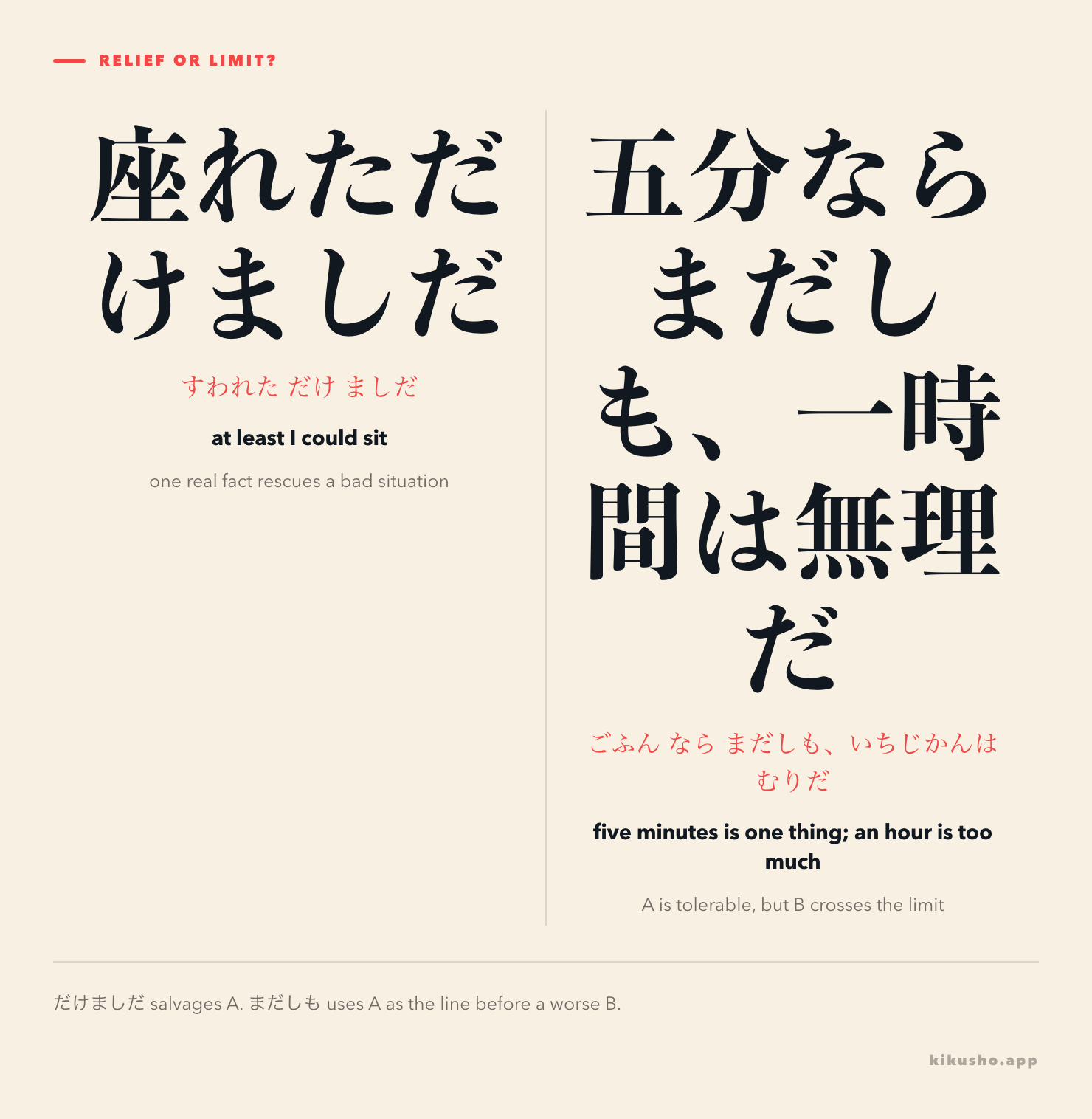
だけましだ finds one saving feature
The whole situation is poor, disappointing or dangerous. The clause before だけましだ names the feature that prevents it from being worse.
電車は混んでいたが、座れただけましだ。
The train was crowded, but at least I was able to sit.
The crowded train is not being praised. 座れた is simply enough to produce a small, relative consolation.
給料は下がったが、仕事があるだけましだ。
My salary went down, but at least I still have a job.
An unstated comparison supports the judgment: losing the job would have been worse. The pattern can therefore sound practical, resigned or blunt. Telling another person 仕事があるだけましだ may sound like “You should be grateful you have a job,” which can dismiss their complaint.
Attach it to a plain predicate:
| Word class | Form placed before だけましだ | Model phrase |
|---|---|---|
| verb | plain form | 怪我がなかっただけましだ |
| い-adjective | plain form | 少し安いだけましだ |
| な-adjective | な | 静かなだけましだ |
| noun | である | 軽傷であるだけましだ |
The noun form is relatively formal. In natural conversation, speakers often recast the noun as a clause: 軽い怪我で済んだだけましだ, “at least it ended with only a minor injury.” The related form だけまだましだ adds まだ and strengthens the sense that the feature is preferable only by comparison.
Bunpro describes まし as “better” or “preferable” and notes both standard and polite endings. JLPT Sensei gives the same N2 attachment range and emphasizes that the situation itself need not be good.
まだしも sets a tolerable benchmark, then exceeds it
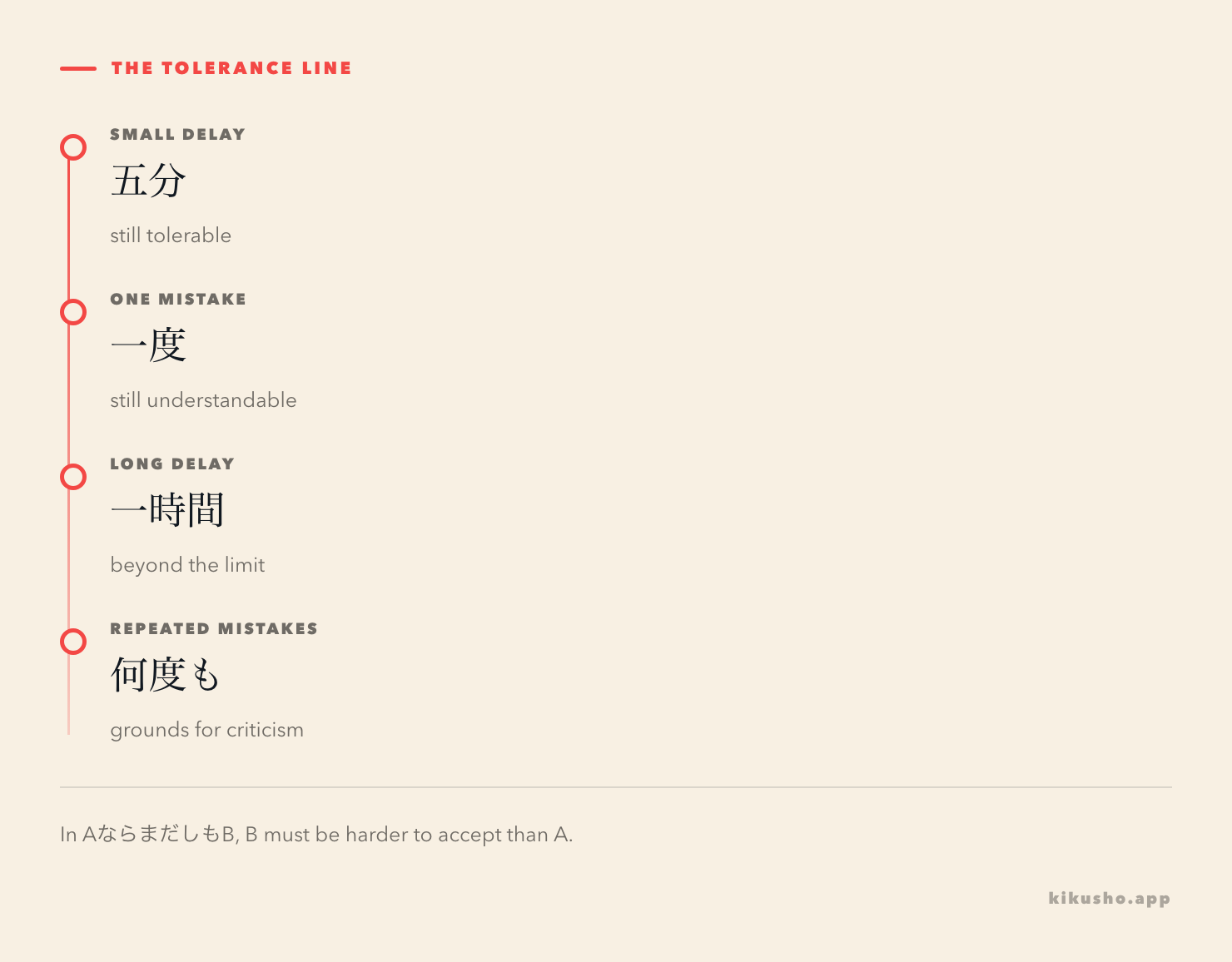
In AならまだしもB, A is not necessarily desirable. It is merely easier to accept, understand or excuse than B.
十分ならまだしも、一時間は待てない。
Ten minutes would be one thing, but I cannot wait an hour.
The sentence establishes ten minutes as the outer tolerable point and then rejects an hour. The usual order matters: B is worse, larger, less reasonable or less acceptable than A.
一度ならまだしも、三度も同じ間違いをするのは問題だ。
Once would be understandable, but making the same mistake three times is a problem.
With nouns and quantities, Nならまだしも and Nはまだしも are common. なら presents A as a condition or benchmark. は takes A as the contrasted topic:
旅行はまだしも、留学する自信はない。
I might manage travel, but I do not have the confidence to study abroad.
Verbs and adjectives can appear in the plain form, often with の before なら/は when the whole proposition is treated as the benchmark:
知らなかったのならまだしも、知っていて黙っていたのは許せない。
Not knowing would be one thing, but knowing and staying silent is unforgivable.
The construction frequently carries criticism, disbelief or frustration. That tone comes from B crossing the speaker's limit. In a neutral comparison of two ordinary options, a simple AよりBのほうが is usually clearer.
The overlap is a viewpoint, not a free substitution
Both patterns may be translated with “at least” or “better than,” but they answer different questions.
Suppose a hotel is noisy but cheap:
ホテルはうるさいが、安いだけましだ。
The hotel is noisy, but at least it is cheap.
The low price is a real saving feature inside the current stay.
一泊一万円ならまだしも、三万円は払えない。
Ten thousand yen a night would be one thing, but I cannot pay thirty thousand.
Now the speaker creates a price threshold. The first price is tolerated; the second is rejected.
Replacing one ending with the other would require rebuilding the sentence. 安いまだしも is not a grammatical shortcut for 安いだけましだ. Conversely, 一万円だけましだ would evaluate ten thousand yen as a saving fact; it would not by itself set up the explicit A-versus-B boundary.
The same English gloss can also hide other grammar. せめて introduces a minimum hope, as in せめて一日休みたい, “I want at least one day off.” It does not evaluate an existing consolation the way だけましだ does. The ないまでも and なりとも lesson covers a conceded weaker result and a modest noun-based minimum; the だけ and くらい lesson covers restriction, approximation and basic-minimum readings.
What changes when the wrong form is chosen
If you use だけましだ, you commit to the clause before it being a real or accepted feature worth salvaging. That can sound insensitive if the listener does not see it as consolation.
If you use まだしも, you rank two cases and usually judge the second more harshly. Reversing the scale creates a strange argument:
一時間ならまだしも、十分は待てない。
Without unusual context, this says an hour is tolerable but ten minutes is not. Grammar cannot repair the reversed logic.
The contrast can concern degree, frequency, responsibility, difficulty or social acceptability. What must stay stable is the direction: A remains inside the boundary, and B goes beyond it.
日本語NET records Nは/Nなら attachment and the acceptable-A versus unacceptable-B relation. 絵でわかる日本語 independently confirms plain-form attachment and notes the frequent critical tone. JLPT Sensei places both だけましだ and まだしも at N2; Bunpro independently places だけましだ there. Treat those labels as practical study guidance: the JLPT itself does not provide a complete grammar-item list.
In Kikusho, preserve the negative background with だけましだ and both sides of the scale with まだしも. 座れただけましだ needs the crowded train to explain the consolation. 十分ならまだしも、一時間は待てない needs both quantities to keep the boundary visible during review.
Practice: locate the saving fact or the boundary
Question 1
The apartment is expensive, but it is close to work. Choose the form that presents proximity as a real consolation.
ア) 職場に近いだけましだ
イ) 職場に近いならまだしも
ウ) 職場に近いせめて
エ) 職場に近いはまだしも
Question 2
Complete the criticism: “Ten minutes would be one thing, but being an hour late is unacceptable.”
十分__、一時間も遅れるのは許せない。
ア) だけましで
イ) ならまだしも
ウ) であるだけましだ
エ) なだけましで
Question 3
Which sentence uses the correct direction of the scale in an ordinary waiting context?
ア) 一時間ならまだしも、五分は待てない。
イ) 五分ならまだしも、一時間は待てない。
ウ) 一時間だけましだ、五分は待てない。
エ) 五分はましだけ、一時間は待てない。
Question 4
Arrange the chunks to say “The train was crowded, but at least I could sit.”
- 座れた
- 電車は混んでいたが
- だけましだ
- 、
- 。
Question 5
Choose the sentence that contrasts an excusable lack of knowledge with knowing and remaining silent.
ア) 知らないだけましだ、知っていて黙っていた。
イ) 知らなかったのならまだしも、知っていて黙っていたのはよくない。
ウ) 知らないせめて、知っていて黙っていたのはよくない。
エ) 知らなかっただけまだしも、知っていて黙っていた。
Question 6
Which attachment is standard for a な-adjective before だけましだ?
ア) 静かでだけましだ
イ) 静かのだけましだ
ウ) 静かなだけましだ
エ) 静かならまだしもだ
Question 7
Complete both blanks in the exchange.
A: 新しい仕事は大変?
B: 忙しいけど、残業代が出る( )。でも、一日一時間( )、毎日四時間の残業は続けられないよ。
ア) ならまだしも/だけましだ
イ) だけましだ/ならまだしも
ウ) だけまだしも/であるだけましだ
エ) はまだしも/なだけましだ
Answers and explanations
Answer 1
ア) 職場に近いだけましだ. The apartment is already expensive, and proximity is the actual feature that makes it less bad. まだしも would need a worse B after the benchmark.
Answer 2
イ) ならまだしも. Ten minutes is placed inside the tolerable range before the sentence rejects an hour.
Answer 3
イ) 五分ならまだしも、一時間は待てない. Five minutes is the lesser burden. The reversed order in ア would require special context to make sense.
Answer 4
2 → 4 → 1 → 3 → 5. 電車は混んでいたが、座れただけましだ。 Sitting is the real consolation within the crowded journey.
Answer 5
イ. 知らなかったのならまだしも treats ignorance as potentially excusable, then criticises the worse fact of knowing and staying silent.
Answer 6
ウ) 静かなだけましだ. A な-adjective keeps な before だけましだ. Choice エ starts a different contrast and is incomplete in meaning.
Answer 7
イ) だけましだ/ならまだしも. Overtime pay is a real saving feature, so the first blank takes だけましだ. One hour is the tolerable benchmark before four hours, so the second takes ならまだしも.
Common questions
What does だけましだ mean?
だけましだ says that an imperfect or unpleasant situation has at least one real feature that makes it better than a worse alternative. It is often translated as “at least” or “I suppose that is something.”
What does ならまだしも mean?
AならまだしもB places A inside a tolerable or understandable range, then presents B as worse, excessive or unacceptable. English often uses “A is one thing, but B...”
What is the difference between だけましだ and まだしも?
だけましだ evaluates one actual saving feature inside a bad situation. まだしも builds an explicit contrast: A would still be tolerable, but B crosses the speaker's limit.
Are だけましだ and まだしも N2 grammar?
JLPT Sensei, Bunpro and several independent Japanese-teacher references place these patterns at N2. The JLPT itself does not publish an exhaustive official grammar list.