On this page
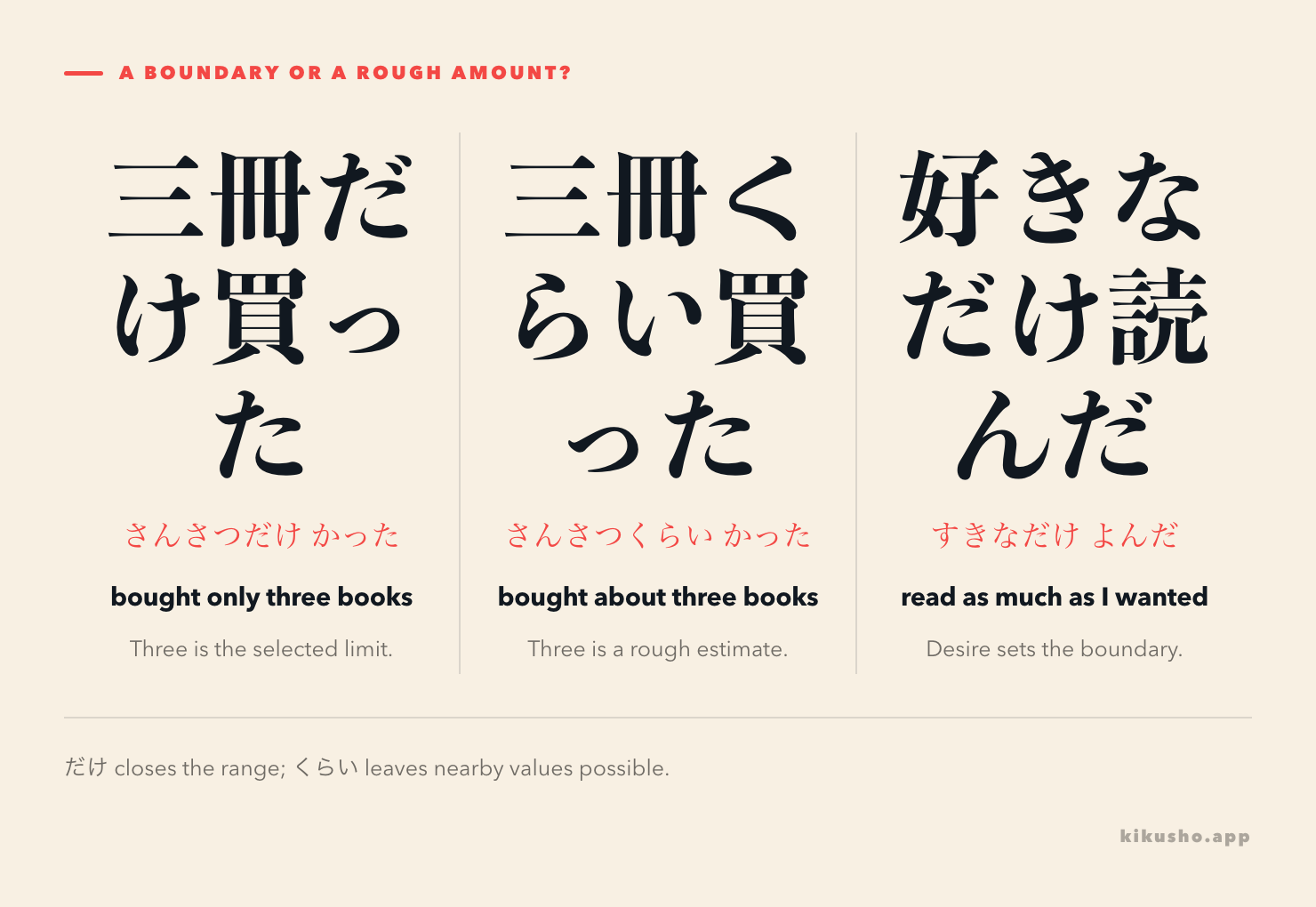
だけ draws a boundary; くらい/ぐらい makes the amount or degree rough. 三冊だけ買った says the purchase was limited to three books. 三冊くらい買った estimates the number at about three.
At N3, だけ also appears in expressions such as できるだけ and 好きなだけ, where the boundary comes from ability or desire rather than a number. くらい moves beyond simple estimates too: it can describe an extreme degree or present something as the minimum one should manage.
Ask whether the boundary is fixed or deliberately fuzzy
The same counter makes the difference visible.
| Sentence | What the number does | Natural reading |
|---|---|---|
| 切符を二枚だけ買った | sets the selected limit | I bought only two tickets |
| 切符を二枚くらい買った | gives a rough estimate | I bought about two tickets |
With だけ, the speaker excludes alternatives beyond the chosen boundary. With くらい, nearby values remain possible. The sentence may describe one, two, or three in a casual estimate, depending on what is being counted and how precise the speaker can be.
今日は一時間だけ勉強した。
きょうは いちじかんだけ べんきょうした。
I studied for only one hour today.
今日は一時間くらい勉強した。
きょうは いちじかんくらい べんきょうした。
I studied for about one hour today.
The first speaker treats one hour as the whole permitted or achieved amount. The second does not commit to an exact duration.
だけ marks the edge of the selected range
The familiar use from the basic だけ lesson means “only” or “just.” It follows the word or phrase whose scope it limits.
| Form | Example | Meaning |
|---|---|---|
| noun + だけ | 水だけ飲んだ | drank only water |
| quantity + だけ | 一つだけ選ぶ | choose only one |
| plain verb + だけ | 見ただけだ | merely saw it |
This boundary can also mean “all the way up to what the context permits.” That is the N3 use targeted here.
食べたいだけ食べてください。
たべたいだけ たべて ください。
Please eat as much as you want.
必要なだけ持っていってください。
ひつようなだけ もって いって ください。
Please take as much as you need.
できるだけ早く返事をします。
できるだけ はやく へんじを します。
I will reply as soon as possible.
In each sentence, だけ still marks a limit. Desire sets it in 食べたいだけ, need sets it in 必要なだけ, and ability sets it in できるだけ. English changes from “only” to “as much as,” but the Japanese keeps one boundary idea.
JLPT Sensei's N3 だけ lesson identifies this “as much as” use and gives the same core attachment pattern. Nihongo NET describes it as acting up to the limit of a possible or necessary range. The restrictive particle learned earlier is therefore a prerequisite, not a separate spelling that happens to look identical.
くらい and ぐらい estimate quantity, time, and distance
The two pronunciations are interchangeable in these uses. Put either form after the amount you want to soften.
| Quantity | Approximate phrase | Meaning |
|---|---|---|
| 十分 | 十分くらい | about ten minutes |
| 三人 | 三人ぐらい | about three people |
| 二キロ | 二キロくらい | about two kilometres |
| 千円 | 千円ぐらい | about one thousand yen |
駅まで十分ぐらいかかります。
えきまで じゅっぷんぐらい かかります。
It takes about ten minutes to the station.
会場には百人くらいいました。
かいじょうには ひゃくにんくらい いました。
There were about one hundred people at the venue.
A case particle can follow the approximate phrase: 十人くらいが来た, 千円くらいで買える, and 三時くらいまで待つ are all possible. The approximation belongs to the amount before it; the following particle gives that whole phrase its role in the sentence.
An introductory university grammar guide documents quantity + くらい/ぐらい and notes that the particle can combine with は, を, and まで. It also contrasts these conversational forms with the more formal-looking prefix 約(やく) used before a quantity.
くらい also places an event on a scale of degree
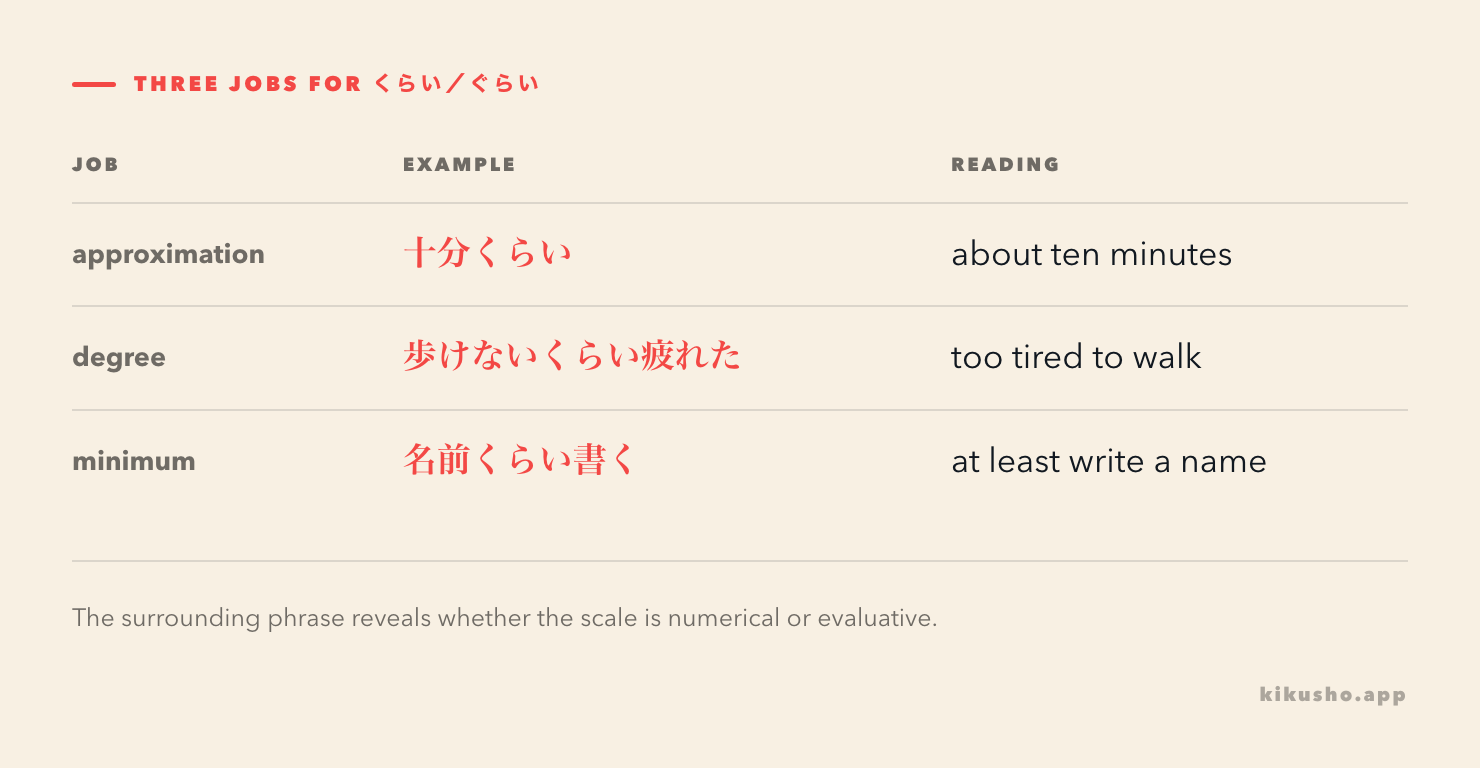
After a plain clause, くらい/ぐらい can show the degree reached by a feeling, state, or result. English often uses “so…that” or “to the point that.”
声が出ないくらい驚いた。
こえが でないくらい おどろいた。
I was so surprised that I could not speak.
毎日食べたいくらい、このカレーが好きです。
まいにち たべたいくらい、この カレーが すきです。
I like this curry so much that I want to eat it every day.
The clause before くらい provides a point on the scale. It need not be a literal outcome; “unable to speak” can be an expressive measure of surprise. JLPT Sensei's くらい/ぐらい page covers both approximation and degree and lists plain verbs, nouns, い-adjectives, and な-adjectives + な as attachments.
For very strong degree and comparison patterns, the あまりにも and ほど lesson continues the scale. くらい often sounds conversational and can deliberately make the comparison feel ordinary or accessible.
A minimum with くらい can carry attitude
With an ordinary task or example, くらい can mean “at least this much” or “something as basic as this.”
名前くらい書いてください。
なまえくらい かいて ください。
Please at least write your name.
お礼のメールくらい送ってほしかった。
おれいの メールくらい おくって ほしかった。
I wanted you to at least send a thank-you email.
The speaker treats the marked action as a low minimum. This can encourage someone, complain about what they failed to do, or dismiss the task as easy. JLPTPass separates this rhetorical minimum from numerical approximation and warns that tone can make it demanding.
だけ cannot replace it without changing the claim. 名前だけ書いてください means “write only your name,” excluding an address or other information. 名前くらい書いてください means the name is the least the speaker expects. One restricts the content; the other evaluates the minimum.
これだけ and これくらい point to different kinds of “this much”
Both forms can accompany a gesture, quantity, or previously mentioned amount.
これだけあれば十分です。
これだけ あれば じゅうぶんです。
Having this amount is enough.
これくらいあれば十分です。
これくらい あれば じゅうぶんです。
Having roughly this much is enough.
これだけ selects the amount in front of the speaker as the relevant boundary. これくらい treats it as a point on a rough scale. Context can make both translations sound like “this much,” so ask whether nearby quantities are still included.
The same test works with a price. 三千円だけ使った says the money spent was limited to exactly three thousand yen in the speaker's accounting. 三千円くらい使った estimates the spending around that figure. Calling the second one “only three thousand yen” in English can hide the approximation that the Japanese particle contributes.
Kikusho cards should keep the number and the speaker's stance
A bare card for だけ may teach “only” and then fail on 好きなだけ. A bare くらい card may teach “about” and miss the impatience in 電話くらいしてよ. The useful unit is the marked amount or clause plus the sentence that reveals what the speaker is doing with it.
A useful Kikusho example preserves 三冊だけ, 三冊くらい, or できるだけ早く as one unit. The editable nuance field can record whether the sentence sets a hard boundary, offers an estimate, measures a degree, or signals a minimum expectation.
Practice
Complete all seven questions before consulting the explanations.
Question 1. You bought exactly two tickets and no more. Choose the sentence.
- ア. 切符を二枚くらい買った。
- イ. 切符を二枚だけ買った。
- ウ. 切符を二枚ぐらいだけ買った。
- エ. 切符だけを二枚くらい買った。
Question 2. Complete “It takes about ten minutes.”
- ア. 十分だけかかります。
- イ. 十分しかかかります。
- ウ. 十分くらいかかります。
- エ. 十分までかかります。
Question 3. Choose the natural expression for “Please come as early as possible.”
- ア. できるくらい早く来てください。
- イ. できるだけ早く来てください。
- ウ. できただけ早く来てください。
- エ. できるだけくらい来てください。
Question 4. Arrange the fragments into “Please take as much water as you need.”
- 持っていってください
- 水を
- 必要なだけ
Question 5. Which sentence uses くらい to measure an extreme degree rather than estimate a number?
- ア. 十人くらい来ました。
- イ. 三十分ぐらい待ちました。
- ウ. 歩けないくらい疲れました。
- エ. 千円くらいでした。
Question 6. Which sentence means “At least write your name,” with a possible note of impatience?
- ア. 名前だけ書いてください。
- イ. 名前くらい書いてください。
- ウ. 名前しか書いてください。
- エ. 名前までだけ書いてください。
Question 7. Choose the pair that completes the host's explanation.
料理は好きな(甲)食べていいです。参加者は二十人(乙)です。
- ア. 甲: だけ/乙: くらい
- イ. 甲: くらい/乙: だけ
- ウ. 甲: だけ/乙: だけ
- エ. 甲: ぐらい/乙: しか
Answers and explanations
Answer 1. イ. 切符を二枚だけ買った. だけ restricts the purchase to two tickets. くらい and ぐらい would make two an estimate; the other choices add unrelated scope or combine particles without a reason.
Answer 2. ウ. 十分くらいかかります. くらい marks ten minutes as approximate. 十分だけ would limit the duration to ten minutes, while しか requires a negative predicate.
Answer 3. イ. できるだけ早く来てください. できるだけ sets the boundary at what is possible, so the phrase means “as early as possible.”
Answer 4. 必要なだけ水を持っていってください. 必要な sets the needed range, and だけ extends the permission up to that boundary.
Answer 5. ウ. 歩けないくらい疲れました. “Unable to walk” measures how tired the speaker was. The other three answers put くらい or ぐらい after a numerical quantity and give an approximation.
Answer 6. イ. 名前くらい書いてください. くらい presents writing a name as the minimum expected. 名前だけ would mean “write only your name,” excluding other information.
Answer 7. ア. 甲: だけ/乙: くらい. 好きなだけ permits eating up to the amount desired. 二十人くらい estimates attendance at about twenty people.
N3 placement and checked scope
JLPT Sensei lists the “as much as” だけ use at N3, as do Nihongo NET and MLC Japanese Language School. Bunpro places basic restrictive だけ at N5. That apparent disagreement partly reflects scope: learners meet “only” early, then extend the same boundary logic to 好きなだけ, 必要なだけ, and できるだけ. Kikusho records the inventory disagreement rather than treating a surface-form match as proof that every use belongs at one level.
JLPT Sensei and JLPTPass place the approximation, degree, and minimum uses of くらい/ぐらい at N3, although simple numerical approximation is often introduced earlier. The prerequisites are counters, quantities, plain-form clauses, and basic particle scope. The JLPT publishes no exhaustive official grammar list.
The reviewed だけ item is the context-defined upper range, with the elementary restrictive meaning included only to show the shared boundary. The reviewed くらい/ぐらい item covers approximation, degree, and rhetorical minimum. Separate patterns such as だけでなく, だけあって, しか~ない, and comparative ほど remain outside this lesson.
An estimate leaves the edges open. A limit tells you where the speaker has drawn them, even when desire or possibility draws the line instead of a number.
Common questions
What is the difference between だけ and くらい?
だけ draws a boundary: only that item or amount, or as much as a need, wish, or ability permits. くらい/ぐらい makes a quantity approximate or places something on a scale of degree, as in ten minutes or so.
Do くらい and ぐらい mean the same thing?
Yes. In modern standard Japanese they are interchangeable in these uses. Both can mean about, approximately, to the extent that, or at least this much. Individual speakers and fixed phrases may favour one pronunciation.
Why is できるだけ not translated as only can?
In できるだけ, だけ marks the full boundary of what is possible. The phrase therefore means as much as possible or as far as one can, not only can.
Can くらい sound dismissive?
Yes. A phrase such as 名前くらい書いてください presents writing a name as a minimum expectation. Depending on tone, it can sound impatient or imply that the task should be easy.