On this page
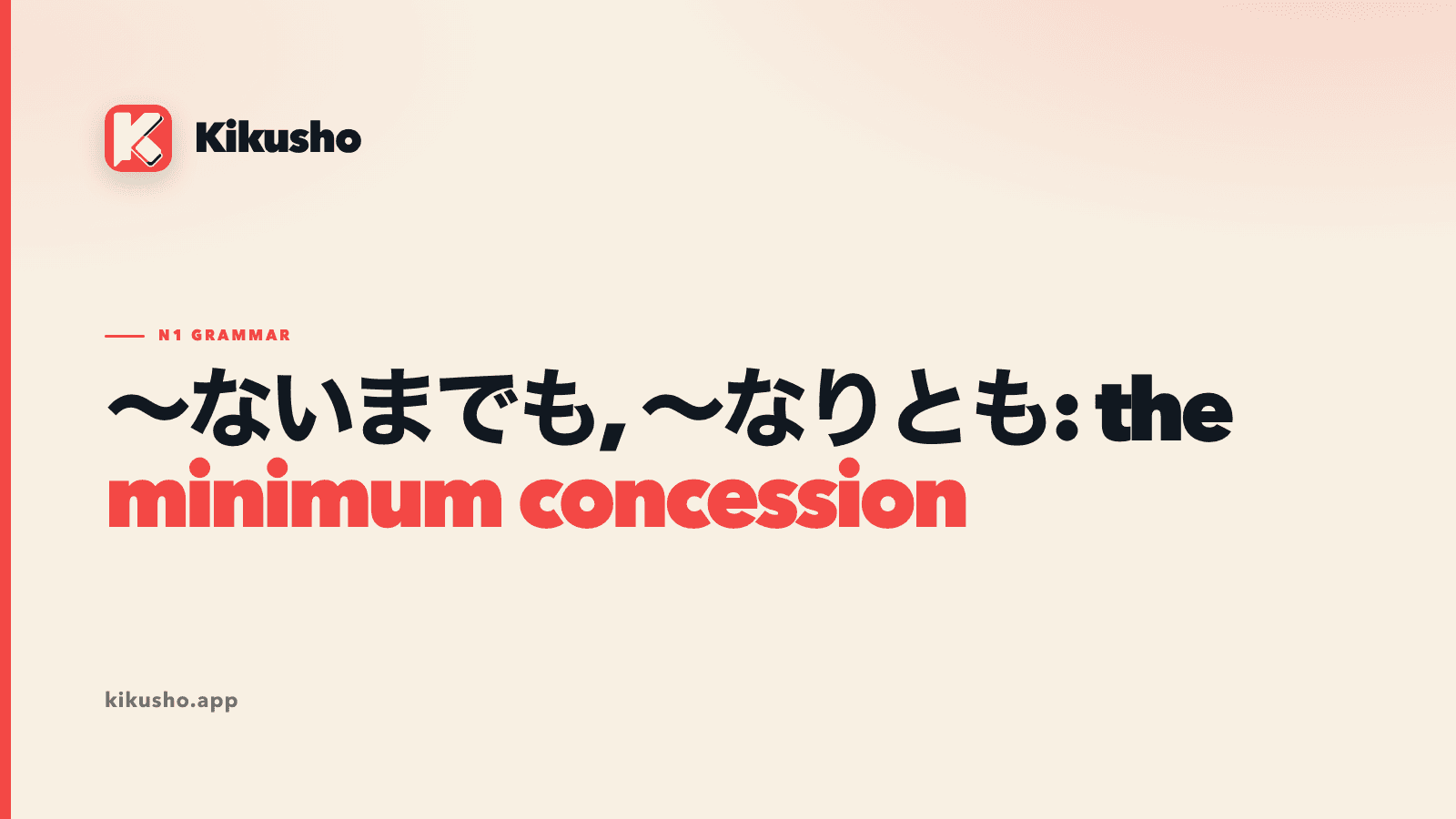
If you want someone to read the introduction without demanding the whole book, 全部読まないまでも means “even if you don't read all of it,” leaving room for that smaller task. なりとも approaches a minimum from the other side: 多少なりとも, “even to some degree,” names the modest amount itself.
Concede the higher degree or name the smaller amount
〜ないまでも(ないまでも, nai made mo)sets aside a stronger action, description or degree and then supplies a weaker one that still matters. 〜なりとも(なりとも, nari tomo)attaches to a noun or quantity expression and presents it as a modest minimum, often “at least” or “even a little.”
This N1 grammar comparison teaches those two constructions, including the common 〜とは言わないまでも frame and 多少なりとも. Bunpro's ないまでも lesson and its なりとも lesson both place them at N1. The inventory records agreement with its comparison lists, but placements are study estimates, not an official exhaustive JLPT syllabus.
The shared English gloss at least hides the difference. One construction needs a negative predicate; the other gives you a noun-based minimum. Neither guarantees that the situation is pleasant or that the speaker is making a request.
Ask which part of the scale you have written
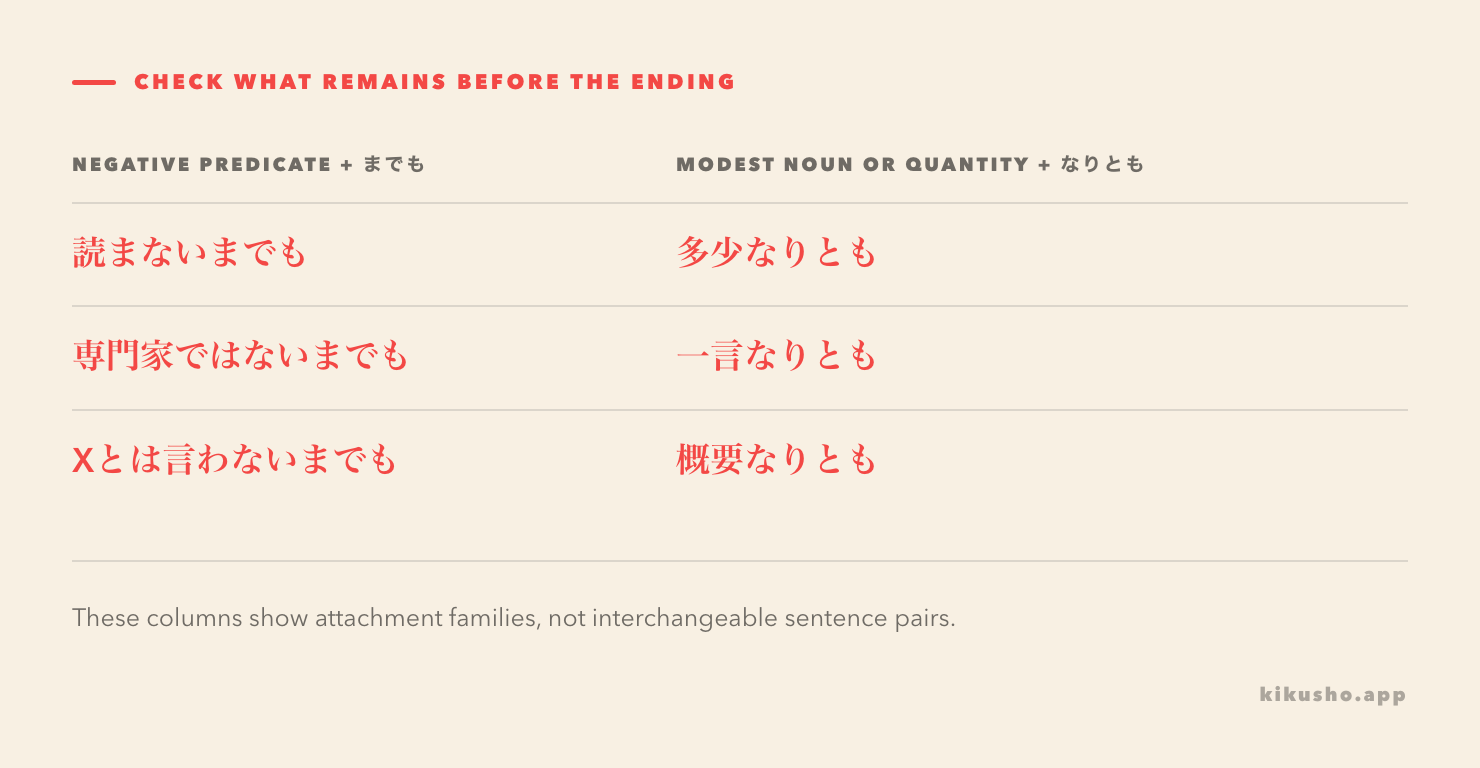
Identify the material immediately before the ending. Is it a negative clause describing the more ambitious or extreme possibility? Or is it the amount, word or option you would settle for?
| What your sentence supplies | Construction | What it contributes |
|---|---|---|
| A stronger action, negated | Verb in ない-form + までも | Concede that the action need not reach that extent |
| A stronger noun description, negated | Noun + ではないまでも | Set aside that description while retaining a lesser claim |
| A description you will not go so far as to assert | X + とは言わないまでも | “I would not say X, but…” |
| A modest quantity or noun option | Noun + なりとも | “At least N” or “even a little N” |
The table is an attachment test, not a rule that every noun produces equally natural prose. With なりとも, start from established partners such as 多少(たしょう), some degree, and 一言(ひとこと), a word or short remark. The quantity remains small relative to the context.
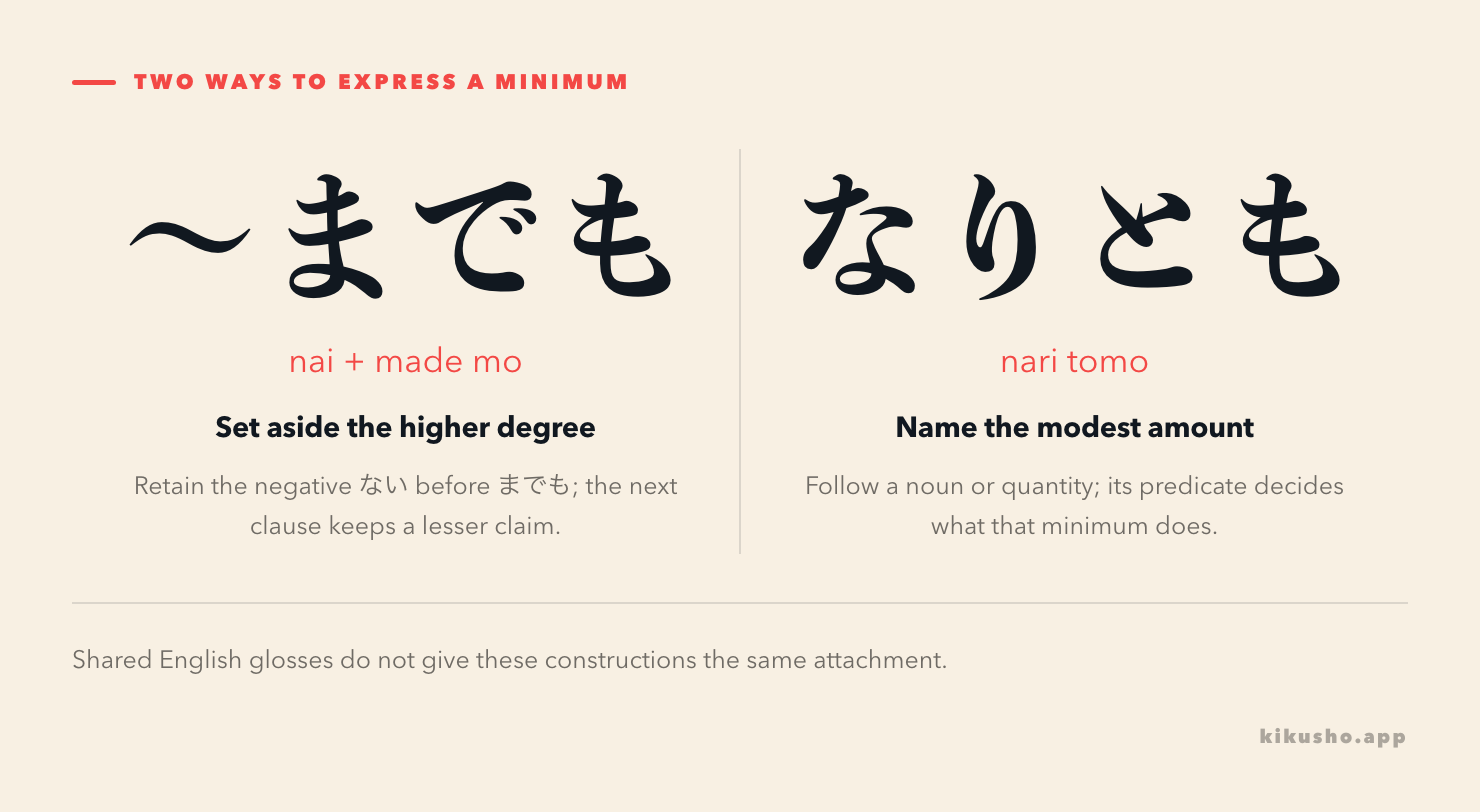
ないまでも leaves a lesser claim standing
Keep the completed plain negative verb and add までも. Do not replace ない with なりとも. For the opening's verb, 読む(よむ)→ 読まない → 読まないまでも. The negative-form reference supplies the prerequisite bases; this lesson uses them to organise a concession.
本を全部読まないまでも、序章には目を通してほしい。
ほんを ぜんぶ よまないまでも、じょしょうには めを とおしてほしい。
Even if you don't read the whole book, I'd like you to look through the introduction.
全部 means all of it; 序章 is the introductory chapter. 目を通す means to look through or read over something. The second clause preserves a smaller reading task. It does not ask the reader to do the opposite of reading, and it does not excuse every possible task.
A noun description needs a negative predicate too:
専門家ではないまでも、基礎知識はある。
せんもんかでは ないまでも、きそちしきは ある。
Although I'm no expert, I do have basic knowledge.
専門家 is an expert and 基礎知識 is basic knowledge. The lesser claim is knowledge below expert standing. 専門家ないまでも omits the predicate that makes the noun negative. Bunpro records ではない and its conversational contraction じゃない in this attachment; the fuller form is a useful starting point for reading.
とは言わないまでも moderates a description
Here the negative verb is 言わない, from 言う(いう), say. とは introduces the description the speaker declines to assert so strongly.
世界一とは言わないまでも、この店のパンはかなりおいしい。
せかいいちとは いわないまでも、この みせの パンは かなり おいしい。
I wouldn't call it the best in the world, but this shop's bread is very good.
世界一 is the best in the world; かなり means quite or considerably. The speaker withholds the superlative while keeping the praise. 日本語NET's explanation checks the lower-degree relation and the frequent use of せめて or 少なくとも in the following clause. Those words can make the minimum explicit; they are not compulsory parts of the construction.
Not every comparison is praise:
この計画は失敗とは言わないまでも、修正が必要だ。
この けいかくは しっぱいとは いわないまでも、しゅうせいが ひつようだ。
I wouldn't go so far as to call this plan a failure, but it needs revision.
The writer concedes the harsher label 失敗, failure, while retaining a negative assessment. 修正, revision, is the lesser problem here. A gloss such as “the minimum acceptable achievement” would miss this adverse use. The scale may measure how bad something is, rather than how much you hope to achieve.
なりとも makes a modest quantity count
Use noun + なりとも for the minimum use taught here. It does not need a preceding negative verb or a separately stated larger target.
この資料が多少なりとも役に立てば、うれしいです。
この しりょうが たしょうなりとも やくに たてば、うれしいです。
I'll be glad if this material is of some help, even if only a little.
資料 is material or documentation; 役に立つ means to be useful. The modest amount belongs to usefulness. The speaker is not announcing that the material is useless, nor claiming that it will solve the whole problem.
For a request, the noun can name the small contribution:
ご意見を一言なりともお寄せください。
ごいけんを ひとことなりとも およせください。
Please send us your views, even if only a short remark.
意見 is an opinion. 一言 need not mean exactly one written word: here it is a brief comment. The request's polite phrasing comes from other material, including お寄せください. なりとも itself contributes the modest minimum.
There can also be an acknowledgment rather than a wish:
話し合いは多少なりとも進んだ。
はなしあいは たしょうなりとも すすんだ。
The discussion made some progress, even if only a little.
The past 進んだ says that progress occurred. 日本語NET's なりとも page includes both wishes and evaluations; do not manufacture a request just because the construction often appears in one.
Both can fit one situation without being substitutes
Suppose a colleague cannot yet give a detailed report. You can set aside that higher demand:
詳しい報告とは言わないまでも、概要は教えてほしい。
“I don't insist on a detailed report, but I'd like to know the outline.”
Or you can name the smaller contribution directly:
概要なりとも教えてほしい。
“I'd like you to tell me at least the outline.”
Read 詳しい報告 as くわしい ほうこく and 概要 as がいよう. The first sentence states what you are relaxing; the second need not name any larger demand. 詳しい報告なりとも would instead present the detailed report itself as the minimum, a different stance.
They can combine: 詳しい報告とは言わないまでも、概要なりとも教えてほしい。 The result explicitly relaxes the larger request and presents the smaller one. It is deliberately emphatic and rather stiff; do not add both endings to every modest request you write.
The clause can reject a minimum, and register cannot repair attachment
With なりとも, inspect what the following predicate does to the quantity:
一分なりとも無駄にしたくない。
いっぷんなりとも むだに したくない。
I don't want to waste even a single minute.
The smallest amount is being rejected as waste. This does not mean one minute of waste is permitted. Enuncia's comparison illustrates the same minimum-under-negation relation with money and contrasts the stiff expression with everyday だけでも. The predicate, not the English gloss at least, decides what is accepted.
なりとも can sound somewhat old-fashioned. 少しでも(すこしでも), “even a little,” or せめて〜だけでも, “at least just…,” will often be easier in ordinary conversation. That is a register choice, not an automatic substitution in every sentence. Shogakukan's dictionary entry also records broader historical attachments and alternative-selection uses. This page teaches the modern modest-minimum comparison, not all of that history.
Formal phrasing does not by itself create respect for someone. The politeness guide separates addressee politeness from honorific and humble transformations. Another N1 negative, にかたくない, instead calls imagining or understanding easy; its negative is doing a different job.
When you paste a formal request into Kikusho, retain the quantity with its following predicate in the editable example. 一言なりとも and 一分なりとも無駄にしたくない train different responses to a minimum. A register note can preserve the stiff tone, while the full line keeps you from retrieving a request where the text rejects waste.
Practice questions
Try the whole set before opening the numbered solutions. All six questions are original.
Question 1
Complete the concession about the book without demanding that it be read in full.
本を全部( )、序章には目を通してほしい。
- A. 読まなりとも
- B. 読まないまでも
- C. 読みないまでも
- D. 読まないまで
Question 2
Choose the noun-based minimum taught in this lesson. 経験(けいけん)means experience and 作業(さぎょう)means work or a task.
経験が( )あれば、作業の流れはつかみやすい。
- A. 多少ないまでも
- B. 多少なりても
- C. 多少なりたい
- D. 多少なりとも
Question 3
Rebuild the request from the fragments below, using each exactly once. Select the fragment that fills ★.
詳しい報告__ __ ★ __。
- A. 概要なりとも
- B. 教えてください
- C. 言わないまでも、
- D. とは
Question 4
Choose the phrase that keeps the writer below expert standing while acknowledging useful knowledge.
私はこの分野の専門家ではありません。ただ、基礎知識はあります。( )、初心者向けの説明ならできます。
分野(ぶんや)means field; 初心者(しょしんしゃ)means beginner.
- A. 専門家なりとも
- B. 専門家ではないまで
- C. 専門家ではないまでも
- D. 専門家なりても
Question 5
Which interpretation preserves the degree expressed by この資料は多少なりとも役に立った?
- A. The material solved every problem completely.
- B. The material was entirely useless.
- C. The material could not possibly be helpful.
- D. The material was helpful, at least to a small extent.
Question 6
Select the conclusion supported by the speaker's statement, without adding a time limit or permission to waste time.
会の残り時間は短い。司会者は「一分なりとも無駄にしたくない」と言った。この発言は、( )という気持ちを示している。
残り時間(のこりじかん)means remaining time; 司会者(しかいしゃ)is the person chairing the event.
- A. 一分までなら無駄にしていい
- B. 短い時間であっても、大切に使いたい
- C. 一分で会を終えることが決まっている
- D. 時間が余ることを希望している
Answers and explanations
For this set, track the negative predicate separately from the noun that names the minimum.
Answer 1: B. 読まないまでも keeps 読む's negative base 読まない and adds までも. C uses the ます-stem 読み with the wrong negative ending; A does not supply either construction's required attachment. D stops at まで and omits the concessive も. The lesser task is looking through the introductory chapter, not abandoning the book entirely.
Answer 2: D. 多少なりとも names a modest degree of experience. The sentence means that having even some experience makes the workflow easier to grasp. A tries to append ない directly to 多少; B changes the fixed ending to なりても; C introduces たい without a suitable verb. 流れ(ながれ)is flow or sequence here, and つかみやすい means easy to grasp.
Answer 3: A at ★. The order is D → C → A → B: 詳しい報告とは言わないまでも、概要なりとも教えてください。 “Even if not a detailed report, please tell me at least the outline.” とは connects the higher description to 言わない; までも closes that concession. 概要なりとも supplies the modest object before the final request 教えてください.
Answer 4: C. 専門家ではないまでも builds a negative noun predicate, then concedes the stronger description. It fits the paragraph's basic knowledge and ability to explain things to beginners. A supplies a noun minimum without a predicate to connect it to the following clause; B omits も from the construction; D is not the fixed なりとも ending. The writer is claiming limited competence, not expert status.
Answer 5: D. 多少なりとも keeps the contribution modest, and past 役に立った says that it was useful. A replaces that modest amount with complete success. B reverses the positive predicate; C adds impossibility. A small contribution is still a contribution in this sentence.
Answer 6: B. Under 無駄にしたくない, even the smallest time unit named is something the speaker does not want to waste. A would permit that waste, reversing the statement. C invents a fixed finishing time; D invents a wish for spare time. The chair's wording expresses careful use of the remaining time, not a numerical allowance.
Common questions
What does ないまでも mean?
It concedes that something does not reach, or need not reach, a higher degree while presenting a lesser degree that holds or is wanted. Attach までも to a plain negative verb, as in 読まないまでも, or use a negative noun predicate such as 専門家ではないまでも.
What does なりとも mean?
In the modest-minimum use, it follows a noun or quantity expression and means at least or even a little. 多少なりとも means even to some degree. It can occur in requests, wishes and evaluations; the rest of the sentence decides whether that minimum is wanted, acknowledged or rejected.
Are ないまでも and なりとも interchangeable?
No. ないまでも sets aside a higher degree in a negative clause; なりとも presents a modest noun-based amount or option. A sentence can combine them, but you cannot substitute one ending for the other without rebuilding its attachment and changing what it says.
Is なりとも an honorific expression?
It has a stiff, somewhat old-fashioned tone, but it does not itself raise or lower a person. A request may add honorific or humble forms separately. Everyday conversation will often choose 少しでも or せめて〜だけでも for a comparable modest request.