On this page
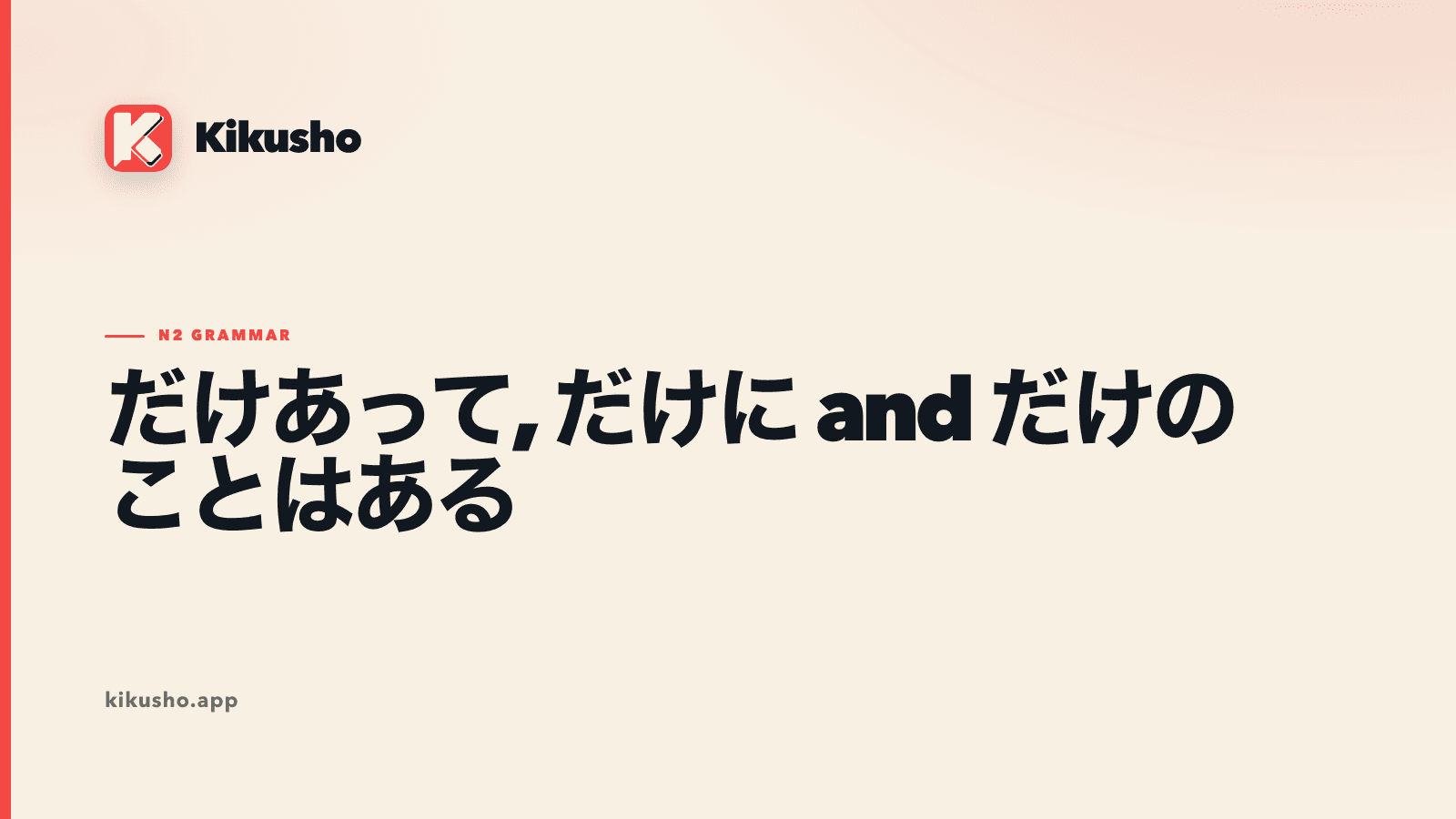
Choose by the job the ending performs. だけあって introduces a result that fits a quality or experience; だけに makes that reason especially consequential; だけのことはある looks back at an observed result and says the effort, price or status was not for nothing.
The three forms share だけ, but they do not organize the sentence in the same way.
The rule fits in three lines
| Form | Core move | Typical shape |
|---|---|---|
| だけあって | The result lives up to A | Aだけあって、B |
| だけに | Precisely because of A, B is all the more significant | Aだけに、B |
| だけのことはある | B proves that A was worthwhile or explains the result | B。Aだけのことはある |
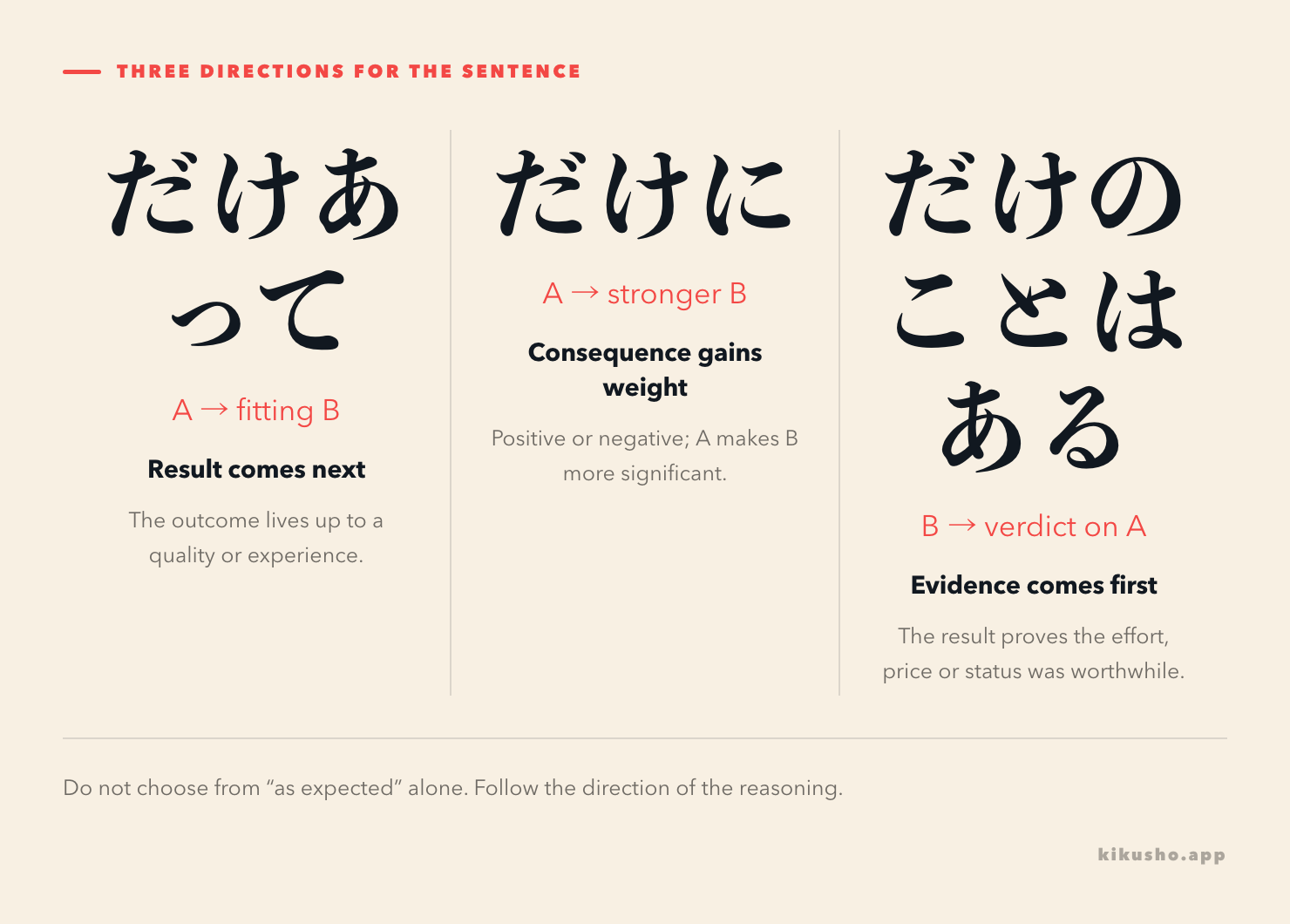
The English phrase “as expected” can translate all three. Sentence direction decides more reliably than the gloss.
Ask whether the result comes next or came first
Use this test while reading or writing:
- Are you about to state a fitting, observable result? Choose だけあって.
- Are you explaining why a reaction or consequence is stronger, including a negative one? Choose だけに.
- Have you already stated the impressive result and now want to validate the cause? Choose だけのことはある.
Compare one person's experience:
十年教えているだけあって、説明が分かりやすい。
“As you would expect from someone who has taught for ten years, the explanation is clear.”
十年教えているだけに、一つの間違いでも気になる。
“Precisely because they have taught for ten years, even one mistake bothers them.”
説明が分かりやすい。十年教えてきただけのことはある。
“The explanation is clear. Those ten years of teaching were not for nothing.”
The first sentence points forward from experience to a fitting skill. The second measures how much that experience affects a reaction. The third starts with the evidence and then approves the history behind it.
だけあって presents a result as fitting
だけあって links a recognized basis to a result that seems appropriate for it. The basis is often a profession, reputation, ability, price or accumulated experience:
元オリンピック選手だけあって、走り方がきれいだ。
“As expected of a former Olympic athlete, the way she runs is beautiful.”
The result is available for evaluation now. The speaker sees how the person runs and finds that performance fitting for a former athlete. さすが often appears nearby when admiration is explicit:
さすが職人だけあって、仕上がりが丁寧だ。
“As expected of a craftsperson, the finish is meticulous.”
The construction is stronger than an ordinary から. 職人だから、仕上がりが丁寧だ gives a reason. 職人だけあって adds the speaker's judgement that the result lives up to what “craftsperson” led them to expect.
Usage guides disagree on how positive this judgement must be. Bunpro gives a strict production rule: use だけあって for a positive result relative to the basis. JLPT Sensei includes a cheap bag breaking quickly, and the Japanese-teacher site Nihongo no Sato gives difficulty booking a popular restaurant. Those examples treat an undesirable result as predictably fitting. For dependable learner production, reserve だけあって for recognition or approval and use だけに when disappointment, shock or another negative consequence is central.
だけに makes the consequence heavier
だけに can overlap with だけあって when a result naturally follows from A:
大切な試験だけに、みんな真剣だった。
“Precisely because it was an important exam, everyone was serious.”
Its wider strength is proportionality: A makes B more intense, more difficult or more emotionally charged. That makes it natural when expectation is broken:
試合をずっと楽しみにしていただけに、中止の知らせはつらかった。
“Because I had been looking forward to the match so much, the cancellation was all the more painful.”
The excitement did not predict a cancellation. Instead, it increased the disappointment caused by cancellation. だけあって would point the reader toward a fitting result and would be a poor choice for this contrast.
The result need not be emotional:
この仕事は自由なだけに、責任も重い。
“Precisely because this work offers freedom, the responsibility is also heavy.”
Nihongo no Sato identifies なおさら, 余計に and かえって as frequent cues for this “all the more” or contrary-result use. The crucial point is not that one of those adverbs must appear. A needs to increase the force or significance of B.
だけのことはある gives the verdict after the evidence
With だけのことはある, the reader commonly meets the result first:
この料理は香りまで素晴らしい。三時間かけて作っただけのことはある。
“Even the aroma of this dish is wonderful. Spending three hours making it was not for nothing.”
The second sentence revalues the three hours in light of the finished dish. Depending on context, natural English may use “no wonder,” “as expected,” “it was worth it” or “not for nothing.” JLPT Sensei explicitly records both the expectation reading and the worthwhile-effort reading.
It also works with status:
対応が落ち着いている。さすがプロだけのことはある。
“The response is calm. That is what you would expect from a professional.”
This form often closes an evaluation. It does not usually introduce the following result in the same direct way as だけあって. A related form, だけのことはあって, can do that introductory work: 長く準備しただけのことはあって、発表は成功した. Keep the final ある form as the retrospective verdict taught here.
All three share the same basic attachment
For a present affirmative predicate, verbs and い-adjectives attach in plain form, な-adjectives take な, and nouns attach without だ.
| Predicate | だけあって | だけに | だけのことはある |
|---|---|---|---|
| Verb | 練習しているだけあって | 練習しているだけに | 練習しただけのことはある |
| い-adjective | 高いだけあって | 高いだけに | 高いだけのことはある |
| な-adjective | 有名なだけあって | 有名なだけに | 有名なだけのことはある |
| Noun | プロだけあって | プロだけに | プロだけのことはある |
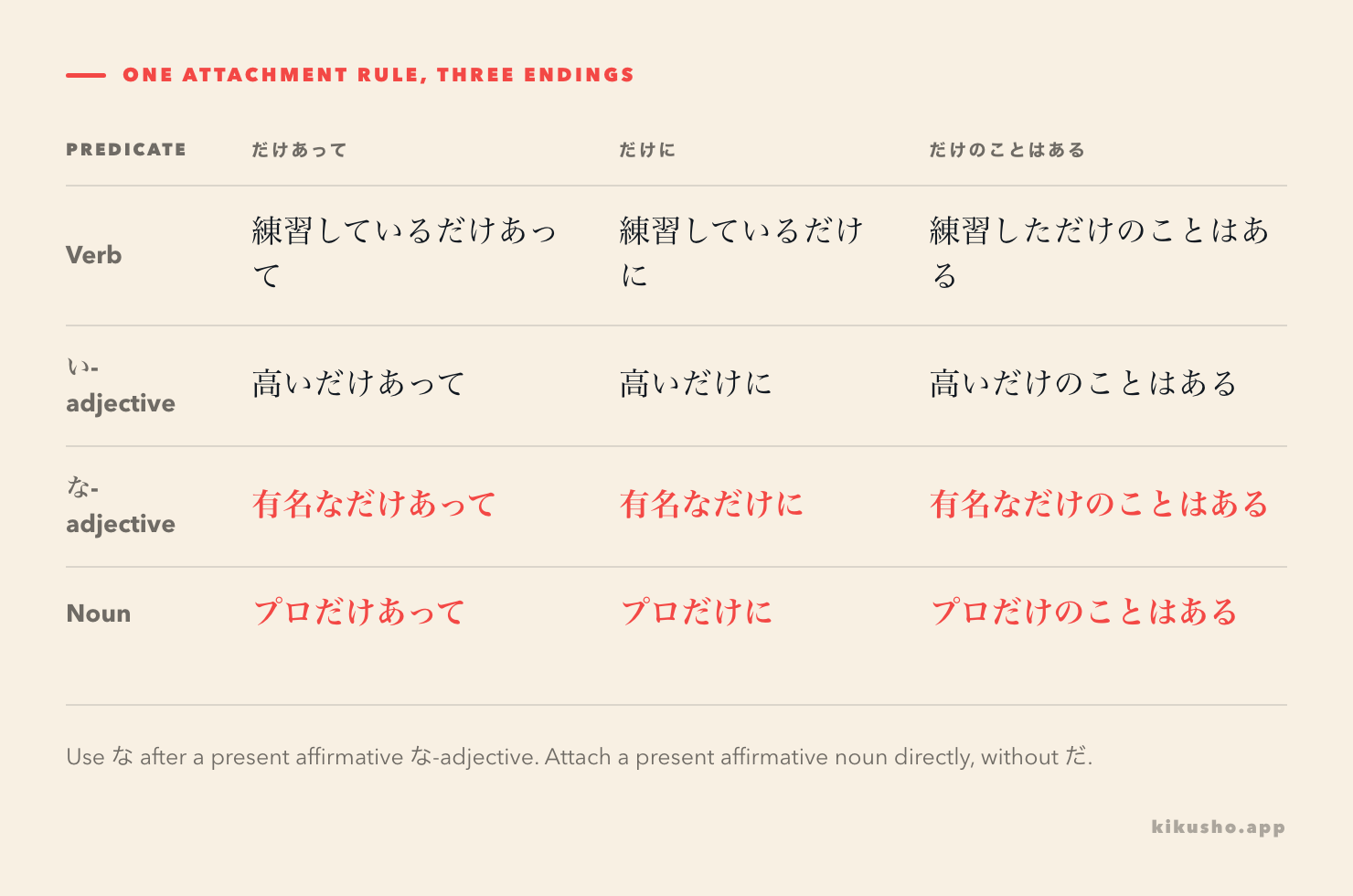
Do not insert present affirmative だ: プロだだけに is incorrect. Past time is different because だった is the plain past form:
元選手だっただけに、けがの不安をよく理解している。
“Precisely because she used to be an athlete, she understands the fear of injury well.”
The fundamental uses of だけ as a limit and くらい as an approximation come earlier. In these N2 patterns, だけ no longer works as a standalone translation of “only”; the complete construction establishes the cause-and-evaluation relationship.
One positive result creates real overlap
Suppose a chef trained in Kyoto and prepares an excellent meal:
京都で修業しただけあって、料理が上品だ。
“As expected from training in Kyoto, the cooking is refined.”
京都で修業しただけに、味へのこだわりが強い。
“Precisely because of training in Kyoto, the chef is especially particular about flavor.”
料理が上品だ。京都で修業しただけのことはある。
“The cooking is refined. The training in Kyoto was not for nothing.”
All three can fit the broad situation. The first foregrounds a result that meets expectations. The second foregrounds the degree of influence. The third sounds like a conclusion drawn after tasting the food.
If you only need to explain a discovered conclusion, わけだ and its negative relatives organize the logic differently. だけのことはある adds approval or validation; わけだ can simply mark the listener's realization.
N2 is the shared teaching placement
Kikusho's September 2026 inventory assigns all three constructions to N2. JLPT Sensei and Bunpro independently use the same placement, and Nihongo no Sato teaches だけあって and だけに together at N2. The agreement is editorial guidance rather than an official exhaustive JLPT grammar list.
The attachment rule assumes plain forms and the two adjective classes. The semantic step is harder: you must track whether B fulfills an expectation, grows because of A, or has already supplied evidence for a final appraisal.
When keeping one of these sentences in Kikusho, capture both the basis and the result. For だけのことはある, include the preceding result sentence too. A card containing only だけに = precisely because cannot test the relationship that makes the three forms different.
Practice
Complete all seven tasks before moving to the explanations.
Question 1
Choose the ending that presents a visible skill as fitting a professional status.
彼はプロの通訳( )、言葉の選び方が正確だ。
ア. だけにして
イ. だけあって
ウ. だけのことにある
エ. だけしかなくて
Question 2
The speaker had high hopes, so the failure hurts even more. Choose the best form.
長い間期待していた( )、失敗したときのショックは大きかった。
ア. だけに
イ. だけあって
ウ. だけで
エ. だけのことはある
Question 3
Complete the sentence with the correct attachment of 有名 and だけあって.
この店は( )、予約がなかなか取れない。
Question 4
Which pair best preserves this order: observed result first, retrospective approval second?
ア. 仕上がりが美しい。丁寧に作っただけのことはある。
イ. 丁寧に作っただけのことはある。仕上がりが美しいだけに。
ウ. 仕上がりが美しいだけに。丁寧に作った。
エ. 丁寧に作っただだけあって、仕上がりが美しい。
Question 5
Combine the two ideas with だけに to show an intensified consequence.
この仕事は自由だ。責任が重い。
Question 6
Choose the grammatically correct present affirmative noun attachment.
ア. 専門家だだけあって、説明が詳しい。
イ. 専門家なだけに、説明が詳しい。
ウ. 専門家だけあって、説明が詳しい。
エ. 専門家ので、説明が詳しい。
Question 7
Read the situation and choose the sentence that best gives a final “the effort was worth it” judgement.
三か月準備した発表が大成功した。
ア. 三か月準備しただけに、発表する。
イ. 三か月準備しただけで、成功とは限らない。
ウ. 三か月準備しただけあって、まだ結果は分からない。
エ. 三か月準備しただけのことはある。
Write down seven answers before revealing the review below.
Answers and explanations
Answer 1. イ. プロの通訳だけあって identifies professional status as the basis for the accurate word choice observed next. ア and ウ are malformed versions of the target patterns. エ changes the sentence into a restriction with しか〜ない.
Answer 2. ア. The long expectation increases the shock of failure, so だけに expresses “all the more because.” だけあって normally guides the reader toward a fitting evaluation, while final だけのことはある would validate the waiting rather than introduce the shock.
Answer 3. 有名なだけあって. A present affirmative な-adjective takes な before this pattern. The sentence says the difficulty of booking fits the restaurant's fame.
Answer 4. ア. The first sentence supplies the beautiful result; 丁寧に作っただけのことはある then validates the careful work. イ and ウ leave だけに without a complete result clause. エ contains the incorrect sequence だだけ.
Answer 5. One natural answer is この仕事は自由なだけに、責任が重い。 The な-adjective 自由 takes な, and the freedom makes the responsibility especially weighty.
Answer 6. ウ. A present affirmative noun attaches directly: 専門家だけあって. Do not add だ or adjectival な. エ would need なので for an ordinary reason, but it would not carry the same expectation-based evaluation.
Answer 7. エ. The successful presentation is already known, and だけのことはある judges the three months of preparation worthwhile. ア gives no completed consequence, イ removes certainty despite the stated success, and ウ combines an expectation form with an unresolved result.
Common questions
What is the main difference between だけあって and だけに?
だけあって normally presents a visible result as fitting someone's quality, status or experience. だけに makes the reason especially relevant and can show that a positive or negative reaction is stronger precisely because of it.
Where does だけのことはある go in a sentence?
It commonly follows an observed result as a sentence-final evaluation: the effort, price, status or experience was not for nothing and explains the result.
Does a noun take だ before these three patterns?
A present affirmative noun normally attaches directly: プロだけあって, プロだけに and プロだけのことはある. A past noun can use だった, as in 元選手だっただけに.