On this page
~て済む says that doing A is enough to settle a matter, so no larger action is necessary. The same 済む can put a ceiling on money, time or damage: 千円で済んだ means the cost stopped at 1,000 yen, while かすり傷で済んだ means the harm went no further than a scratch.
Think of a situation that could have demanded more. 謝っただけで済んだ presents an apology as the limited response that closed it. The construction does not merely say that the apology finished; it evaluates that response as sufficient.
This lesson teaches inventory item g-3dc3701a4bd1, て済む(てすむ). JLPT Sensei places it at N3, as do independent lessons from 日本語NET and 毎日のんびり日本語教師. These are teaching estimates because the JLPT publishes no exhaustive current grammar list.
The rule: A is enough, and the matter stops there
The event before 済む supplies the sufficient action or limit. The larger situation is understood from context.
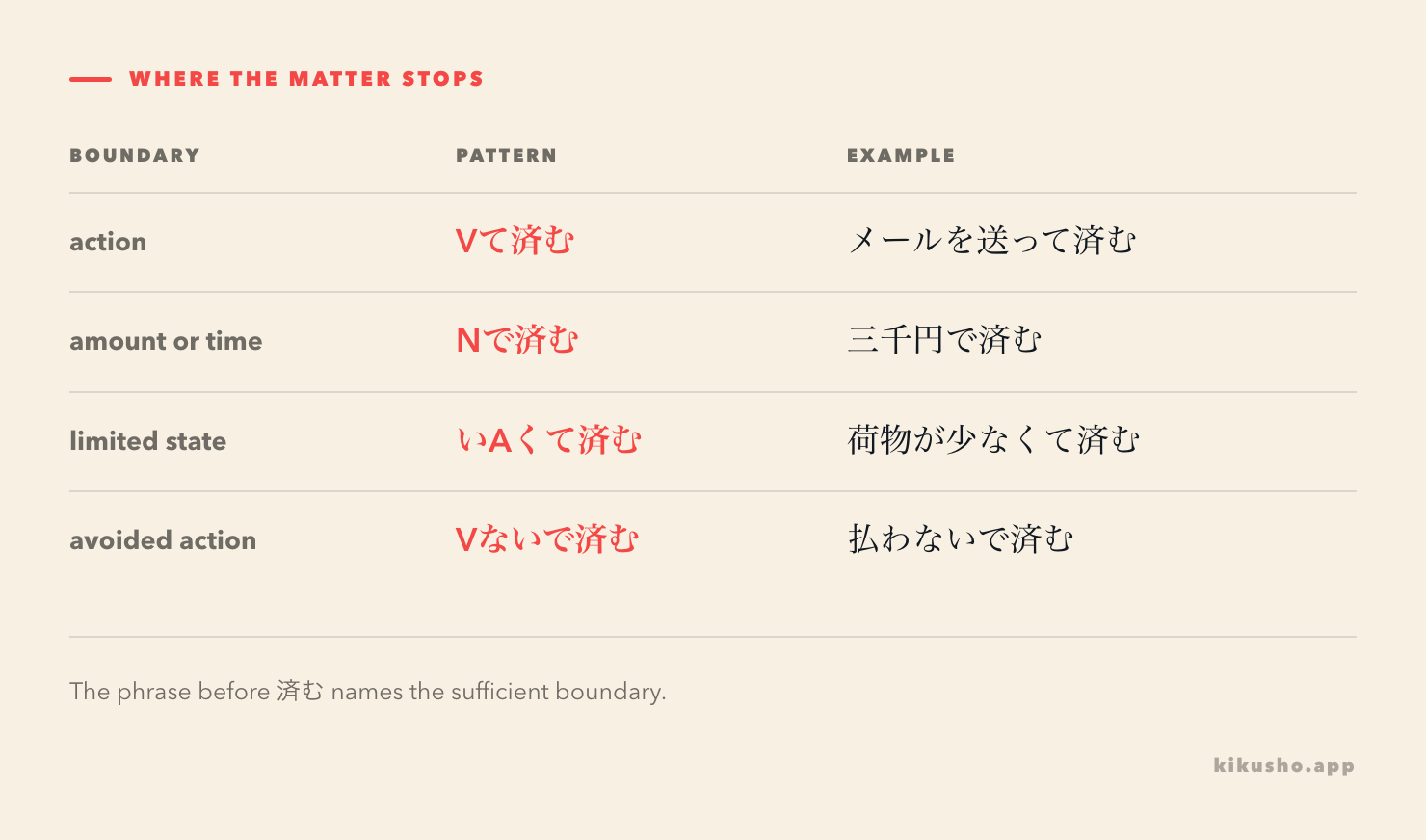
| Form | What supplies the limit | Example | What stops there |
|---|---|---|---|
| Vて + 済む | an action | メールを送って済む | sending one email settles it |
| Nで + 済む | a means, amount, time or outcome | 千円で済む | the cost stays at ¥1,000 |
| いAくて + 済む | a limited quality or state | 荷物が少なくて済む | the baggage remains light |
| Vないで + 済む | an avoided action | 払わないで済む | payment is unnecessary |
The verb is written 済む and read すむ. It is unrelated to 住む, also read すむ, which means “to live” or “reside.” Context normally separates them, but the kanji matters in a lesson about written notices and bills.
A て-form names the action that was sufficient
Put a complete verb て-form before 済む. Forms ending in で keep that sound: 話す → 話して済む, 謝る → 謝って済む, 読む → 読んで済む.
店の皿を割ってしまったが、謝っただけで済んだ。
みせの さらを わってしまったが、あやまっただけで すんだ。
I broke a plate at the restaurant, but an apology was enough to settle it.
The sentence suggests a more serious response was possible: paying compensation, replacing the plate or facing another consequence. だけ makes the small boundary explicit, but it is not required.
The だけで lesson explains how that phrase marks a limited input as sufficient. With 済む, the sentence also says that the surrounding problem closed at that boundary.
この手続きは、申込書を一枚書いて済みます。
この てつづきは、もうしこみしょを いちまい かいて すみます。
This procedure can be completed by filling out one application form.
Here 書いて済みます does not mean that writing itself comes to an end. It says one written form is enough for the whole procedure. The polite ending belongs to 済みます; the first verb remains in its て-form.
Nで済む sets a ceiling on cost, time or consequence
A noun plus で can state what proved sufficient. This is often the clearest use because the number or outcome marks the boundary directly.
修理代は三千円で済んだ。
しゅうりだいは さんぜんえんで すんだ。
The repair cost came to only 3,000 yen.
説明は五分で済みます。
せつめいは ごふんで すみます。
The explanation will take only five minutes.
転んだけれど、かすり傷で済んだ。
ころんだけれど、かすりきずで すんだ。
I fell, but got away with only a scratch.
The English word “only” is often natural because the speaker compares the result with a larger feared amount. It is an implication, not a separate particle hidden inside 済む. A neutral scheduling sentence such as 会議は一時間で済む予定です can simply state the expected limit.
毎日のんびり日本語教師 documents verb, noun and adjective connections and describes the limit as sufficient without a more troublesome situation arising. MaruMori's N3 entry also records Vだけで済む, where one action alone settles the matter.
The negative form names the action you avoid
Vないで済む, Vなくて済む and Vずに済む say that an expected, costly or unwelcome action did not become necessary.
友達が車を出してくれたので、タクシー代を払わないで済んだ。
ともだちが くるまを だしてくれたので、タクシーだいを はらわないで すんだ。
A friend gave me a ride, so I did not have to pay for a taxi.
データが残っていたので、全部入力し直さずに済んだ。
データが のこっていたので、ぜんぶ にゅうりょくしなおさずに すんだ。
The data was still there, so I avoided having to enter everything again.
These forms focus on relief from A, whereas affirmative Vて済む identifies A itself as the sufficient measure. Compare:
- 電話して済んだ: making the call was enough.
- 電話しないで済んだ: making the call was avoided.
The negative variants are often taught as their own neighbouring point. 日本語NET places ~ないで済む/~ずに済む at N2, while the assigned ~て済む item is placed at N3 by the sources cited above. Keep that study-order difference visible without turning it into an official boundary.
済ませる makes someone actively finish the matter
済む is intransitive: the procedure, cost or problem is settled. 済ませる is transitive: someone finishes or handles something, often with a deliberately limited means.
昼食はパンで済んだ。
ちゅうしょくは パンで すんだ。
Bread was enough for lunch.
昼食をパンで済ませた。
ちゅうしょくを パンで すませた。
I made do with bread for lunch.
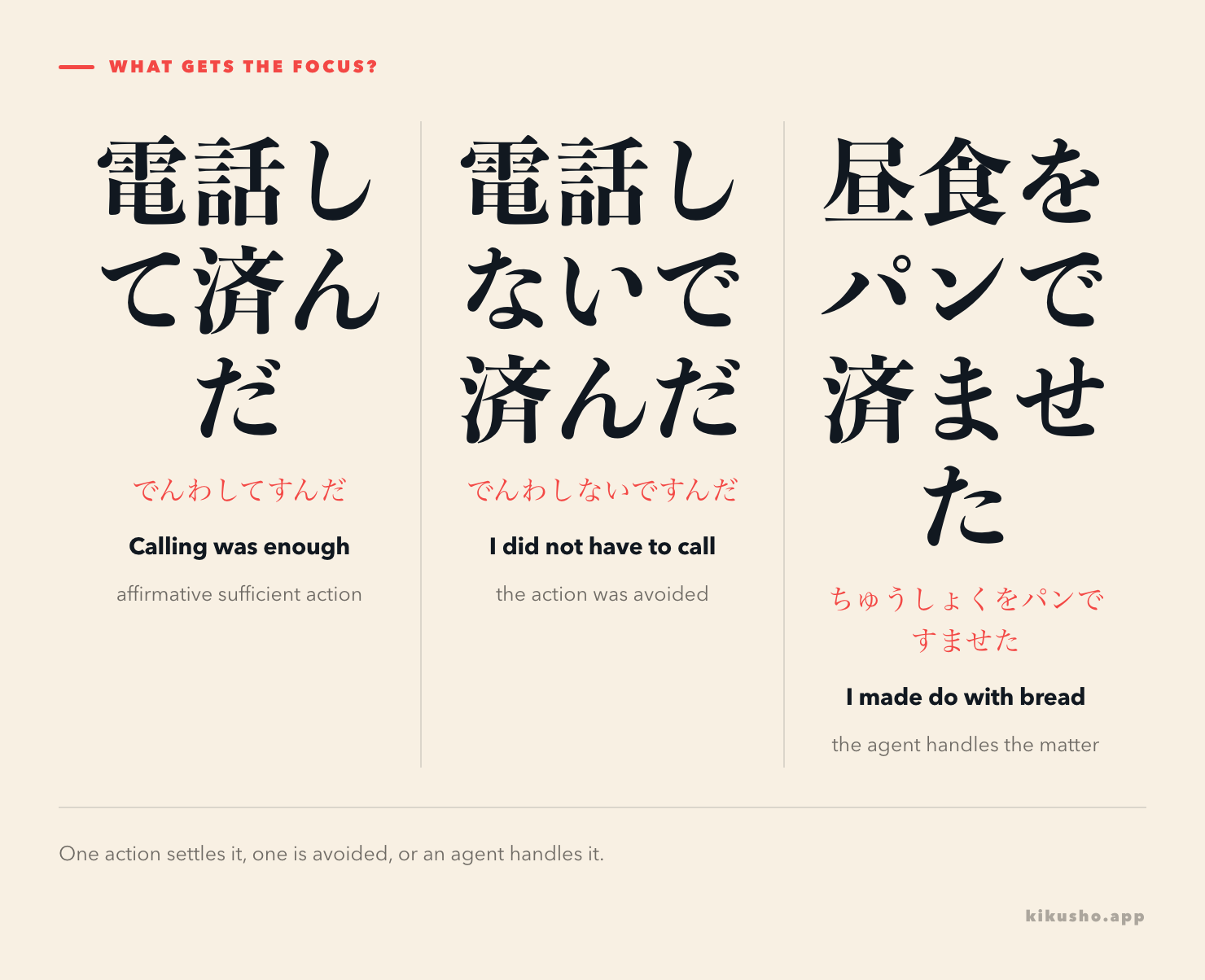
The second sentence gives the agent a more active role and marks 昼食 with を. It can suggest convenience, compromise or deliberate economy. Do not replace every 済む with 済ませる merely because a person is involved; choose according to whether the sentence presents the matter as settled or the person as handling it.
A serious problem may reject the proposed limit
The construction can be negated when the proposed response is not enough:
人を傷つけたのだから、謝って済む問題ではない。
ひとを きずつけたのだから、あやまって すむ もんだいではない。
You hurt someone, so this is not a problem that can be settled with an apology.
The sentence preserves the “A would settle it” relationship, then rejects it with 問題ではない. This is different from simply saying 謝らないで済む, which means that apologizing is unnecessary. One denies sufficiency; the other avoids the action.
The final verb carries tense, politeness and conjecture:
| Ending | Example | Reading |
|---|---|---|
| 済む | 電話で済む | a call will be enough |
| 済んだ | 電話で済んだ | a call was enough |
| 済みます | 電話で済みます | a call will be enough, polite |
| 済みそうだ | 電話で済みそうだ | it looks as though a call will be enough |
Preserve the larger problem on the card
The fragment 三千円で済んだ gives a limit but hides what cost 3,000 yen. When you capture a repair notice or message in Kikusho, keep 修理代は with the amount. The editable card then tests the relationship between the expense and its ceiling, rather than an isolated number that could describe a ticket, meal or fine.
For a negative example, retain the event that made the action unnecessary: 友達が車を出してくれたので、払わないで済んだ. That reason is what turns the negative into relief instead of a bare refusal to pay.
Practice: locate the sufficient boundary
Complete every question before opening the explanation section.
Question 1 — grammar choice. The repair cost was limited to 3,000 yen. Which sentence expresses that result correctly?
- A. 修理代は三千円を済んだ。
- B. 修理代は三千円で済んだ。
- C. 修理代は三千円に済ませた。
- D. 修理代は三千円が済んだ。
Question 2 — meaning. In 謝っただけで済んだ, what larger claim does 済んだ make about the apology?
Question 3 — negative formation. Say “I did not have to pay” with 払う and ~ないで済む.
Question 4 — sentence composition. Arrange the chunks into “The explanation will take only five minutes.”
- 五分で
- 説明は
- 済みます
Question 5 — 済む or 済ませる. You deliberately made do with bread for lunch. Choose the best sentence.
- A. 昼食をパンで済ませた。
- B. 昼食をパンが済んだ。
- C. 昼食にパンを済んだ。
- D. 昼食でパンを済ませた。
Question 6 — passage completion. Fill both gaps with one answer pair.
パソコンが故障した。大きな出費を覚悟したが、部品の交換だけで( )。データも残っていたので、全部入力し直さないで( )。
- A. 済んだ/済んだ
- B. 済ませた/済ませた
- C. 済まなかった/済ませた
- D. 済んだ/済まなかった
Keep both selections fixed before reading the answers.
Answers and explanations
Answer 1. B, 修理代は三千円で済んだ. The noun phrase 三千円で sets the upper boundary on the cost. 済む is intransitive here, so the amount does not take を and there is no agent actively marked as settling the bill.
Answer 2. The apology was enough to settle the whole matter, and no larger response or consequence became necessary. だけ limits the response to apologizing; 済んだ says the situation closed at that limit.
Answer 3. 払わないで済んだ (はらわないで すんだ) means “I did not have to pay” or “I got away without paying.” The negative action comes before で済む; 払って済んだ would instead say that paying was sufficient.
Answer 4. 説明は五分で済みます。 (せつめいは ごふんで すみます). 五分で gives the expected duration ceiling, and polite 済みます closes the sentence.
Answer 5. A, 昼食をパンで済ませた. The transitive form 済ませた presents the speaker as deliberately handling lunch with bread, and 昼食 takes を. The other choices mix the roles and particles of the intransitive and transitive constructions.
Answer 6. A, 済んだ/済んだ. Replacing one part was enough to settle the repair, so affirmative 交換だけで済んだ fits the first blank. The saved data made re-entry unnecessary, so 入力し直さないで済んだ fits the second.
Why the scale matters more than “finish”
Translating 済む only as “finish” hides the comparison that makes the construction useful. A cost of 3,000 yen matters because it could have been higher; one replacement part matters because the whole machine could have required replacement; a scratch matters because the injury could have been worse.
OpenAI Codex performed the AI editorial check for this lesson. It compared the attachment patterns, readings, translations, pragmatic limits, neighbouring negative and transitive forms, and all six exercises with the cited independent references. No human or native-speaker review is claimed.
Common questions
What does ~て済む mean in Japanese?
It says that an action or limited measure is enough to settle a matter, with no need for something greater. 謝って済んだ means that apologizing was enough to resolve the situation.
Can a noun come before 済む?
Yes. Noun + で + 済む marks an amount, means or consequence as sufficient: 千円で済んだ means it cost only 1,000 yen, and かすり傷で済んだ means the outcome was limited to a scratch.
What is the difference between ~て済む and ~ないで済む?
~て済む names what was sufficient to settle the matter. ~ないで済む says an expected or unwanted action was avoided: 払わないで済んだ means “I did not have to pay.”
What is the difference between 済む and 済ませる?
済む is intransitive and presents the matter as settled within a limit. 済ませる is transitive and presents someone as actively finishing or dealing with it, as in 昼食をパンで済ませた.