On this page
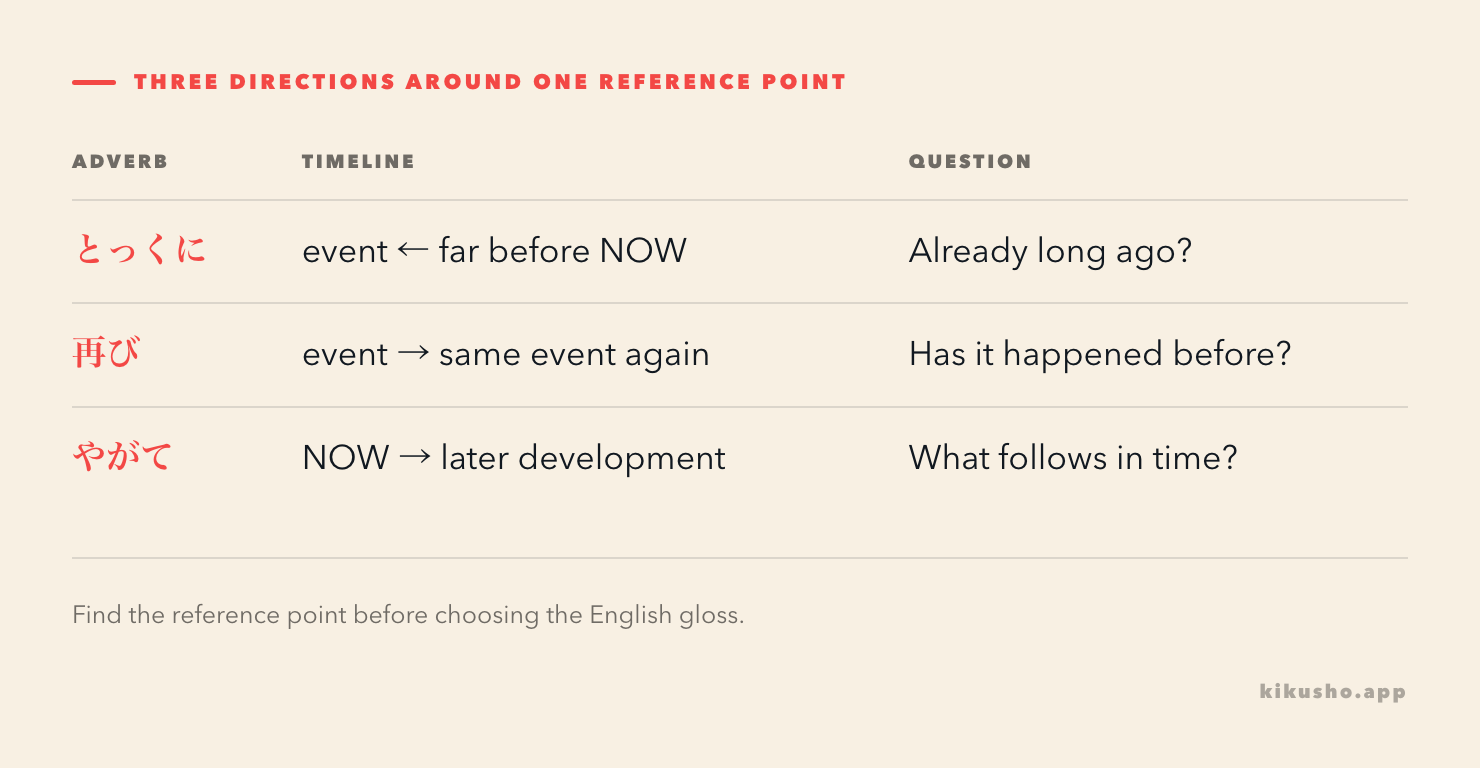
再び(ふたたび) looks back to an earlier occurrence and repeats it, とっくに looks back to something completed much earlier, and やがて carries the story forward to what happens before long or eventually. The three are adverbs, but their arrows point in different directions.
Put the reference point in the middle
Imagine that the sentence has a reference point called now. It may be the actual present or the moment currently being narrated.
| Adverb | Relation to the reference point | Central question | Typical translation |
|---|---|---|---|
| 再び | an earlier event occurs one more time | Has this happened before? | again, once more |
| とっくに | an event was complete well before this point | Was it already far in the past? | long ago, already |
| やがて | the account advances toward a later event | What follows as time passes? | before long, eventually |
These words do not attach to a special verb form. They usually appear before the phrase or predicate they modify:
- 再び会う: meet again
- とっくに帰った: left long ago
- やがて分かる: understand eventually
The verb tense still matters. とっくに naturally accompanies a past event or a state already established, while やがて often introduces a later development. 再び can work in either direction because repetition can be remembered, observed or predicted.
再び repeats an earlier event
再び presents a second occurrence of the same action or state. The interval may be short or long, but the earlier occurrence must be recoverable from context.
修理が終わり、工場は再び動き始めた。
しゅうりが おわり、こうじょうは ふたたび うごきはじめた。
The repairs ended, and the factory began operating again.
The sentence has two operating periods separated by a shutdown. 再び marks the return to the earlier state. It can also point into the future:
来年、再びこの町を訪れたい。
らいねん、ふたたび この まちを おとずれたい。
I want to visit this town again next year.
Kotobank's dictionary entry for 再び defines it as the repetition of the same action or state. Compared with また, 再び often feels more deliberate, formal or literary. A friend will readily say また明日; a report or narrative may describe a service becoming available 再び.
Do not confuse 再び with 二度と~ない. The latter means “never again” and requires a negative predicate: 二度と同じ間違いをしない. 再び itself has no negative requirement.
とっくに puts completion well behind you
とっくに says that something happened, ended or became true much earlier than the relevant point. It often corrects an assumption that the event is recent or still pending.
田中さんなら、とっくに帰りましたよ。
たなかさんなら、とっくに かえりましたよ。
If you mean Ms Tanaka, she left a long time ago.
その申込期間はとっくに終わっている。
その もうしこみきかんは とっくに おわっている。
That application period ended long ago.
The second example uses ~ている because the deadline's ended state still holds. Bunpro describes とっくに as “long ago” and notes that it places the event further back than neutral もう or すでに. Shogakukan's comparison of もう, もはや, すでに and とっくに likewise identifies the emphasis on a considerably earlier time and notes that とっくに is common in speech.
That register matters. 手続きはすでに完了しています is neutral and suits a formal notice. 手続きならとっくに終わったよ sounds conversational and can carry impatience, surprise or correction. The emotion comes from the situation; the stable meaning is the large gap before the reference point.
Avoid adding a precise clock time unless the contrast licenses it. 三時に終わった locates an event exactly. とっくに終わった deliberately treats the earlier time as distant rather than measuring it.
やがて lets the next stage emerge
やがて advances a narrative from one stage to a later result. The interval is not measured precisely. It may be short in a scene or much longer in a life story.
雨は弱くなり、やがて空が明るくなった。
あめは よわくなり、やがて そらが あかるくなった。
The rain weakened, and before long the sky grew bright.
小さな研究は、やがて大きな計画へと発展した。
ちいさな けんきゅうは、やがて おおきな けいかくへと はってんした。
The small study eventually developed into a major project.
Bunpro's やがて entry gives “before long” and “eventually” among its central readings. Kotobank records the modern forward-time sense as a later event arising after time passes. This is usually more narrative than もうすぐ, which directly says an event is near now, or 直ちに, which removes any permitted delay.
One other use needs recognition. In 東京へ来て、やがて三年になる, やがて means “nearly”: it will soon be three years. This duration use measures an approaching amount. The core choice in this lesson is the narrative use that links one stage to what follows.
One story can use all three
Consider a local cinema that closed and later reopened:
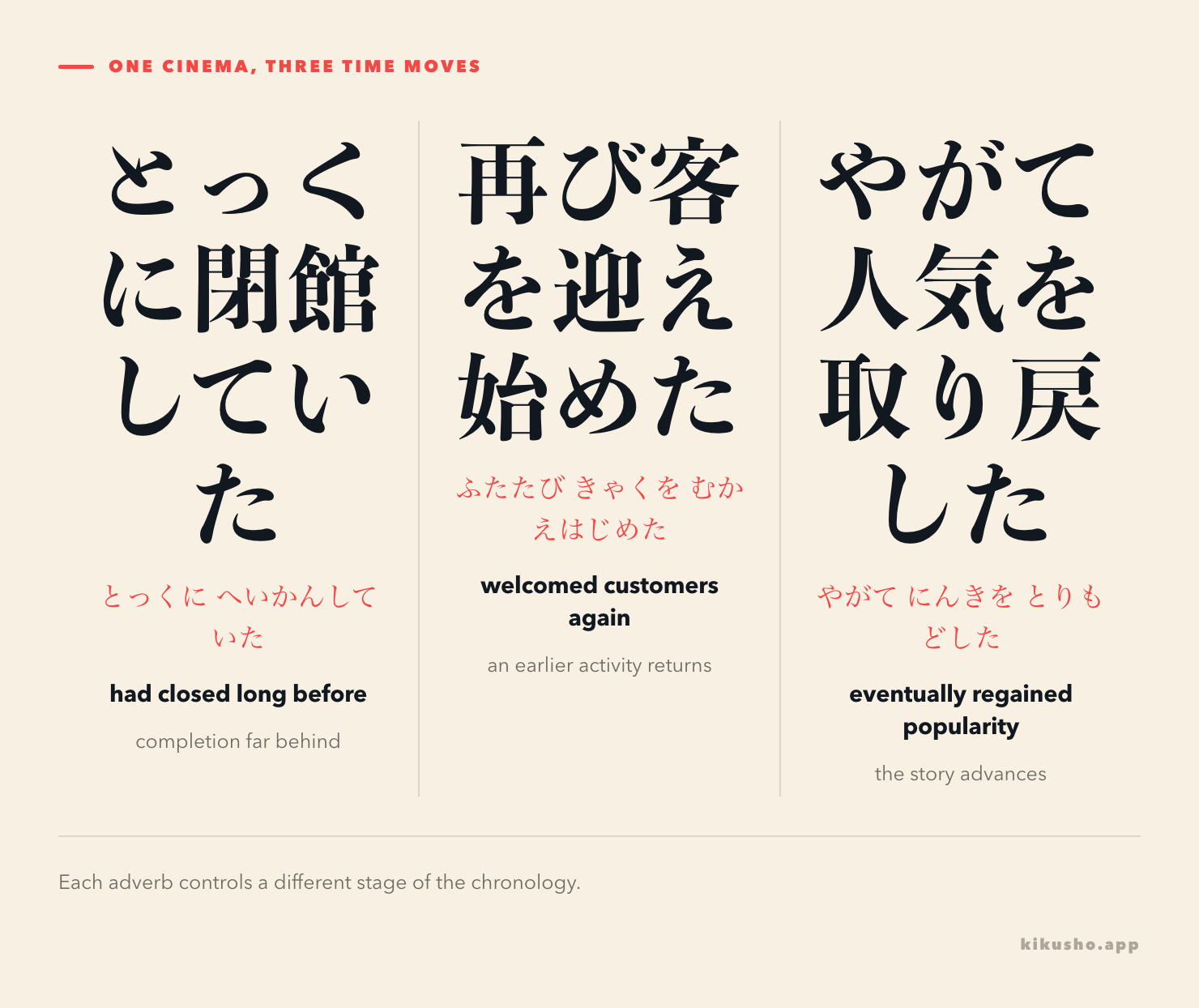
映画館はとっくに閉館していたが、改装後、再び客を迎え始めた。やがて、週末は満席になるほど人気を取り戻した。
えいがかんは とっくに へいかんしていたが、かいそうご、ふたたび きゃくを むかえはじめた。やがて、しゅうまつは まんせきに なるほど にんきを とりもどした。
The cinema had closed long before, but after renovation it began welcoming customers again. Eventually, it regained enough popularity to sell out on weekends.
The first adverb establishes an old completed state. The second restores an earlier activity. The third moves the account to the later consequence. Replacing them mechanically would scramble the timeline: 再び閉館していた would say the cinema had closed again, while とっくに客を迎え始めた would say the reopening began long before the reference point.
The neighbouring expressions answer different timing questions. The しばらく and すでに comparison separates an interval from prior completion. The Japanese time-word guide contrasts a duration, an approaching event and an appropriate time to act. For speed rather than position on a timeline, compare いきなり, 一気に and 直ちに.
When saving one of these expressions in Kikusho, keep the clause that supplies its reference point. とっくに alone loses the corrected expectation; とっくに閉館していた keeps it. やがて becomes clearer with both stages, and 再び needs enough context to recover the first occurrence.
Why the N2 label is not exact
JLPT Sensei places all three items at N2. Bunpro agrees for とっくに and やがて but places 再び at N3. The disagreement concerns teaching order, not the recurrence meaning described here.
The JLPT publishes no exhaustive current grammar list. Kikusho keeps the trio in an N2 comparison because reading longer narratives requires tracking their reference points, while recording the earlier N3 placement for 再び instead of presenting the boundary as official.
Practice: follow the arrow in time
1 · A service restored
The railway line had operated before, closed for repairs and then opened once more. Complete the sentence: 工事が終わり、電車が__走り始めた。
A. とっくに
B. 再び
C. やがて
D. すでに
2 · The bus is no longer waiting
Someone asks whether the bus is still at the stop. You know it left a long time ago. Which reply fits?
A. バスなら、とっくに出発しました。
B. バスなら、再び出発しました。
C. バスなら、やがて出発しました。
D. バスなら、二度と出発しました。
3 · A later development
Complete the narrative: 雲が切れ、__月が見えてきた。 The moon appeared before long as the scene developed.
A. 再び
B. とっくに
C. やがて
D. 二度と
4 · Keep the register
Which sentence is the most neutral choice for a formal notice stating that processing is already complete, without stressing “long ago”?
A. 手続きはすでに完了しています。
B. 手続きはとっくに完了したよ。
C. 手続きは再び完了しています。
D. 手続きはやがて完了していました。
5 · Repair the timeline
Rewrite 店はやがて閉店していた so it says “The shop had closed long before.”
6 · Read all three stages
Read: その制度はとっくに廃止されていたが、新しい形で再び導入された。やがて、ほかの地域にも広がった。 Which account is accurate?
A. The system was about to end, was introduced for the first time and immediately disappeared.
B. The system had ended long before, returned in a new form and later spread to other regions.
C. The system repeatedly ended and had already spread before its introduction.
D. The system never ended, returned without precedent and spread long ago.
Answers and explanations
1 · B, 再び. The line operated before, and the new opening repeats that earlier state. とっくに would place the start far in the past; やがて would present it as the next development.
2 · A, バスなら、とっくに出発しました. The question assumes the bus may still be there, and とっくに corrects that assumption by placing its departure much earlier. 再び would require a previous departure, while 二度と requires a negative predicate.
3 · C, やがて. The clearing clouds provide the earlier stage, and the moon's appearance follows as the scene develops. とっくに would put the appearance well before the reference point.
4 · A, 手続きはすでに完了しています. すでに neutrally marks an established completed state and suits a notice. The とっくに option is conversational and stresses that completion was much earlier.
5 · 店はとっくに閉店していた. The past perfect-style context calls for an event already completed well before the reference point. やがて would move the story toward a later closing instead.
6 · B. とっくに establishes the old abolition, 再び marks the system's return, and やがて introduces its later spread. Each word controls a different stage of the chronology.
A reader who tracks the reference point does not need to memorize three English glosses. Look for the prior occurrence, the long-finished event or the next stage, and follow the arrow the adverb supplies.
Common questions
What is the difference between 再び, とっくに and やがて?
再び says an action or state occurs again, とっくに places a completed event or established state much earlier than the relevant time, and やがて moves the account forward toward what happens before long or eventually.
What is the difference between 再び and また?
Both can mean again, but 再び is more deliberate and somewhat more formal or literary. また is the ordinary conversational choice and has additional uses, including adding another point.
Can とっくに mean simply already?
It can translate as already, but it emphasizes that the event happened or the state became true well before the relevant time. Neutral もう or すでに does not always carry that distance.
Is 再び N2 grammar?
Study resources disagree. Kikusho retains it in this N2 comparison because JLPT Sensei lists it at N2, while Bunpro places it at N3. The JLPT does not publish an exhaustive official grammar list.