On this page
しばらく待っています says that the waiting continues for an unspecified interval. すでに待っています says the person was already waiting before the relevant moment. Both sentences concern time, but only the first measures a stretch; the second locates a state relative to a reference point.
Ask whether the sentence measures a stretch or crosses a point
Imagine arriving at a station at 9:00. One timeline can answer two different questions:
田中さんはしばらく待っています。
たなかさんは しばらく まっています。
Tanaka has been waiting for a while.
The speaker looks at the length of the waiting. No number tells us whether しばらく covers ten minutes or an hour.
九時に着いた時、田中さんはすでに待っていました。
くじに ついた とき、たなかさんは すでに まっていました。
When I arrived at nine, Tanaka was already waiting.
Now 9:00 is the reference point. The waiting began before it. すでに does not say how long Tanaka waited; even one minute would satisfy the sentence.
| Expression | Main question | Information supplied | Information left open |
|---|---|---|---|
| しばらく待っている | For how long? | An interval exists | Its exact length |
| すでに待っている | Had it begun yet? | The state began earlier | How long before |
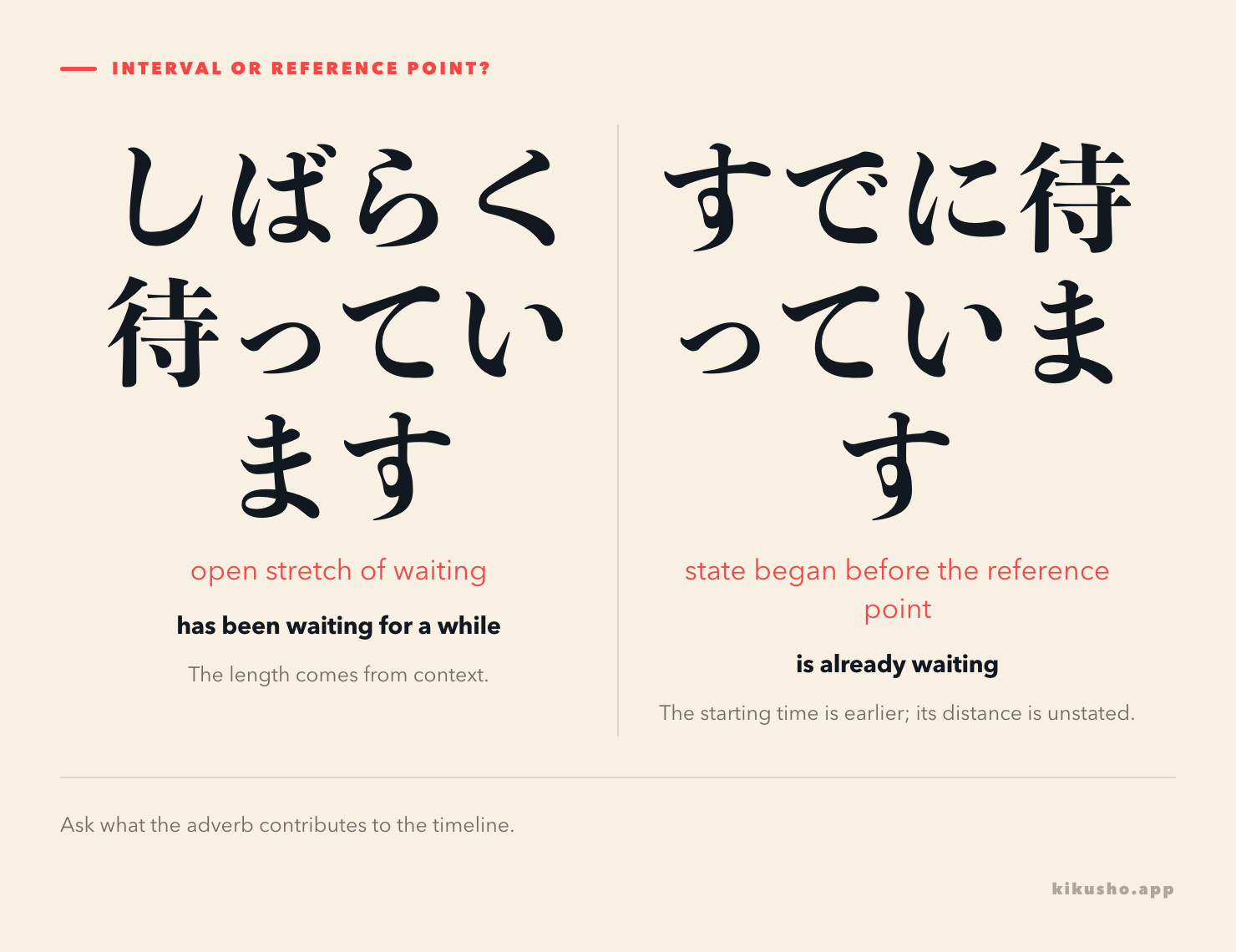
This is the most reliable choice test. Look past the English adverb and draw the time relation. A horizontal stretch suggests しばらく. A change or state already on the earlier side of a chosen point suggests すでに.
しばらく leaves the interval for context to size
しばらく(暫く, shibaraku)is an adverb meaning “for a while,” “for some time,” or, in a temporary decision, “for the time being.” It normally sits before the clause it frames:
ここでしばらくお待ちください。
ここで しばらく おまちください。
Please wait here for a while.
来年から、しばらく大阪に住む予定です。
らいねんから、しばらく おおさかに すむ よていです。
From next year, I plan to live in Osaka for a while.
The first interval may be a few minutes. The second may be months or years. Shogakukan's dictionary entry records both a relatively short interval and a condition that continues for some time. Treating the word as a fixed number of minutes would therefore erase part of its ordinary range.
The surrounding predicate changes how you view that interval:
| Frame | Example | View of the interval |
|---|---|---|
| しばらく + ongoing action | しばらく待っています | The action continues for a while |
| しばらく + future plan | しばらく休みます | A temporary period lies ahead |
| しばらく + completed action | しばらく考えました | The completed action occupied some time |
| しばらく + negative state | しばらく会っていません | The non-occurrence extends over a period |
| しばらくして | しばらくして雨がやみました | A while passes before the next event |
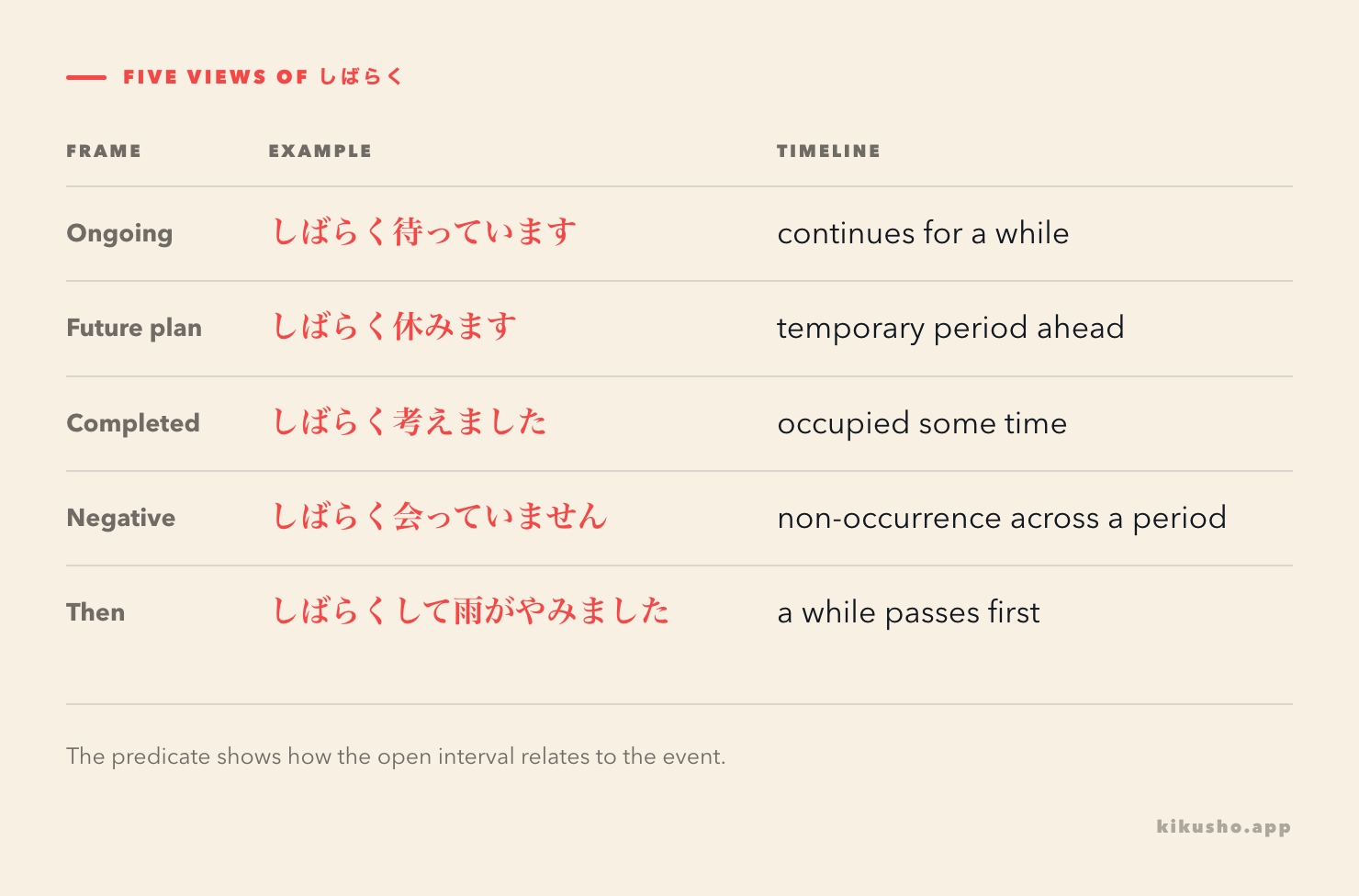
In しばらく会っていません, the negative form does not mean “I met them briefly.” It means meeting has not occurred during the relevant stretch. In しばらくして, meanwhile, the phrase looks forward from one event to another: a while passed, and then the rain stopped.
You may also see しばらくの間, where の connects しばらく to the noun 間, and しばらく前, “some time ago.” These still leave a temporal distance unspecified. The common spelling is in hiragana, although 暫く exists.
The earlier N4 time-word lesson introduces しばらく as vocabulary beside expressions for the recent past and approaching events. The present comparison adds the N3 sentence test: decide whether you are measuring an interval or locating a state before a reference time.
すでに places the result on the earlier side
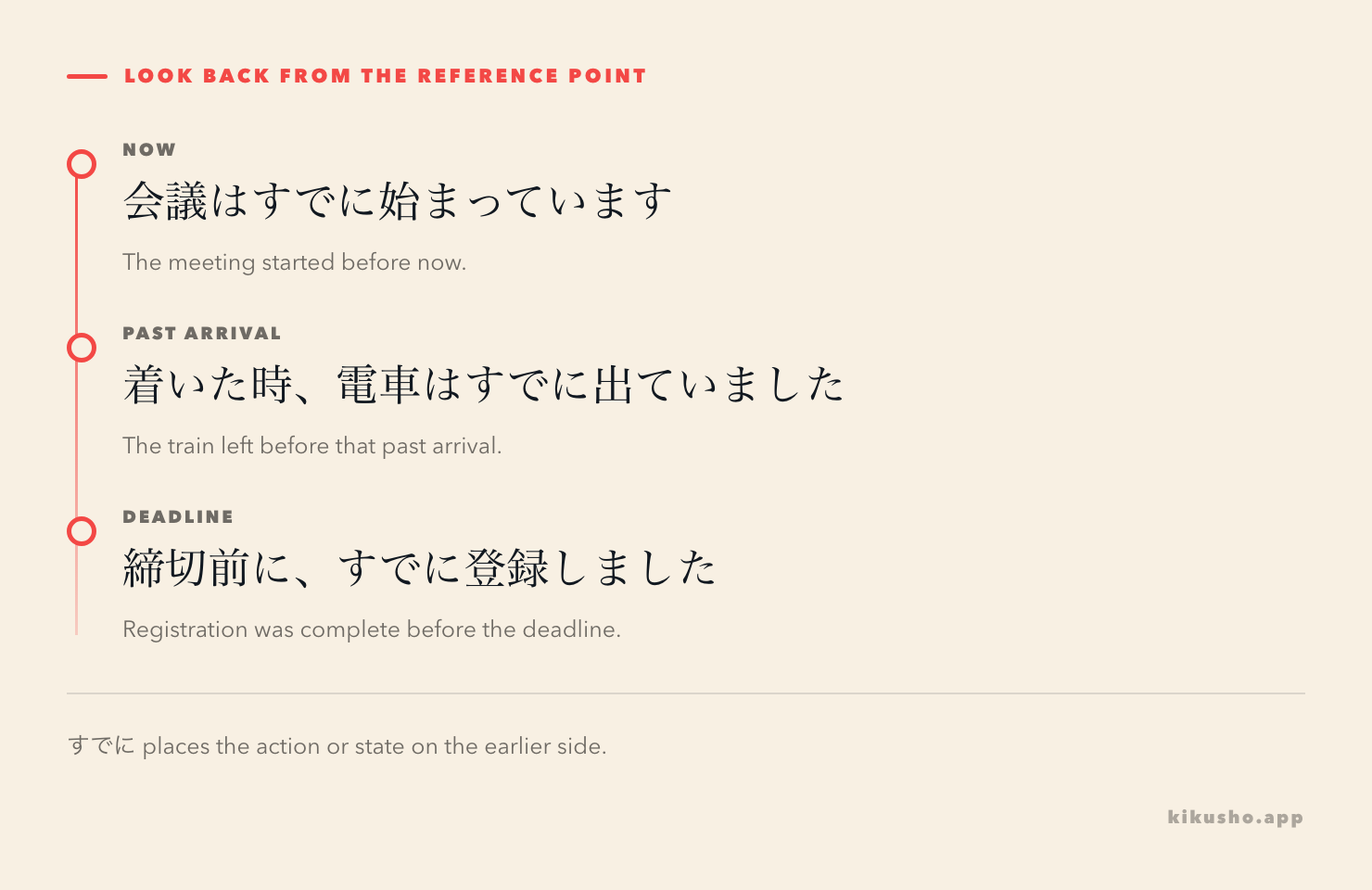
すでに(既に, sudeni)means “already.” It tells the listener that an action was complete, or a state was established, before the time currently under discussion:
会議はすでに始まっています。
かいぎは すでに はじまっています。
The meeting has already started.
The start occurred before now, and the resulting state holds now. A past story can move the reference point away from the present:
駅に着いた時には、最終電車はすでに出ていました。
えきに ついた ときには、さいしゅうでんしゃは すでに でていました。
By the time I reached the station, the last train had already left.
Here 着いた時 supplies the point. The departure is earlier than that point, even though both events are in the past. Translating すでに mechanically as “before now” would miss this shift.
The expression can also modify a state without narrating a visible completed action:
その方法では、すでに手遅れです。
その ほうほうでは、すでに ておくれです。
With that method, it is already too late.
彼はその頃、すでに有名でした。
かれは そのころ、すでに ゆうめいでした。
He was already famous by then.
Kanjipedia includes both the idea of something having happened earlier and a state already being in place. Shogakukan likewise covers an earlier completed action and an established fact. These definitions explain why a rule requiring すでに to stand only before an accomplishment verb is too narrow.
すでに and もう overlap, but their range is different
In many completion sentences, both adverbs work:
申込期間はすでに終わりました。
もう申込期間は終わりました。
The application period has already ended.
すでに often presents the timing as an objective or established fact. It fits notices, reports and explanations especially well. もう is frequent in conversation and can bring the speaker's reaction closer to the surface. This is a tendency, not a ban on speaking with すでに.
Bunpro's reference for すでに describes it as more formal than もう and notes its frequent sense that the earlier change cannot now be altered. That nuance is easy to hear in すでに手遅れです, but irreversibility is not a requirement in every example. すでに準備できています simply reports that preparation is already complete.
Do not replace every もう with すでに. もう一度 means “one more time,” and もう食べない can mean “I won't eat any more.” Those uses do not express earlier completion. The overlap belongs to the “already” reading, not to the entire word もう.
Keep duration and completion separate in close pairs
Put the adverbs into the same sentence shape to expose the change:
彼はそこにしばらく住んでいました。
He lived there for a while.
私が会った時、彼はすでにそこに住んでいました。
When I met him, he was already living there.
The first sentence measures the residence as an interval. The second puts the residence before the meeting. It says nothing about whether that residence lasted briefly or for decades.
The same distinction holds with completion:
しばらく考えてから、返事をしました。
I thought for a while and then replied.
連絡をもらった時には、すでに返事をしていました。
By the time I received the message, I had already replied.
In the first, thinking occupies a stretch before the reply. In the second, the reply is complete before a later reference point. If both facts matter, both adverbs can appear in a larger account: しばらく考えましたが、電話が来た時にはすでに返事を送っていました. Each then does its own job.
JLPT Sensei places しばらく and すでに at N3, and Bunpro also places すでに at N3. Another teaching source places しばらく at N2. Such labels are study estimates: the JLPT does not publish an exhaustive official grammar-item list. The time-relation test remains useful regardless of when a textbook schedules the words.
Build each Kikusho card around the time relation itself. A card containing only すでに = already cannot show what the earlier event is earlier than, so capture 着いた時には、すでに出ていた. With しばらく, include the situation that makes an interval of minutes, months or years plausible.
Test the timeline before choosing
Work through the complete six-part exercise, then check the separate solution section.
Question 1: grammar choice. A station announcement says the last train left before the passenger arrived. Choose the best completion: 駅に着いた時、最終電車は__出ていました。
- ア. しばらく
- イ. すでに
- ウ. もう一度
- エ. しばらくの間
Question 2. What does しばらく京都に住む予定です tell you?
- ア. The move to Kyoto has already been completed.
- イ. The speaker will live in Kyoto for an exact number of days.
- ウ. The speaker plans a temporary stay whose exact length is unstated.
- エ. Kyoto was the speaker's home long ago.
Question 3. Choose the sentence that naturally reports an established state before now.
- ア. 申込期間はすでに終わっています。
- イ. 申込期間はしばらく終わっています。
- ウ. 申込期間はすでにの間です。
- エ. 申込期間はしばらく前を終わっています。
Question 4: sentence composition. Arrange the pieces to say “After thinking for a while, I answered”: 答えました / しばらく / 考えてから.
Question 5. A colleague says この機械はしばらく使っていません. Which interpretation follows from the sentence?
- ア. The machine has not been used for an unspecified period.
- イ. The machine had already broken before it was used.
- ウ. The machine was used for only a few seconds.
- エ. The machine will certainly be used immediately.
Question 6: text grammar. Fill both blanks with the pair that preserves the timeline.
店の前で__待ちました。けれども、店員に聞いた時には、限定商品は__売り切れていました。
- ア. すでに / しばらく
- イ. しばらく / すでに
- ウ. しばらく / しばらく
- エ. すでに / もう一度
Answers and explanations
Answer 1. イ, すでに. Arrival supplies the past reference point, and the train's departure happened before it. しばらく would describe an interval but cannot by itself establish this event order. もう一度 means “one more time.”
Answer 2. ウ. しばらく frames living in Kyoto as a period whose length comes from context. It supplies neither a fixed count nor earlier completion. A long stay is possible if the wider plan supports it.
Answer 3. ア, 申込期間はすでに終わっています. The application period ended before now, and the closed state holds. イ treats an ending as though it were simply a continuing duration; ウ and エ do not form the required adverbial pattern.
Answer 4. しばらく考えてから、答えました。 しばらく comes before 考える and measures the thinking interval. てから then orders the answer after that completed thinking.
Answer 5. ア. The negative predicate 使っていません says non-use continues across the period marked by しばらく. The sentence does not specify how long that period is, assert a breakdown or predict immediate use.
Answer 6. イ, しばらく / すでに. Waiting occupies an open interval, so the first blank takes しばらく. The inquiry supplies a reference point, and the sellout was already complete before it, so the second takes すでに. ア reverses the two time relations, ウ fails to express prior completion, and エ says the product sold out one more time.
The passage works because it asks both time questions in order: how long did the person wait, and what state had been reached by the later inquiry? Drawing one stretch and one reference point makes the pair visible before translation does.
Common questions
What is the difference between しばらく and すでに?
しばらく describes an interval whose exact length comes from context. すでに says that an action or state was in place before a reference time. The first answers for how long; the second answers whether the change had happened yet.
Is しばらく always a short time?
No. A request to wait しばらく may concern minutes, while しばらく会っていない can cover months or years. The situation supplies the scale.
What is the difference between すでに and もう?
Both can mean already, but すでに often presents the timing as an objective or established fact and is common in formal information. もう is more conversational and has other uses that すでに cannot replace.
Are しばらく and すでに N3 grammar?
Several study resources place them at N3, though one source places しばらく at N2. These are publisher estimates because the JLPT does not issue an exhaustive official grammar list.