On this page
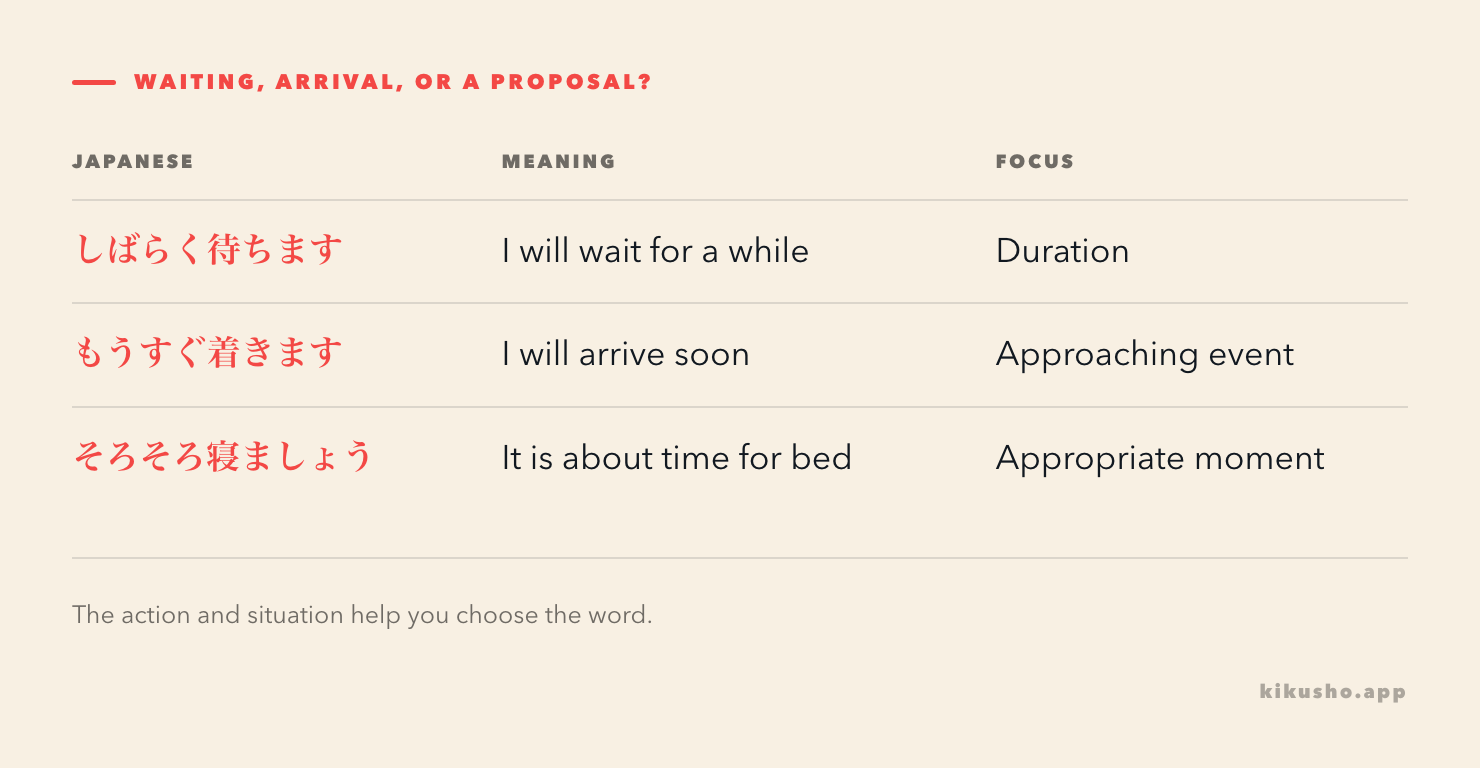
しばらく待ちます means you will wait for a while; もうすぐ着きます means you will arrive soon. Japanese time words distinguish the length of an activity from its position in time, and そろそろ adds the sense that the expected moment is approaching.
Eight words for different questions about time
A message can tell you when something happened, how long it lasted, or whether it is time to do something next. English translations such as “a while” and “soon” hide those differences. Keep the Japanese word with the kind of sentence it belongs in.
This N4 vocabulary set covers 間, 内, 最近, しばらく, 将来, そろそろ, 昔 and もうすぐ. The level follows this curriculum's vocabulary inventory, whose two Waller/Tanos-derived lists share one source family. It is a study placement, not an official exhaustive JLPT syllabus. Reading a word and knowing every grammar construction that contains it are separate tasks.
| Word | Reading | Part of speech here | Meaning to retain | Useful combination |
|---|---|---|---|---|
| 間 | あいだ | Noun | Interval; space between | 休みの間: during the break |
| 内 | うち | Noun | Within an area or time range | 三日のうちに: within three days |
| 最近 | さいきん | Noun, used adverbially | Recently; lately | 最近のニュース: recent news |
| しばらく | しばらく | Adverb | For a while | しばらく待つ: wait for a while |
| 将来 | しょうらい | Noun, used adverbially | Future; prospects | 将来の計画: plans for the future |
| そろそろ | そろそろ | Adverb | About time; soon | そろそろ出発する: depart about now |
| 昔 | むかし | Noun, used adverbially | In the past; long ago | 昔の写真: old photographs |
| もうすぐ | もうすぐ | Adverbial expression | Soon; before much more time passes | もうすぐ着く: arrive soon |
A noun used adverbially can set the time of the sentence without becoming a different word. Compare 最近、読みました, “I read it recently,” with 最近のニュース, “recent news.” The second attaches to another noun with の; the first tells you when the reading happened.
Give an interval a shape
間: an interval or the space between
夏休みの間、祖父の店を手伝いました。
なつやすみの あいだ、そふの みせを てつだいました。
During the summer holiday, I helped at my grandfather's shop.
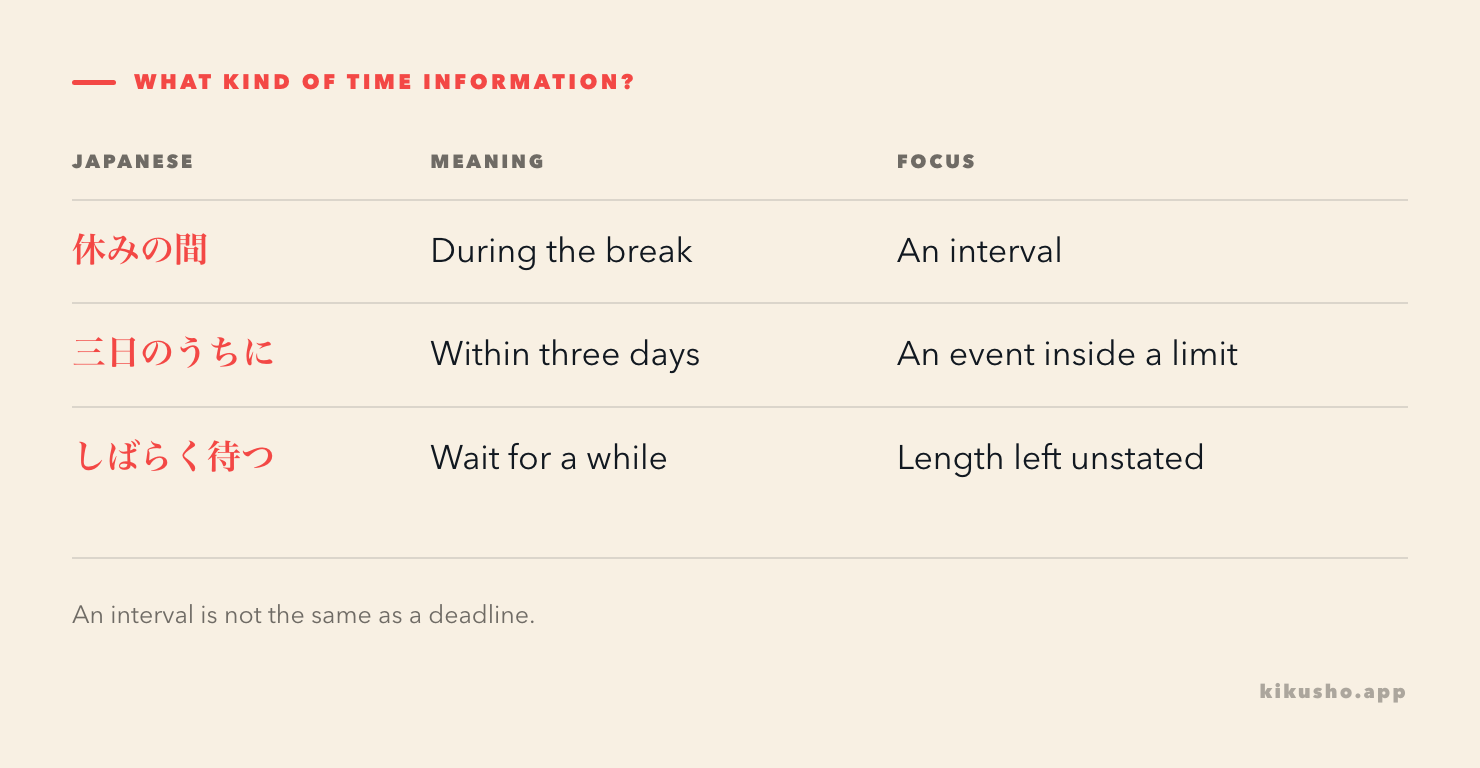
The holiday provides the interval. You are placing the helping within that stretch of time, rather than giving the listener a date. Learn 休みの間 as a noun phrase, with の between the two nouns.
The same reading also describes space: 駅と学校の間にパン屋があります(えきと がっこうの あいだに パンやが あります)means “There is a bakery between the station and the school.” That spatial sense explains why the word is not simply an equivalent of “while.” NINJAL's dictionary entry for あいだ records both spatial and temporal uses.
In this lesson, read the standalone word 間 as あいだ. The character has other readings in compounds; recognising it does not make every occurrence あいだ. The broader guide to multiple kanji readings shows why the whole word determines the reading.
内: inside a range
三日のうちに返事をします。
みっかの うちに へんじを します。
I will reply within three days.
The reply belongs inside the stated time limit. This is not a claim that replying takes three days. Contrast a span with an event occurring within it: one describes an interval, the other locates the response before the interval is over.
内 can mean the inside of a physical area, too. 円の内と外(えんの うちと そと)means “inside and outside the circle.” Kanjipedia includes both the inside and time-range meanings; Shogakukan's dictionary gives the temporal sense separately from home and group membership.
You will also meet phrases such as 明るいうちに(あかるいうちに), “while it is still light.” Here the usable interval lasts only while that condition holds. This gives you a foothold in the word's meaning; a full comparison of clause patterns with うちに and 間に needs its own grammar lesson. Do not turn the vocabulary gloss “within” into a rule that they can replace each other everywhere.
しばらく: leave the length unstated
雨が強いので、ここでしばらく待ちます。
あめが つよいので、ここで しばらく まちます。
The rain is heavy, so I will wait here for a while.
しばらく待つ does not tell you the number of minutes. In a different situation, しばらく会っていません means “I haven't seen them for a while,” potentially a much longer interval. The situation supplies the scale.
The kanji spelling is 暫く, also read しばらく. You can write the everyday expression in kana. Shogakukan lists both a relatively short interval and a period continuing for some time, so “a little while” is a useful first gloss but an unreliable stopwatch.
Place an event relative to now
最近: the recent past or lately
最近、新しい自転車を買いました。
さいきん、あたらしい じてんしゃを かいました。
I recently bought a new bicycle.
This locates a single purchase in the recent past. 最近は自転車で通っています(さいきんは じてんしゃで かよっています), “Lately I've been commuting by bicycle,” instead describes a current pattern over a recent period.
NINJAL treats 最近 as both a noun and an adverb and notes that its time range depends on context. It does not mean “yesterday,” and it does not promise that something will happen soon. For a noun combination, retain 最近の出来事(さいきんの できごと), “recent events.”
昔: look back from a distance
昔、この道には電車が走っていました。
むかし、この みちには でんしゃが はしっていました。
Long ago, trains used to run along this road.
昔の写真 is a photograph from the past, not a photograph you recently took. The word often creates a contrast with how things are now. Shogakukan's entry notes that it commonly refers to a distant past, without requiring one fixed amount of elapsed time.
Do not translate it as “ancient history” automatically. A person describing an earlier period of their own life can use 昔 as well. The relevant distance is supplied by the story.
将来: what lies ahead
将来、小さな喫茶店を開きたいです。
しょうらい、ちいさな きっさてんを ひらきたいです。
In the future, I would like to open a small café.
The speaker has an aspiration, with no opening date stated. 将来の計画(しょうらいの けいかく), “plans for the future,” is a useful phrase when talking about study, work or where you hope to live. The noun can also concern prospects: 会社の将来 is “the company's future.” Shogakukan's bilingual entry records those future and prospects senses.
将来 does not itself mean “soon.” You can qualify it as 近い将来(ちかい しょうらい), “the near future,” when that is what you intend. A plan and an approaching event need different amounts of information.
Two ways to approach the next moment
もうすぐ: an event is near
バスはもうすぐ駅に着きます。
バスは もうすぐ えきに つきます。
The bus will arrive at the station soon.
The arrival is still ahead, but the remaining wait is short in this situation. もうすぐ着く reports an approaching arrival; しばらく待つ describes spending an interval waiting. They cannot exchange places merely because both concern a short time.
Tofugu's explanation of もう shows how もうすぐ presents something as close to completion or arrival. It differs from a general claim that an action can be done quickly. “Soon” concerns where the event is relative to now; “quickly” can concern how fast someone performs it.
そろそろ: the expected time is approaching
もう十時ですね。そろそろ寝ましょう。
もう じゅうじですね。そろそろ ねましょう。
It's already ten. It's about time we went to bed.
Here そろそろ helps propose the next action because the appropriate time has arrived or is approaching. It also works with predictions: そろそろバスが来るでしょう, “The bus should be coming about now.” It is not restricted to invitations.
Chika Sensei's comparison shows that both もうすぐ and そろそろ can describe an expected arrival. A simple rule saying one is always wrong beside a future verb would miss that overlap. With そろそろ, listen for the speaker's sense of timing.
There is another meaning to recognise. そろそろと歩く can describe walking slowly or cautiously, rather than walking soon. Shogakukan distinguishes slow movement from the approach of a time or state. Context decides which meaning you have encountered.
Keep the situation with the word
For these eight words, a useful example preserves either a time boundary or the speaker's reason for choosing it. Save 三日のうちに返事をする with the promised reply, and そろそろ寝ましょう with the late hour. A bare English “within” or “soon” loses those clues. That is one reason to retain a word in its original sentence.
When adding a phrase to Kikusho by text, use the editable example field to retain that situation. In a later offline review, the phrase can remind you whether you were describing a duration, a plan or an event nearly happening. The point is to recover the choice you made in the conversation.
Attempt the following questions as a group. The answer section begins only after the last one.
Practice questions
Question 1: read the plan
You see 将来の計画 on a worksheet about plans. How do you read 将来?
- A. しょうらい
- B. しょらい
- C. じょうらい
- D. しょうれい
Question 2: recognise the written word
Select the kanji pair for さいきん, meaning “recently”?
- A. 最後
- B. 最初
- C. 最近
- D. 近所
Question 3: locate the purchase
The speaker bought a camera a few days ago. Select the expression that presents this as a recent event.
( )、カメラを買いました。
- A. 将来
- B. 最近
- C. もうすぐ
- D. そろそろ
Question 4: interpret the promise
三日のうちに返事をします。
Which interpretation best preserves the promise?
- A. Replying will take three full days of work.
- B. I replied three days ago.
- C. I will begin replying after three days have passed.
- D. I will reply within the next three days.
Question 5: read the whole situation
A friend says しばらく会っていません about someone they used to see. What does the phrase tell you?
- A. They will meet almost immediately.
- B. Exactly three days have passed since they met.
- C. They have not met for an unspecified period.
- D. They have never met.
Question 6: place the building in time
A photograph shows a building as a school forty years ago. It is a library now. Choose the caption that matches this history.
- A. 昔、この建物は学校でした。
- B. 最近、この建物は学校になりました。
- C. 将来、この建物は学校になります。
- D. もうすぐ、この建物は学校になります。
Question 7: keep the speaker's intention
It is late, and the speaker proposes ending today's work. Which translation best captures そろそろ終わりにしましょう?
- A. We finished this recently.
- B. It's about time we called it a day.
- C. We must work for exactly one more hour.
- D. We never started working.
Answers and explanations
Check both the meaning of the time word and what the rest of the sentence allows it to describe.
Answer 1
A: しょうらい. Keep the long しょう at the beginning and らい at the end. 将来の計画 means “plans for the future.” The other options change the reading.
Answer 2
C: 最近. The pair is read さいきん. A is 最後(さいご), “last”; B is 最初(さいしょ), “first”; D is 近所(きんじょ), “neighbourhood.” A shared character does not make the whole word equivalent.
Answer 3
B: 最近. The camera purchase already happened in the near past. 将来 places something in the future, while もうすぐ and the timing sense of そろそろ look toward an approaching event. None supplies the stated recent-past meaning.
Answer 4
D. The three days provide the range within which the reply will happen. The sentence neither measures three days spent composing it nor postpones the start until that interval has ended. B incorrectly turns a promise into a completed event.
Answer 5
C. しばらく leaves the interval unspecified, and 会っていません says that meeting has not happened during it. The phrase does not fix a number of days, predict an imminent meeting or claim they have never met at all.
Answer 6
A. “This building used to be a school” places its former use in the past. Read 建物 as たてもの. B describes a recent change into a school. C places that change in the future, and D says it will happen soon. Only A matches the building's former use in the old photograph.
Answer 7
B. The speaker judges that it is time to stop and makes a proposal. The sentence specifies neither a completed past action nor an exact extra duration. Remember the possible overlap in predictions: this exercise tests the proposal in its stated setting, not a claim that そろそろ and もうすぐ can never share a sentence frame.
Common questions
Is しばらく always a short time?
No. It describes an unspecified interval whose length depends on the situation. Waiting at a counter and not seeing someone for a while can involve very different lengths of time.
What is the difference between そろそろ and もうすぐ?
もうすぐ says that an event is near. そろそろ often suggests that the expected or appropriate time is approaching. Both can describe an expected arrival, but そろそろ is especially useful when proposing that it is time to act.
Does 最近 only describe one recent event?
No. 最近 can locate a particular event in the recent past or describe a situation in the period leading up to now. The rest of the sentence tells you which is intended.