On this page
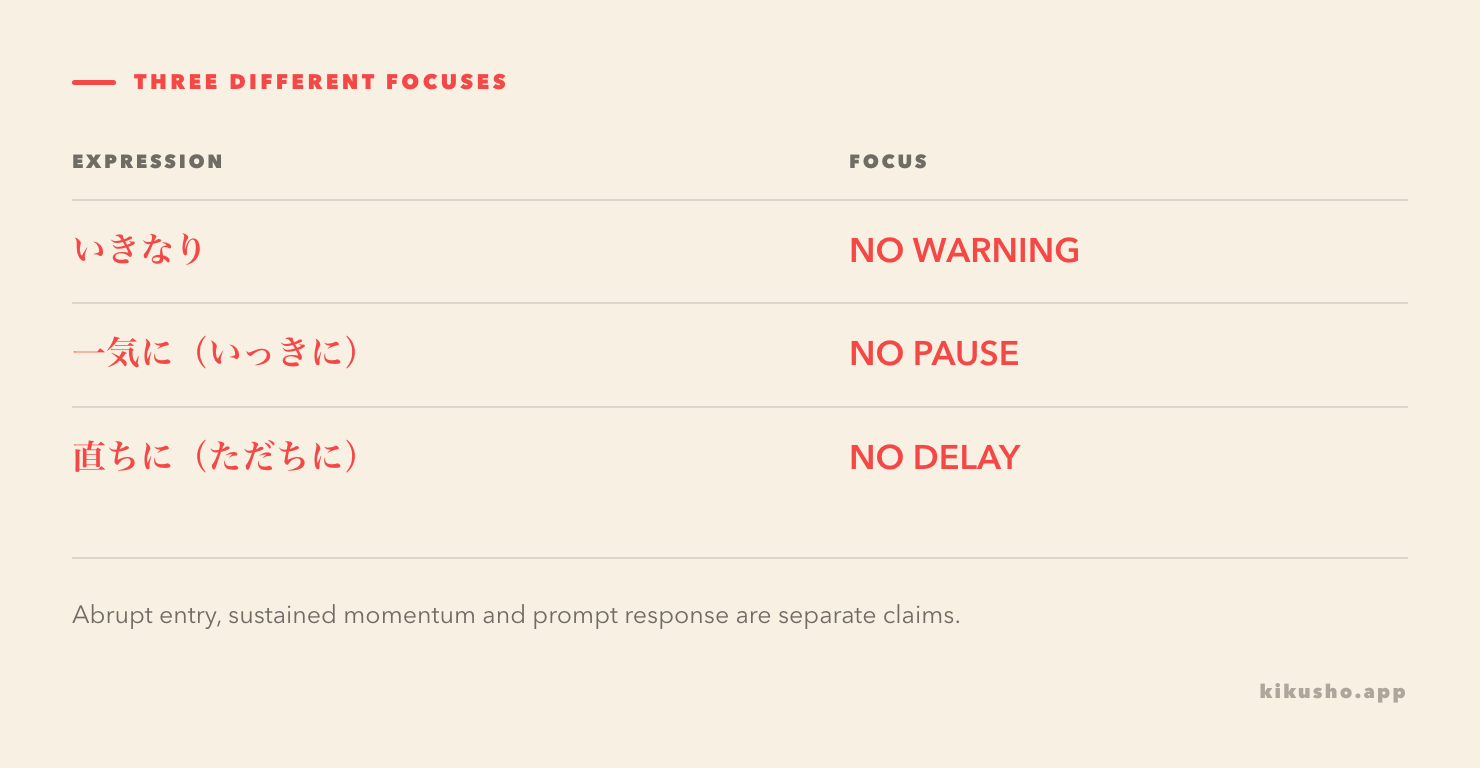
Choose いきなり for an abrupt start or a skipped expected step, 一気に(いっきに) for movement completed in one sustained push, and 直ちに(ただちに) for an action taken without delay. All three can reach English as “suddenly” or “immediately,” but each points at a different part of the event.
The test: surprise, momentum or delay?
Ask one question before translating:
| What matters? | Choose | What the adverb presents |
|---|---|---|
| There was no warning or an expected stage was skipped | いきなり | an abrupt, surprising entry into the event |
| The action continued or the change advanced in one push | 一気に | momentum without a pause or intermediate stage |
| The next action began with no permitted delay | 直ちに | prompt response, often as a formal duty or instruction |
The same situation can support more than one word when the speaker changes focus. 雨がいきなり強くなった presents the stronger rain as abrupt. 雨が一気に強くなった presents the increase as a rapid surge. 警報が出たので、直ちに避難した moves to the response: evacuation began without delay.
None of these is a conjugating suffix. They are adverbial expressions placed before the predicate they modify:
- いきなり質問する: ask abruptly, with no lead-in
- 一気に読み終える: finish reading in one push
- 直ちに報告する: report without delay
いきなり enters without warning or preparation
いきなり marks an abrupt event from the observer's point of view. The surprise may come from a literal lack of warning:
会議中、彼はいきなり立ち上がりました。
かいぎちゅう、かれは いきなり たちあがりました。
During the meeting, he suddenly stood up.
It can also mark a missing step in a normal sequence:
説明を読まずに、いきなり難しい問題を解こうとした。
せつめいを よまずに、いきなり むずかしい もんだいを とこうとした。
Without reading the explanation, I tried to tackle a difficult problem straight away.
The second event need not be physically fast. Someone may spend an hour on that difficult problem. いきなり describes how they entered the task, without the expected preparation.
Bunpro's いきなり entry highlights abrupt or unexpected development. The Japan Forum's reference chapter on sudden-event adverbs separately notes that いきなり can emphasise the speaker's surprise at an unexpected event. These accounts support the same core without requiring every occurrence to express shock.
In noun modification, いきなりの + noun is also possible: いきなりの質問, “a question out of nowhere,” or いきなりの変更, “an abrupt change.” The kana spelling is ordinary; the rare kanji form 行き成り is not required for this lesson.
一気に carries the event through in one push
一気に(いっきに) originally evokes doing something in one breath. It presents an action as uninterrupted or a change as moving rapidly across a range:
この本を週末に一気に読みました。
この ほんを しゅうまつに いっきに よみました。
I read this book in one go over the weekend.
午後になって、気温が一気に上がった。
ごごに なって、きおんが いっきに あがった。
In the afternoon, the temperature rose sharply all at once.
Kotobank's 一気に entry gives the central sense as doing something without stopping partway. Its rapid-change uses grow naturally from that image: the movement passes through the intervening range in one sweep.
Do not force surprise into 一気に. A planned sprint can be 一気に走る, and a scheduled update can change every screen 一気に. The speaker is measuring continuity or pace, not claiming that the event arrived without warning.
The nearby 一度に(いちどに) groups things into one time or batch. 十人を一度に入れる admits ten people at once; it does not say that anyone rushed or persisted. The 一度に and ついでに lesson develops that distinction with simultaneous groups and convenient secondary actions.
直ちに removes the delay
直ちに(ただちに) says that an action follows without delay. It belongs naturally in instructions, warnings, business reports and official announcements:
異常を発見した場合は、直ちに作業を中止してください。
いじょうを はっけんした ばあいは、ただちに さぎょうを ちゅうしして ください。
If you detect an abnormality, stop work immediately.
結果が分かり次第、直ちにご連絡します。
けっかが わかりしだい、ただちに ごれんらくします。
As soon as the result is known, we will contact you without delay.
The word does not say that stopping work or making contact is surprising. It evaluates the gap before the action. The Agency for Cultural Affairs explains in its guidance on official wording that 直ちに is commonly used when immediacy is highest and delay is not permitted. Kotobank records both the immediate “without delay” sense and a separate “directly” sense. This lesson teaches the timing use.
In casual conversation, すぐに often carries the same basic timing with less institutional weight:
- すぐに行くよ。: I'll go right away.
- 直ちに避難してください。: Evacuate immediately.
That is a register tendency, not a ban. A speaker can use 直ちに for deliberate seriousness, and public writing can use すぐ when plain language matters.
One timeline, three different claims
Compare a manager receiving an urgent report:
新人はいきなり部長に電話しました。
The new employee called the department head with no lead-in or expected step.
新人は資料を一気に読みました。
The new employee read the material straight through in one push.
新人は問題を直ちに部長へ報告しました。
The new employee reported the problem to the department head without delay.
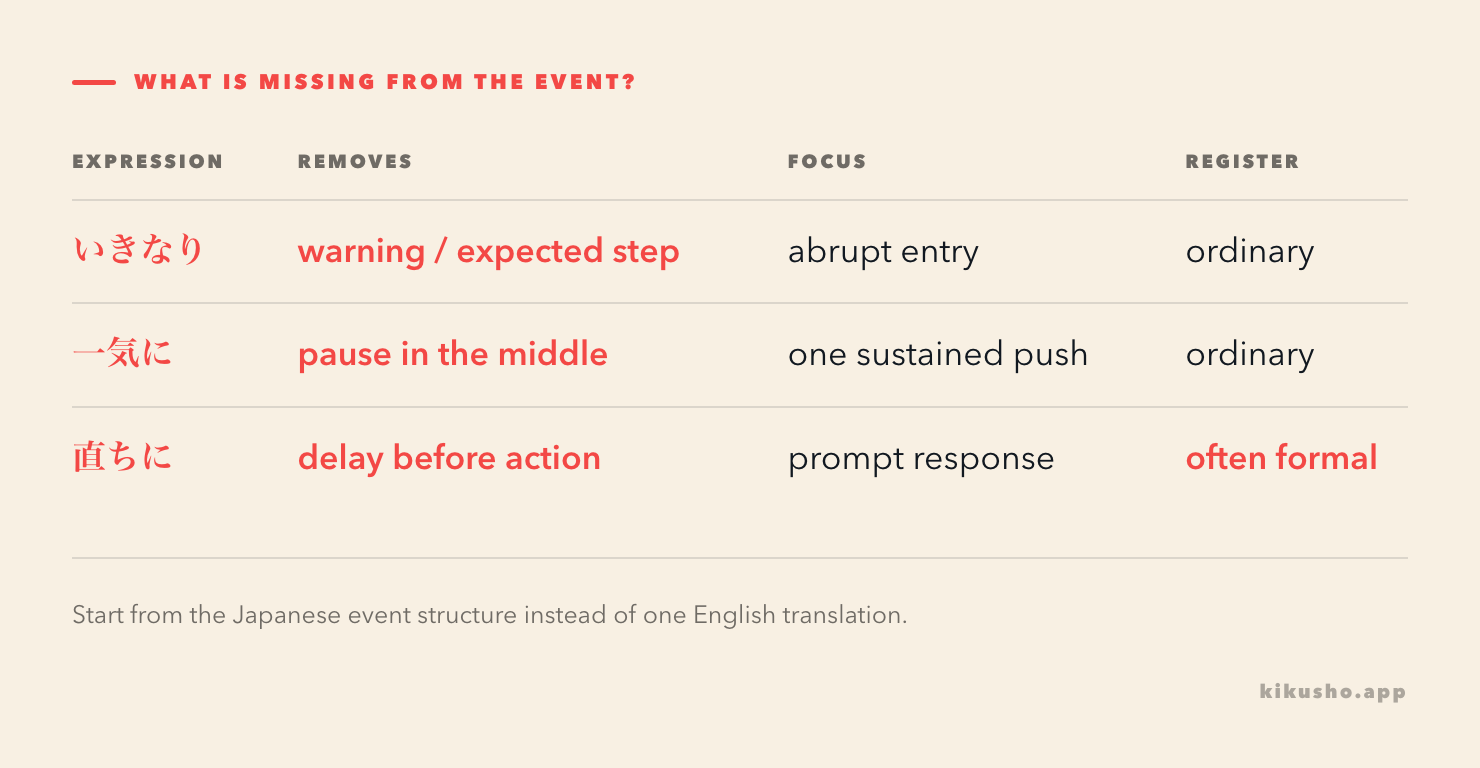
Replacing one word changes the claim. いきなり資料を読んだ suggests that reading began without a lead-in or skipped something expected. 一気に資料を読んだ says the reading continued in one push. 直ちに資料を読んだ says the person began promptly because the situation required it.
This also explains real overlap. After an alarm, someone may 直ちに階段を下り, begin descending without delay, and then 一気に外まで走る, continue all the way outside in one push. If the alarm itself sounded with no warning, it began いきなり. The three adverbs can coexist because they measure different boundaries.
For a different kind of immediate sequence, the かと思ったら and か~ないかのうちに comparison links two observed events. Those patterns encode the relation between clauses; the three adverbs here modify how one event begins or proceeds.
When a sentence from a warning or conversation is worth saving in Kikusho, keep the adverb with its predicate. A card for 直ちに alone hides the formal instruction; 直ちに作業を中止する preserves both register and action. A captured 一気に上がる records a rapid change, while いきなり上がる records an abrupt one. Review the proposed fields before saving so the English gloss does not flatten all three into “suddenly.”
Where the N2 label becomes uncertain
JLPT Sensei places all three expressions on its N2 grammar list, and Bunpro independently labels いきなり N2. Bunpro places 直ちに at N3 instead. That is a real level disagreement, not a difference in the meaning taught here.
The official JLPT does not publish an exhaustive current grammar syllabus. This lesson keeps the curriculum's N2 comparison because the contrast is useful at that stage, while recording that 直ちに may appear earlier in another publisher's sequence. The dictionaries and government guidance verify language and register, not an exam boundary.
Practice: choose the focus before the English gloss
1 · The call without a lead-in
The speaker was startled because the other person began with a personal question. Which word fits?
A. 一気に
B. 直ちに
C. いきなり
D. 一度に
2 · The uninterrupted draft
Complete the sentence: 締め切り前に、報告書を__書き上げた。 The writer finished it in one sustained push.
A. いきなり
B. 一気に
C. 直ちに
D. わざわざ
3 · The formal safety order
Which sentence best suits an official evacuation instruction?
A. いきなり建物から出てください。
B. 一気に建物から出てください。
C. 直ちに建物から避難してください。
D. 一度に建物から避難してください。
4 · Two stages in one response
Choose the best pair: 警報が鳴ったので、__避難を始め、階段を__下りた。 The response began without delay, then continued down the stairs in one push.
A. いきなり / 直ちに
B. 直ちに / 一気に
C. 一気に / いきなり
D. 一度に / 直ちに
5 · Change the emphasis
Rewrite 気温がいきなり上がった so that the sentence highlights a rapid surge rather than surprise.
6 · Read the workplace scene
Read: 担当者はいきなり結論を話し始めたが、事故の報告を受けると、資料を一気に確認し、直ちに工場へ連絡した。 Which account is accurate?
A. The person unexpectedly began with the conclusion, checked the material in one push and contacted the factory without delay.
B. The person formally began with the conclusion, was surprised by the material and called several factories simultaneously.
C. The person delayed the conclusion, checked one page and made an unexpected personal call.
D. The person read the conclusion repeatedly and contacted the factory after a permitted delay.
Answers and explanations
1 · Abrupt entry: C, いきなり. The clue is the missing lead-in and the speaker's surprise. 一気に would measure uninterrupted momentum, while 直ちに would measure delay before the question.
2 · One sustained push: B, 一気に. 書き上げる already points to completion, and 一気に adds that the writer worked through without pausing. The sentence does not present the start as surprising or formally required.
3 · No delay permitted: C, 直ちに建物から避難してください. A formal safety instruction calls for prompt action. いきなり would make the evacuation abrupt or poorly staged, and 一気に would focus on continuous movement rather than response time.
4 · Response then momentum: B, 直ちに / 一気に. 直ちに says the evacuation began without delay. 一気に says the descent continued in one push. Reversing them changes both intended focuses.
5 · Rapid surge: 気温が一気に上がった. 一気に makes the rise feel like one swift movement across a range. The original いきなり foregrounds abruptness from the observer's perspective.
6 · Three focuses: A. いきなり marks the missing lead-in, 一気に describes the uninterrupted check, and 直ちに marks the prompt formal response. Each adverb contributes a different part of the account.
The most reliable cue is the thing the sentence refuses to allow: いきなり removes warning or preparation, 一気に removes the pause in the middle, and 直ちに removes the wait before the response.
Common questions
What is the difference between いきなり, 一気に and 直ちに?
いきなり presents something as abrupt, unexpected or missing an expected step. 一気に presents an action or change as continuing in one push. 直ちに says that the next action must or will begin without delay, often in formal instructions and reports.
Can 一気に mean suddenly?
It can describe a rapid change, such as temperatures rising all at once, but its central image is momentum or completion without a break. It does not by itself say that the event surprised the speaker.
Is 直ちに formal Japanese?
Yes. 直ちに is common in official instructions, warnings, announcements and formal reports. In ordinary conversation, すぐに is often more natural.
Are these expressions officially N2 grammar?
No exhaustive official JLPT grammar list exists. Kikusho places the trio in an N2 comparison because one source lists all three at N2, while Bunpro places 直ちに at N3. The disagreement is disclosed rather than erased.