On this page
Nからして selects one representative feature or clue and says that this point alone already supports a wider judgment. In この店は入口からしておしゃれだ, “this shop is stylish starting with the entrance,” the entrance is not merely a location; it is the first revealing sample of the shop as a whole.
JapaneseNET lists two linked uses: presenting one example that suggests the rest and judging from a piece of evidence. Bunpro also places からして at N2, as does the retained JLPT Sensei entry. These level labels are preparation estimates rather than an exhaustive official JLPT syllabus.
Attach からして directly to a noun
The construction is compact:
N/noun phrase + からして + judgment
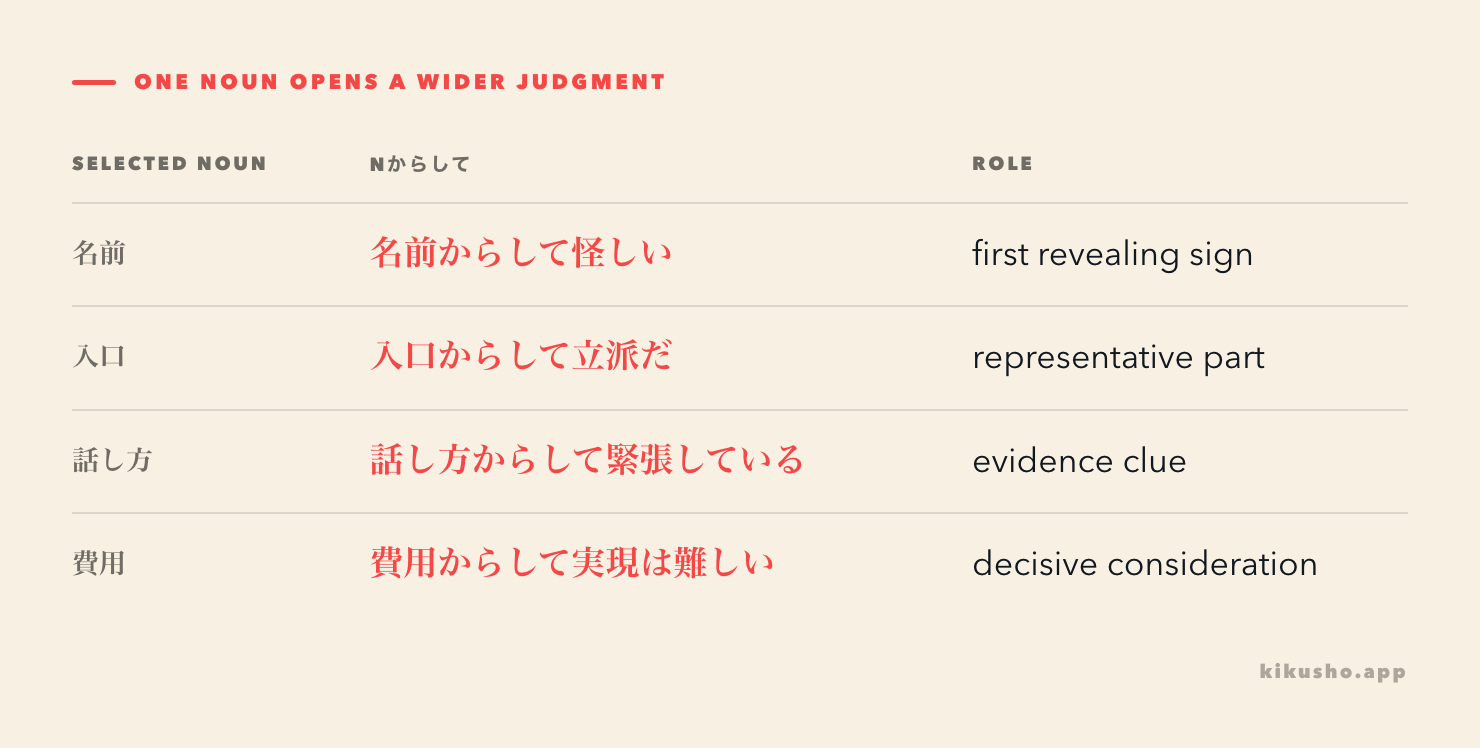
| Noun phrase | Resulting frame | What is selected |
|---|---|---|
| 名前 | 名前からして怪しい | the name as a first revealing sign |
| 入口 | 入口からして立派だ | the entrance as a representative part |
| 話し方 | 話し方からして緊張している | manner of speaking as evidence |
| 費用 | 費用からして実現は難しい | cost as a decisive consideration |
The noun may contain modifiers:
この店は入口の雰囲気からして高級そうです。
このみせは いりぐちの ふんいきからして こうきゅうそうです。
This shop looks upscale judging even from the atmosphere at the entrance.
The selected unit is the full noun phrase 入口の雰囲気. Do not insert だ or a finite clause before からして.
Use one part to evaluate a wider whole
In the representative-sample use, the speaker points to one part and implies that the same evaluation extends beyond it.
このホテルはロビーからして豪華です。
このホテルは ロビーからして ごうかです。
This hotel is luxurious starting with the lobby.
The lobby is evidence, but the sentence does more than infer one hidden fact. It presents the lobby as an early example of the hotel's overall luxury.
この説明書は最初の一文からして分かりにくいです。
このせつめいしょは さいしょの いちぶんからして わかりにくいです。
This manual is hard to understand from the very first sentence.
The first sentence is the selected sample. The reader expects the difficulty to continue through the manual. This implication explains why translations such as “even the first sentence,” “starting with the first sentence,” and “the first sentence alone” can all fit.
The reviewed J-nihongo explanation describes this as choosing a representative part whose character reveals the whole. It also warns that the pattern is not simply a temporal starting point.
Use one clue as the basis for a conclusion
In the evidence use, the noun identifies the feature from which the speaker draws a conclusion.
声からして、電話の相手は若い人でしょう。
こえからして、でんわの あいては わかい ひとでしょう。
Judging from the voice, the person on the phone is probably young.
この匂いからして、何かが焦げています。
このにおいからして、なにかが こげています。
Judging from this smell, something is burning.
The clue should have a plausible connection to the conclusion. A random detail cannot carry からして merely because it appears first in the sentence.
The two uses meet in the idea of a revealing point. A lobby reveals the wider character of a hotel; a voice supports a conclusion about a caller. Context tells you whether the sentence emphasizes representative sampling or inference.
からして often sounds evaluative
Criticism is common because one conspicuous failure can suggest that more failures follow.
彼の説明は言葉遣いからして失礼です。
かれの せつめいは ことばづかいからして しつれいです。
His explanation is rude, starting with his choice of words.
The sentence does not say that wording is the only problem. It selects wording as enough to establish the negative impression.
Positive judgments are equally grammatical:
あの家は玄関からして立派です。
あのいえは げんかんからして りっぱです。
That house is impressive starting with the entrance.
The tendency toward negative contexts is therefore a usage pattern, not part of the conjugation. JapaneseNET explicitly notes the negative tendency while giving a positive entrance example as well.
からして and からすると overlap, but their focus differs
Both expressions can translate as “judging from.” Compare:
話し方からすると、かなり緊張しているようです。
はなしかたからすると、かなり きんちょうしているようです。
Judging from the way he speaks, he seems quite nervous.
話し方からして、かなり緊張しているようです。
はなしかたからして、かなり きんちょうしているようです。
His way of speaking alone already suggests that he is quite nervous.
からすると neutrally establishes the basis for an inference. からして presents the selected clue as especially revealing and can carry the sense that this one point is already enough. The difference is one of framing, so some contexts permit both.
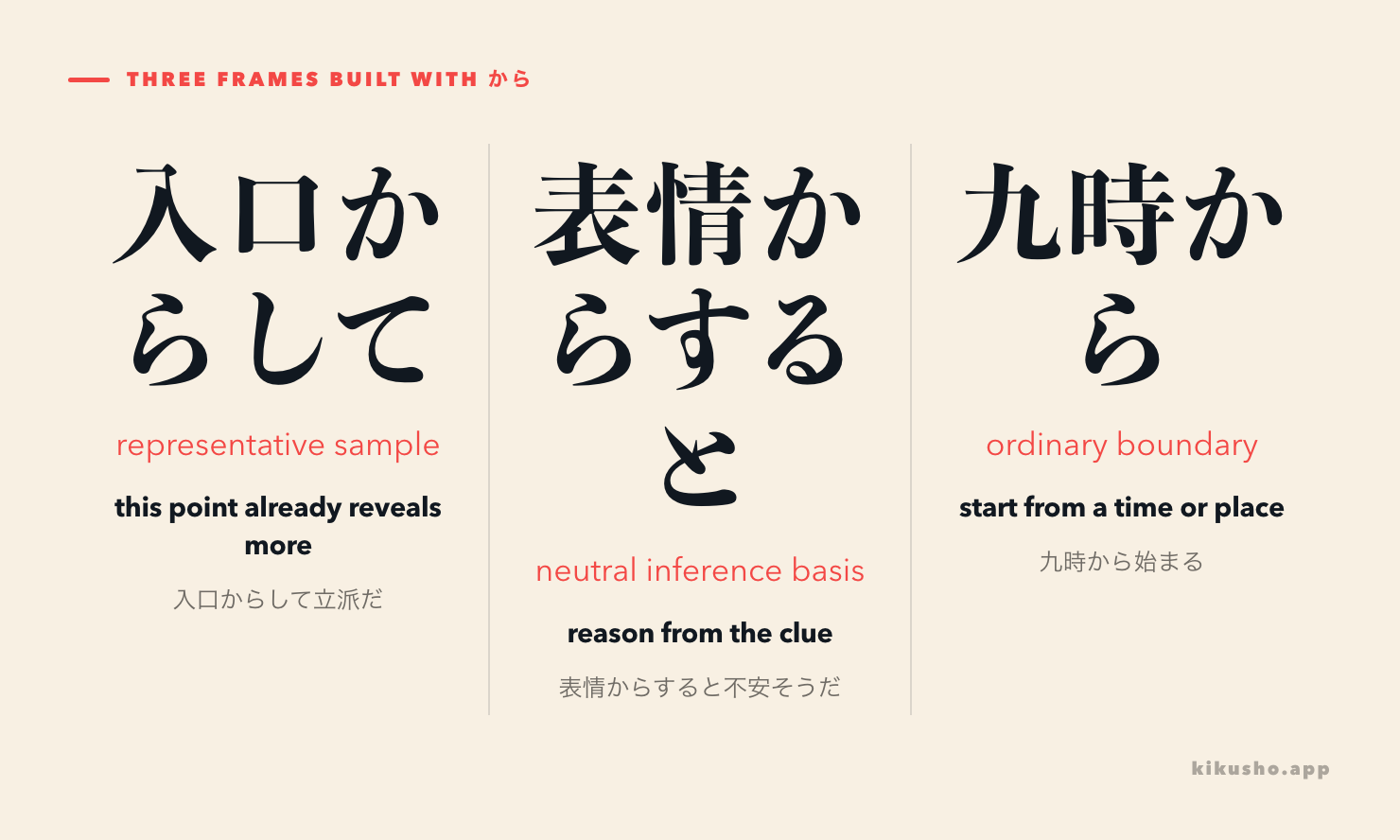
The full から言うと, から見ると and からすると lesson compares criterion, viewpoint and inference. Add からして when the chosen clue or sample itself deserves emphasis.
Plain から does not automatically evaluate anything
Basic から can mark a place, time or source:
会議は九時から始まります。
かいぎは くじから はじまります。
The meeting starts at nine.
That sentence locates the start time. It does not use nine o'clock as evidence for a larger judgment.
Now compare:
この会議は開始時間からして無理があります。
このかいぎは かいしじかんからして むりが あります。
This meeting is unreasonable starting with its scheduled start time.
Here the start time is one representative defect. More problems may follow. Even 最初からして does not merely mean “from the beginning”; in a sentence such as 最初からしておかしかった, the beginning is singled out as the first revealing problem.
からして is not the same as さえ
Both can lead to English “even,” but their jobs differ.
名前さえ知りません。
なまえさえ しりません。
I do not even know the name.
名前からして怪しいです。
なまえからして あやしいです。
The name itself already seems suspicious.
さえ marks an extreme or minimal item within a scale. からして treats the noun as a sample or clue for an evaluation. The さえ~ば lesson explains how さえ can make one condition sufficient; からして instead tells the reader where the speaker's wider judgment begins.
Register and responsible use
からして appears in conversation, reviews, criticism, analysis and explanatory writing. It is useful when the speaker wants the reader to notice why one feature is diagnostic. Because it easily generalizes from a single point, it can sound judgmental when applied to a person: 服装からして信用できない draws a broad conclusion from clothing alone.
Keep the logical link visible in study examples. In Kikusho, save 入口からして高級そうだ or 声からして若い人だろう, rather than the isolated gloss “judging from.” The full phrase shows whether the noun is a representative part or an evidence cue.
Practice
Classify the selected noun as a representative sample, a clue, or a plain starting point across all six items before opening the explanations.
Question 1
Choose the form that says the lobby is already a representative sign of the whole hotel.
このホテルはロビー__豪華です。
ア. から
イ. からして
ウ. にして
エ. として
Question 2
Which sentence uses からして as evidence for an inference?
ア. 電車は東京から出ます。
イ. 会議は午後からです。
ウ. 声からして、相手は若い人でしょう。
エ. 家から駅まで歩きます。
Question 3
What wider implication is most natural?
この説明書は最初の一文からして分かりにくい。
ア. Only the first sentence is difficult.
イ. The first sentence is a representative sign that the manual is difficult.
ウ. The manual became easy after the first sentence.
エ. The speaker began reading at one o'clock.
Question 4
Arrange the chunks into a sentence that judges the plan from its cost.
__ __ __ __。
- 実現は\
- この計画は\
- 難しいです\
- 費用からして
Question 5
Explain the difference between the two sentences.
A. 会議は九時から始まります。
B. この会議は開始時間からして無理があります。
Question 6
Read the passage. Is the judgment positive or negative, and which feature supports it?
あの旅館は入口からして落ち着いた雰囲気で、部屋にも期待できそうです。
Answers and explanations
Answer 1
イ. からして. The lobby is selected as one revealing part whose luxury suggests the character of the hotel beyond that single space. Plain から would need an ordinary origin or starting-point relationship.
Answer 2
ウ. The voice is an observable clue, and でしょう presents the conclusion that the caller is probably young. The other sentences use ordinary から for a place or time boundary.
Answer 3
イ. The first sentence is presented as an early representative sample. からして invites the reader to expect that the manual's difficulty extends beyond that one sentence.
Answer 4
2 → 4 → 1 → 3: この計画は費用からして実現は難しいです。Cost is the selected consideration supporting the wider judgment that implementation is difficult.
Answer 5
A uses plain から to mark nine o'clock as the meeting's starting time. B uses からして to select the scheduled start time as one revealing defect that supports a broader negative evaluation of the meeting.
Answer 6
The judgment is positive. The calm atmosphere at the entrance is the representative feature, and it leads the speaker to expect that the rooms will also be good. This confirms that からして is not restricted to criticism.
Common questions
What does からして mean in Japanese?
Nからして selects one noticeable feature or clue and uses it to support a wider evaluation. It can mean even judging from N, starting with N, or N alone tells you. The speaker implies that the selected point is revealing.
How does からして attach?
It attaches directly to a noun or noun phrase: 名前からして, 話し方からして, 入口の雰囲気からして. It does not normally take a complete finite clause before it.
What is the difference between からして and からすると?
Both can mark evidence. からすると neutrally presents a basis for an inference. からして more strongly singles out the clue as revealing or treats it as one representative point from which the wider evaluation is already apparent.
Is からして always negative?
No. It often supports criticism because a bad first sign can imply more problems, but positive examples such as 玄関からして立派だ are natural. The following predicate supplies the positive or negative judgment.