On this page
Use ところに when another event enters a scene at that exact moment: 出かけようとしていたところに、宅配便が届いた, “A delivery arrived just as I was about to leave.” Use ところを見ると when the first situation is evidence for a conclusion: 何度も時計を見ているところを見ると、彼は急いでいるようだ, “Judging from the way he keeps checking the time, he seems to be in a hurry.”
The forms share ところ, but the particles lead the sentence in different directions. に locates the second event in time. を makes the situation the object of 見る, and the speaker reasons from what they observe.
This lesson covers inventory items g-a72e39833740, ところに, and g-447ffd560960, ところを見ると. Bunpro, JLPT Sensei and J-nihongo place the relevant patterns at N2. The Japan Foundation explains the particle contrast without assigning a current JLPT level. These are teaching placements; the JLPT does not publish an exhaustive grammar syllabus.
ところに catches a second event entering the scene
The first clause establishes a scene. The second clause says what appeared or occurred at that point.
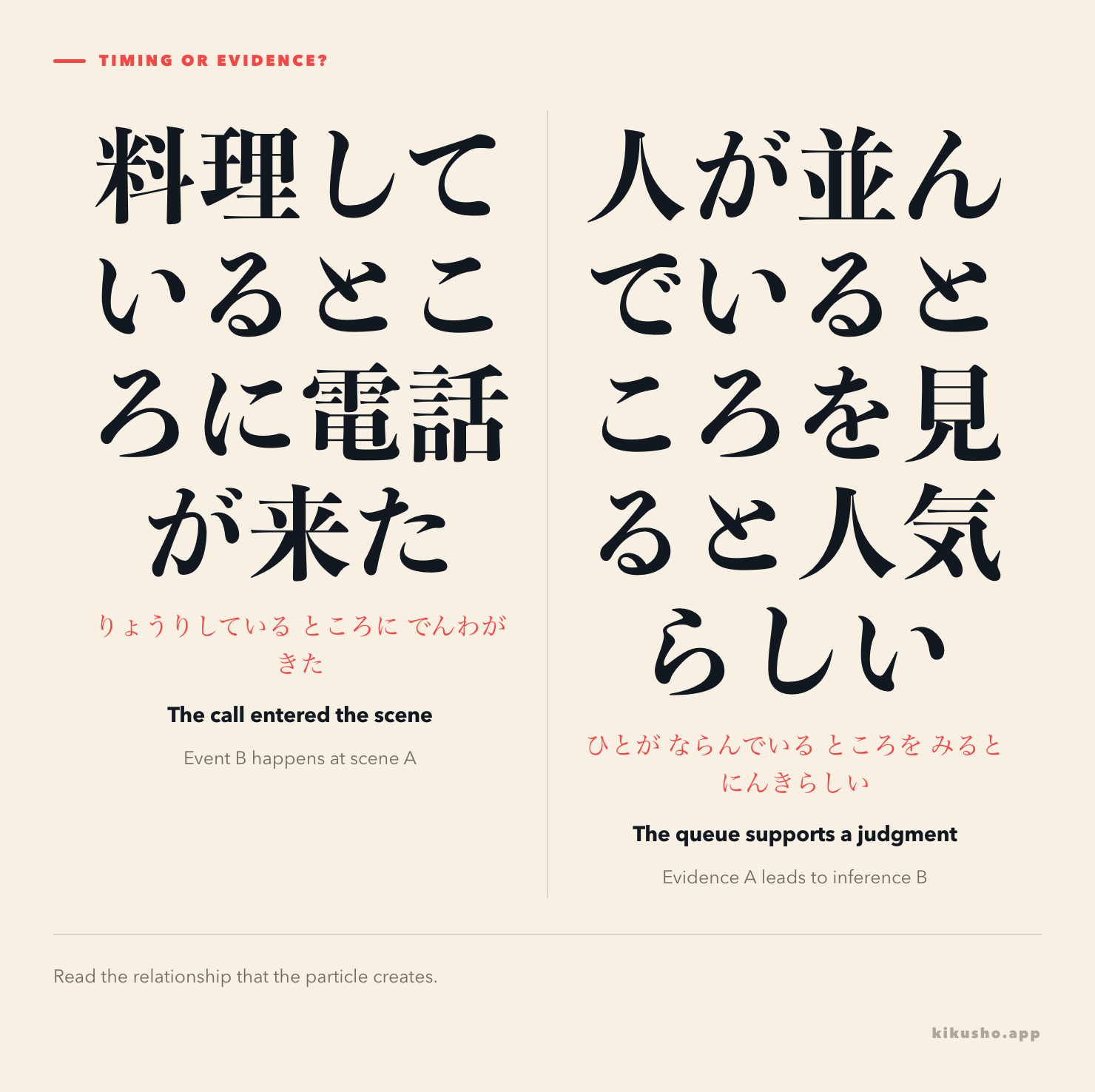
夕食を作っているところに、友人から電話がかかってきた。
ゆうしょくを つくっている ところに、ゆうじんから でんわが かかってきた。
A friend called while I was making dinner.
Plain 夕食を作っているときに would also locate the call during dinner preparation. ところに spotlights the scene into which the call arrived. The Japan Foundation describes this に as marking the destination of an arriving person, object or development; common following verbs include 来る, やって来る, 届く, 電話がかかってくる and 通りかかる.
The incoming event is often unexpected or interrupts what was developing, but surprise is a common effect rather than a fixed translation.
困っていたところに、先輩が声をかけてくれた。
こまっていた ところに、せんぱいが こえを かけてくれた。
Just when I was in trouble, a senior colleague offered to help.
The second event can be welcome. What matters is its timing against the highlighted scene.
The verb form locates the stage of ところに
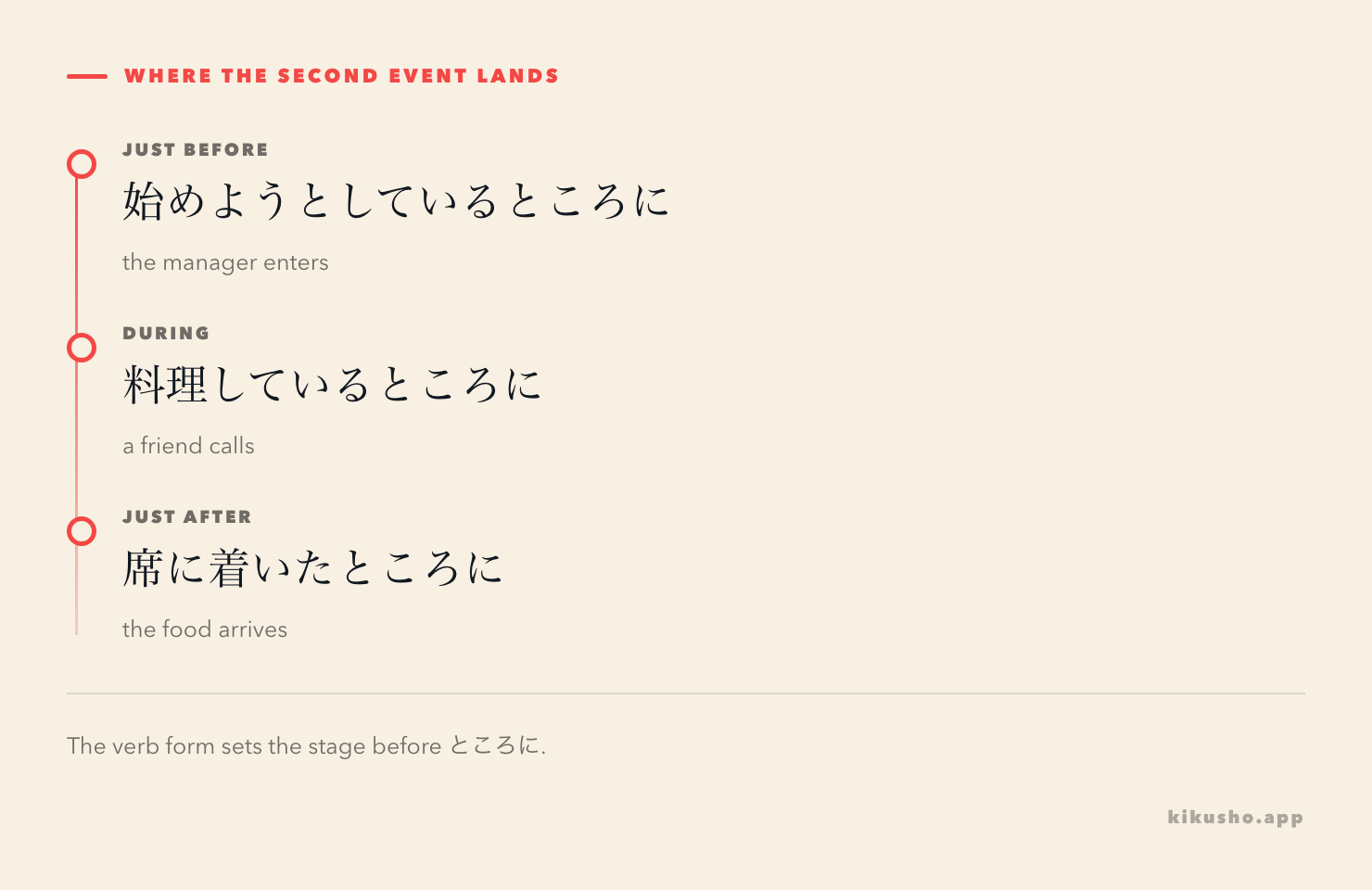
The form before ところ controls whether the scene is just before, during or just after an action.
| Form before ところに | Stage | Example |
|---|---|---|
| Vる / Vようとしている | just before | 出かけようとしているところに |
| Vている | during | 料理しているところに |
| Vていた | scene already underway | 困っていたところに |
| Vた | immediately after | 席に着いたところに |
会議を始めようとしているところに、部長が入ってきた。
かいぎを はじめようとしている ところに、ぶちょうが はいってきた。
The manager came in just as we were about to start the meeting.
席に着いたところに、注文した料理が運ばれてきた。
せきに ついた ところに、ちゅうもんした りょうりが はこばれてきた。
The food we ordered was brought over just after we sat down.
The basic ところ timeline explains how Vる, Vている and Vた select the stage. Adding に lets another event land at that stage.
ところへ makes the arrival image stronger
When something moves or arrives into the scene, ところへ can often replace ところに.
出かけようとしていたところへ、客がやって来た。
でかけようとしていた ところへ、きゃくが やってきた。
A visitor arrived just as I was about to go out.
The Japan Foundation explicitly gives に/へ as alternatives in this use. へ foregrounds direction into the scene; に identifies the time or situation where the arrival occurred. Do not turn this into a strict good-event or bad-event distinction.
ところを見ると turns observation into inference
In ところを見ると, the particle を belongs to the verb 見る. The speaker looks at an aspect, behavior or observable fact and then states what it suggests.
店の前に人が並んでいるところを見ると、人気があるらしい。
みせの まえに ひとが ならんでいる ところを みると、にんきが あるらしい。
Judging from the people lined up outside, the shop appears to be popular.
The queue is evidence. Popularity is the inference. らしい keeps the conclusion appropriately tentative.
机の上に資料が残っていないところを見ると、会議はもう終わったようだ。
つくえの うえに しりょうが のこっていない ところを みると、かいぎは もう おわった ようだ。
Seeing that no documents remain on the desks, the meeting seems to have ended.
A negative observation can also support the reasoning. The form does not require literal eye contact at the moment of speaking, but the basis should be an observable situation rather than pure hearsay.
The conclusion should still sound like a judgment
Common endings in the second clause reveal that the speaker is inferring:
| Ending | Stance |
|---|---|
| ~ようだ | it appears that |
| ~らしい | it seems / apparently |
| ~だろう/でしょう | probably |
| ~かもしれない | perhaps |
| ~のかな | I wonder if |
返事が来ないところを見ると、まだ決めていないのかもしれない。
へんじが こない ところを みると、まだ きめていないのかもしれない。
Judging from the lack of a reply, perhaps they have not decided yet.
A bare categorical claim can sound too certain when one observed detail is the only basis. Bunpro notes that だろう, かも, でしょう and similar forms commonly appear because the construction presents a subjective conclusion.
Use the second clause to identify the pattern
When a long clause hides the particle, inspect what follows.
| After the pattern | Likely relationship |
|---|---|
| 来た, 届いた, 電話がかかってきた | an event entered the scene: ところに/へ |
| ようだ, らしい, だろう, かもしれない | a conclusion from evidence: ところを見ると |
レポートを書いているところに、パソコンが止まった。
レポートを かいている ところに、パソコンが とまった。
The computer froze while I was writing the report.
夜遅くまでレポートを書いているところを見ると、締め切りが近いのだろう。
よる おそくまで レポートを かいている ところを みると、しめきりが ちかいのだろう。
Judging from the fact that they are writing the report late at night, the deadline is probably near.
The first sentence narrates two events. The second observes one event and reasons about an unseen cause.
ところを見ると and からすると take different evidence shapes
ところを見ると naturally follows a clause that depicts behavior or a situation. からすると/からすれば commonly follows a noun naming the evidence, standard or viewpoint.
彼が何度も時計を見ているところを見ると、急いでいるようだ。
かれが なんども とけいを みている ところを みると、いそいでいる ようだ。
Judging from how he keeps checking his watch, he seems to be in a hurry.
この成績からすると、合格できる可能性が高い。
この せいせきから すると、ごうかくできる かのうせいが たかい。
Judging from these grades, the chance of passing is high.
The first focuses on an observable action. The second uses 成績 as a body of evidence. They overlap in English, but their attachment points differ.
The related と見える and と見えて lesson also draws conclusions from outward evidence. ところを見ると explicitly packages the observed situation before the judgment; と見えて often connects an inferred state to a following visible consequence.
Do not confuse ところを見ると with watching an action
The literal sequence Vているところを見る can mean “watch someone while they are doing V.” The conditional と after 見る is what builds the inference frame.
子どもが絵を描いているところを見た。
こどもが えを かいている ところを みた。
I saw the child drawing a picture.
子どもが毎日絵を描いているところを見ると、絵が本当に好きなのだろう。
こどもが まいにち えを かいている ところを みると、えが ほんとうに すきなのだろう。
Judging from the child's drawing every day, they must really like art.
The first reports perception. The second uses the observation as a premise and continues to a conclusion.
Preserve both sides on a study card
Save 困っていたところに先輩が来た as a pair of timed events. For ところを見ると, save the evidence and its cautious conclusion together: 返事がないところを見ると、迷っているのかもしれない. Hiding the second clause during review turns the relationship into the retrieval target.
Practice
1. Choose the event entering the scene
夕食を作っている__、友人から電話がかかってきた。
ア. ところを見ると
イ. ところに
ウ. ところだった
2. Choose the evidence-based conclusion
店の前に長い列ができている__、かなり人気があるらしい。
ア. ところに
イ. ところを見ると
ウ. ところへ来ると
3. Identify the stage
会議を始めようとしているところに、部長が入ってきた。
When did the manager enter?
ア. Just before the meeting began.
イ. While the meeting was ending.
ウ. After everyone had left.
4. Build the inference
Put all four pieces in order.
ア. 急いでいるようだ イ. 彼が ウ. ところを見ると エ. 何度も時計を見ている
5. Choose the form with noun-based evidence
__、今年は売上が伸びそうだ。
ア. この注文数からすると
イ. この注文数ところを見ると
ウ. この注文数にところに
6. Distinguish perception from inference
Which sentence means “I saw the child drawing,” without adding a conclusion?
ア. 子どもが絵を描いているところを見た。
イ. 子どもが絵を描いているところを見ると、絵が好きなのだろう。
7. Follow the office narrative
山田さんは出社するとすぐ机を片づけ始めた。箱に私物を入れ、名札も外している。その様子__、今日で会社を辞めるのかもしれない。
ア. ところに
イ. ところへ
ウ. ところを見ると
First decide whether the packing supplies a timestamp or a clue; the numbered reasoning follows beneath the disclosure.
Answers and explanations
- イ. ところに. The phone call occurred during the highlighted dinner-preparation scene. ア would require the second clause to state an inference drawn from that scene.
- イ. ところを見ると. The queue is observable evidence, and 人気があるらしい is the tentative conclusion. ところに would instead locate another event at the scene.
- ア. Just before the meeting began. 始めようとしている presents the group on the verge of starting, and the manager's entrance lands at that moment.
- イ–エ–ウ–ア: 彼が何度も時計を見ているところを見ると、急いでいるようだ. The repeated checking is the evidence; ようだ marks the inference.
- ア. この注文数からすると. 注文数 is a noun naming the evidence, so noun plus からすると fits directly. The other two choices combine the noun and ところ patterns incorrectly.
- ア. 子どもが絵を描いているところを見た. It ends with the past perception verb 見た. イ adds conditional と and a conclusion with だろう, creating the inference pattern.
- ウ. ところを見ると. Packing personal belongings and removing a name badge are observed clues. かもしれない presents resignation as an inference rather than a witnessed fact.
The exact query places two visually similar patterns side by side. The reliable distinction comes from the relationship between clauses: ところに coordinates the timing of two events, while ところを見ると turns the first situation into evidence for the speaker's judgment.
This lesson was reviewed for both inventory items, before-during-after attachment with ところに, the に/へ alternation, observable positive and negative evidence with ところを見ると, tentative conclusion endings, and the boundaries with literal perception, basic temporal ところ, からすると and と見える. The final language pass verified each example and every exercise against that timing-versus-evidence distinction.
Common questions
What is the difference between ところに and ところを見ると?
ところに places a second event at the exact scene or moment described before it. ところを見ると treats the preceding observable situation as evidence and introduces the speaker's inference.
What forms can come before ところに?
A verb form locates the stage: Vる or Vようとしている can mark just before, Vている marks during, and Vた marks just after. The following clause gives the event that entered or occurred at that scene.
What usually follows ところを見ると?
The result commonly contains an inference marker such as ようだ, らしい, だろう, かもしれない or のかな. These endings show that the speaker is judging from evidence rather than reporting a proven fact.
Can ところに be replaced by ところへ?
Often yes when the second clause describes a person, object, message or event arriving into the scene. へ makes the directional image especially clear; に marks the moment or situation where it occurs.