On this page
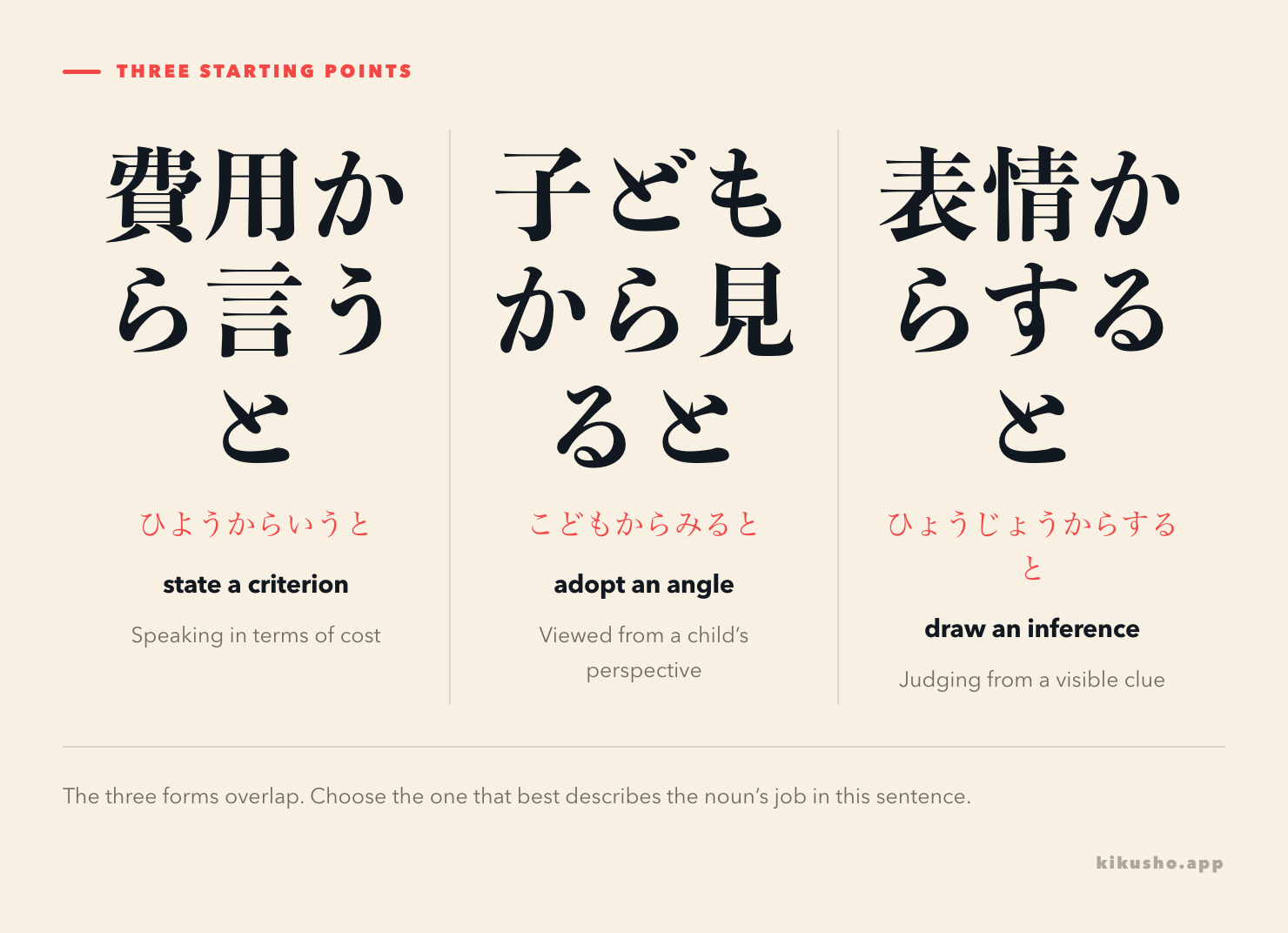
から言うと usually states an opinion from a chosen criterion, から見ると adopts an observer's or evaluative angle, and からすると often draws a conclusion from a clue or circumstance. All three can mean “from the standpoint of” and they overlap, so first identify what the noun before から is doing.
費用から言うと、この案が一番現実的だ。
ひようからいうと、このあんがいちばんげんじつてきだ。
In terms of cost, this proposal is the most realistic.
初心者から見ると、この説明は少し難しい。
しょしんしゃからみると、このせつめいはすこしむずかしい。
From a beginner's point of view, this explanation is a little difficult.
表情からすると、結果に納得していないようだ。
ひょうじょうからすると、けっかになっとくしていないようだ。
Judging from that expression, the person does not seem satisfied with the result.
Cost is a criterion the speaker names. A beginner is the holder of a viewpoint. A facial expression is evidence from which the speaker infers an unseen attitude.
Ask what kind of starting point the noun provides
All three patterns turn noun A into the starting point for judgment B:
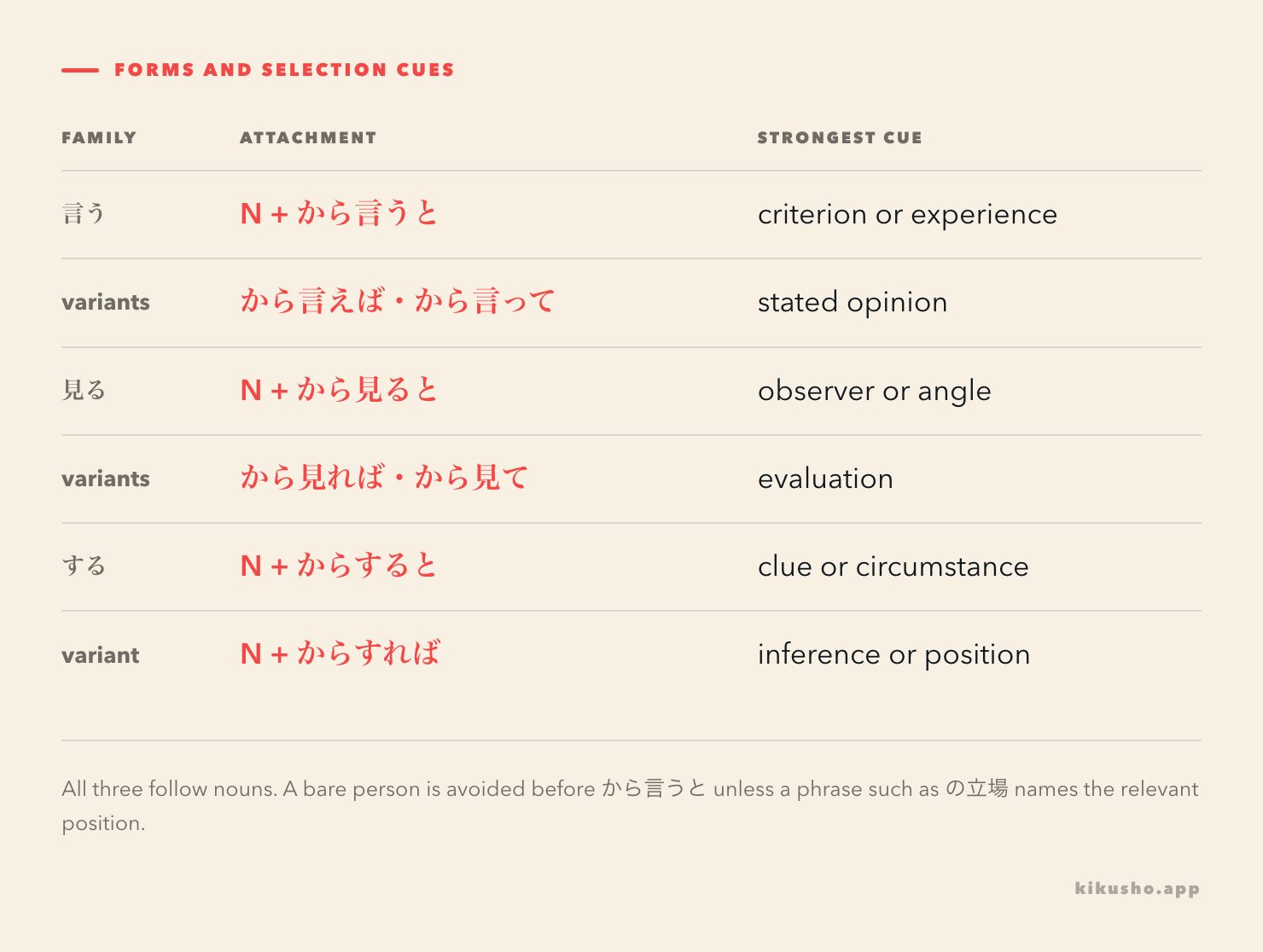
| Main tendency | Pattern | Useful English cue |
|---|---|---|
| select a criterion, domain or experience and state an opinion | N + から言うと | speaking in terms of A |
| adopt an observer's position or evaluate something through an angle | N + から見ると | viewed from A |
| use a clue, data or circumstances to infer a conclusion | N + からすると / からすれば | judging from A |
This table gives you a production default, not a promise that only one form can ever fit. 経験, 成績, 専門家の立場 and similar nouns can support more than one viewpoint. The verb inside the expression changes which relationship receives attention.
から言うと names what you are speaking in terms of
Use Nから言うと when the noun supplies the criterion, domain or experience behind a stated evaluation.
使いやすさから言うと、前の機種のほうがよかった。
つかいやすさからいうと、まえのきしゅのほうがよかった。
In terms of ease of use, the previous model was better.
私の経験から言うと、最初の一週間が一番大変だった。
わたしのけいけんからいうと、さいしょのいっしゅうかんがいちばんたいへんだった。
Speaking from my experience, the first week was the hardest.
The speaker makes the frame explicit before giving an opinion. Common nouns include 価格, 費用, 安全性, 便利さ, 経験, 結果 and 法律. The pattern is not limited to literal speech; 言う marks the standpoint from which the statement is framed.
A bare person noun is a poor default here. Avoid using 田中さんから言うと simply for “from Tanaka's point of view.” Name the relevant position instead:
専門家の立場から言うと、その判断には問題がある。
せんもんかのたちばからいうと、そのはんだんにはもんだいがある。
Speaking from an expert's standpoint, there is a problem with that judgment.
Bunpro's から言うと reference gives N + から言うと, から言えば and から言って, and explicitly cautions against a bare person name while allowing person + の立場. JLPT Sensei's lesson independently gives the N2 study placement and criterion-based uses with ability, experience and personality.
Do not turn the caution into an excessive ban. A person can appear inside a noun phrase that specifies the relevant standpoint, as in 親の立場から言えば. What the construction resists is treating a bare name as a simple information source or viewpoint holder.
から見ると places the judgment at an observer's angle
Nから見ると is the natural member when A is the person or group whose view you adopt.
子どもから見ると、大人の一日は長く感じられるかもしれない。
こどもからみると、おとなのいちにちはながくかんじられるかもしれない。
From a child's point of view, an adult's day may feel long.
海外の利用者から見ると、この案内は分かりにくい。
かいがいのりようしゃからみると、このあんないはわかりにくい。
From the perspective of overseas users, this guide is difficult to understand.
It also works with an angle from which something can be inspected or evaluated:
外から見ると、建物は新しそうだ。
そとからみると、たてものはあたらしそうだ。
Seen from outside, the building looks new.
売上の推移から見ると、需要は少しずつ回復している。
うりあげのすいいからみると、じゅようはすこしずつかいふくしている。
Viewed through the sales trend, demand is gradually recovering.
The second type can approach evidence-based judgment, which is why から見ると often overlaps with からすると. The difference is one of framing: 見る presents the evidence as an angle for viewing or evaluation; する more readily presents it as the basis from which the conclusion is inferred.
Bunpro's から見ると entry lists から見れば, から見て and から見たら beside the target form and places the family at N2. A Japanese-teacher reference, 毎日のんびり日本語教師, independently distinguishes a person-based viewpoint from a situation or state used as the angle of judgment, while assigning the pattern to N3. That level difference is another reminder that provider lists are editorial.
からすると turns clues or circumstances into an inference
Use Nからすると or Nからすれば when the following clause sounds like a conclusion reached from A.
話し方からすると、かなり緊張しているようだ。
はなしかたからすると、かなりきんちょうしているようだ。
Judging from the way the person is speaking, they seem quite nervous.
荷物の重さからすれば、本は三冊以上入っているだろう。
にもつのおもさからすれば、ほんはさんさついじょうはいっているだろう。
Judging from the weight of the luggage, there are probably at least three books inside.
The frequent endings ようだ, そうだ, らしい, だろう and はずだ fit because the speaker is not directly reporting the hidden fact. The clue supports a judgment about it.
The noun can also name a broader standpoint:
会社からすると、この変更には大きな費用がかかる。
かいしゃからすると、このへんこうにはおおきなひようがかかる。
From the company's standpoint, this change will involve a large cost.
This use overlaps with person-based から見ると. Choose からすると when you want “considering A's position or circumstances”; choose から見ると when the viewpoint itself is the image you want the reader to hold.
Bunpro's からすると・からすれば lesson analyzes the noun as the basis on which the speaker makes an evaluation and places the pattern at N2. The reviewed J-nihongo comparison also groups personal position, materials, circumstances and standards as bases for evaluation or supposition. These broad descriptions explain why a rigid one-to-one rule would be misleading.
In the overlap, preserve the writer's chosen metaphor
Compare three sentences about the same set of scores:
平均点から言うと、今年の試験は難しかった。
In terms of the average score, this year's exam was difficult.
過去五年の成績から見ると、今年の結果は低い。
Viewed against the last five years of results, this year's result is low.
今回の成績からすると、合格者は少ないだろう。
Judging from this set of results, there will probably be few successful candidates.
The facts may be similar. 言う foregrounds the criterion being discussed, 見る the comparative angle through which the result is viewed, and する the evidence-to-conclusion step. In many real sentences, replacing one with another would remain grammatical but shift the emphasis.
The variants inside each family usually preserve that core relationship. から言えば and から言って remain criterion frames. から見れば, から見て and から見たら remain viewing frames. からすれば and conversational からしたら remain considering or inference frames. Do not try to derive a large certainty scale from と, ば and たら alone; the noun and the conclusion carry more of the practical difference.
These forms do not report what a source said
新聞によると means “according to the newspaper” and attributes information to a source. 新聞からすると means that the speaker treats some feature of the newspaper as the basis for a judgment. They are not interchangeable.
新聞によると、選挙は来月行われる。
According to the newspaper, the election will take place next month.
紙の色からすると、この新聞はかなり古いようだ。
Judging from the colour of the paper, this newspaper seems quite old.
The によると and によれば lesson develops source attribution. The にとって lesson covers a different viewpoint relationship: 私にとって大切だ evaluates how something matters to me, while 私から見ると不自然だ presents my angle on what I observe.
Capture the inferential hinge rather than an isolated gloss. In Kikusho, 足跡からすると、動物は山へ向かったらしい preserves the clue and the conclusion; からすると = judging from alone cannot show whether the missing noun is evidence, a viewpoint holder or a reported source.
Practice: identify the relationship before the translation
Complete all six tasks before opening the answers.
Question 1 — stated criterion. Choose the form that frames price as the criterion being discussed.
価格__、こちらの機種のほうが買いやすい。
- ア. によると
- イ. から言うと
- ウ. にとって
- エ. として
Question 2 — observer's viewpoint. Choose the natural form for “from a child's point of view.”
子ども__、この階段はとても高い。
- ア. から見ると
- イ. から言うと
- ウ. によると
- エ. を通じて
Question 3 — inference from a clue. The speaker sees wet umbrellas and infers that it is raining. Complete the sentence.
入口の傘__、外は雨らしい。
- ア. として
- イ. から言って
- ウ. からすると
- エ. にとって
Question 4 — sentence composition. Arrange the chunks into “Speaking from my experience, changing the plan now would be risky.” Use each once.
- 今計画を変えるのは危険だ
- 私の経験
- から言うと
Question 5 — source or inference. Which sentence reports the forecast's information rather than making a separate inference from visible conditions?
- ア. 空の様子からすると、午後は雨らしい。
- イ. 天気予報によると、午後は雨だそうだ。
- ウ. 私から見ると、午後は雨だ。
- エ. 費用から言うと、午後は雨だ。
Question 6 — three viewpoints in context. Choose the pair that first adopts the user's perspective, then infers a problem from the test data.
初めて使う人__、この画面は複雑だ。テストの結果__、説明を短くする必要がありそうだ。
- ア. から言うと/によると
- イ. から見ると/からすると
- ウ. からすると/にとって
- エ. によると/から見ると
Answers and explanations
Answer 1. イ, から言うと. Price is the criterion from which the speaker evaluates ease of purchase. によると would require price to be an information source, while にとって and として express different relationships.
Answer 2. ア, から見ると. A child is the holder of the viewpoint through which the stairs are evaluated. A bare person noun is not the production default for から言うと, and neither によると nor を通じて supplies this perspective.
Answer 3. ウ, からすると. The umbrellas are observable evidence for the inference marked by らしい. から言って normally frames a criterion or experience, and the other choices do not connect a clue to a conclusion.
Answer 4. 私の経験から言うと、今計画を変えるのは危険だ. The experience noun supplies the basis from which the speaker states an opinion about changing the plan.
Answer 5. イ. によると attributes the rain prediction to the forecast, and そうだ marks reported information. Sentence ア makes the speaker infer rain from the sky's appearance; the other two frames do not express source attribution.
Answer 6. イ, から見ると/からすると. The first sentence adopts the viewpoint of a first-time user. The second treats test results as evidence supporting a proposed change.
Level and review note
JLPT Sensei places から言うと, から見ると and からすると/からすれば at N2. Bunpro currently places から見ると and からすると/からすれば at N2 but から言うと at N3; 毎日のんびり日本語教師 also places から見ると at N3. Kikusho retains the assigned N2 curriculum grouping and records those provider disagreements.
The official JLPT FAQ states that the test does not publish exhaustive grammar, vocabulary or kanji lists. The useful skill is the relationship in the sentence: criterion, viewing angle, inference or reported source.
OpenAI Codex, acting as an AI agent, checked the final lesson's noun attachments, deliberately overlapping cases, original sentences and exercise keys. This page has not received a human Japanese-language review.
Common questions
What is the difference between から言うと, から見ると and からすると?
から言うと commonly selects a criterion or experience from which the speaker states an opinion. から見ると presents an observer or evaluative angle. からすると often treats a clue, circumstance or standpoint as the basis for an inference. The meanings overlap, so these are selection tendencies rather than three absolute rules.
What comes before these three patterns?
All three follow a noun or noun phrase: 価格から言うと, 子どもから見ると and 表情からすると. A bare person name is normally avoided before から言うと; use a phrase such as 専門家の立場から言うと instead.
What variants of から言うと and から見ると are common?
から言えば and から言って belong to the から言うと family. から見れば, から見て and から見たら belong to the から見ると family. からすれば is a central alternative to からすると.
Are these patterns N2 grammar?
JLPT Sensei places all three target items at N2. Bunpro places から見ると and からすると at N2 but currently teaches から言うと at N3. These are editorial placements because the JLPT does not publish an exhaustive grammar list.