On this page
AかのようにB says that B looks, sounds or happens as if the imagined situation A were true. In 彼は何も知らないかのように話した, “he spoke as if he knew nothing,” the speaker compares his manner of speaking with ignorance without asserting that he truly knew nothing.
JLPT Sensei places かのように at N2 and gives the three useful endings かのように, かのような and かのようだ. Bunpro also classifies かのようだ at N2 and distinguishes its strong hypothetical comparison from the more neutral resemblance of ordinary よう. The level labels are editorial preparation guides; no exhaustive official JLPT grammar list exists.
AかのようにB builds an imagined comparison
The clause before かのように supplies a scene. The following statement describes something that resembles that scene.
会場は、時間が止まったかのように静かになりました。
かいじょうは、じかんが とまったかのように しずかに なりました。
The venue became quiet as if time had stopped.
Time did not literally stop. Its stopping is the comparison used to make the silence vivid. The pattern often appears when the imagined scene is impossible, exaggerated or known to differ from reality, but falsity is not a grammatical requirement. The speaker may simply avoid committing to whether A is true.
彼女は以前にもここへ来たことがあるかのように、迷わず歩きました。
かのじょは いぜんにも ここへ きたことが あるかのように、まよわず あるきました。
She walked without hesitation as if she had been here before.
The sentence describes her behaviour. It does not settle whether she actually visited before. Context could later confirm or deny that possibility.
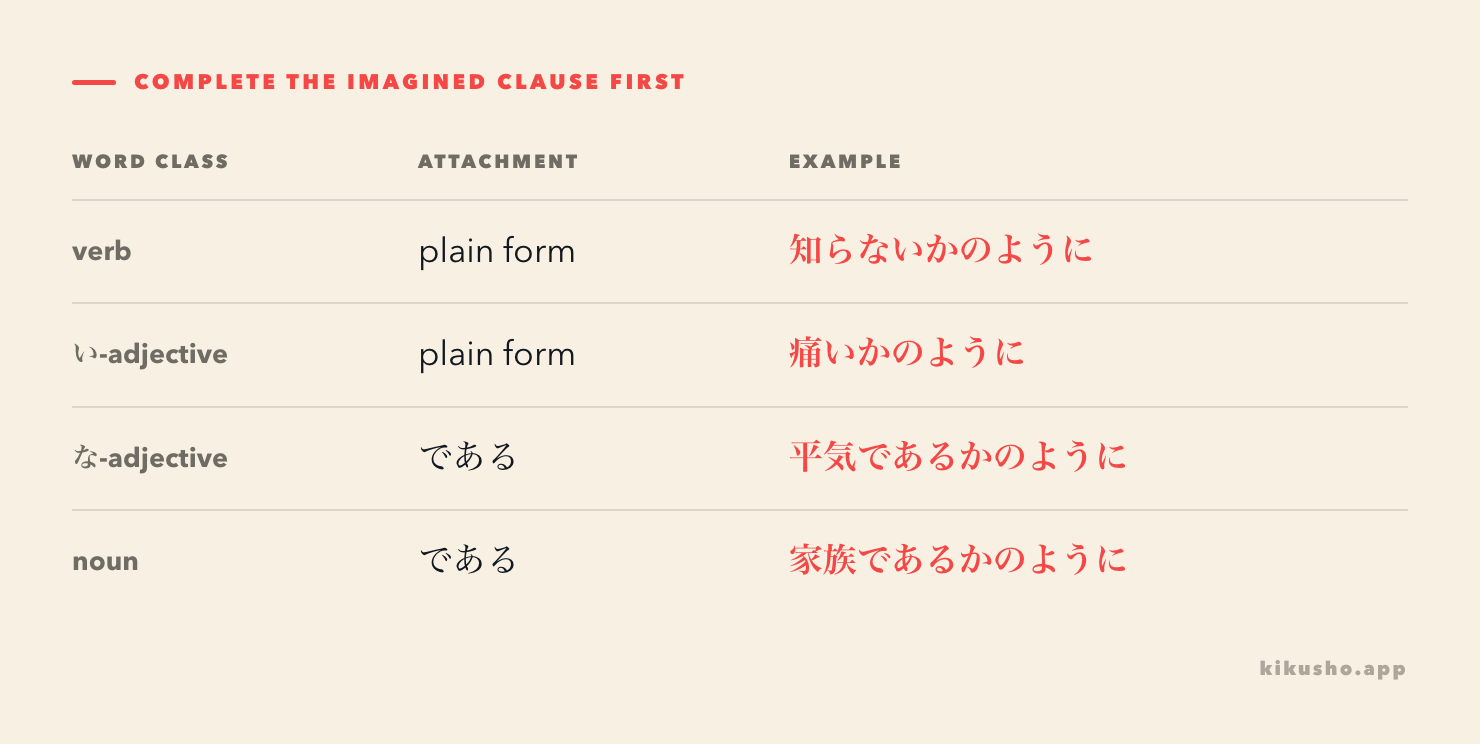
Put a plain clause before かのよう
Verbs and い-adjectives use their plain forms. A present-positive noun or な-adjective usually takes である in the careful N2 pattern.
| Material before かのよう | Formation | Example |
|---|---|---|
| verb | plain verb + かのよう | 知らないかのように |
| い-adjective | plain い-adjective + かのよう | 痛いかのように |
| な-adjective | な-adjective + である + かのよう | 平気であるかのように |
| noun | noun + である + かのよう | 家族であるかのように |
The plain verb can be affirmative, negative, progressive or past:
| Time or polarity | Form | Comparison |
|---|---|---|
| nonpast | 知っているかのように | as if someone knows |
| negative | 知らないかのように | as if someone does not know |
| past | 何もなかったかのように | as if nothing had happened |
| past negative | 聞かなかったかのように | as if someone had not heard |
彼は何もなかったかのように仕事を続けました。
かれは なにも なかったかのように しごとを つづけました。
He continued working as if nothing had happened.
The past form なかった belongs inside the imagined scene. The actual continuation stays in the main clause.
Noun+かのよう also occurs
The explicit Nであるかのよう form is the safest choice for formal writing and test-style attachment. Direct Nかのよう is also attested, especially when the noun itself supplies a compact role or image.
彼はこの部屋を自分の家かのように使っています。
かれは このへやを じぶんの いえかのように つかっています。
He uses this room as if it were his own home.
Chika Sensei's attachment note teaches Nであるかのように as the expected answer while also noting that direct N+かのように is grammatical. For reliable production, use である when you are constructing a full noun or な-adjective clause and learn direct noun examples as combinations you have actually met.
Choose に, な or だ by what follows
The imagined comparison remains the same. The ending changes its sentence job.
かのように leads into a predicate
Use に when the comparison describes how an action happens or what degree a quality reaches.
子どもたちは自分たちが優勝したかのように喜びました。
こどもたちは じぶんたちが ゆうしょうしたかのように よろこびました。
The children celebrated as if they had won.
かのような modifies a noun
Use な when a noun follows.
外では世界が終わるかのような音がしました。
そとでは せかいが おわるかのような おとが しました。
Outside there was a sound as if the world were ending.
The entire clause 世界が終わるかのような describes 音.
かのようだ ends the statement
Use だ or polite です when the comparison is the predicate of the sentence.
雲の上を歩いているかのようでした。
くもの うえを あるいているかのようでした。
It felt as if I were walking above the clouds.
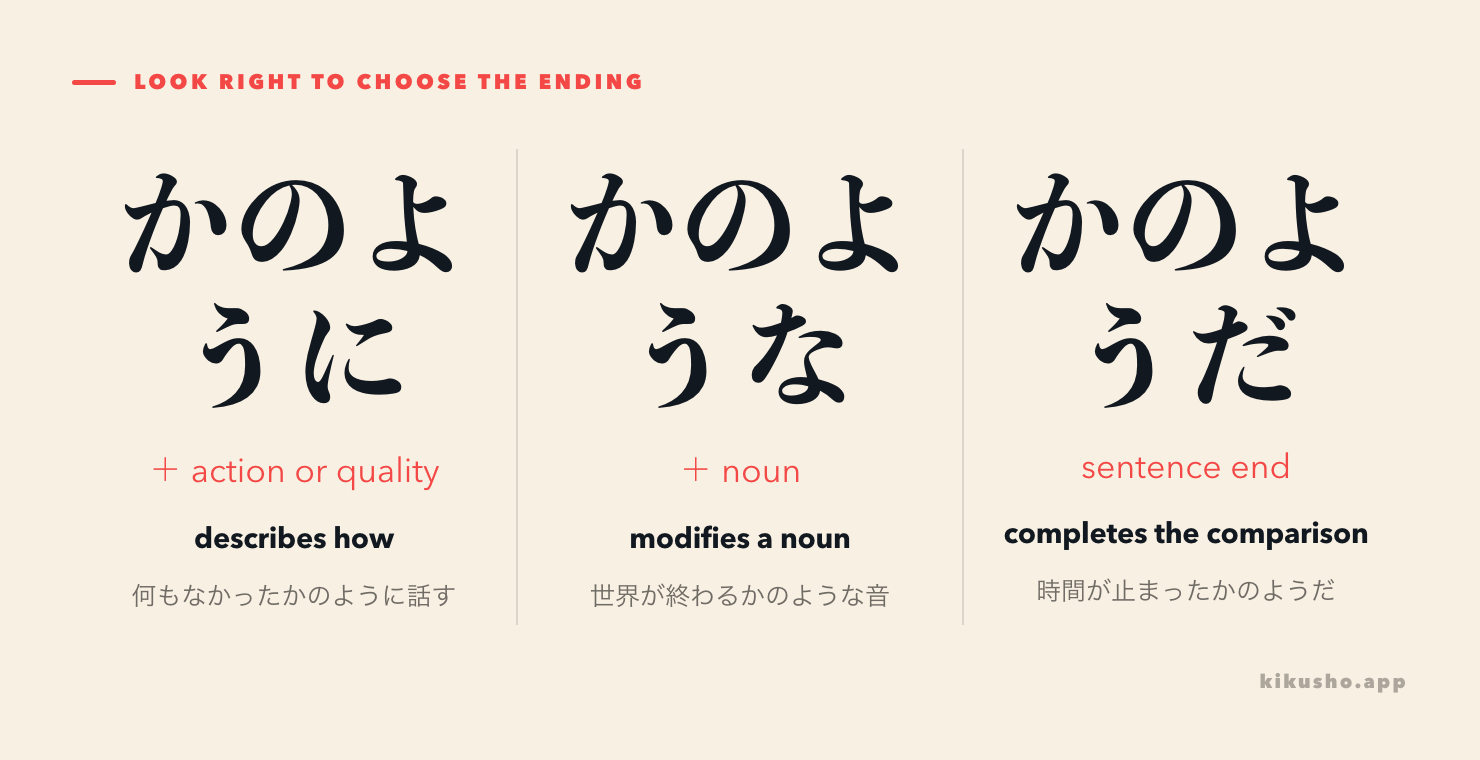
Nihongo-bu's teaching page uses the same division: ように before a following action or quality, ような before a noun, and ようだ at sentence end. Thinking to the right prevents a common mistake: changing the ending according to the word before か instead of the word after よう.
まるで strengthens the comparison
まるで often appears earlier in the sentence and means “just” or “quite,” making the resemblance emphatic.
その知らせを聞いて、彼はまるで夢を見ているかのような顔をしました。
そのしらせを きいて、かれは まるで ゆめを みているかのような かおを しました。
On hearing the news, he made a face as if he were dreaming.
The grammar still works without まるで. It is an emphasis cue rather than a required half of the construction. The earlier lesson on ふりをする and まるで explains why まるで marks resemblance while ふりをする claims that someone deliberately performs an appearance.
かのようだ is stronger than neutral ようだ
Ordinary ようだ has several jobs. It can report an inference based on evidence or make a straightforward comparison. Adding かの foregrounds an imagined proposition and gives the comparison a stronger “as if” quality.
部屋の電気がついています。彼はまだいるようです。
へやの でんきが ついています。かれは まだ いるようです。
The room light is on. It seems that he is still there.
The evidence supports a real possibility. Compare:
彼はこの会社の社長であるかのように命令しました。
かれは このかいしゃの しゃちょうであるかのように めいれいしました。
He gave orders as if he were the president of this company.
The second sentence evaluates his manner by comparing it with an imagined status. It does not infer from evidence that he probably is the president. Review そう, よう, らしい and みたい for the broader evidence system.
Do not confuse it with purpose ように
Both patterns end in ように, but their left sides and meanings differ.
| Sentence | Job of ように |
|---|---|
| 忘れないようにメモしました。 | desired result: I wrote a note so that I would not forget |
| 忘れたかのように何も言いませんでした。 | imagined comparison: said nothing as if they had forgotten |
Purpose ように commonly follows a potential form, negative form or non-volitional outcome and leads to an intentional action. Comparison かのように contains か and describes resemblance. The ように versus ために lesson develops the purpose pattern separately.
Register and viewpoint
かのよう is more literary and deliberate than conversational みたい. It fits narration, essays, news commentary and careful spoken descriptions. In casual conversation, a speaker may prefer みたいに or an ordinary よう comparison.
The pattern reports the current speaker's comparison. When it describes another person's behaviour, avoid turning that comparison into an unsupported accusation. 彼は知らないかのように話した says his manner resembled someone who did not know. It does not by itself prove that he knew and lied. If deliberate pretence is established, 知らないふりをした states that stronger claim.
Save enough context in Kikusho to preserve both halves of the comparison. A card containing only かのように hides what was imagined and what resembled it; 何もなかったかのように仕事を続けた keeps the contrast available during review.
Practice
Decide the attachment, the right-hand ending and the kind of comparison in all six items before revealing the explanations.
Question 1
Choose the safe formal attachment after the noun 家族.
彼は私を本当の家族__かのように助けてくれました。
ア. だ
イ. である
ウ. な
エ. の
Question 2
Choose the ending that modifies the noun 態度.
彼女は何も気にしていないかのよう__態度でした。
ア. に
イ. で
ウ. な
エ. だ
Question 3
Which sentence makes a strong imagined comparison rather than an evidence-based inference?
ア. 足音がするので、誰か来たようです。
イ. 彼はすべてを見てきたかのように語りました。
ウ. 忘れないように予定を書きました。
エ. 雨が降りそうです。
Question 4
Order the four chunks so that his behaviour suggests nothing had happened.
__ __ __ __。
- 話し続けました\
- 何も\
- 彼は\
- なかったかのように
Question 5
Read the pair. Which sentence states deliberate pretence, and which only compares an appearance?
A. ケンは寝たふりをしました。
B. ケンは眠っているかのように静かでした。
Question 6
Read the passage and explain whether the writer confirms that the manager owns the shop.
店長は、自分の店であるかのように家具の位置まで細かく指示しました。しかし、店の所有者については何も書かれていません。
Answers and explanations
Answer 1
イ. である. 家族 is a noun, so 家族であるかのように supplies a complete formal clause before the comparison. Direct 家族かのように can occur, but the question asks for the safe explicit attachment.
Answer 2
ウ. な. The noun 態度 follows, so the comparison must modify it: 気にしていないかのような態度. に would lead into a predicate, and だ would end the comparison.
Answer 3
イ. The speaker compares his manner of speaking with someone who has witnessed everything. ア uses evidence to infer a likely arrival, ウ expresses a desired result, and エ is an appearance prediction with そう.
Answer 4
3 → 2 → 4 → 1: 彼は何もなかったかのように話し続けました。The imagined scene is 何もなかった; かのように then describes how he continued speaking.
Answer 5
A states deliberate pretence. ふりをする says Ken performed the pose of sleep. B only compares his stillness with sleeping; it does not establish intention and remains compatible with him truly being asleep.
Answer 6
No. 自分の店であるかのように compares the manager's detailed directions with the behaviour of an owner. The following sentence explicitly says ownership is not stated, so the comparison cannot be treated as evidence that the manager owns the shop.
Common questions
What does かのように mean in Japanese?
AかのようにB means that B happens in a way that strongly resembles the imagined situation A: as if A were true. The speaker presents a comparison without asserting A as fact, and the context often shows that A is unlikely or contrary to reality.
What is the difference between かのように, かのような and かのようだ?
They share the same comparison. かのように leads into an action or quality, かのような modifies a noun, and かのようだ ends the statement. The material after よう determines the ending.
How does かのように attach to a noun?
The safest formal pattern is noun + である + かのように, as in 家族であるかのように. Direct noun + かのように also occurs, especially in compact comparisons, but である makes the clause structure explicit and is the reliable N2 form.
Is かのように the same as purpose ように?
No. かのように creates an as-if comparison. Purpose ように states a desired result, as in 忘れないようにメモする, meaning to write a note so as not to forget. The か and the surrounding clause identify the comparison pattern.