On this page
A person can walk in a forest, compare trees within a forest, or continue onward through a forest. Japanese does not leave those relations inside the English word “in”: 中を traces a path or demanding setting, 中で locates an event, and 中では highlights the domain in which a statement applies.
Read the particle after 中 before translating
The noun 中(なか) means an interior, a group or the midst of a situation. The particle after it tells you what that interior is doing in the sentence.
| Form | Job of 中 | Typical predicate | Example |
|---|---|---|---|
| Nの中を | route or setting traversed | 歩く, 走る, 進む, 通る | 森の中を歩く |
| Nの中で | location of an event; selection domain | 待つ, 話す, 選ぶ, 一番~ | 部屋の中で待つ |
| Nの中では | highlighted or contrastive scope | rule, evaluation, comparison | 三つの中では一番軽い |
二人は暗い森の中をゆっくり進んだ。
ふたりは くらい もりの なかを ゆっくり すすんだ。
The two of them moved slowly through the dark forest.
二人は森の中で少し休んだ。
ふたりは もりの なかで すこし やすんだ。
The two of them rested for a while in the forest.
The physical place has not changed. In the first sentence, the forest lies along the movement. In the second, it is where the rest occurs.
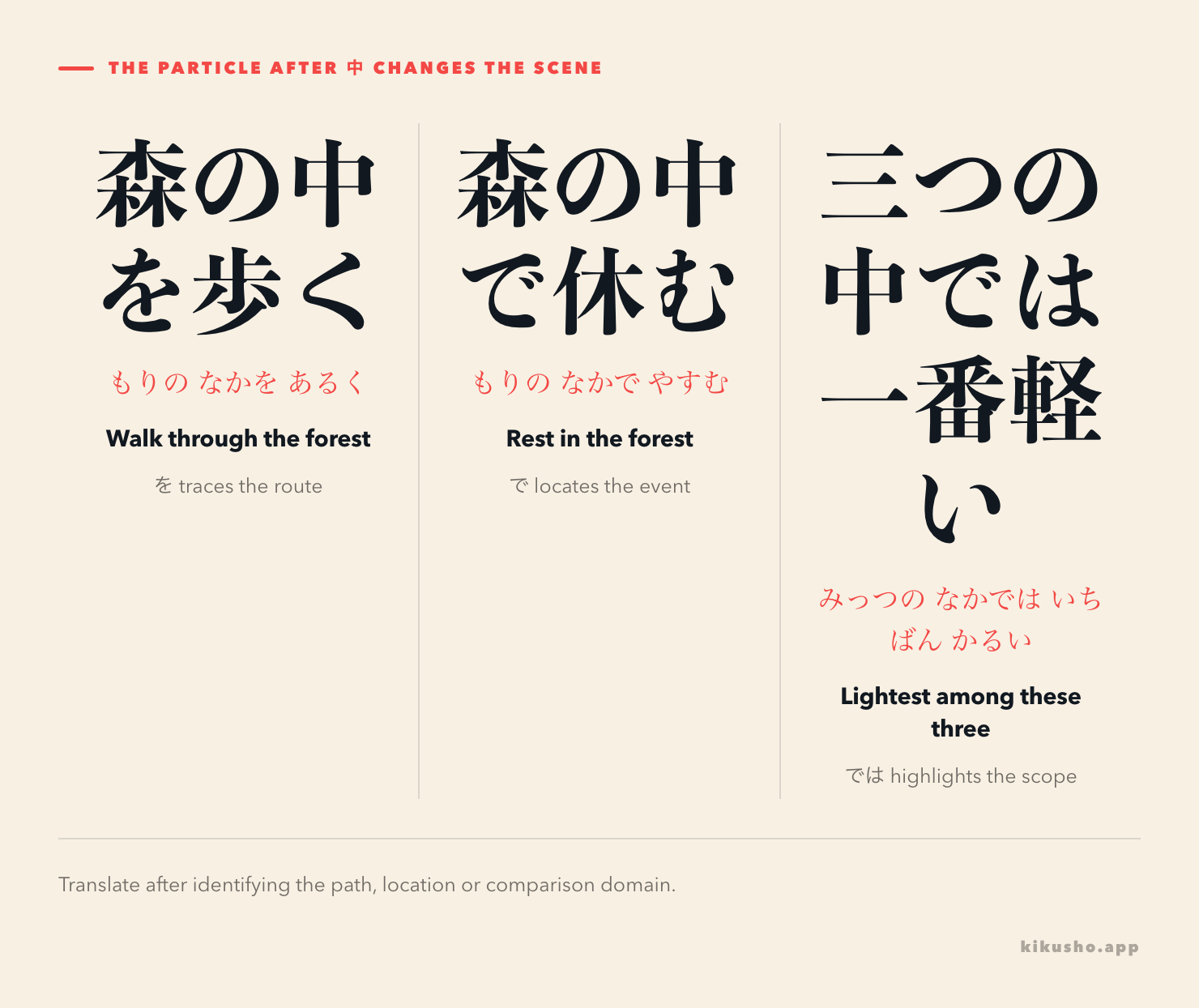
中を follows movement through a space
With verbs of motion, を can mark a path rather than a direct object. The Japan Foundation's route-particle material lists verbs such as 通る, 歩く, 走る, 飛ぶ, 登る, 渡る, 行く and 帰る with this use.
人混みの中を駅の出口まで進んだ。
ひとごみの なかを えきの でぐちまで すすんだ。
I made my way through the crowd to the station exit.
子どもたちは雪の中を走って帰った。
こどもたちは ゆきの なかを はしって かえった。
The children ran home through the snow.
The first noun is not what someone moves. It is the area their movement crosses. This is why a potential sentence keeps を:
この狭い洞窟の中を通れますか。
この せまい どうくつの なかを とおれますか。
Can we pass through this narrow cave?
Changing を to で changes the scene rather than merely changing style. 店の中を歩き回る follows someone's movement around the store. 店の中で友達を待つ locates the waiting there. Bunpro's 中を discussion makes the same route-versus-location distinction with walking inside a house. The 込む and 通す lesson shows how 雨の中を歩き通す adds continuation to this route frame.
A difficult circumstance can become the path
The “interior” need not be a room or forest. Weather, danger, opposition and pressure can surround an action like a space through which someone moves.
激しい雨の中を、救助隊は山へ向かった。
はげしい あめの なかを、きゅうじょたいは やまへ むかった。
The rescue team headed toward the mountain through the heavy rain.
厳しい状況の中を、彼女は一人で生き抜いた。
きびしい じょうきょうの なかを、かのじょは ひとりで いきぬいた。
She survived the harsh circumstances on her own.
The second sentence extends the path image from geometry to a period of hardship. を makes the adverse setting feel like something endured from one side to the other. Plain 厳しい状況の中で暮らした simply locates the life within those circumstances and is less directional.
A courteous formula uses the same framing:
お忙しい中をお越しいただき、ありがとうございます。
おいそがしい なかを おこしいただき、ありがとうございます。
Thank you for coming despite being busy.
Here 忙しい modifies 中 directly. The visitor's busy circumstances are treated as the setting they crossed in order to come. JLPT Sensei's 中を/中では entry records this polite use alongside physical movement examples.
Do not turn 中を into a general substitute for “during.” A static or ordinary activity usually needs で:
- 会議の中で意見を述べた: stated an opinion during the meeting
- 図書館の中で勉強した: studied inside the library
- 箱の中で猫が寝ている: a cat is sleeping in the box
None of those predicates traverses the setting. Using を would demand a route-like reading that the sentence does not provide.
中では puts a boundary around the claim
で marks a location or domain. Adding は makes that domain the contrastive topic: the statement is valid within this boundary, perhaps unlike elsewhere.
図書館の中では静かにしてください。
としょかんの なかでは しずかに してください。
Please be quiet inside the library.
The request is scoped to the library interior. It does not claim that silence is required everywhere.
この地域の中では、この町の人口が最も多い。
この ちいきの なかでは、この まちの じんこうが もっとも おおい。
Within this region, this town has the largest population.
The boundary matters because 最も needs a set over which the comparison is made. 中で can also establish that set:
この地域の中で、この町の人口が最も多い。
Within this region, this town has the largest population.
Both are possible. 中では puts extra contrast on the selected domain: this result holds within the region under discussion, even if a wider comparison would differ. 中で presents the comparison more neutrally.
This scope use works especially well in questions:
日本酒の中では、どれが一番おすすめですか。
にほんしゅの なかでは、どれが いちばん おすすめですか。
Among the sake options, which do you recommend most?
The set can contain people, objects, places or experiences. Iku's 中で reference verifies the comparison scope with families, classes, seasons and candidates. は does not create the set; it highlights the boundary already marked by で.
Clauses and adjectives can describe the surrounding 中
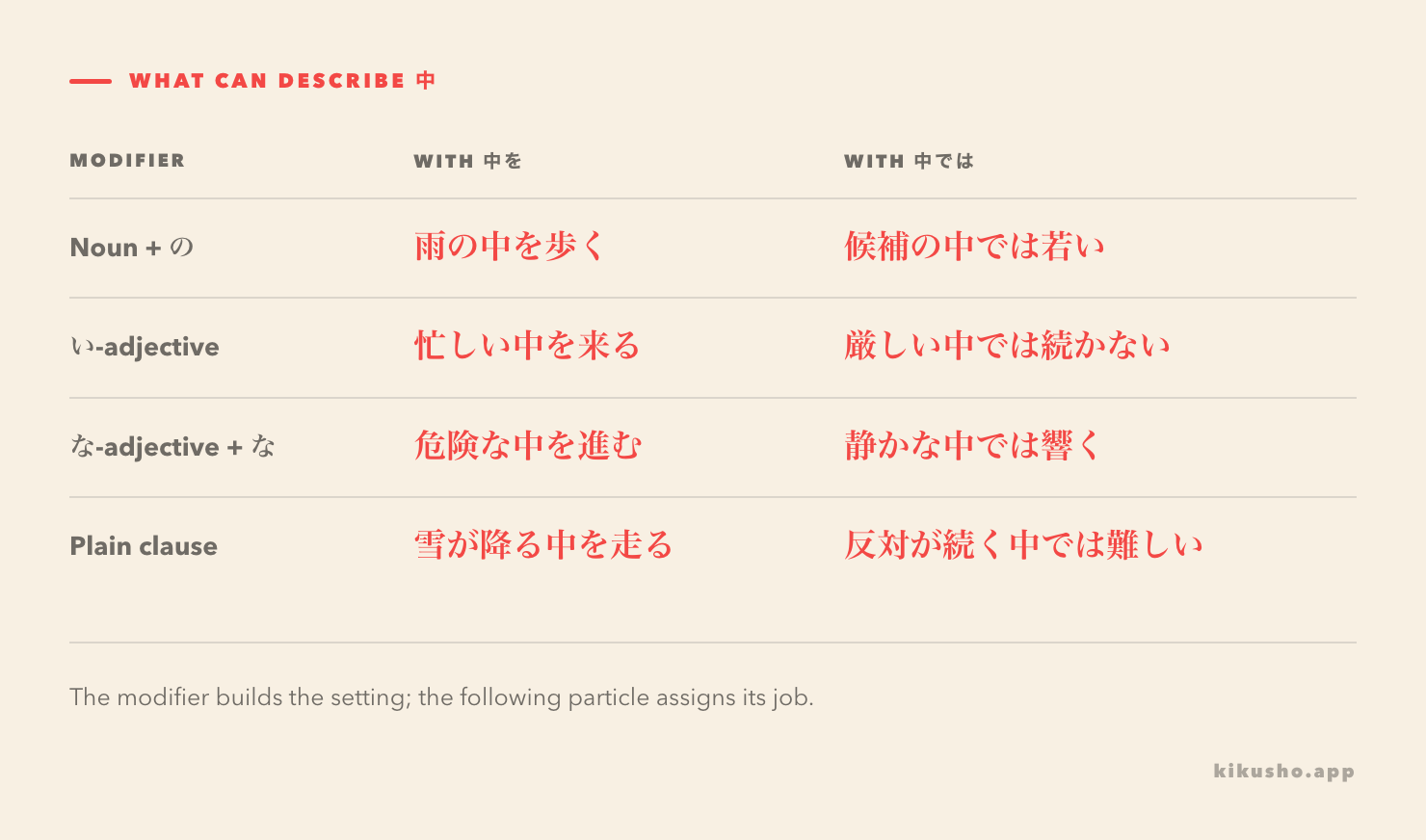
A noun followed by の is the easiest frame, but 中 can also be modified by an adjective or a complete clause:
| Modifier | 中を example | 中では example |
|---|---|---|
| N+の | 雨の中を歩く | 候補の中では若い |
| い-adjective | 忙しい中を来る | 厳しい中では続けにくい |
| な-adjective+な | 危険な中を進む | 静かな中では音が響く |
| plain clause | 雪が降る中を走る | 反対が続く中では決めにくい |
雪が降り続く中を、選手たちはゴールへ向かった。
ゆきが ふりつづく なかを、せんしゅたちは ゴールへ むかった。
The athletes headed for the finish while snow kept falling.
意見が大きく分かれる中では、急いで結論を出さないほうがいい。
いけんが おおきく わかれる なかでは、いそいで けつろんを ださない ほうが いい。
While opinions remain sharply divided, it is better not to rush to a conclusion.
The first clause becomes the scene traversed by the athletes. The second becomes the conditions under which the advice applies. This is why memorising both as “in the midst of” is insufficient: the following particle still determines the relation.
Keep 中 separate from 中(ちゅう) and 最中
The reading here is なか. It names an interior, group or surrounding situation. The suffix ~中(ちゅう) marks an activity in progress or a bounded period:
- 会議の中では: within the meeting as a setting or scope
- 会議中は: while the meeting is in progress
- 午前中は: during the morning
最中(さいちゅう) focuses even more tightly on the very middle of an event: 会議の最中に電話が鳴った, “The phone rang right in the middle of the meeting.” Do not read 森の中を as もりのちゅうを or replace it with 最中を.
In Kikusho, keep the motion verb or comparison beside 中. A card that stores only 中を = in cannot recover why を appeared. 人混みの中を進む preserves the traversed route; 候補の中では最も若い preserves the limited comparison set. Those are the relations you need to recognize in a longer sentence.
Hane, JLPT Sensei and Bunpro group these uses in N2 study material. The Japan Foundation also teaches route を at an earlier stage, and comparison 中で appears in earlier course sequences. The N2 value lies in choosing among the overlapping frames in complex clauses, not in claiming that the noun 中 itself begins at N2. The test organization does not publish a complete official grammar inventory.
Practice the route, location and scope
Choose from the sentence's relation, then open the explanations below the final prompt.
Question 1
Which particle presents the crowd as the route being crossed? 人混みの中( )駅まで進んだ。
- ア. を
- イ. で
- ウ. では
- エ. に
Question 2
Choose the natural location marker: 子どもたちは体育館の中( )昼ご飯を食べた。
- ア. を
- イ. で
- ウ. から
- エ. へ
Question 3
What does は contribute in この三つの中では、青が一番軽い?
- ア. It marks the blue item as a route.
- イ. It highlights these three as the limited comparison domain.
- ウ. It changes 中 to the reading ちゅう.
- エ. It shows that the comparison happened in the past.
Question 4
Arrange the chunks to say “The rescue team continued through the heavy snow”: 進み続けた / 救助隊は / 激しい雪の中を.
Question 5
Choose the sentence that thanks a visitor for coming despite busy circumstances.
- ア. お忙しい中をお越しいただき、ありがとうございます。
- イ. お忙しい中では寝てください。
- ウ. お忙しい中に比べて、ありがとうございます。
- エ. お忙しい中まで一番です。
Question 6
Read the two sentences. Which explanation is correct?
森の中を歩いた。
森の中で写真を撮った。
- ア. Both particles mark a direct object.
- イ. を marks the traversed area; で marks where the photo was taken.
- ウ. を marks a destination; で marks a starting point.
- エ. The sentences differ only in politeness.
Confirm the role of the space in each predicate before revealing the answer set.
Answers and explanations
Answer 1
ア. を. 進む describes movement, and the crowd is the area traversed on the way to the station. で would locate an action inside the crowd without giving it the same route function; では would make it a highlighted scope.
Answer 2
イ. で. Eating is an event located inside the gym. The gym is neither a route crossed by the meal nor a destination selected by the predicate.
Answer 3
イ. It highlights these three as the limited comparison domain. で establishes the set, and は contrasts or foregrounds that boundary. The particle does not change the reading, tense or physical route.
Answer 4
救助隊は激しい雪の中を進み続けた. The topic comes first, 激しい雪の中を supplies the difficult setting traversed, and the movement predicate closes the sentence.
Answer 5
ア. お忙しい中をお越しいただき、ありがとうございます. The formula acknowledges the visitor's busy circumstances as a setting crossed in order to come. The other endings do not form the intended courteous thanks.
Answer 6
イ. を marks the traversed area; で marks where the photo was taken. Walking can trace a route through the forest. Taking a photo is simply located there. The distinction concerns the noun's relation to each verb, not politeness.
Common questions
What is the difference between 中を and 中では?
中を usually presents a space or circumstance as the route through which an action unfolds. 中では adds は to 中で and highlights a location, group or situation as the scope within which the following statement holds.
Why does 森の中を歩く use を instead of で?
With a movement verb such as 歩く, を can mark the route or area traversed. 森の中を歩く follows movement through the forest; 森の中で歩く merely locates the act of walking inside it.
How does 中では work in comparisons?
It limits the comparison to a named set and often adds contrast: この三つの中では、 青が一番軽い means that among these three, the blue one is the lightest.
Is 中を/中では really N2 grammar?
JLPT Sensei, Bunpro and several teaching archives group these uses at N2, although route を and comparison scope are also taught earlier in some courses. The level is therefore an editorial study placement, not an official syllabus claim.