On this page
AからBにかけて describes a loose span from A toward or through B in time or space. Nにかけては instead introduces a field in which someone or something stands out: “when it comes to N.” The shared sound is easier to parse when you look for two endpoints in the first pattern and an evaluation after the second.
See a span or judge a strength
Start by asking what kind of noun comes before にかけて and what the rest of the sentence does.
| Pattern | What comes before it | What follows | Core reading |
|---|---|---|---|
| AからBにかけて | two times or places | an event or condition across the span | from A through B |
| time/place + にかけて | one time or place understood as an extent | an event continuing or spreading there | over / through |
| field + にかけては | a skill, subject or activity | confidence, superiority or praise | when it comes to N |
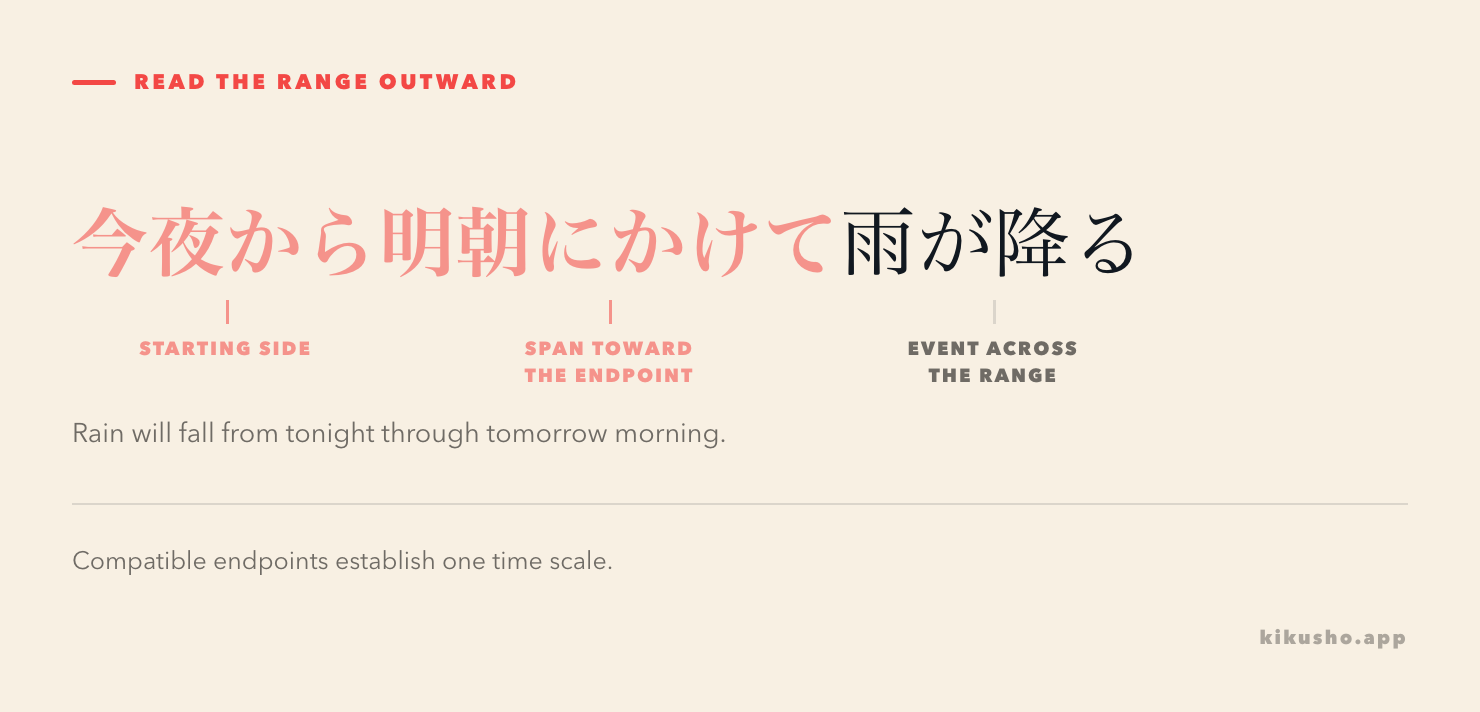
今夜から明日の朝にかけて、強い雨が降るでしょう。
こんやから あしたの あさにかけて、つよい あめが ふるでしょう。
Heavy rain is expected from tonight through tomorrow morning.
料理にかけては、姉にかなう人はいません。
りょうりにかけては、あねに かなう ひとは いません。
When it comes to cooking, nobody can match my older sister.
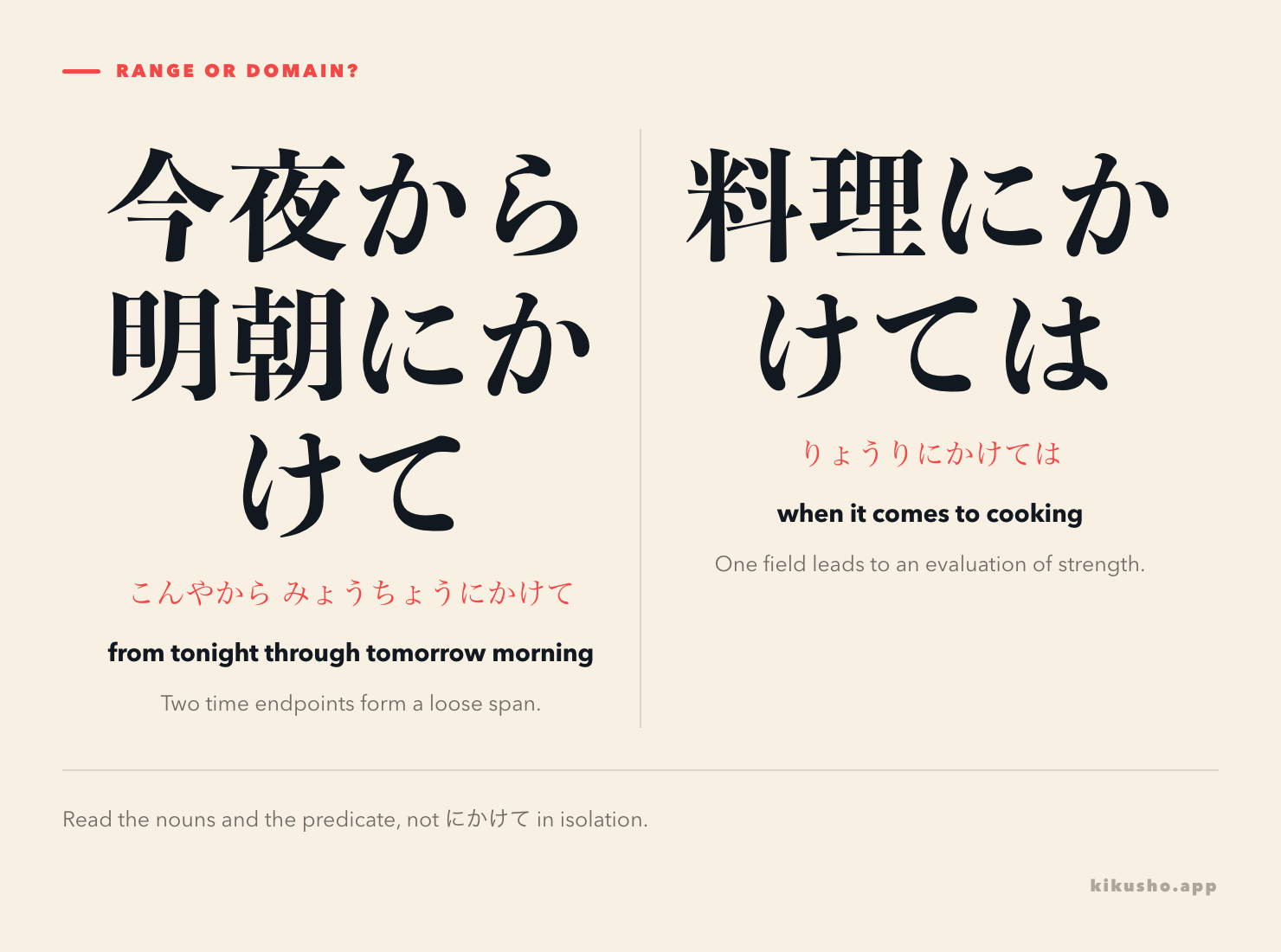
The first sentence makes no judgment about rain being talented or superior. It places the forecast across a time span. The second has no starting and ending points. 料理 names the field, and かなう人はいません supplies the favorable comparison.
Build the range with two compatible endpoints
The full range pattern is:
noun A + から + noun B + にかけて
A and B normally belong to the same scale. Two periods produce a time range; two locations produce a spatial range.
| Scale | Example range | Natural continuation |
|---|---|---|
| time of day | 昼から夕方にかけて | 雨が降る |
| calendar | 六月から七月にかけて | 蒸し暑くなる |
| geography | 駅前から川沿いにかけて | 桜が咲く |
| area of a building | 入口からロビーにかけて | 人が並ぶ |
駅前から川沿いにかけて、桜が咲いています。
えきまえから かわぞいにかけて、さくらが さいています。
Cherry trees are in bloom from the station area through the riverside.
The expression presents a zone rather than a route taken by one traveler. It works especially well for weather, distribution, seasonal change and events whose effect spreads across a period or area. News reports and forecasts therefore use it often.
JLPT Sensei's から〜にかけて entry gives the noun-to-noun structure and places it at N3. Bunpro's range entry also places it at N3 and describes it as standard, with frequent use in writing and news.
Let the boundaries remain soft
から〜まで marks the start and endpoint directly. から〜にかけて presents an approximate or spreading span, so its edges need not feel mathematically sharp.
| Sentence | Focus | Likely situation |
|---|---|---|
| 九時から五時まで働きます。 | stated start and endpoint | a work schedule |
| 朝から昼にかけて雨が降ります。 | broad period across which rain occurs | a forecast |
The rain sentence does not promise that the first drop falls exactly at the boundary called 朝 or that the final drop stops at the first instant of 昼. It gives the listener a useful window. Similarly, 関東から東北にかけて雪が降る describes snow across a broad geographical band; it does not draw a precise line around every affected town.
This difference is a tendency of presentation, not a license to combine unrelated endpoints. 東京から三時にかけて mixes a place with a time and cannot form one coherent scale. Choose 東京から横浜にかけて or 一時から三時にかけて instead.
The から and まで lesson gives the basic start-to-end pattern. When the issue is a result due by one boundary, the までに lesson separates that deadline from both a duration and the broad span taught here.
A single noun can supply the understood extent
Range にかけて can appear without an explicit Aから when the noun itself identifies the period through which something extends.
今週末にかけて、気温が下がる見込みです。
こんしゅうまつにかけて、きおんが さがる みこみです。
Temperatures are expected to fall through this weekend.
来年にかけての計画を立てています。
らいねんにかけての けいかくを たてています。
We are making plans extending into next year.
Context supplies the starting side: now, an already mentioned event or another understood reference point. In the second sentence, の lets the entire range phrase modify 計画. Do not assume every bare Nにかけて has this reading, however. A noun such as 週末 readily names a time extent, while 料理 readily names a field of ability.
Use にかけては for a field of excellence
The domain pattern is:
noun + にかけては + favorable evaluation
It highlights performance, knowledge, confidence or another notable quality within the named field.
地図を読むことにかけては、彼がチームで一番速いです。
ちずを よむことにかけては、かれが チームで いちばん はやいです。
When it comes to reading maps, he is the fastest on the team.
漢字の知識にかけては、田中さんは誰にも負けません。
かんじの ちしきにかけては、たなかさんは だれにも まけません。
When it comes to kanji knowledge, Tanaka is second to none.
Useful predicates include 自信がある (be confident), 一番だ (be the best), 詳しい (be knowledgeable), 優れている (excel) and 誰にも負けない (lose to nobody). A verb phrase can become the field by adding こと, as in 地図を読むこと.
JLPT Sensei's にかけて entry lists noun + にかけて(は) and explicitly associates this use with praising another person or boasting about an ability. Its examples also show that にかけて can sometimes appear without は. For a learner producing this domain meaning, にかけては is the clearest default.
This is narrower than a neutral “regarding.” 環境問題にかけて話しました is not a safe way to say “I talked about environmental problems.” Use 環境問題について話しました. Choose にかけては when the following clause evaluates an outstanding capacity within the field.
Read は from the whole sentence
The syllables にかけては do not always guarantee the domain meaning. Topic or contrast は can also follow the range expression.
今夜から明日にかけては雨ですが、明日の午後には晴れるでしょう。
こんやから あしたにかけては あめですが、あしたの ごごには はれるでしょう。
It will rain from tonight into tomorrow, but it should clear tomorrow afternoon.
This remains a range because 今夜から明日 supplies two time endpoints and the sentence reports weather across them. Compare it with 料理にかけては姉が一番です: 料理 is one field, and 一番です evaluates the sister within it.
Use three clues together:
- Is there AからB? Two compatible endpoints strongly signal a range.
- What does the noun name? A time or place favors extent; a skill or subject favors a domain.
- What does the predicate do? Weather, change or distribution extends across a range. Confidence, comparison or praise evaluates a domain.
When you save one of these expressions in Kikusho, keep the sentence large enough to preserve the clues. A card with only にかけて hides the contrast. A forecast such as 今夜から明朝にかけて雨が降る or an evaluation such as 料理にかけては誰にも負けない keeps the intended parse visible. Confirm the reading and meaning before saving, then edit the example if your source sentence gives clearer endpoints or a more concrete skill.
Treat JLPT levels as teaching estimates
The two major sources do not draw the level boundary in the same place. JLPT Sensei places both から〜にかけて and its domain-oriented にかけて(は) material at N3. Bunpro places the time-and-space range at N3 but teaches the domain にかけては at N2.
That is a publisher disagreement, not a change in how the sentences work. The official JLPT FAQ explains why it no longer publishes an exhaustive vocabulary, kanji and grammar specification assigning every item to one level. This lesson follows the N3 curriculum placement while flagging the difference so that a Bunpro learner is not surprised. For study, recognize the range first and learn the domain contrast alongside it; both depend on reading the noun and predicate rather than translating the sounds in isolation.
Test the two readings
Answer all seven questions before checking the single correction section below.
Question 1: grammar choice. A forecast predicts snow across the period from tonight through tomorrow morning. Which sentence fits?
- A. 今夜まで明日の朝にかけて、雪が降るでしょう。
- B. 今夜から明日の朝にかけて、雪が降るでしょう。
- C. 今夜にかけては、雪が一番上手です。
- D. 今夜から明日の朝までに、雪が続きます。
Question 2: range or domain. What does 写真にかけては、山田さんが一番詳しいです do?
- A. It gives the route from a photograph to Yamada.
- B. It sets a deadline for taking photographs.
- C. It evaluates Yamada's knowledge in the field of photography.
- D. It says photographs continued until Yamada arrived.
Question 3: exact or broad boundary. Choose the more natural form for a posted work shift that starts at nine and ends at five.
- A. 九時から五時まで働きます。
- B. 九時から五時にかけて働きます。
Question 4: sentence composition. Use 関東, 東北, から, にかけて, and 雨が降っています to write “It is raining from the Kanto region through Tohoku.”
Question 5: repair the meaning. A learner writes 料理については、姉にかなう人はいません but wants the stronger “when it comes to cooking, nobody can match my sister” pattern from this lesson. Rewrite the field marker.
Question 6: interpret は. Is 今夜から明日にかけては雨です a domain judgment or a range with topic/contrast は? Give the clue that decides it.
Question 7: text grammar. Read the notice: 金曜日から土曜日にかけて、駅前から川沿いにかけて祭りが行われます。会場の案内にかけては、佐藤さんが誰よりも詳しいです。 Which summary is accurate?
- A. The festival has a Friday-to-Saturday time range and a station-to-riverside area; Sato stands out in knowledge of the venue guide.
- B. Friday and the riverside are exact deadlines, and Sato will guide nobody.
- C. Every にかけて phrase praises Sato's skill.
- D. Every にかけて phrase describes only a geographical route.
Answers and explanations
Answer 1. B. 今夜から明日の朝にかけて joins two time endpoints and gives the broad window across which the snow is expected. A breaks the structure, C turns weather into an impossible skill evaluation, and D uses deadline までに with a continuing condition.
Answer 2. C. 写真 names the field, にかけては highlights it, and 一番詳しい supplies the positive comparison. There are no two endpoints and no event spreading across a period.
Answer 3. A, 九時から五時まで働きます. A posted shift presents its start and endpoint directly. にかけて can cover a broad period, but it is less suitable when the purpose is to state the scheduled boundaries.
Answer 4. 関東から東北にかけて、雨が降っています。 関東 and 東北 are compatible geographical endpoints. The rain is the condition distributed across that area.
Answer 5. 料理にかけては、姉にかなう人はいません。 については can introduce cooking as a neutral topic, but にかけては fits the intended claim of unmatched ability in that field.
Answer 6. It is a range with topic or contrast は. 今夜から明日 supplies two time endpoints, and 雨です reports weather across them. A domain reading would instead use a field noun and an evaluative predicate.
Answer 7. A. The first phrase maps a time span, the second maps a spatial span, and the third evaluates Sato within the field of venue guidance. Identical surface material can perform different jobs because the nouns and predicates create different structures.
Read outward from にかけて: endpoints plus an extending event produce a range, while one field plus favorable evaluation produces the domain reading. That sentence-level test is more dependable than treating the expression as one fixed English translation.
Common questions
What does から〜にかけて mean?
It marks an approximate span from A toward or through B in time or space. It often describes weather, events or conditions spread across that range, without presenting both boundaries as sharply as から〜まで.
What is the difference between にかけて and にかけては?
Range にかけて extends through a time or place. Domain にかけては means “when it comes to” a field and normally leads to a favorable evaluation, strength or claim of confidence. The noun and the predicate reveal the use.
Is から〜にかけて N3 or N2 grammar?
JLPT Sensei and Bunpro place the range use at N3. JLPT Sensei also teaches the domain use at N3, while Bunpro places にかけては at N2. These are publisher estimates because the JLPT does not publish an exhaustive grammar list.
Can は follow the range use of にかけて?
Yes. In 今夜から明日にかけては雨です, は adds topic or contrast to the whole range. The two endpoints and weather predicate still make this a range, not a claim about skill in a domain.