On this page
から marks a starting point and まで marks an endpoint: 三時から五時まで means “from three until five,” and 店から駅まで means “from the shop to the station.” Each particle follows the time or place it labels, and either can be used without the other when only one boundary matters.
The same two labels describe a timetable or a route
Think of the pair as two marks on a line. The nouns change between time and space; the start-and-end relationship stays the same.
| What you label | Starting point | Endpoint | Whole range |
|---|---|---|---|
| Clock times | 三時から(さんじから) | 五時まで(ごじまで) | From three until five |
| Days | 火曜日から(かようびから) | 木曜日まで(もくようびまで) | From Tuesday to Thursday |
| Places | 店から(みせから) | 駅まで(えきまで) | From the shop to the station |
| A route starting here | ここから | 公園まで(こうえんまで) | From here to the park |
These are boundary phrases, not complete sentences by themselves. You still need a predicate when giving a full statement: です, 働きます, 歩きます, or whatever describes the range in that situation. A short answer can omit what the question already supplies.
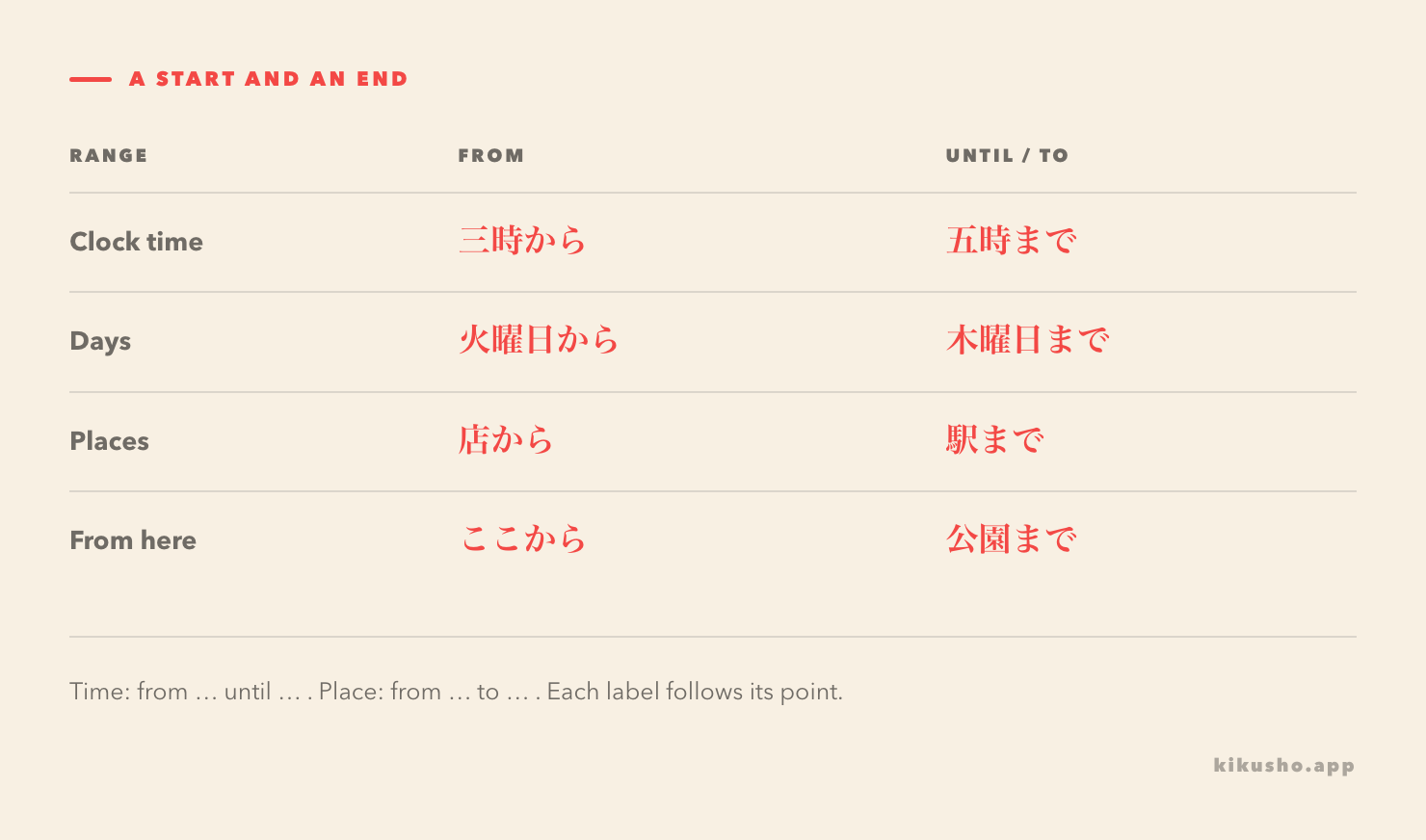
The table also shows the direction of attachment. English says from the shop; Japanese says 店から. Adding から before 店 would put the particle on the wrong side of its noun.
A time range gives two clock points, not a duration word
今日の練習は午後三時から午後五時までです。
きょうの れんしゅうは ごごさんじから ごごごじまでです。
Today's practice is from 3 p.m. until 5 p.m.
午後三時 is the beginning and 午後五時 is the end. This two-hour range uses clock times with 時(じ). To name the elapsed length instead, say 二時間(にじかん), “two hours.” 三時間から五時間まで would use durations, not state that practice begins at three o'clock and ends at five.
Japanese Professor's time lesson distinguishes clock 時 from duration 時間 and confirms that either boundary particle can stand alone. For the behaviour of ordinary calendar expressions, see Japanese time words and に.
In the basic range, attach から and まで directly to those clock points. 三時から五時まで does not need an extra time に inserted before each boundary particle.
明日は午前八時から働きます。
あしたは ごぜんはちじから はたらきます。
Tomorrow I will work from 8 a.m.
This names the beginning and leaves the finish open. It does not secretly mean “from eight until five.” Likewise, 午後六時まで待ちます (ごごろくじまで まちます), “I'll wait until 6 p.m.,” gives the endpoint without telling you when the waiting began. A missing boundary is missing information, not a grammatical failure.
Place boundaries describe the portion of travel you name
店から駅まで歩きます。
みせから えきまで あるきます。
I will walk from the shop to the station.
The shop is the origin; the station is the limit of the walking route described here. The sentence does not tell you what happens before you reach the shop or after you reach the station.
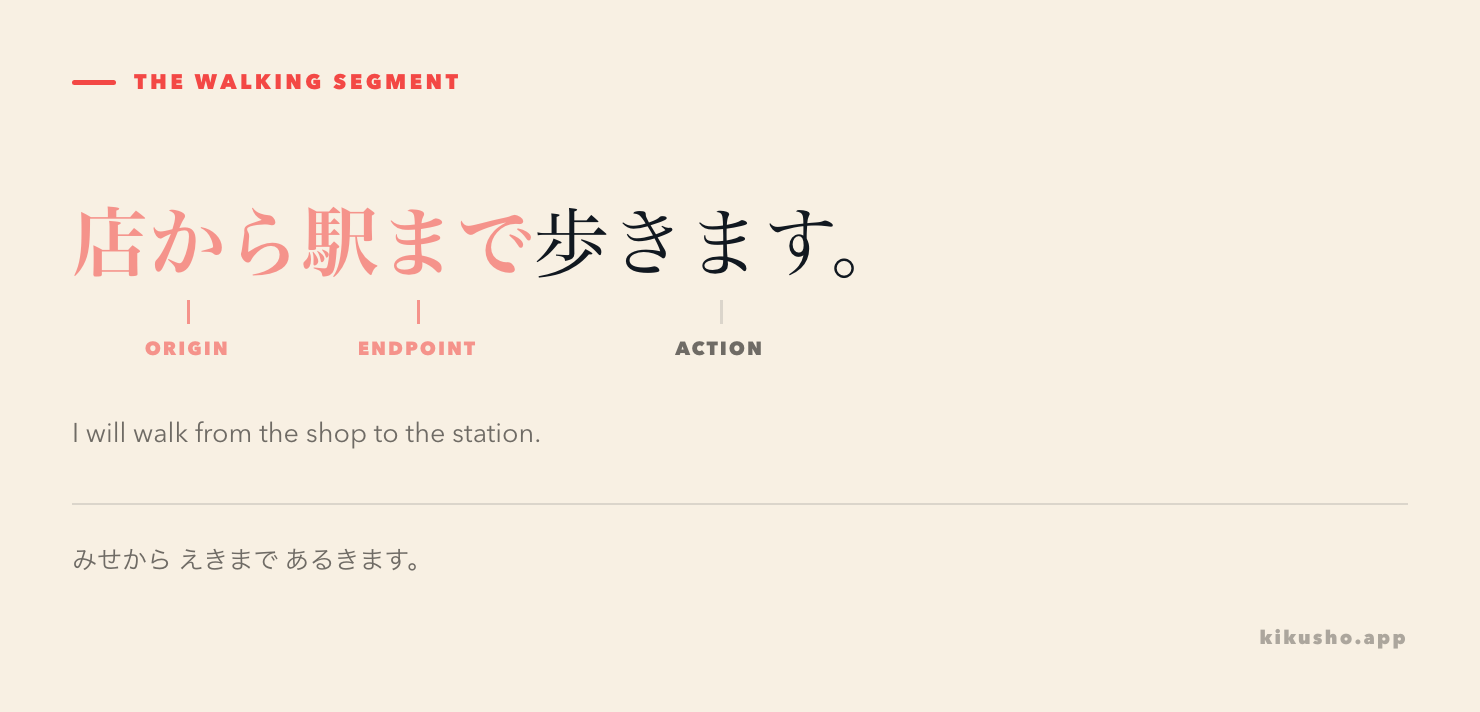
Changing just the particle can reverse the role of a place. 駅から says “from the station”; 駅まで says “as far as the station.” A listener cannot recover that distinction from the English word station alone.
You can add the means of travel separately:
図書館から学校までバスで行きます。
としょかんから がっこうまで バスで いきます。
I will go from the library to school by bus.
から and まで bound the journey. バスで says how you travel. The transport vocabulary lesson explains why that means-of-travel で differs from the に in 電車に乗る.
The Japan Foundation's Marugoto town lesson explicitly separates these three jobs. Its companion daily-life notes use the same boundaries for starting and ending times. Both belong to one teaching series; they are not two independent source families.
The two particles work separately and remain unchanged
When someone asks 何時からですか (なんじからですか), “From what time?”, 三時からです answers the start. 何時までですか (なんじまでですか), “Until what time?”, asks for the other end. Replying 五時までです gives it.
For places, どこから asks “from where?” and どこまで asks “as far as where?” Keep the direction when answering: ここからです means “from here,” not “to here.”
The particles themselves do not conjugate. The final verb supplies tense and politeness:
昨日は午後五時まで働きました。
きのうは ごごごじまで はたらきました。
Yesterday I worked until 5 p.m.
Until remains まで; 働きました makes the report past and polite. The ordinary boundary particles have standard register. Choosing a polite ending does not change them into a different pair.
A reason and a deadline are different constructions
The から in 学校から labels an origin. In a sentence such as 雨だから、家にいます (あめだから、いえに います), “Because it is raining, I'll stay home,” から follows a reason instead. Look at the whole phrase before translating: an origin and a claim explaining a decision do different jobs. The から and ので lesson teaches causal attachment; this page does not replace it.
Do not interpret every pair of から and まで in a sentence as one range. A reason can coexist with an unrelated endpoint. The connection must come from the phrases themselves, not just the appearance of the two particles.
Similarly, 五時まで待ちます is waiting until five. A deadline for finishing something by five normally calls for までに, a separate pattern. Bunpro's noun + まで explanation contrasts ongoing activity with completion by a deadline. The notices-and-deadlines lesson shows how a reception period differs from a completion deadline. This is a boundary warning, not a full lesson on までに.
This lesson covers boundary まで, with its level evidence
JLPT Sensei groups “until,” “as far as” and other まで meanings on an N5 page. There is also an N4 lesson with the same spelling on Bunpro's other まで page, whose focus is “even” and extent. Bunpro's specific noun + まで boundary lesson, linked above, is N5. Matching the spelling alone therefore does not establish a disagreement about the boundary use taught here.
Treat these publisher labels as estimates of teaching level. The exam organisers do not give learners a complete official list of grammar constructions. This lesson covers time and place endpoints, together with starting-point から. It does not teach emphatic “even,” every extent meaning, or verb-clause + まで. Recognising these boundary phrases does not mean you have learned every construction written with まで.
In Kikusho, a photo of a timetable can become a card you inspect before saving. Preserve the two clock points in its editable example rather than replacing them with the single word “hours.” Listening to the card's audio then keeps the start and finish attached to the particles you need to retrieve.
Practice
For the next six questions, mark every named boundary as a start or an end on paper. The solutions are grouped after Question 6 so you can check the whole set together.
Question 1
Practice finishes at 4 p.m. Choose the particle meaning “until”:
練習は午後四時( )です。
れんしゅうは ごごよじ( )です。
- ア. から
- イ. の
- ウ. まで
- エ. を
Question 2
Build a polite sentence meaning “I will walk from the bank to the park.” Put the origin first, then the endpoint, then the verb. Use all three pieces once:
公園まで / 歩きます / 銀行から
銀行(ぎんこう) means bank; 公園(こうえん) means park.
Question 3
Read the message:
明日は午前七時から働きます。午後一時までです。
あしたは ごぜんしちじから はたらきます。ごごいちじまでです。
Tomorrow I will work from 7 a.m. It is until 1 p.m.
Which summary preserves both boundaries?
- ア. 午前一時から午後七時まで働きます。
- イ. 午前七時から午後一時まで働きます。
- ウ. 午前七時まで働きます。
- エ. 午後一時から働きます。
Question 4
The walk begins here. Choose “from”:
ここ( )歩きます。
- ア. まで
- イ. から
- ウ. の
- エ. を
Question 5
Write “Yesterday I waited until 10 a.m.” Use 昨日, 午前十時, まで, and the polite past of 待つ(まつ), “wait.” Put yesterday first and the verb last.
Question 6
Read the route description:
今日は店から駅まで歩きました。それから電車に乗りました。
きょうは みせから えきまで あるきました。それから でんしゃに のりました。
Today I walked from the shop to the station. Then I took a train.
Which phrase gives the endpoint of the walking part?
- ア. 店から
- イ. 電車に
- ウ. 今日は
- エ. 駅まで
Answers and explanations
Answer 1
ウ. まで: 練習は午後四時までです, “Practice is until 4 p.m.” 四時 is read よじ. The prompt supplies a finishing time. から would name the starting time instead. の can link nouns but does not label this endpoint; を does not express “until” in the supplied sentence.
Answer 2
銀行から公園まで歩きます。
ぎんこうから こうえんまで あるきます。
“I will walk from the bank to the park.”
銀行から is the origin and 公園まで the endpoint. The stated order puts the origin first; 歩きます comes last. Reversing the particles would reverse the route, which would require changing the supplied pieces as well as changing their order. A route statement names this journey's boundaries without describing any earlier or later travel.
Answer 3
イ. 午前七時から午後一時まで働きます, “I will work from 7 a.m. until 1 p.m.” Keep 午前 with seven and 午後 with one. ア swaps the hours and their day periods. ウ makes seven the endpoint rather than the start and drops one. エ makes one the start and drops seven. Neither single-boundary option preserves the full message.
Answer 4
イ. から gives ここから歩きます, “I will walk from here.” The endpoint remains unspecified. まで would make “here” the endpoint; の cannot attach the origin directly to 歩きます this way. を can have route-related uses elsewhere, but it does not mean “from” in the construction requested. Omitting an endpoint does not make ここから incomplete as an origin phrase.
Answer 5
昨日は午前十時まで待ちました。
きのうは ごぜんじゅうじまで まちました。
“Yesterday I waited until 10 a.m.”
待つ → 待ちます → 待ちました supplies the polite past. まで stays unchanged. Adding は after 昨日 is natural; 昨日午前十時まで待ちました also meets the prompt without は. This asks for the extent of the waiting, not a deadline by which to perform one completed action. A non-past 待ちます would not satisfy the requested past report.
Answer 6
エ. 駅まで is “as far as the station,” the endpoint of the walking segment. 店から gives its origin. 電車に belongs to the later boarding action, and 今日は frames the account as today. The train trip follows the walking; it does not turn the station into the end of the entire day's travel.
Common questions
Must から and まで always appear together?
No. Each can mark its own boundary: 三時から means from three, and 五時まで means until five. Use both when you need to state the full range; one alone leaves the other boundary unspecified.
Does 駅まで mean from the station or to the station?
駅まで means to or as far as the station: the station is the endpoint of the stated journey. 駅から means from the station and marks its starting point.
Can まで express a deadline like English by five?
Basic time + まで expresses until that time, as in 五時まで待ちます, I will wait until five. A deadline for completing an action normally uses the separate までに construction. Do not treat until five and by five as interchangeable.