On this page
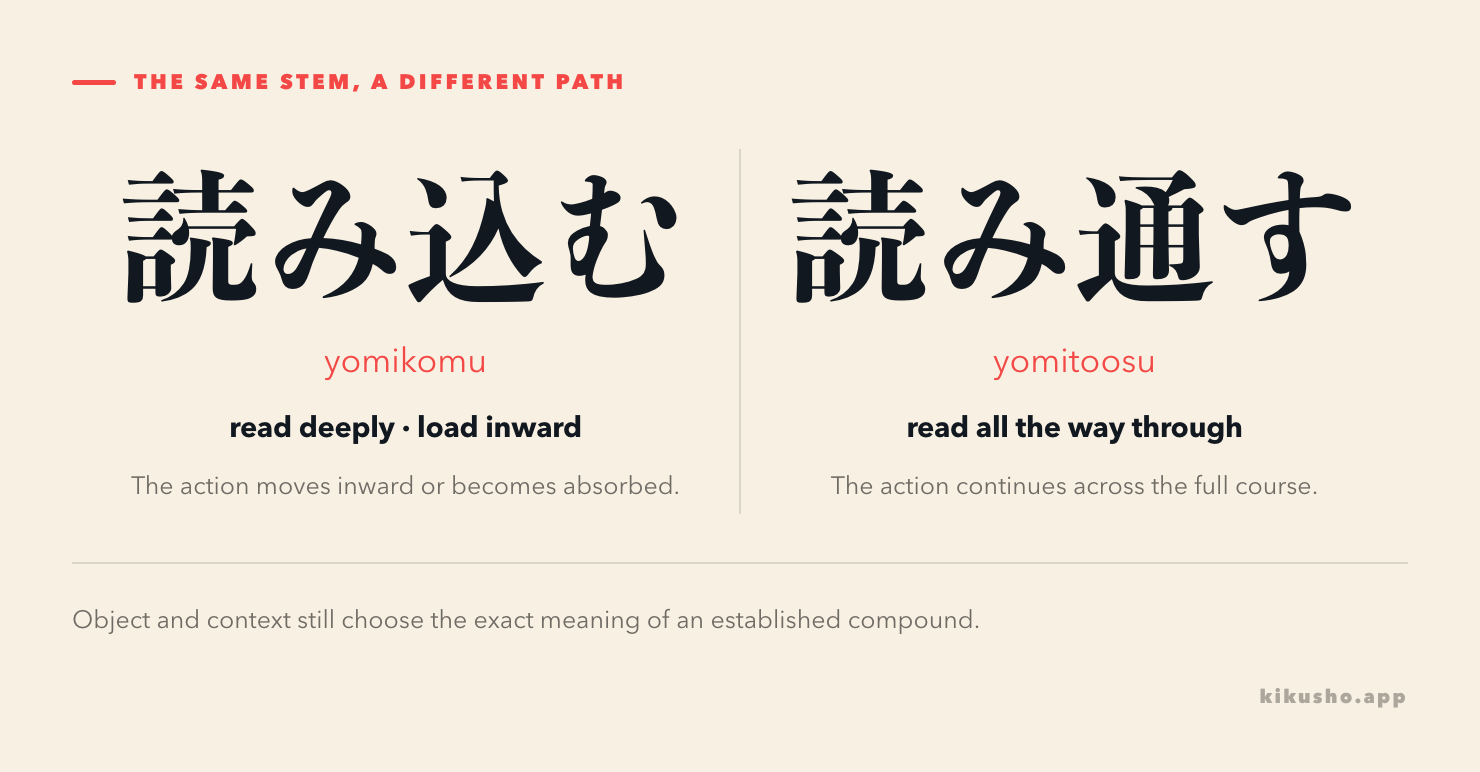
Attach 込む(こむ) when a recognized compound presents movement inward or entry into a deep, intense or continuing state. Attach 通す(とおす) when an action is maintained through an interval or carried all the way to its endpoint: 小説を読み込む can mean reading a novel closely, while 小説を読み通す means reading it through from beginning to end.
Both follow a verb's ます-stem, and both can make an action feel extended. Their viewpoint differs. 込む points inward or deeper into an activity or state; 通す draws a line from the beginning through the whole course. JLPT Sensei and independently authored Japanese-teacher references place both patterns at N3. Those labels organize study materials rather than define an official form-by-form JLPT syllabus.
Build the compound from the ます-stem
Remove ます and add the second verb: 読みます → 読み + 込む/通す, 考えます → 考え + 込む, and 歩きます → 歩き + 通す. Once attached, the last element controls conjugation. Both 込む and 通す are godan verbs: 読み込みます/読み込んだ/読み込まない and 読み通します/読み通した/読み通さない.
| Base verb | Stem | Compound | Past form | Core view |
|---|---|---|---|---|
| 飛ぶ | 飛び | 飛び込む | 飛び込んだ | move inward |
| 考える | 考え | 考え込む | 考え込んだ | enter deep thought |
| 読む | 読み | 読み通す | 読み通した | read through the whole course |
| 歩く | 歩き | 歩き通す | 歩き通した | keep walking to the end |
The formation rule helps you parse a word, but it is not a license to coin any combination. Japanese compound verbs have established pairings and meanings. 申し込む, for example, means “apply” or “sign up”; it is not a predictable instance of “speak inward.” The lesson on 飛び出す, 申し込む and 横切る treats such forms as complete vocabulary. Check the whole compound in a dictionary or a reliable sentence before producing it.
込む can point inward or into a deeper state
The spatial family is the easiest to picture. 子どもがプールに飛び込んだ (こどもが プールに とびこんだ) means “The child jumped into the pool.” 箱に服を押し込んだ (はこに ふくを おしこんだ) says “I pushed the clothes into the box.” 申込書に住所を書き込んでください asks someone to write or fill an address into the application form. Bunpro's first 込む entry groups compounds in which something goes or is put inside.
The second family treats an activity or state as something the subject enters deeply. その問題について考え込んだ (その もんだいについて かんがえこんだ) means “I became absorbed in thought about that problem.” 友達と話し込んで、終電を逃した means “I got caught up talking with a friend and missed the last train.” 彼は急に黙り込んだ means “He suddenly fell silent,” often with the resulting silence continuing.
Depth does not always mean duration. 信じ込む is to become firmly convinced, and 思い込む is to assume or be convinced, sometimes mistakenly. Conversely, duration can appear because a person remains inside the state: 眠り込む describes falling deeply asleep, and 座り込む can describe sitting down and staying there. Bunpro's second 込む entry covers depth, intensity and remaining in a state; 日本語NET's N3 lesson separately identifies inward movement and prolonged activity.
Context and the first verb therefore matter more than one English gloss. 読み込む can mean reading something carefully enough to absorb it, or loading data into a system. 話し込む describes becoming engrossed in conversation. No endpoint is required in either sentence.
通す maintains the same action across the whole course
通す focuses on continuity. 長い小説を一晩で読み通した (ながい しょうせつを ひとばんで よみとおした) means “I read the long novel all the way through in one night.” 雨の中を駅まで歩き通した says “I kept walking through the rain all the way to the station.” The action occupies the interval without being abandoned.
The pattern often carries resolve, consistency or resistance to interruption. 彼は最後まで自分の意見を言い通した means “He maintained his position to the end.” 何を聞かれても、彼女は黙り通した means “Whatever she was asked, she remained silent throughout.” The latter is different from 黙り込んだ, which presents the transition into silence and the state that follows. 黙り通した evaluates her maintaining that silence across the questioning.
JLPT Sensei gives ます-stem + 通す for continuing or doing something through to the end. 日本語NET's 通す account also marks N3, notes that the available verbs are limited, and describes actions continued to the end. The pattern frequently concerns a person's action or maintained stance. It need not be admirable: 嘘をつき通す means keeping up a lie.
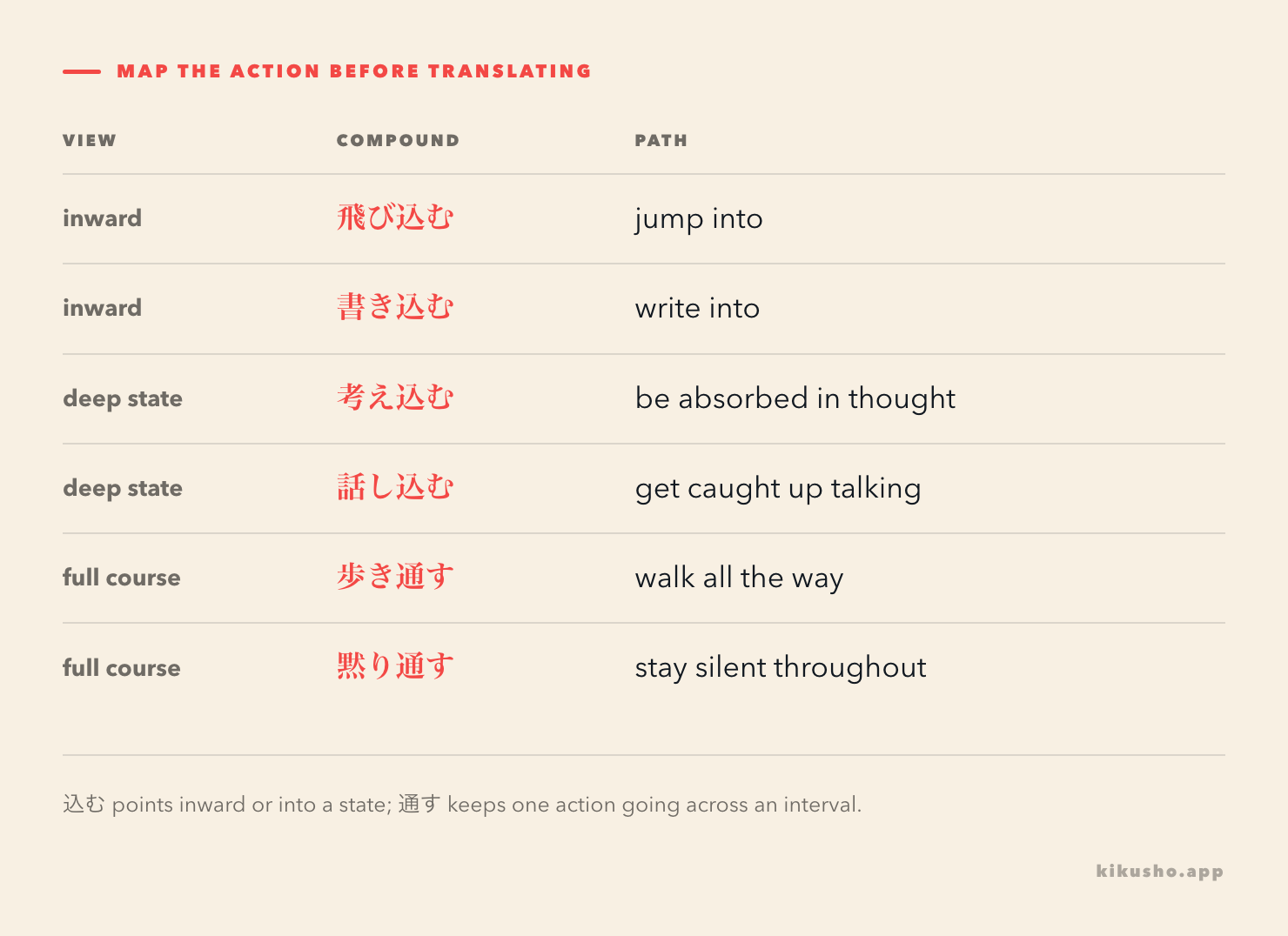
| View | Compound | What the sentence presents |
|---|---|---|
| movement inward | 飛び込む/押し込む | crossing or forcing something into an inside |
| deep or continuing state | 考え込む/話し込む | becoming absorbed or remaining engaged |
| maintained to the endpoint | 読み通す/歩き通す | one action spanning the whole course |
| maintained stance | 言い通す/黙り通す | not changing the action or position |
The same first verb exposes the contrast
With 読む, the object and situation select the interpretation. この資料をよく読み込んでください asks someone to study the material closely. この資料を最後まで読み通してください asks them to continue until they reach the end. A careful reader might do both, but each compound highlights a different achievement.
With 信じる, 彼の説明を信じ込んだ presents entry into a firm belief: “I became convinced by his explanation.” 反対されても仲間を信じ通した presents continued belief despite opposition: “I kept believing in my teammate throughout.” 込む changes the depth or state; 通す measures persistence across changing circumstances.
This is also why 通す does not merely mean “finish.” 読み終わる states that reading ended. 読み切る strongly presents complete consumption or completion. 読み通す keeps attention on the uninterrupted or sustained course. The lesson on かける, 切る and 切れない develops the completion contrast, while 始める, 出す, 続ける and 終わる maps more neutral action phases.
When capturing a compound in Kikusho, select the whole verb and retain its object or destination. 読む alone cannot tell you whether 読み込む means close reading or data loading, and an isolated 通す loses the action that was sustained. A saved line such as 資料を最後まで読み通した preserves both the compound and the endpoint clue for later offline review.
Practice: choose the path of the action
Complete all seven items before consulting the explanation block.
Question 1 — choose the compound. You became absorbed in a difficult problem and thought deeply about it. Which sentence fits?
- A. 難しい問題について考え込んだ。
- B. 難しい問題について考え通した。
- C. 難しい問題について考え出した。
Question 2 — attachment. Change 歩きます into the compound meaning “keep walking all the way through,” in plain past form.
Question 3 — meaning in context. In 申込書に住所を書き込んでください, is 込む presenting inward insertion, deep absorption, or persistence to an endpoint?
Question 4 — sentence composition. Say “I read the novel all the way through to the end.” Use 小説, 最後まで, and 読み通す in the past.
Question 5 — contrast. Complete the pair with 黙る: “He suddenly fell silent” with 込む, then “He remained silent throughout the interview” with 通す.
Question 6 — text grammar. Read: 由美は資料を何度も読み込んだ。しかし、長すぎて最後までは読み通せなかった。 Did Yumi read carefully, reach the end, both, or neither?
Question 7 — boundary. A learner creates 食べ込みました to mean “I ate the meal to the end.” Why is applying the stem rule alone unsafe, and which established completion pattern could express the intended result?
Answers and explanations
Answer 1. A, 難しい問題について考え込んだ。 考え込む is an established compound for becoming absorbed in thought. B mechanically attaches 通す but is not the ordinary target for this situation. 考え出す in C means beginning to think or devising something, so it changes the action phase.
Answer 2. 歩き通した (あるきとおした). Remove ます from 歩きます, attach 通す, then conjugate the final godan verb to past 通した.
Answer 3. It presents inward insertion: the writer puts the address into the form's field. The sentence does not say the person writes for a long time or continues writing to a stated endpoint.
Answer 4. A model answer is 小説を最後まで読み通した (しょうせつを さいごまで よみとおした). 最後まで supplies the endpoint, and 読み通した presents the reading as sustained through it.
Answer 5. 彼は急に黙り込んだ。面接の間、ずっと黙り通した。 The first compound presents entering and remaining in silence. The second measures the same silence across the whole interview.
Answer 6. Yumi read the material carefully but did not reach the end. 何度も読み込んだ establishes close or repeated reading, while the potential negative 読み通せなかった explicitly denies completing the whole course.
Answer 7. The stem identifies where a second verb would attach, but it does not prove that Japanese has established that compound with the intended sense. For simply finishing the meal, 食べ終わりました is a dependable neutral choice; 食べ切りました can emphasize eating it completely. Learn 込む and 通す pairings as whole verbs from attested examples.
Common questions
What is the difference between verb-stem + 込む and 通す?
込む often presents movement inward or entry into a deep, intense or continuing state. 通す presents one action as maintained through an entire interval or all the way to its endpoint.
How do you attach 込む and 通す to a verb?
Attach either to the ます-stem: 読みます becomes 読み込む or 読み通す. The final 込む or 通す then conjugates as a godan verb.
Can 込む and 通す follow any Japanese verb?
No. Many combinations are established compound verbs, and 通す also favors a limited set of actions that can be sustained. Learn the whole compound from reliable examples rather than inventing one from the rule.