On this page
につけ marks an event that repeatedly brings a natural thought, feeling or reaction. につき follows a noun and usually gives a formal reason, a rate per unit, or a formal topic; the final vowel changes the construction, not just the pronunciation.
この写真を見るにつけ、故郷を思い出す。
この しゃしんを みるに つけ、ふるさとを おもいだす。
Whenever I see this photograph, I remember my hometown.
館内点検中につき、本日は休館いたします。
かんないてんけんちゅうに つき、ほんじつは きゅうかんいたします。
Due to an inspection inside the building, we are closed today.
The first sentence looks inward at a response that arises again. The second sounds like a notice explaining an operational decision. Their similar sound hides different attachment, meaning and register.
Test the word before it and the result after it
Start with the element before the expression. A dictionary-form verb such as 見る or 聞く points to につけ(て). The trigger repeats, and the following clause usually describes a feeling, memory, realization or involuntary response.
A noun immediately followed by につき needs a second test. Is the sentence a formal notice giving a reason? Is it calculating one share for each person, item or period? Is it formal correspondence introducing a topic? Those are the main につき frames.
| Form | Frame | What follows |
|---|---|---|
| V辞書形/N + につけ(て) | whenever one encounters A | a natural thought, feeling or reaction |
| AにつけBにつけ | whether A or B | the same response or situation in either case |
| N + につき | due to N | an official result, restriction or request |
| unit + につき | per each unit | a price, limit, reward or allocation |
| topic + につき | regarding N | a formal question, report or statement |
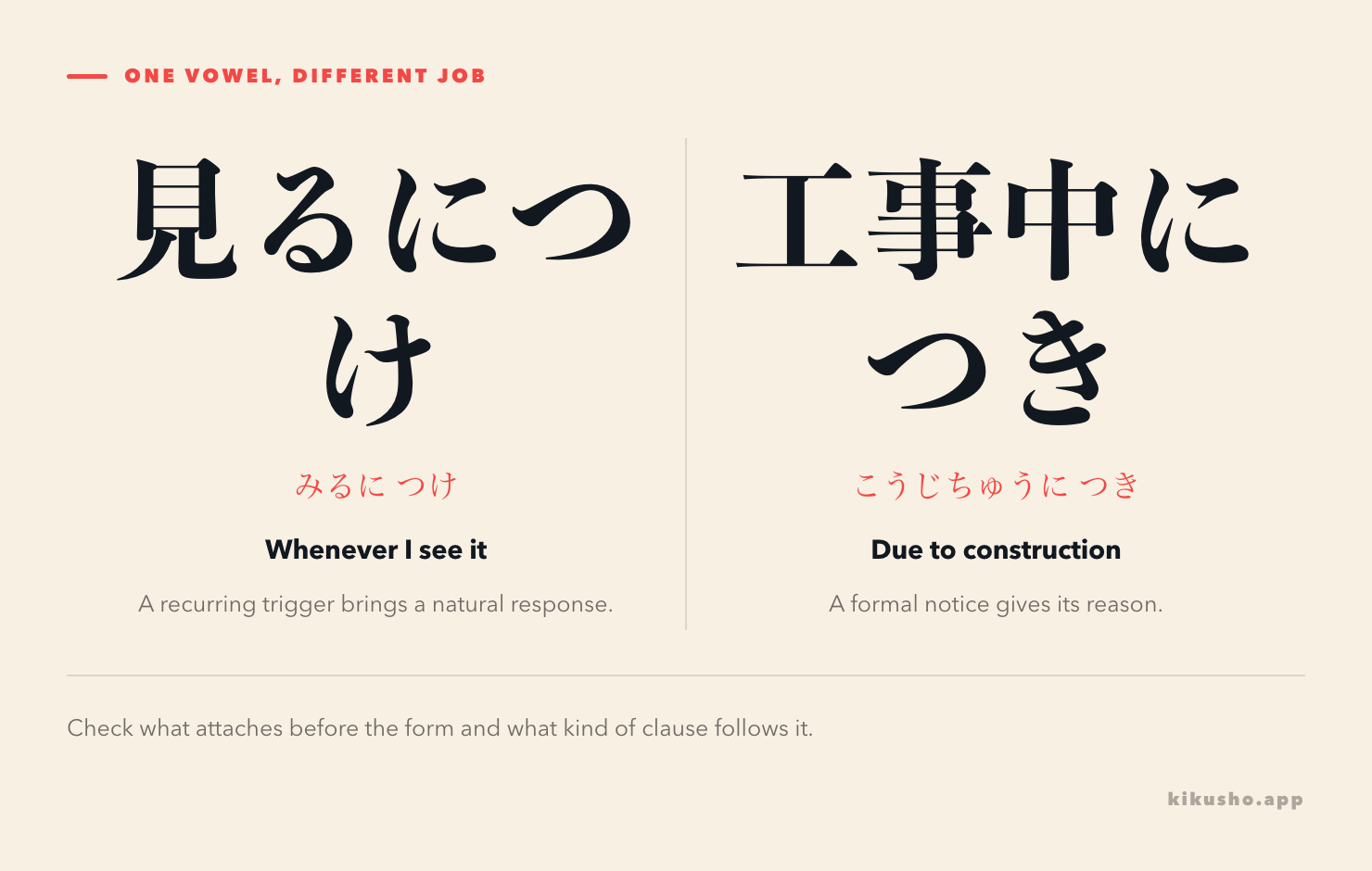
This attachment test is especially useful in reading questions. English “each time,” “due to,” “per” and “regarding” are far apart, even though the Japanese strings differ by only one kana.
につけ links a recurring trigger to a natural response
につけ(て) follows a dictionary-form verb or, in some expressions, a noun. It means “whenever” or “every time,” but it is more literary and reflective than everyday たびに.
被災地の映像を見るにつけ、胸が痛む。
ひさいちの えいぞうを みるに つけ、むねが いたむ。
Whenever I see footage of the disaster area, my heart aches.
祖母の声を聞くにつけ、子どもの頃を思い出す。
そぼの こえを きくに つけ、こどもの ころを おもいだす。
Whenever I hear my grandmother’s voice, I remember my childhood.
The second clause is not normally a fresh plan chosen on each occasion. It arises from the trigger: 懐かしくなる, 心配になる, 思い出す, 感じる, 胸が痛む. This restriction separates につけ from the broader たびに.
出張するたびに、お土産を買う。
Whenever I travel for work, I buy souvenirs.
The buying is a deliberate repeated action, so たびに is the ordinary choice. 出張するにつけ、お土産を買う sounds poorly matched because the result is a routine decision rather than a response that wells up.
Bunpro’s につけ entry records the verb and noun attachments, the recurring-response meaning and the literary, old-fashioned register. A Japanese teacher’s explanation independently notes that the following clause typically contains a naturally arising emotion, reaction or state, not an order or intentional act.
One fixed expression behaves more freely: 何かにつけ(て), “at every opportunity” or “whenever anything comes up.”
彼は何かにつけて、昔の自慢話をする。
かれは なにかに つけて、むかしの じまんばなしを する。
He tells boastful stories about the past at every opportunity.
Here the result can be repeated behavior rather than an emotion. Learn the whole phrase as a conventional unit instead of using it to erase the restriction on ordinary Vにつけ.
AにつけBにつけ covers two contrasting occasions
The doubled form presents two contrasting situations and says that the following response or state holds in either one.
よいにつけ悪いにつけ、知らせはすぐにください。
よいに つけ わるいに つけ、しらせは すぐに ください。
Whether the news is good or bad, please tell me immediately.
成功するにつけ失敗するにつけ、その経験から学ぶことはある。
せいこうするに つけ しっぱいするに つけ、その けいけんから まなぶことは ある。
Whether one succeeds or fails, there is something to learn from the experience.
The pair often uses opposites, and よきにつけ悪しきにつけ is a particularly literary version. This is different from a single trigger followed by a spontaneous feeling. It is also more colored and literary than the logical alternative pattern にしろ~にしろ. For neutral reasoning about two possibilities, see the comparison of にせよ and にしろ.
Japanese teaching references do not always state the paired form’s limits identically. N1et’s につけ overview separates the recurring-trigger use from the doubled “whether A or B” use and describes the latter as more emotional or literary than にしろ. That distinction is useful, but authentic fixed phrases can be directive, as in よいにつけ悪いにつけ、知らせてください. Treat the register and pairing as strong tendencies, not a ban on every volitional predicate.
につき gives an official reason
The reason use of Nにつき belongs to notices, signs, formal announcements and official correspondence. It is close to “due to N” or “on account of N.”
強風につき、ロープウェーは運休しております。
きょうふうに つき、ロープウェーは うんきゅうして おります。
Due to strong winds, the ropeway is not operating.
会議中につき、入室はご遠慮ください。
かいぎちゅうに つき、にゅうしつは ごえんりょください。
A meeting is in progress, so please refrain from entering.
The noun is usually a compact circumstance such as 工事中, 定休日, 雨天, 満席 or 好評. The second clause announces the consequence or asks the public to act accordingly.
Tanosuke’s teacher reference describes this as a stiff written form used to publicly explain a situation or reason. Bunpro independently records the noun attachment, formal register and “due to” meaning at N2.
Do not use it as a general conversational substitute for から or ので:
雨が降ったので、家にいた。
Because it rained, I stayed home.
This personal explanation is natural with ので. 雨につき、家にいた sounds like a public notice has been inserted into an ordinary account.
につき can assign an amount to each unit
After a person, item, time span or price, につき means “per” or “for each.” It identifies the unit used for an allocation.
お一人につき二枚まで購入できます。
おひとりに つき にまいまで こうにゅうできます。
You may purchase up to two tickets per person.
駐車料金は三十分につき三百円です。
ちゅうしゃりょうは さんじゅっぷんに つき さんびゃくえんです。
Parking costs 300 yen per thirty minutes.
二百円につき一ポイントが付きます。
にひゃくえんに つき いちポイントが つきます。
You receive one point for every 200 yen.
The two instances of つき in the last sentence are unrelated in function. The first につき marks the rate unit. The final 付きます is the verb 付く, “to be added.” The sentence is a useful reminder to parse the whole frame rather than match a sound.
The unit use is formal but common in pricing, campaign rules and quantity limits. Tanosuke’s explanation separates this use from the notice-reason use and contrasts a concrete allocation unit with the broader target marker に対して.
Formal につき can also mark the topic
In formal letters and business language, Nにつき can be a shortened, stiff equivalent of Nについて, “regarding N.”
先日のご提案につき、確認したい点がございます。
せんじつの ごていあんに つき、かくにんしたい てんが ございます。
Regarding your recent proposal, there are some points I would like to confirm.
The Japan Foundation’s teaching-material site distinguishes formal topic につき from notice-reason につき and also documents the per-unit pattern. Context decides which noun relation is active:
- 改装中につき、休業します: due to renovation, we are closed
- 改装計画につき、ご説明します: regarding the renovation plan, we will explain
- 一店舗につき、二名参加できます: two people may participate per store
If the sentence simply discusses a topic in ordinary Japanese, use について. The lesson on に関する and について covers the everyday topic frame and its noun-modifying forms.
Similar sound is not a shared slot
The decisive clues now fit into a small sequence:
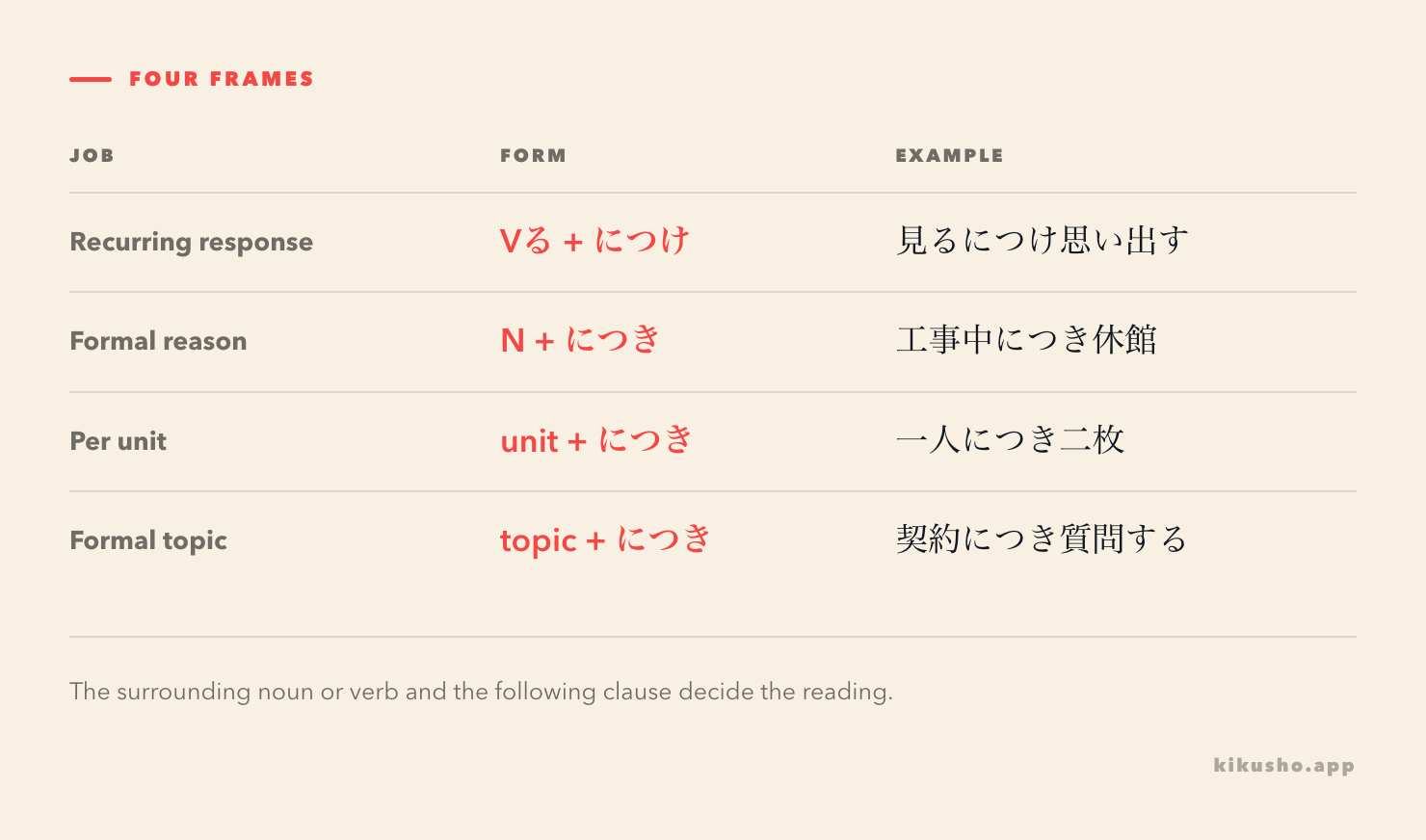
- A dictionary-form verb before the expression strongly indicates につけ.
- A recurring feeling, memory or natural reaction after it confirms につけ.
- A noun plus an official consequence points to reason につき.
- A countable unit followed by an amount or limit points to per-unit につき.
- A formal noun followed by a question, report or explanation may be topic につき.
In Kikusho, capture the clause on both sides of the form. A card with only につき cannot tell you whether you saw a closure notice or a per-person limit. 一人につき二枚まで preserves the unit and allocation; 写真を見るにつけ故郷を思い出す preserves the trigger and involuntary memory.
Both target items are placed at N2 by the curriculum, JLPT Sensei and Bunpro. The official JLPT does not publish an exhaustive modern grammar list, so this is a source-backed study placement rather than an official boundary.
Practice: read the attachment and register
Question 1 · recurring memory
Complete: この曲を聞く( )、学生時代を思い出す。
- A. につき
- B. につけ
- C. についての
- D. に対して
Question 2 · public notice
Complete the sign: 設備点検中( )、午後三時まで入館できません。
- A. につけ
- B. につれて
- C. につき
- D. について
Question 3 · ticket limit
Which sentence means “Each customer may buy up to three tickets”?
- A. お客様につけ、チケットを三枚まで買えます。
- B. お客様につき、チケットを三枚まで買えます。
- C. お客様について、チケットが三枚までです。
- D. お客様をつき、チケットを三枚まで買えます。
Question 4 · deliberate routine
Choose the natural completion: 京都へ行く( )、同じ店で漬物を買う。 The buying is a deliberate habit.
- A. たびに
- B. につけ
- C. につき
- D. につけにつき
Question 5 · formal topic
In a business email, complete: 先日の契約内容( )、質問がございます。
- A. につけ
- B. につき
- C. につれて
- D. につけては
Question 6 · paired construction
Which sentence uses the literary “whether good or bad” frame correctly?
- A. よいにつき悪いにつき、結果を受け止める。
- B. よいについて悪いについて、結果を受け止める。
- C. よいにつけ悪いにつけ、結果を受け止める。
- D. よいをつけ悪いをつけ、結果を受け止める。
Check all six choices before opening the explanation panel; the same sound is a poor guide when attachment and register disagree.
Answers and explanations
The clue in question 1
B. につけ. 聞く is a dictionary-form verb, and 思い出す is a memory that naturally returns whenever the song is heard. につき requires a noun in the uses taught here.
The clue in question 2
C. につき. 設備点検中 is the formal reason for a public restriction. This is the compact style of a posted notice.
The clue in question 3
B. お客様につき、チケットを三枚まで買えます. Each customer is the unit to which the three-ticket maximum applies. The other choices use the wrong construction or particle.
The clue in question 4
A. たびに. Buying pickles is a chosen routine repeated on every trip. につけ favors a thought, feeling or reaction that arises naturally from the trigger.
The clue in question 5
B. につき. In formal correspondence, 契約内容につき means “regarding the contract terms.” The following 質問がございます confirms the topic reading rather than a reason or rate.
The clue in question 6
C. よいにつけ悪いにつけ、結果を受け止める. The doubled につけ frame presents two contrasting cases and applies the same response to either one. につき does not build this literary alternative pair.
Common questions
What is the difference between につけ and につき?
につけ means whenever an event naturally brings a recurring thought or feeling. につき follows a noun in formal notices to give a reason, assigns something per unit, or formally marks a topic.
What can come before につけ?
In its whenever use, につけ or につけて follows a dictionary-form verb or a noun. The paired AにつけBにつけ pattern can also use contrasting forms such as よい and 悪い.
Is につき common in conversation?
Its reason and topic uses are formal and common in notices, announcements and business writing. The per-unit use appears naturally in prices, limits and allocations.