On this page
に沿って says that an action follows a route, sequence, policy or request. の下で(のもとで) says that an action happens under a person’s guidance, an authority, a system or a set of conditions.
Compare a plan and the environment in which it is made:
方針に沿って、研究計画を作った。
ほうしんに そって、けんきゅうけいかくを つくった。
We made the research plan in accordance with the policy.
専門家の指導のもとで、研究計画を作った。
せんもんかの しどうの もとで、けんきゅうけいかくを つくった。
We made the research plan under an expert’s guidance.
The first sentence traces a prescribed direction. The second places the work inside a relationship of supervision. English can use “under” or “according to” loosely for both ideas, so the Japanese noun-action relationship is the safer guide.
Ask whether the action traces a line or occurs under a framework
Picture に沿って as movement along a line. The line can be visible, such as a river or road, or abstract, such as a plan, policy, procedure or request. The action develops in the same direction without departing from it.
Picture のもとで as an umbrella over the action. A teacher may supervise it; a law may govern it; freedom or strict conditions may characterize the environment in which it occurs. The noun does not provide a route to trace. It establishes who or what presides over the situation.
| Question | Choose | Typical nouns |
|---|---|---|
| What line, order or instruction does the action follow? | Nに沿って | 道, 川, 計画, 方針, 手順, 要望 |
| Under whose guidance or under what conditions does it happen? | Nのもとで | 先生, 指導, 管理, 法律, 自由, 条件 |
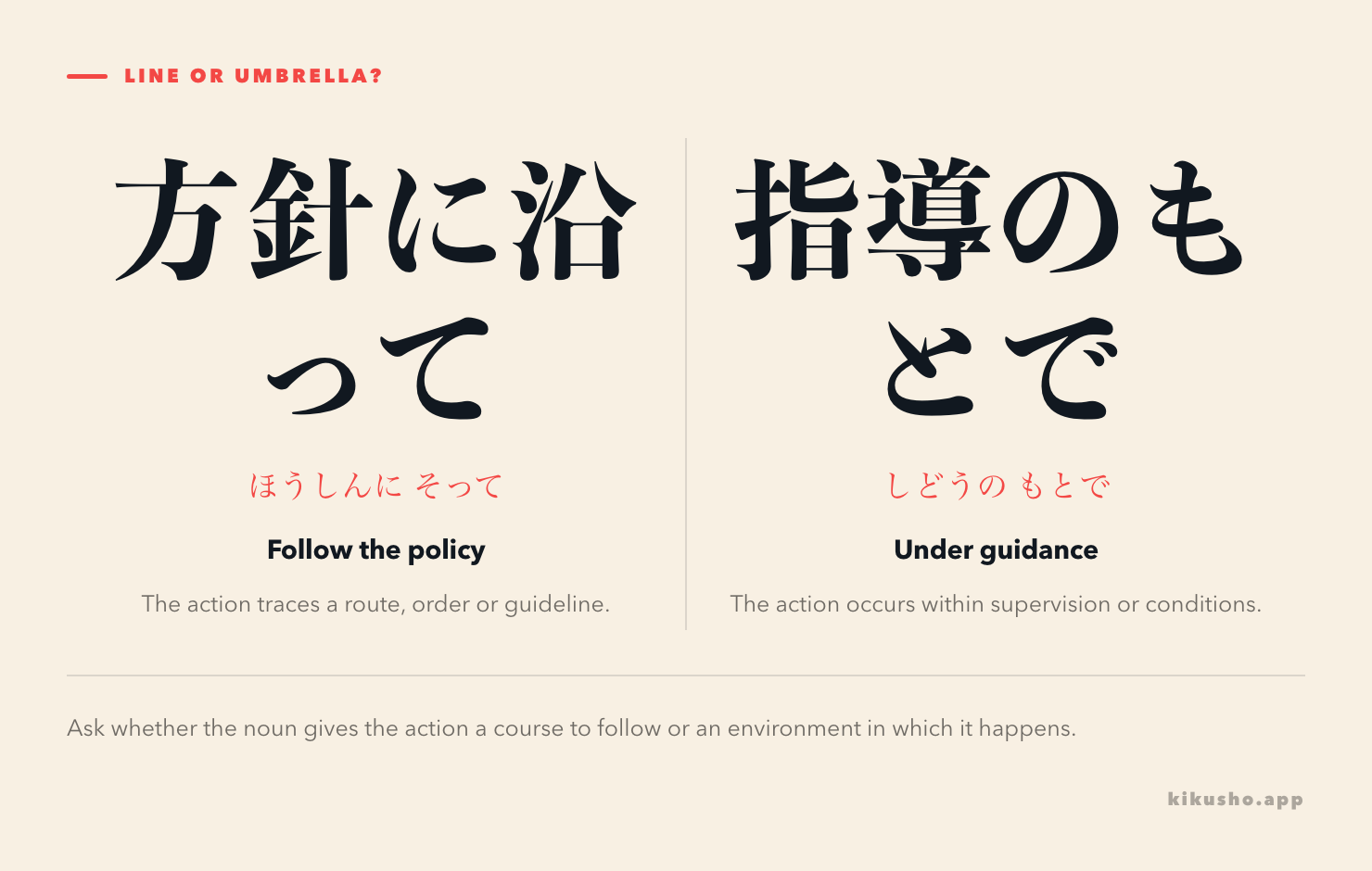
This “line or umbrella” test explains the contrast more reliably than one English translation.
に沿って follows a physical or abstract line
に沿って(にそって, ni sotte) attaches to a noun. Its literal use follows the course or shape of something extended through space:
川に沿って桜の木が並んでいる。
かわに そって さくらの きが ならんでいる。
Cherry trees stand in a row along the river.
線路に沿って歩いた。
せんろに そって あるいた。
We walked along the railway line.
The same spatial image extends to an ordered procedure or guiding standard:
マニュアルに沿って機械を点検してください。
マニュアルに そって きかいを てんけんして ください。
Please inspect the machine according to the manual.
お客様のご要望に沿って、案を修正しました。
おきゃくさまの ごようぼうに そって、あんを しゅうせいしました。
We revised the proposal in line with the customer’s request.
Bunpro’s に沿って reference treats “along” and “in accordance with” as connected uses and shows the construction after nouns. A Japanese applied-linguistics comparison likewise describes Xに沿ってY as carrying out Y in the flow or direction of X.
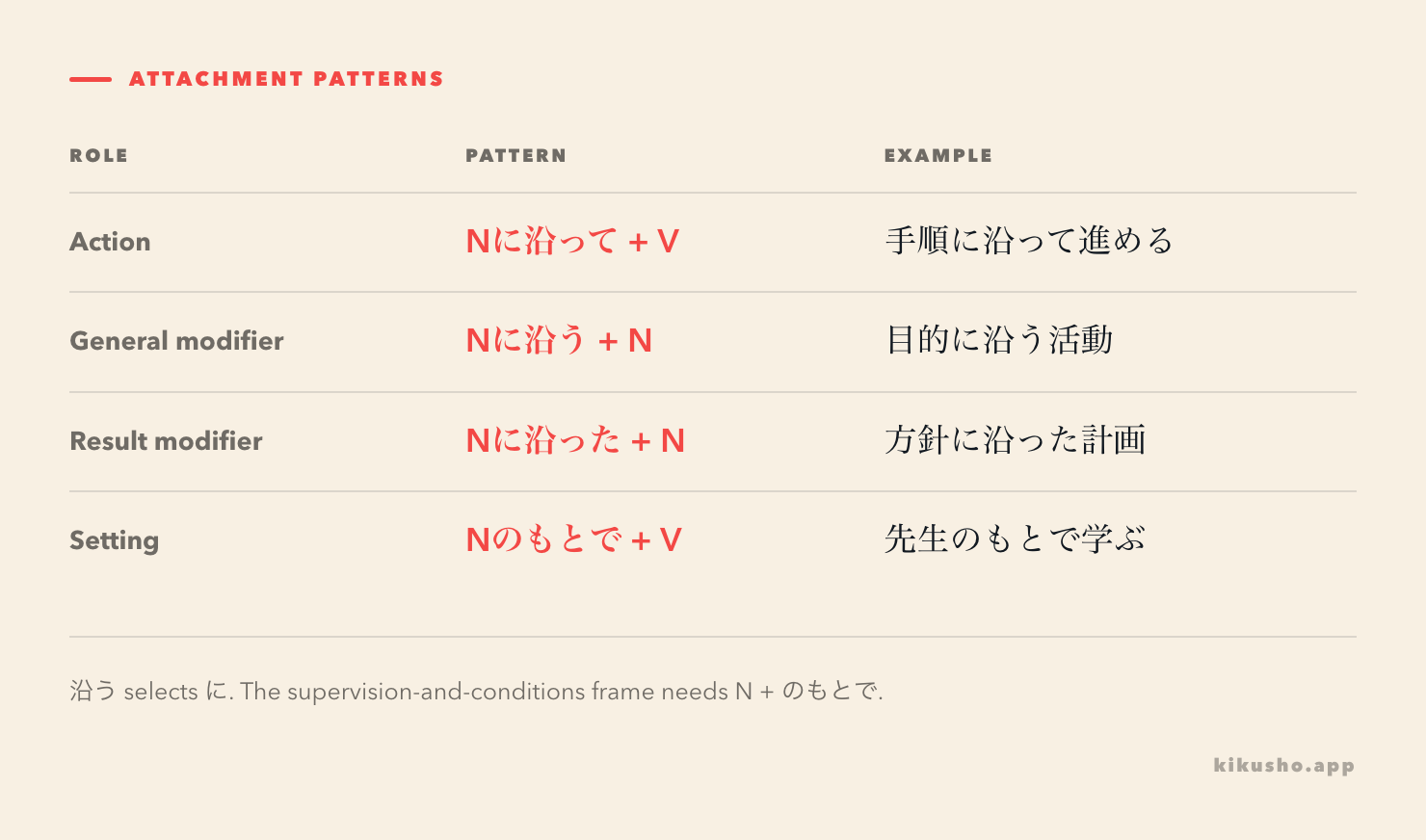
The verb is 沿う, “to run along” or “to conform to.” Its main frames are:
- Nに沿って + action: carry out the action following N
- Nに沿う + noun: a noun that conforms to N
- Nに沿った + noun: a noun shaped or completed in accordance with N
目的に沿う活動
もくてきに そう かつどう
activities that fit the objective
方針に沿った計画
ほうしんに そった けいかく
a plan made in accordance with the policy
With abstract nouns, the phrase suggests conformity rather than mere reference. 依頼に沿って書き直す means that the rewriting follows what was requested, not simply that the request was consulted.
の下で places an action under guidance or conditions
In this pattern, 下 is normally read もと, not した: Nの下で(Nのもとで, N no moto de). It presents the person, organization, authority or conditions surrounding an action.
山田先生のもとで日本文学を研究した。
やまだせんせいの もとで にほんぶんがくを けんきゅうした。
I studied Japanese literature under Professor Yamada.
医師の管理のもとで治療を続けた。
いしの かんりの もとで ちりょうを つづけた。
I continued treatment under a doctor’s supervision.
The pattern also works with an authority or an abstract environment:
新しい法律のもとで、制度が運用される。
あたらしい ほうりつの もとで、せいどが うんようされる。
The system is administered under the new law.
言論の自由のもとで、多様な意見が交わされた。
げんろんの じゆうの もとで、たような いけんが かわされた。
Diverse views were exchanged under freedom of speech.
日本語NET presents のもとで as an N2 pattern for acting under someone’s influence or within a condition. Japanese teacher Tanosuke independently emphasizes people, guidance and influence, while a second teacher resource documents broader condition and environment uses.
The particle で helps: it marks the setting in which the action occurs. 先生のもとで学ぶ does not mean that the teacher is a set of instructions. It means the learning takes place in the teacher’s sphere of guidance.
The same project can contain both relationships
The forms can appear in one situation because they answer different questions:
部長の指導のもとで、会社の方針に沿って計画を立てた。
ぶちょうの しどうの もとで、かいしゃの ほうしんに そって けいかくを たてた。
Under the department manager’s guidance, we made a plan in accordance with company policy.
部長の指導のもとで identifies the supervisory setting. 会社の方針に沿って identifies the direction the plan follows. Neither phrase makes the other redundant.
This also exposes unnatural substitutions:
- 川に沿って歩く is natural because the river supplies a path. 川のもとで歩く would require a special context in which the river somehow governs the activity.
- 先生のもとで学ぶ is natural because the teacher supervises the learning. 先生に沿って学ぶ sounds as though the person were a physical line or a detailed plan.
- 手順に沿って作業する follows ordered steps. 手順のもとで作業する awkwardly treats the procedure as a governing environment.
- 厳しい管理のもとで働く describes controlled conditions. 厳しい管理に沿って働く would shift toward complying with a specific management policy or sequence.
The noun alone does not always decide the answer. 法律に沿って手続きを変える focuses on conformity to what the law requires. 法律のもとで権利が保障される presents the law as the legal regime in force. The writer chooses which relationship matters.
Keep basis and source expressions separate
Two nearby N2 expressions can also become “based on” in English. に基づいて presents evidence, facts or a rule as the foundation that justifies a judgment. をもとに presents information, experience or a model as source material used to create something.
Compare three views of a rule:
- 規則に沿って申請する: submit an application by following the rule or prescribed procedure
- 規則に基づいて判断する: make a judgment grounded in the rule as authority
- 規則のもとで活動する: operate within the regime established by the rule
The lesson on に基づいて and をもとに gives a full decision test for evidential foundations and source material. Here, remember that に沿って highlights the course of an action, while のもとで highlights its surrounding authority or conditions.
For JLPT study, the curriculum places both target items at N2. Several teaching references agree with that placement, but the exam organizer does not publish an exhaustive modern grammar list. Treat the label as a study guide and learn the relationship each form expresses.
In Kikusho, save enough of the sentence to preserve that relationship. A card with only 方針に沿って hides the action that conforms to the policy, while 方針に沿って計画を修正した gives you a complete retrieval cue. For のもとで, keep the supervising noun and action together: 専門家の指導のもとで調査した.
Practice: choose the line or the umbrella
Question 1 · procedure
Complete: 担当者はマニュアル( )、装置を点検した。
- A. のもとで
- B. に沿って
- C. をもとで
- D. に沿うで
Question 2 · supervision
Complete: 研修生は経験豊かな職人の指導( )、技術を学んだ。
- A. に沿って
- B. に基づく
- C. のもとで
- D. をもとにした
Question 3 · proposal wording
Select the natural Japanese for “a proposal made in line with the request.”
- A. 要望に沿った提案
- B. 要望のもとで提案
- C. 要望に沿っての提案する
- D. 要望を沿った提案
Question 4 · legal environment
Complete: この権利は国際法( )保障されている。 The law is the governing regime.
- A. に沿う
- B. のもとで
- C. を沿って
- D. にもとで
Question 5 · both relationships
Choose the sentence that naturally says “Under the coach’s guidance, we trained according to the plan.”
- A. コーチに沿って、計画のもとで練習した。
- B. コーチの計画に沿った指導を練習した。
- C. コーチの指導のもとで、計画に沿って練習した。
- D. コーチをもとに、計画の下を練習した。
Question 6 · spatial line
In 川に沿って道が続いている, how are the road and river related?
- A. The road continues under the river’s authority.
- B. The road was designed from data about the river.
- C. The road follows the course of the river.
- D. The river is supervised from the road.
Answers and explanations
Why question 1 is B
B. に沿って. The inspection follows the manual’s ordered directions. A treats the manual as a supervising environment, while C and D combine incompatible particles or forms.
Why question 2 is C
C. のもとで. The trainees learn within the craftsperson’s guidance. に沿って would require a route, policy or request that the training follows.
Why question 3 is A
A. 要望に沿った提案. に沿った directly modifies 提案 and says that the proposal conforms to the request. D gives 沿う the wrong particle; B and C do not form the requested noun phrase.
Why question 4 is B
B. のもとで. International law is the legal framework under which the right is protected. D is missing の, and A and C do not make a grammatical frame here.
Why question 5 is C
C. コーチの指導のもとで、計画に沿って練習した. The coach’s guidance supplies the supervisory setting, and the plan supplies the course the training follows.
Why question 6 is C
C. The road follows the course of the river. This is the literal spatial use of に沿って: one extended feature runs alongside another.
Common questions
What is the difference between に沿って and のもとで?
に沿って marks the route, sequence, policy or request that an action follows. のもとで marks the person, authority, system or conditions under which the action takes place.
What comes before に沿って and のもとで?
Both follow nouns. Use Nに沿って for a line or guideline to follow, and Nのもとで for a supervisor, authority or surrounding condition.
How does に沿って modify a noun?
Use Nに沿うN or Nに沿ったN, such as 方針に沿った計画. のもとで usually remains an adverbial phrase before a complete action.